The Cauldron London: Founders, Reviews and Why It Closed?
The Cauldron London blended immersive storytelling, molecular cocktails and interactive technology into a unique hospitality experience. Discover its rise, closure in 2025, and the business lessons behind the brand.
 Hannah
London Lifestyle & Consumer Writer
Hannah
London Lifestyle & Consumer Writer

For several years, The Cauldron London was one of the capital’s more unusual examples of experiential hospitality.
It was not simply a cocktail bar, nor was it an ordinary cocktail-making class.
The business combined molecular mixology, interactive technology, fantasy-inspired storytelling and theatrical hospitality to create an experience in which customers wore robes, used electronic “magic” wands and prepared drinks presented as potions.
From a business perspective, that distinction matters.
The Cauldron was effectively selling entertainment with food and drink attached, rather than relying solely on traditional pub economics.
Customers paid for a scheduled experience, the drinks were incorporated into the ticket value, the surroundings were designed to encourage photography and social sharing, and the technology gave the business an intellectual-property element unusual for an independent bar.
It proved that a London hospitality business could turn something as familiar as a cocktail class into a much more valuable experiential product.
However, anyone searching for The Cauldron London today needs to know one thing immediately:
The Cauldron London is permanently closed.
The UK operation ceased trading in 2025, and companies connected with the business subsequently entered liquidation or were dissolved.
That makes the story of The Cauldron particularly interesting from both a London-business and financial perspective.
It grew from an experimental startup into an international immersive-hospitality brand, attracted thousands of highly positive customer reviews and expanded internationally, yet ultimately faced the same economic pressures that have challenged many experience-led hospitality businesses.
The Cauldron London At a Glance
| Detail | Information |
| Business | The Cauldron |
| Main London venue | 5D Stoke Newington Road, London, N16 8BH |
| Area | Dalston / Stoke Newington, East London |
| Current status | Permanently closed |
| UK closure | May 2025 |
| Founded | Concept began in 2017 |
| Co-founders | Matthew Cortland and David Duckworth |
| Main experience | Interactive potion-making and molecular cocktails |
| Typical duration | Around 1 hour 45 minutes |
| Historic business Instagram | @thecauldronpub |
| Related Wizard Exploratorium Instagram | @wizardexploratorium |
| Historic website | The Cauldron website – no longer an active booking destination |
| London company | The Cauldron London Ltd |
| Company number | 11344372 |
| Former Google rating | Around 4.6/5 from more than 1,500 reviews |
| Harry Potter affiliation | None – it was an independent fantasy-inspired concept |
What Was The Cauldron London?
The Cauldron London was an immersive cocktail venue built around the idea of making fantasy appear real through science and technology.
Guests were normally given robes and an interactive wand before being taken to a potion-making station. Rather than simply ordering conventional cocktails from a bartender, customers followed instructions and created drinks using ingredients, glassware, cauldrons and molecular-mixology techniques.
Some drinks bubbled, changed colour, produced smoke or interacted with props in the venue.
That made the activity closer to a small theatrical production or interactive attraction than an ordinary night at a bar.
The company’s broader philosophy was sometimes described as “magicineering”: using engineering and technology to reproduce effects people normally associate with fantasy.
The concept was smart commercially because customers were paying for three things simultaneously: hospitality, entertainment and novelty.
That combination allowed The Cauldron to differentiate itself in London’s extremely competitive bar market.
The experience was also promoted by major London tourism platforms. Visit London described The Cauldron Potion Making experience as an interactive adventure in which visitors dressed in wizarding robes, used a magic wand and created their own drinks using molecular mixology.
The description helps demonstrate how The Cauldron was positioned to tourists: not simply as somewhere to drink cocktails, but as a bookable London experience built around participation, theatricality and fantasy.
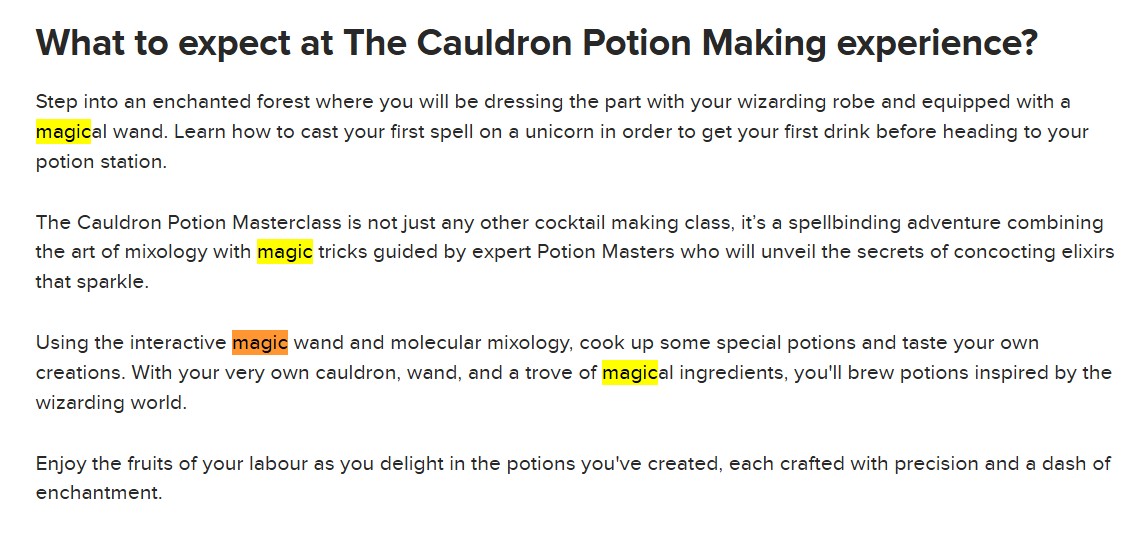
Screenshot: Visit London’s historical description of The Cauldron London Potion Making experience.
Where Was The Cauldron London?
The best-known East London venue operated from:
5D Stoke Newington Road, London, N16 8BH.
The location became closely associated with The Cauldron’s potion-making experience.
There is, however, an important distinction that some older online guides fail to explain.
The company also developed a central London fantasy venue called the Wands & Wizard Exploratorium at 26 Greek Street in Soho.
The Greek Street operation offered related activities such as wizard afternoon tea, wand-making and potion experiences, while the 5D Stoke Newington Road venue was the location most strongly associated with The Cauldron London cocktail bar.
During parts of its history, the company additionally experimented with temporary and pop-up locations in Soho and Hoxton.
This explains why searchers can find several different London addresses connected with The Cauldron.
Who Founded The Cauldron?
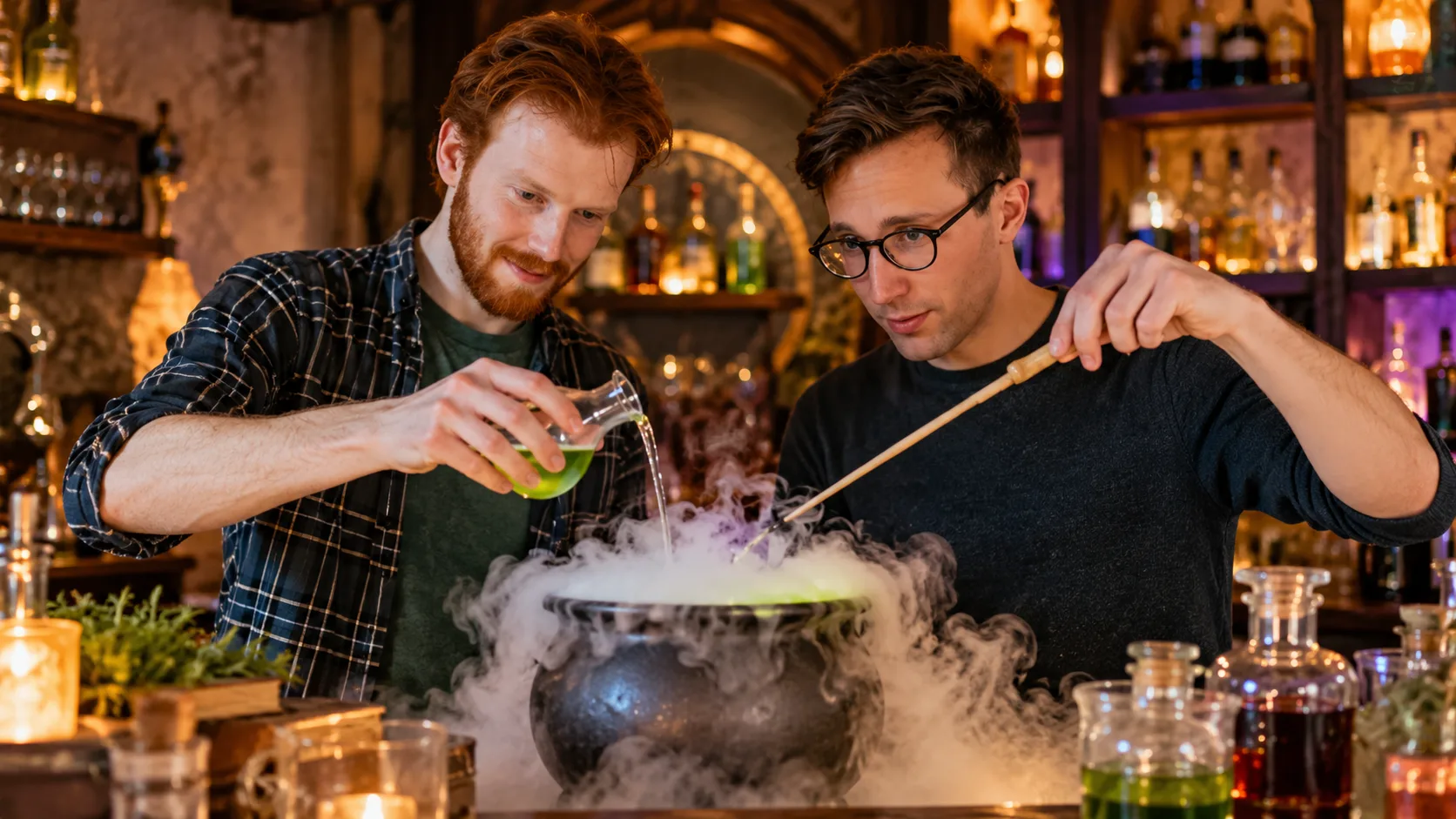
The Cauldron was founded by Matthew Cortland and David Duckworth, whose professional backgrounds were unusually complementary.
Cortland brought experience in technology, product development, startups and design. Company material also described him as a former reading teacher, with postgraduate study in creative digital media and education.
Duckworth came from hospitality and molecular mixology. His background included cocktail experiences, bars, nightlife and events, giving the company the practical food-and-beverage expertise needed to convert Cortland’s technological ideas into something customers could actually experience.
The pair reportedly met after Cortland went looking for a hospitality-focused co-founder in London.
That founder combination became an important part of The Cauldron’s competitive advantage.
Cortland could focus on how technology might make an object appear magical, while Duckworth understood how those effects needed to operate inside a real bar, with real customers, service times, drink recipes and hospitality staff.
Duckworth once described the philosophy neatly:
“Storytelling is a huge part of what we do.”
That arguably explains The Cauldron better than calling it a Harry Potter bar.
The product was storytelling delivered through hospitality.
How Did The Cauldron Start?
The business began on a remarkably small budget.
Company material described The Cauldron as being founded in late 2017 with roughly £3,000 of personal savings after an initial crowdfunding attempt failed to reach its target.
Cortland also launched a crowdfunding appeal explaining that he had moved to London and was reinvesting revenue from early events into improving the technology and developing a more scalable pop-up format.
The early venue was deliberately built inexpensively.
Furniture and parts of the environment were assembled using reclaimed or upcycled materials, while students and designers helped develop props and technology.
From a startup perspective, this was a sensible minimum viable product approach.
Instead of raising millions of pounds before discovering whether customers actually wanted a technology-driven wizard bar, the founders tested the idea through small events, watched customer behaviour and gradually invested in the concept.
The first versions therefore did not need the economics of a fully fitted restaurant to work.
Demand could be proven before significant expansion.
The Technology Was More Important Than It Looked
The “magic wand” was not simply a decorative prop.
Cortland and Duckworth were named as inventors on technology relating to a control device capable of triggering programmed actions using radio-frequency technologies such as RFID or NFC.
The broader idea was that a customer’s wand could interact with parts of the physical environment.
Lights, drinks dispensers, doors and other devices could therefore respond when a guest performed an action.
The founders themselves described the technology as extending well beyond a theatrical prop. In an interview published by ResDiary’s Dish Cult, they explained that The Cauldron’s customisable wands contained embedded sensor technology and could interact with experiences across the company’s venues as well as compatible products designed for use at home.
The same interview also described a dedicated Magic Wand Experience at the Wands & Wizard Exploratorium, where visitors could select components, build an illuminated working wand and then use it for spellcasting activities.
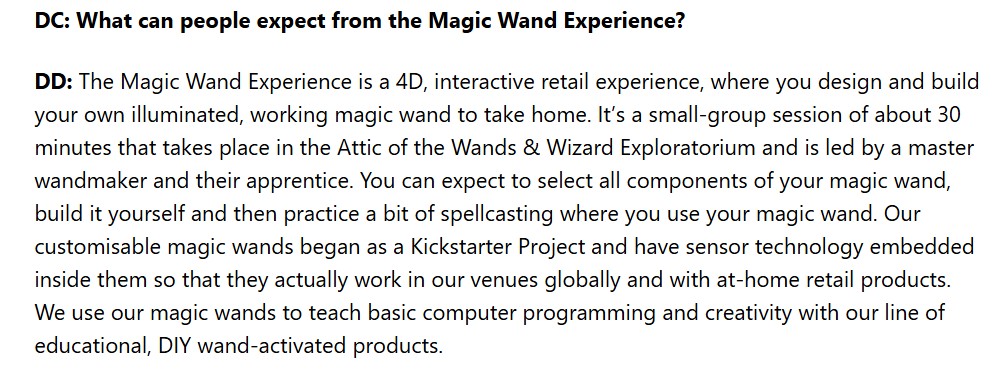
Screenshot: The Cauldron’s founders discussing the sensor technology built into its interactive magic wands and how the devices worked across its venues and other products.
That created something unusual for hospitality: proprietary interactive technology embedded directly into the customer experience.
The technology also gave The Cauldron opportunities beyond selling drinks. The wands could become part of separate experiences, retail products and educational activities, giving the underlying technology potential value outside the cocktail-bar environment.
For competitors, replicating the furniture or fantasy styling would have been relatively easy.
Replicating the complete combination of technology, recipes, operational systems, theatrical design and intellectual property was considerably harder.
That is why The Cauldron should probably be analysed as a hospitality-technology business rather than simply a themed cocktail bar.
What Happened During the Potion-Making Experience?
Historically, a typical Potion Making session lasted about one hour and 45 minutes.
Guests usually received a robe and interactive wand before being introduced to the venue.
They then used the wand to interact with the environment and obtain an initial drink before progressing to their potion station.
Two additional drinks could then be prepared using the provided ingredients and equipment.
Alcohol-free versions were also available, making the concept broader than a conventional adults-only cocktail class.
The strongest element was participation.
Customers were not simply watching somebody perform tricks behind a bar. They were expected to pour, mix, stir and activate parts of the experience themselves.
That dramatically increased the perceived entertainment value.
It also produced a highly photographable experience, something that became particularly valuable as Instagram, TikTok and other visual platforms influenced where people chose to spend money in London.
How Much Did The Cauldron London Cost?
Pricing changed substantially during the venue’s lifetime, so many figures still appearing online should be treated as historical rather than current.
Early versions of the experience were available for around £29.99 per person.
Around 2021, some London sessions were advertised at approximately £30.99 off-peak and £35.99 during peak periods, normally including three drinks.
Pricing later increased as the experience evolved and broader packages were introduced.
The key point from a business perspective is that The Cauldron was able to charge substantially more than the value of the underlying liquid in the glass.
A normal bar sells a cocktail.
The Cauldron sold the cocktail, the production process, entertainment, access to the set, interaction with technology and the memory associated with the experience.
That is classic experiential pricing.
The physical ingredients may represent only a relatively small portion of what the customer is paying for.
Was The Cauldron London Really a Harry Potter Bar?
Not officially. This is another area where many articles oversimplify the story.
The robes, potions, wands and fantasy setting inevitably reminded customers of Harry Potter, and many reviewers described the venue using Harry Potter terminology.
However, The Cauldron repeatedly positioned itself as a general fantasy and science-fiction inspired business, rather than an officially licensed Harry Potter attraction.
It was not part of Warner Bros.’ Wizarding World and was not an official J.K. Rowling venue.
That distinction matters both legally and commercially.
Rather than licensing a single entertainment franchise, The Cauldron created its own fantasy universe and technology.
This gave the founders greater control over the intellectual property and allowed the idea to expand into additional experiences.
What Did Customers Think of The Cauldron London?
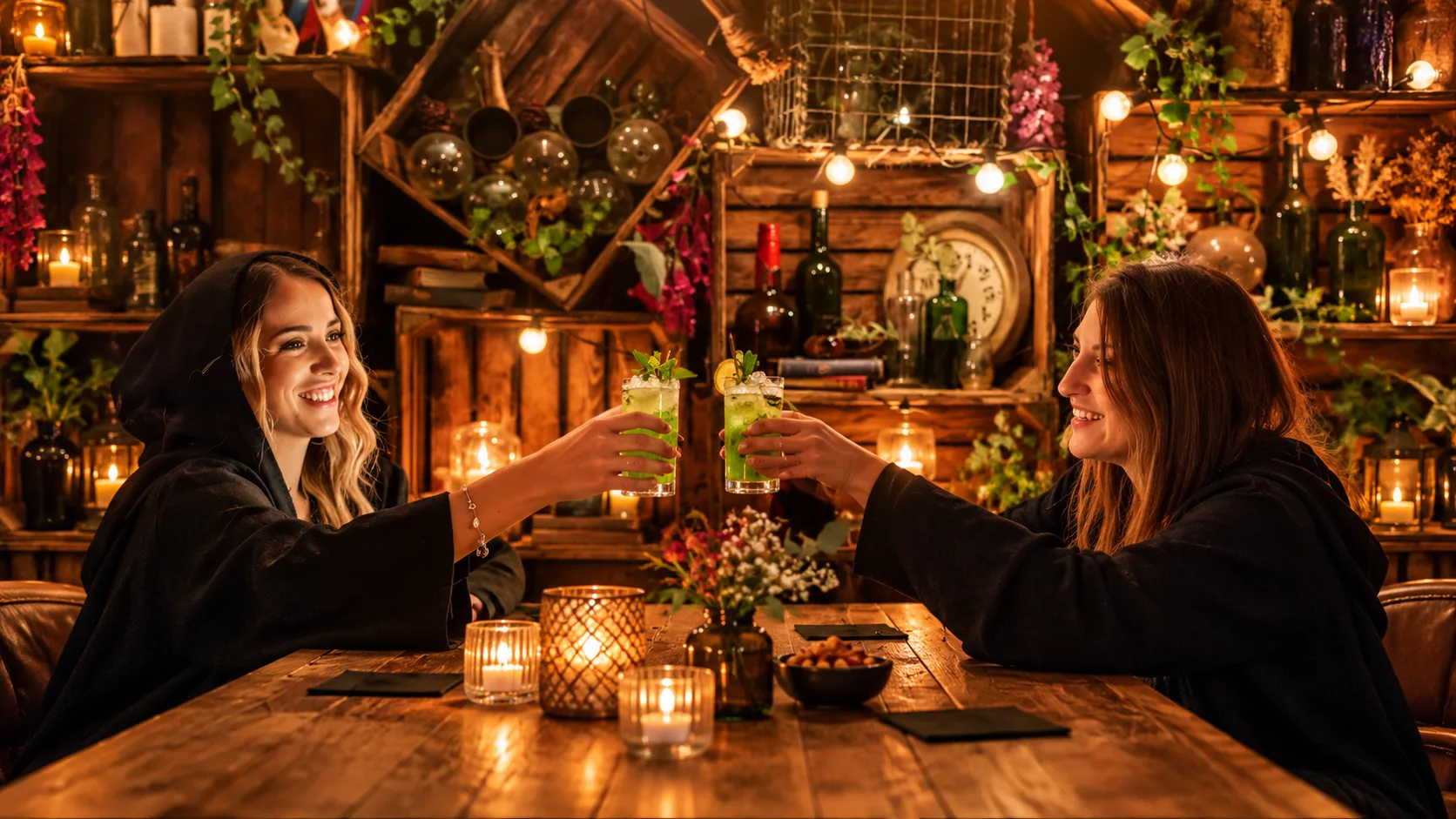
Customer feedback was generally strong.
The historic Google listing reached approximately 4.6 stars from more than 1,500 reviews.
One indexed distribution of 1,581 Google ratings showed roughly 91% of reviewers awarding either four or five stars, including about 80% giving the maximum five-star rating.
For an experiential hospitality venue, that is significant.
The recurring strengths in customer feedback were the atmosphere, staff interaction, novelty of making the cocktails, venue decoration and sense of participation.
One customer simply described the visit as:
“We absolutely loved this experience.”
Another common theme was that visitors enjoyed it even when they were not particularly interested in wizard films or fantasy fiction.
That is commercially important because it suggests the audience extended beyond dedicated fantasy fans.
What Were the Common Complaints?
The feedback was not universally positive.
Some customers felt the experience could be expensive relative to the quantity of food or drink received.
Others found the venue difficult to locate or believed the theatrical effects did not quite justify their expectations.
A small number of reviews also raised service or billing issues.
One criticism summarised the problem as an idea with considerable potential but insufficient “wow factor”.
This highlights a challenge faced by almost every immersive business.
Marketing raises expectations substantially.
Once promotional photographs show bubbling liquids, interactive wands, elaborate sets and dramatic effects, the real-world experience must consistently meet that expectation for every customer.
A conventional pub can survive a relatively ordinary evening.
An immersive attraction is effectively selling the promise that the evening will not be ordinary.
Why The Cauldron Was an Interesting Business Model?
From a financial perspective, The Cauldron had several advantages over a standard cocktail bar.
Pre-booked tickets gave management visibility over future customer numbers. Experiences created a higher potential spend per person.
Scheduled sessions helped control table turnover. Social-media-friendly surroundings generated organic promotion. Group bookings opened the business to birthdays, corporate events, hen parties and celebrations.
There was also potential intellectual-property value beyond the drinks themselves.
Technology, recipes, interactive systems, venue designs, retail products and the broader brand could theoretically be deployed in additional locations.
That scalability explains why the company expanded beyond London.
Over time, versions of The Cauldron appeared in markets including New York, Edinburgh, Dublin, Brighton, Philadelphia and Chicago.
A later statement from Cortland credited a member of the design team with helping the business grow to more than $50 million in global revenue across the UK, US and Ireland.
That figure should be treated as a founder-reported measure rather than independently audited group revenue, but it demonstrates the scale the operation claimed to have reached.
A 2026 biography for Cortland similarly described The Cauldron as having served roughly one million guests during its lifetime.
For something that began with a few thousand pounds and handmade furniture, the growth was substantial.
So Why Did The Cauldron Close?
The Cauldron’s UK operations closed on 28 May 2025.
The insolvency firm involved with the group subsequently said that rising hospitality costs and the cost-of-living crisis contributed to its financial difficulties.
Approximately 50 redundancies resulted from the UK closures.
Several related companies then entered creditors’ voluntary liquidation.
The Cauldron Experience Ltd, associated with the Stoke Newington venue, entered liquidation in June 2025.
The Cauldron London Ltd followed in August 2025.
The group’s parent holding company, The Cauldron Company PLC, was eventually dissolved in June 2026.
For hospitality entrepreneurs, the outcome contains an important lesson.
A strong brand and enthusiastic customers do not necessarily eliminate the economics of running physical venues.
The Financial Challenge Behind Immersive Hospitality
Businesses such as The Cauldron can command premium ticket prices, but they also carry expenses that conventional bars may not.
There are ordinary hospitality costs such as rent, wages, alcohol, insurance, utilities, business rates and stock.
On top of those come the expenses associated with the experience itself: technology development, electronic props, set construction, repairs, specialist staff, software, creative development and the continual need to refresh the product.
If customers are cutting discretionary spending because household finances are under pressure, that combination can become difficult.
A customer might still buy a drink at their local pub while delaying a £40, £50 or £80 immersive night out.
That makes premium experiences particularly exposed to consumer confidence.
The business model can therefore produce attractive revenue per customer when venues are full, but high fixed costs can work in the opposite direction if bookings soften.
Expansion adds another level of risk.
Every additional location creates opportunities for revenue, but also adds leases, staff, fit-out expenditure and management complexity.
The Cauldron’s journey illustrates both sides of experiential hospitality remarkably well.
What Happened to The Cauldron Website?
The historical website was thecauldron.io.
However, people searching for The Cauldron London in 2026 should not rely on that domain as a booking source.
At the time of our latest check, the former site redirected to an unrelated charitable donation page rather than an active Cauldron booking platform.
Anyone encountering an old article containing a “book now” link should therefore check the date carefully.
Historic booking information still appears across tourism websites, reviews and old editorial articles even though the London operation has closed.
What Was The Cauldron London’s Instagram?
The principal business social-media identity was:
Instagram: @thecauldronpub
That account represented the broader Cauldron brand rather than only the Dalston venue.
The related central London Wizard Exploratorium also used:
Instagram: @wizardexploratorium
We could not independently verify official personal Instagram accounts belonging to co-founders Matthew Cortland or David Duckworth strongly enough to recommend publishing a handle.
For a local-business profile, it is better to leave an account out than accidentally direct readers to an unrelated person with the same or similar name.
What Happened to Founder Matthew Cortland?
Cortland’s career has continued beyond The Cauldron.
By 2026, he was publicly associated with technology and research ventures including Prime Directive AI.
That progression is not entirely surprising.
Although The Cauldron operated physical hospitality venues, Cortland’s side of the founding partnership was always closely linked to technology, product development, engineering and experimentation.
The underlying entrepreneurial idea was not simply “open a bar.”
It was to use technology to make physical spaces behave differently.
What About David Duckworth?
David Duckworth was the hospitality and molecular-mixology specialist behind the founding team.
His experience before The Cauldron included interactive cocktail businesses such as ABQ and The Bletchley as well as broader London hospitality and events work.
He was also closely associated with The Magic of Things, the design and R&D operation behind much of The Cauldron’s interactive technology and experience development.
In practice, Duckworth’s role demonstrates how essential operational experience is when technology enters hospitality.
A clever interactive product still needs drinks that can be prepared reliably, staff who can explain it, manageable service times and an experience customers understand.
The Business Lesson From The Cauldron London
The Cauldron London is an unusually useful case study for entrepreneurs.
Its success showed the value of experience-led differentiation.
Instead of competing directly with thousands of London bars on cocktail quality, price or location alone, the founders created something difficult to compare with a conventional venue.
Customers were effectively buying a story.
That reduced direct price comparison and created social-media value that ordinary drinks could not easily replicate.
The company also demonstrated how a startup can validate an unusual idea before committing to major expansion.
It began with pop-ups, improvised furniture, crowdfunding and relatively limited capital before becoming an international operation.
Yet its closure demonstrates the other half of the equation.
Originality cannot remove fixed costs.
Brand awareness cannot eliminate rent.
Strong reviews cannot guarantee that customers will continue spending at the same rate during a cost-of-living squeeze.
And rapid geographical expansion can turn what began as an agile startup into a considerably more complicated organisation.
That combination makes The Cauldron’s rise and closure as interesting financially as it was creatively.
Is The Cauldron London Still Worth Knowing About?
Yes, although not as somewhere to book.
The Cauldron deserves a place in the story of London’s experiential hospitality sector because it successfully combined software, physical technology, theatrical design and food and beverage into a single commercial product.
Its reputation also survived beyond the venue itself.
Thousands of customer reviews, photographs, travel articles and old booking pages continue to rank for The Cauldron London, which explains why people still search for it after the doors have closed.
For visitors, the essential information is now simple: The Cauldron London is permanently closed and cannot currently be booked.
For entrepreneurs, however, its story remains much more valuable.
It showed that an independent hospitality startup could take a highly unconventional idea, build demand with very little initial capital and expand it internationally.
It also showed how vulnerable even a popular experiential brand can become when discretionary consumer spending weakens and operating costs rise.
In that sense, the most interesting part of The Cauldron London is no longer the potion in the glass.
It is the business story behind it.
Is The Cauldron London Permanently Closed?
Yes. The London venue has permanently closed, and the UK Cauldron operations stopped trading in 2025.
Who Owned The Cauldron London?
The business was co-founded by Matthew Cortland and David Duckworth, combining technology and product-design expertise with molecular mixology and hospitality experience.
Where Was The Cauldron London Located?
Its best-known East London venue was at 5D Stoke Newington Road, London N16 8BH, close to Dalston.
How Long Was The Cauldron Experience?
The main Potion Making experience historically lasted about one hour and 45 minutes, normally including an initial drink and two potions made by the guest.
Was The Cauldron Connected to Harry Potter?
No. It used broad fantasy, magic and science-fiction themes but was not an official Harry Potter or Warner Bros. attraction.
Can The Cauldron London Still Be Booked?
No. Older booking and tourism pages remain online, but the London business has closed and historic availability information should not be treated as current.
Hannah is a London lifestyle and consumer writer at London Insider News, covering property, transport, local developments, cost-of-living issues and stories affecting everyday life across the capital.