How Much Is London Congestion Charge in 2027? Daily Costs, 2026 Price Rise and New Rules
Discover how much the London Congestion Charge costs in 2027, including the £18 daily fee, 2026 price increase, electric vehicle discounts, ULEZ charges, payment rules and penalties.
 Hannah
London Lifestyle & Consumer Writer
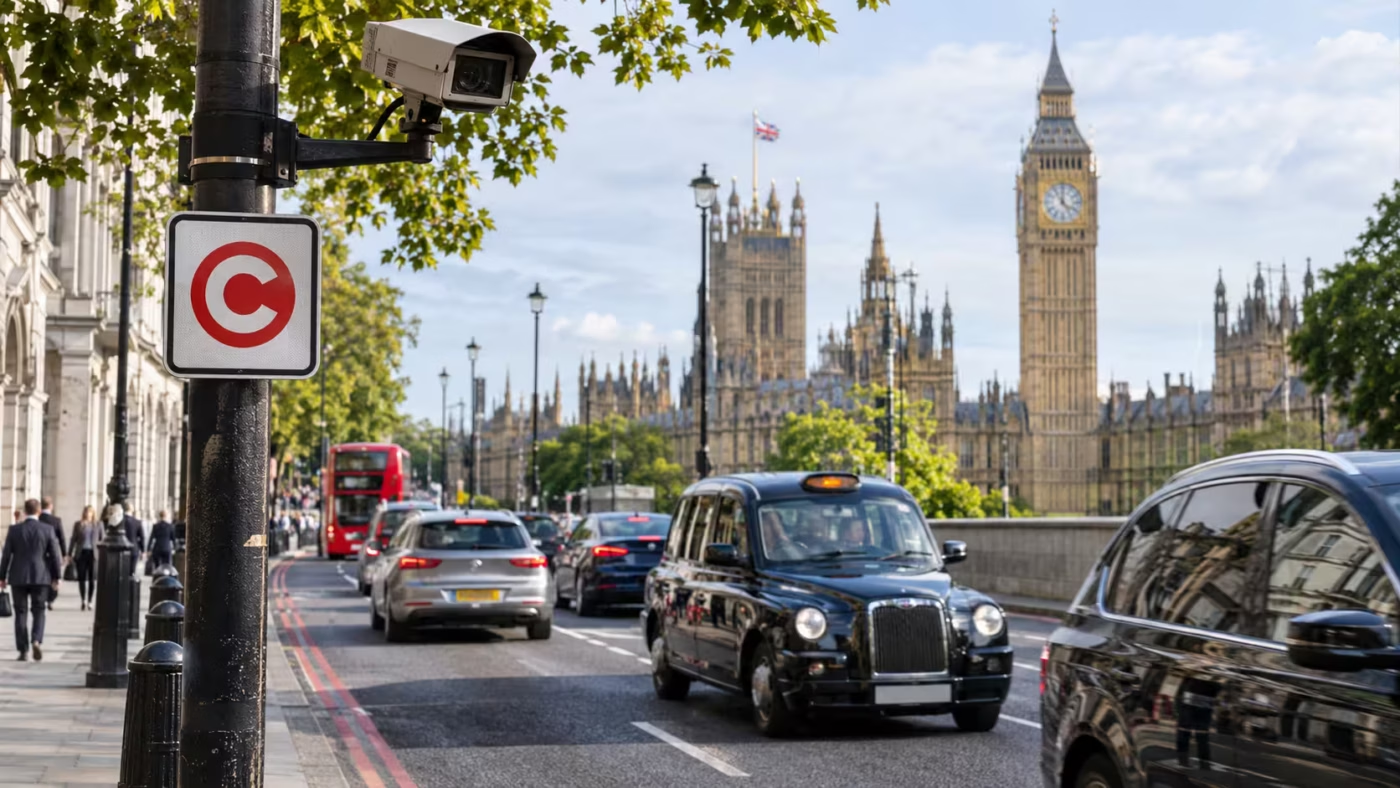
The London Congestion Charge is £18 per day for most drivers entering the central London charging zone during operating hours, provided payment is made in advance or on the day of travel.
Drivers paying within the permitted three-day period after travelling must pay £21 instead.
The £18 charge was introduced on 2 January 2026, representing a 20% increase from the previous £15 rate. As of November 2026, this remains the published standard charge for planning journeys in 2027, although TfL can approve future adjustments.
For occasional visitors, the increase may appear relatively small. However, a self-employed tradesperson, delivery operator or small business using central London roads regularly could spend thousands of pounds annually on the charge alone.
We analysed Transport for London’s published pricing, electric vehicle discounts, 2027 changes and business transport expenses to understand the real financial impact.
Our findings show that the most important consideration is not simply the £18 daily price. It is the number of chargeable days, the vehicle type, additional ULEZ liabilities and whether the driver qualifies for reduced rates.
How Much Is the London Congestion Charge in 2027?
The published standard London Congestion Charge is £18 per vehicle per charging day.
A higher charge of £21 applies when payment is made within the permitted period after the journey. Reduced charges are available for certain registered electric vehicles and eligible residents.
London Congestion Charge Prices for 2026–2027
| Charge category | Daily amount |
| Standard charge, paid in advance | £18 |
| Standard charge, paid on the day | £18 |
| Payment within three days after travel | £21 |
| Eligible electric car on Auto Pay | £13.50 |
| Eligible electric van on Auto Pay | £9 |
| Eligible electric HGV on Auto Pay | £9 |
| Approved 90% residents’ discount | £1.80 |
| Approved 100% discount | £0 |
| Standard unpaid-charge penalty | £180 |
| Penalty paid within 14 days | £90 |
These amounts reflect the published rules as of November 2026. A further increase to the standard charge for 2027 has not been confirmed.
The £18 fee covers all chargeable entries into the zone by the same vehicle on the same day. Driving into and out of the zone multiple times does not generate multiple Congestion Charges for that day.
For example, a courier entering central London at 9am, leaving at midday and returning at 3pm would normally pay one £18 charge, not £36.
Drivers uncertain about their liability can establish whether they need to pay the Congestion Charge before travelling.
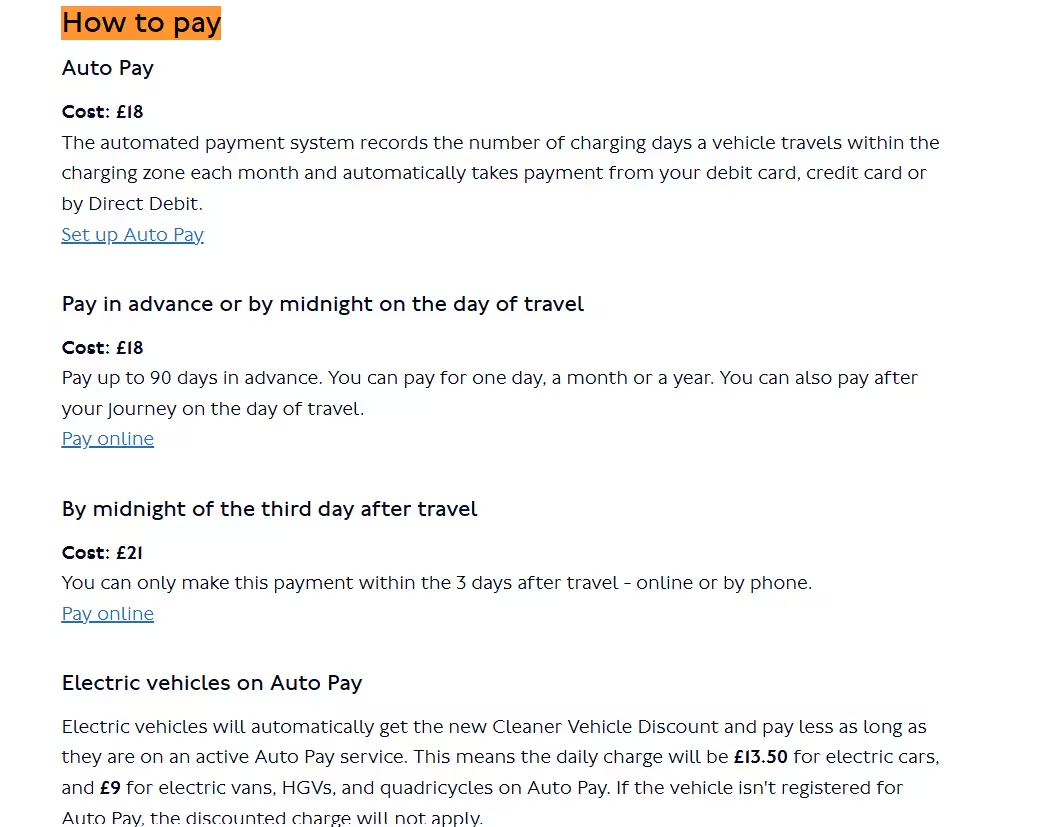
TfL’s official Congestion Charge payment page confirming the £18 standard daily rate, £21 later-payment rate and Auto Pay options.
Why Did the London Congestion Charge Increase by 20% in 2026?
On 2 January 2026, Transport for London increased the standard daily charge from £15 to £18.
This followed a public consultation covering the future pricing structure, electric vehicle discounts and residents’ eligibility.
The increase was the first change to the standard £15 rate since 2020.
| Pricing change | Before January 2026 | From January 2026 |
| Standard daily charge | £15 | £18 |
| Payment within three days | £17.50 | £21 |
| Standard charge increase | — | 20% |
| Additional cost per standard charging day | — | £3 |
For drivers using the zone once a month, the additional cost is approximately £36 annually.
However, a business vehicle operating in central London for 220 chargeable days annually incurs an additional £660 compared with the previous £15 tariff.
That represents a material increase for organisations operating on relatively narrow profit margins.
TfL’s reasoning centres on managing congestion and maintaining the effectiveness of the charging scheme as London’s vehicle fleet becomes increasingly electric.
The important change is that environmental compliance and congestion management are no longer financially interchangeable.
An electric vehicle may produce no tailpipe emissions, but it still occupies road space and contributes to traffic volumes.
This explains why electric cars no longer automatically benefit from a full congestion exemption.
Could the London Congestion Charge Increase Again in 2027?
A separate standard daily price increase for 2027 has not been confirmed as of 16 November 2026.
However, TfL has introduced a revised process through which future Congestion Charge adjustments may be considered.
Under that framework, potential increases can be linked to public transport fares, inflation plus one percentage point, or a lower amount.
Crucially, an annual increase is not automatic. It still requires the relevant decision by TfL and the Mayor of London.
Drivers should therefore distinguish between:
- Confirmed changes introduced in January 2026.
- Confirmed residents’ eligibility changes beginning in March 2027.
- Possible future standard price adjustments that have not yet been approved.
For business forecasting, using £18 as the published baseline while maintaining a separate contingency allowance is more defensible than assuming an unannounced 2027 price.
How Much Does the Congestion Charge Cost Per Week, Month and Year?
The financial impact becomes clearer when the daily rate is multiplied by actual usage.
The following calculations compare standard petrol or diesel vehicles with eligible electric vehicles registered on Auto Pay.
Congestion Charge Cost Comparison
| Chargeable days | Standard vehicle | Electric car | Electric van |
| 1 day | £18 | £13.50 | £9 |
| 5 days | £90 | £67.50 | £45 |
| 10 days | £180 | £135 | £90 |
| 20 days | £360 | £270 | £180 |
| 220 days | £3,960 | £2,970 | £1,980 |
Calculations assume the published rates remain unchanged, the relevant discounts apply and each vehicle enters the charging zone on every stated day.
A standard vehicle entering central London for 20 days every month would generate £4,320 annually in Congestion Charges.
The same number of chargeable days for an eligible electric car would cost £3,240, representing a potential annual saving of £1,080.
For an electric van receiving the 50% discount, the equivalent annual expense would be £2,160.
These figures exclude electricity, fuel, insurance, maintenance, parking, finance repayments and other road-user charges.
Our financial assessment is that businesses should calculate congestion exposure using realistic operating days rather than assuming every working day will generate a charge.
A company that enters the zone three times a week may have significantly lower expenditure than an operator whose vehicles are deployed there daily.
What Are the Congestion Charge Operating Hours in London?
The charge applies during specific hours rather than continuously throughout the day.
| Day | Charging hours |
| Monday to Friday | 7am–6pm |
| Saturday | 12pm–6pm |
| Sunday | 12pm–6pm |
| Bank holidays | 12pm–6pm |
| Christmas Day through the New Year’s Day bank holiday, inclusive | No Congestion Charge |
A motorist driving into the zone at 6:30pm on a weekday would not normally incur the Congestion Charge for that journey.
Similarly, a driver making a Sunday journey entirely before midday would not have to pay the Congestion Charge.
However, this does not necessarily mean the journey is free of other charges.
A vehicle failing London’s ULEZ emissions requirements may still incur the separate £12.50 daily fee.
Businesses arranging early-morning deliveries or evening appointments should examine whether changing journey times is operationally practical.
For example, a supplier able to complete a Saturday delivery before noon could avoid the £18 Congestion Charge without changing vehicles.
Nevertheless, scheduling decisions must consider staffing costs, customer availability and legal restrictions on commercial deliveries.
Which Parts of London Have the Congestion Charge?
The Congestion Charge applies to a defined area of central London rather than the entire capital.
The zone includes major commercial, shopping and employment districts such as parts of Westminster, the City of London, Soho, Covent Garden, Mayfair, Holborn and surrounding central areas.
The exact boundary matters because not every road near these districts falls within the charging zone.
Drivers should also understand that the Congestion Charge zone is much smaller than London’s ULEZ.
A vehicle travelling through outer London may be subject to ULEZ requirements without entering the Congestion Charge zone.
Before travelling, businesses should check the Congestion Charge using their destination postcode, vehicle registration and planned journey.
This is especially important for delivery companies working with unfamiliar addresses.
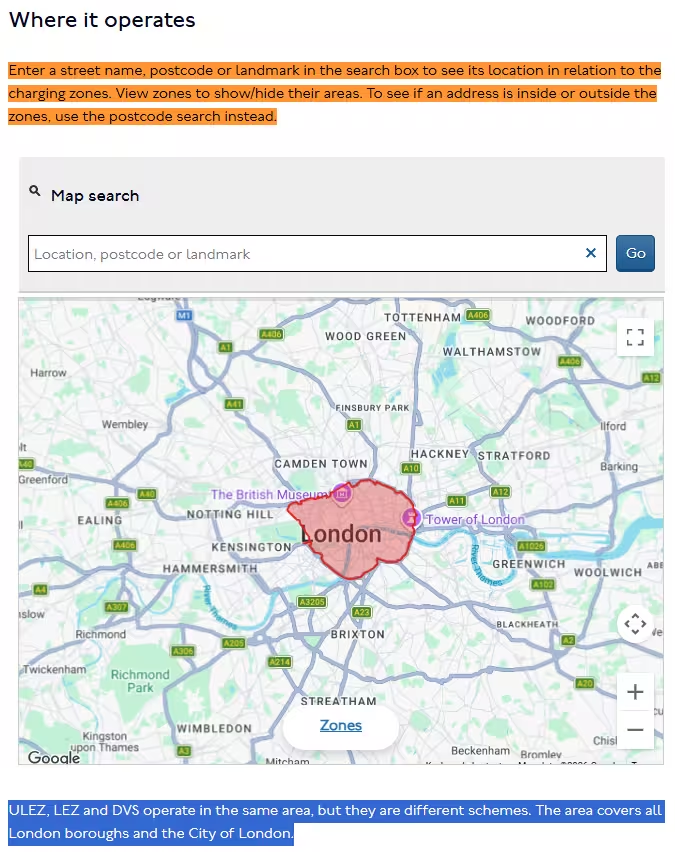
Official TfL Congestion Charge zone map showing the central London charging boundary and the postcode-search facility.
How Much Do Electric Cars and Vans Pay Under the New Rules?
One of the most significant changes introduced in January 2026 was the replacement of the former 100% Cleaner Vehicle Discount.
Before the change, eligible fully electric vehicles could avoid the Congestion Charge entirely.
Under the revised arrangements, eligible electric vehicles receive different reductions according to vehicle classification.
| Electric vehicle | Discount | Daily payment |
| Electric car | 25% | £13.50 |
| Electric van | 50% | £9 |
| Electric HGV | 50% | £9 |
| Eligible electric quadricycle | 50% | £9 |
The discount requires an active TfL Auto Pay arrangement with the correct vehicle registered.
Simply owning an electric car does not automatically reduce the charge when paying through a standard one-off payment.
For commercial operators, the distinction between an electric car and an electric van is financially important.
A business using an electric van for 200 chargeable days would incur £1,800 in Congestion Charges.
An eligible electric car travelling on the same 200 days would incur £2,700.
That creates a £900 annual difference in road-user charging alone.
However, an electric van should not be considered automatically cheaper overall.
Vehicle acquisition costs, payload requirements, charging infrastructure, depreciation and insurance must also be included in the comparison.
Why Auto Pay Matters for Electric Vehicle Owners?
TfL’s Auto Pay system records chargeable vehicle movements and automatically collects applicable charges.
It is free to register for Auto Pay.
For eligible electric vehicles, registration activates the applicable Cleaner Vehicle Discount without a separate discount application, provided TfL has the correct vehicle information.
An electric car without the required Auto Pay registration may therefore pay £18 instead of £13.50.
Across 100 chargeable days, that difference would total £450.
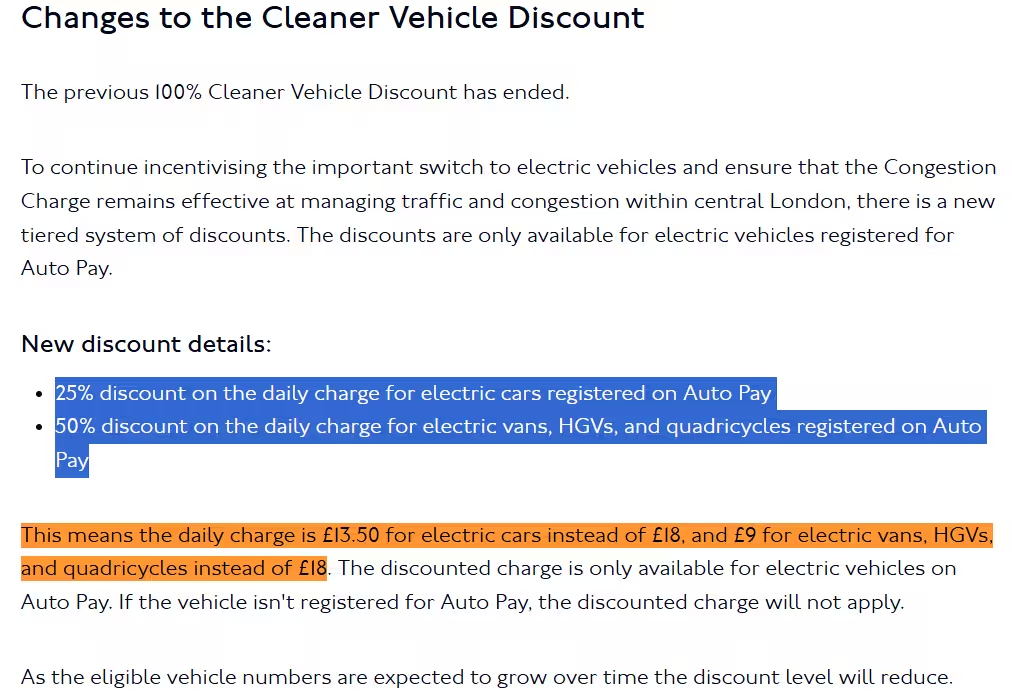
TfL’s Cleaner Vehicle Discount showing the 25% reduction for electric cars and 50% reduction for eligible electric commercial vehicles.
What Changes to the Residents’ Congestion Charge Discount in March 2027?
From 1 March 2027, new applicants for the 90% Congestion Charge Residents’ Discount will generally need to use an electric vehicle.
The change affects new applications rather than automatically removing discounts from existing qualifying residents.
Existing discount holders can retain their 90% reduction for eligible vehicle types, including replacement non-electric vehicles, provided they continue meeting the scheme’s requirements and renew their registration correctly.
The distinction matters for residents planning to replace a vehicle or move into the charging zone.
Residents’ Discount From March 2027
| Applicant category | Position under the confirmed changes |
| Existing qualifying discount holder | Can retain 90% discount, subject to continuing eligibility and renewal |
| New applicant with an eligible electric vehicle | Can qualify for 90% discount |
| New applicant with a petrol or diesel vehicle | Generally ineligible unless a qualifying exception applies |
| New applicant receiving certain eligible benefits | May qualify for a non-electric vehicle concession under the transitional rules |
TfL has also confirmed that residents receiving certain low-income or disability-related benefits can add non-electric vehicles to their discount if they apply before 4 March 2030 and satisfy the relevant conditions.
The specified benefits include Universal Credit, Personal Independence Payment, Attendance Allowance, Carer’s Allowance, Disability Living Allowance, Employment and Support Allowance and State Pension Credit.
These protections are important because replacing a functioning petrol or diesel vehicle with an electric car may represent a substantial financial burden for some households.
An approved residents’ discount reduces the £18 standard charge to £1.80 per charging day.
At 20 chargeable days a month, that represents £36 instead of £360.
TfL also lists a £10 annual registration charge for the residents’ discount.
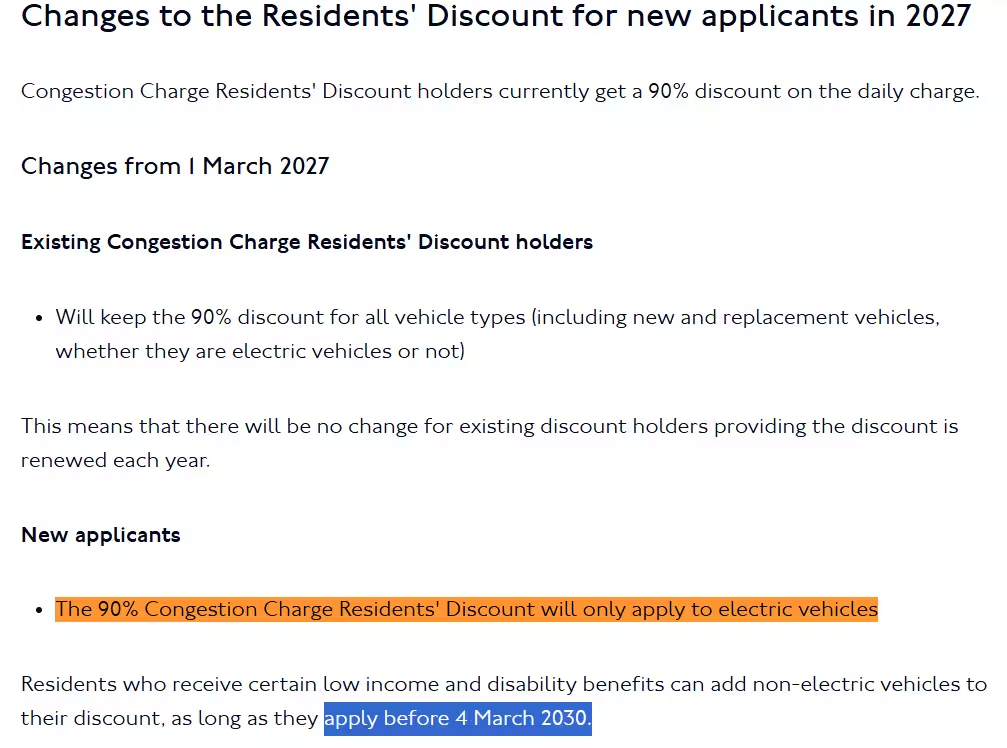
TfL’s confirmed 1 March 2027 residents’ discount changes, including protection for existing holders and restrictions for new applicants.
How Much Is the Congestion Charge and ULEZ Together?
Drivers can be required to pay both the Congestion Charge and Ultra Low Emission Zone charge on the same journey.
The two schemes have different purposes.
The Congestion Charge manages traffic levels in central London, while ULEZ applies emissions requirements across all London boroughs, excluding the M25.
For cars, motorcycles and qualifying light commercial vehicles that do not meet ULEZ standards and are not exempt, the daily ULEZ charge is £12.50.
Combined London Driving Costs
| Driving scenario | Congestion Charge | ULEZ | Total |
| ULEZ-compliant petrol car | £18 | £0 | £18 |
| Non-compliant diesel car | £18 | £12.50 | £30.50 |
| Eligible electric car on Auto Pay | £13.50 | £0 | £13.50 |
| Eligible electric van on Auto Pay | £9 | £0 | £9 |
| Non-compliant car outside Congestion Charge hours but within ULEZ operating hours | £0 | £12.50 | £12.50 |
These examples assume the vehicle is driven within the relevant charging areas and no additional exemption applies.
A non-compliant diesel car entering central London during Congestion Charge hours could therefore cost £30.50 per day before fuel and parking.
Over 20 chargeable days, the combined expense would reach £610.
For a self-employed business owner, that is an important operational cost rather than a minor transport fee.
It also highlights why choosing a ULEZ-compliant vehicle can reduce overall expenditure even if the vehicle still attracts the standard Congestion Charge.
The same principle applies to other location-specific motoring fees.
For example, the Heathrow drop-off charge is separate from ULEZ, while Gatwick drop-off fees operate under their own airport rules.
Drivers comparing airport parking and road-user charging costs should not assume that one payment covers another scheme.
How Much Can the Congestion Charge Cost a London Business?
For businesses, Congestion Charge expenditure depends on the number of vehicles, the frequency of journeys and eligibility for discounts.
A one-person business using a vehicle occasionally may regard the charge as manageable.
However, delivery businesses, construction firms, mobile service providers and private hire operators can generate significant annual costs.
Consider a small maintenance company operating three conventional vehicles inside central London.
If each vehicle incurs the £18 charge for 20 days every month, the company’s monthly expense would be:
3 vehicles × 20 days × £18 = £1,080
Over 12 months, that becomes £12,960.
This does not include ULEZ, parking, fuel or maintenance.
Business Cost Scenarios
| Business arrangement | Chargeable days per vehicle each month | Monthly cost | Annual cost |
| One standard vehicle | 10 | £180 | £2,160 |
| Two standard vehicles | 15 | £540 | £6,480 |
| Three standard vehicles | 20 | £1,080 | £12,960 |
| Three eligible electric cars | 20 | £810 | £9,720 |
| Four eligible electric vans | 15 | £540 | £6,480 |
These are illustrative calculations based on current published charges, with 12 equal operating months and no subsequent price changes.
Our analysis suggests that the greatest financial exposure falls on businesses with frequent central London activity and limited flexibility in scheduling.
Delivery and Courier Businesses
Courier operators often make several stops within central London during one working day.
Because the Congestion Charge is payable per vehicle per charging day, multiple deliveries do not individually multiply the fee.
A courier completing 15 deliveries inside the zone during the same day would normally face one £18 Congestion Charge.
However, a business using five separate vehicles on the same day could face £90 in standard charges.
Route consolidation can therefore reduce charges by limiting the number of vehicles entering the zone.
Tradespeople and Mobile Service Businesses
Electricians, plumbers, decorators and maintenance contractors may need vehicles to transport tools and equipment.
For these businesses, switching to public transport is not always practical.
A tradesperson who visits central London twice weekly over 46 working weeks would incur approximately £1,656 in standard Congestion Charges.
This calculation assumes 92 separate chargeable days.
Such expenditure should be included when calculating project quotations, call-out fees and job profitability.
A contractor offering a fixed-price service without accounting for road charges may underestimate the true cost of delivering the work.
Private Hire and Passenger Transport
Most private hire vehicles must pay the Congestion Charge when operating in the zone during charging hours unless an applicable exemption or discount has been approved.
Qualifying licensed London taxis follow different exemption arrangements.
Electric private hire cars may receive the 25% Cleaner Vehicle Discount when properly registered on Auto Pay.
Drivers must distinguish the amount paid to TfL from any road-charge amounts incorporated into passenger fares by their booking platform or operator.
For independent drivers, analysing how many journeys genuinely require entering the charging zone can help identify unnecessary operating expenses.
What Do TfL’s 2026 Figures Reveal About Congestion Charge Payments?
TfL’s published figures for July to September 2026 provide additional context on the scale of congestion charging in London.
Its data recorded an average of approximately 44,411 valid charges per charging day.
Payment-channel information showed the following distribution:
| Payment channel | Share |
| Auto Pay | 48.03% |
| Fleet | 37.19% |
| Online web payments | 12.85% |
| Mobile app | 1.34% |
| Other methods | Approximately 0.58% |
Auto Pay and fleet payment channels together represented 85.22% of the reported payment-channel usage.
This demonstrates the importance of account-based payment administration within the system.
For businesses, automated charging can reduce the administrative burden of remembering separate daily payments.
However, vehicle registrations and bank details must still be maintained.
When vehicles are sold, leased or reassigned, businesses should promptly update their accounts to avoid inaccurate charging.
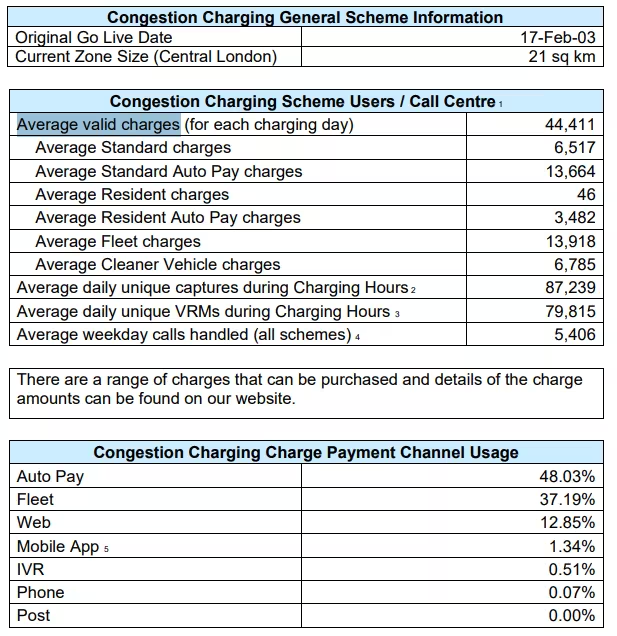
TfL’s July–September 2026 Congestion Charging fact sheet showing average daily valid charges and the distribution of payment methods.
Can Businesses Claim London Congestion Charge as a Tax Expense?
For self-employed professionals and businesses, the tax treatment of Congestion Charge payments is an important consideration.
A charge incurred solely for qualifying business travel can generally be claimed as an allowable business expense, subject to the applicable tax rules.
HMRC’s simplified vehicle expenses guidance distinguishes mileage expenses from incidental journey costs such as parking, tolls and Congestion Charges.
This means a self-employed person using an approved mileage-rate method may still be able to claim qualifying Congestion Charges separately.
However, ordinary commuting between home and a permanent workplace is not automatically eligible for business travel relief.
Is VAT Charged on the London Congestion Charge?
No. The statutory London Congestion Charge is outside the scope of VAT.
Businesses therefore cannot reclaim VAT on the standard Congestion Charge itself because no VAT is charged on that payment.
This distinction is particularly relevant for VAT-registered businesses recording transport expenditure.
The complete amount should be accounted for appropriately rather than incorrectly treating a proportion as recoverable input VAT.
Are Congestion Charge Penalties Tax-Deductible?
Penalty Charge Notices should not be treated in the same way as legitimate travel expenses.
HMRC does not generally allow tax relief for penalties arising from unpaid congestion charges.
This creates an important accounting distinction:
| Expense | General treatment |
| Congestion Charge for qualifying business travel | Generally allowable |
| Congestion Charge for personal journeys | Not an ordinary business expense |
| VAT on statutory Congestion Charge | No VAT to reclaim |
| Congestion Charge PCN | Not eligible for ordinary tax relief |
| Employer-paid private travel charge | May create payroll or benefit reporting obligations |
Companies reimbursing employee travel must also distinguish qualifying business journeys from private travel and normal commuting.
For accurate accounting, employers should retain payment confirmations and journey records and seek tax advice where employee benefit arrangements are complex.
What Happens If You Do Not Pay the London Congestion Charge?
Failing to pay within the permitted deadline can lead to a Penalty Charge Notice.
The financial consequences can be considerably greater than the original daily amount.
| Enforcement stage | Amount |
| Standard payment on the day | £18 |
| Payment within permitted three-day post-travel window | £21 |
| Initial Penalty Charge Notice | £180 |
| PCN paid within 14 days of service | £90 |
| Charge Certificate stage | £270 |
The £21 amount is a permitted higher payment rate, not a penalty.
A £180 PCN may be issued if the appropriate charge has not been paid within the required period and no exemption applies.
An eligible driver paying the PCN within 14 days of service can receive a 50% reduction.
If the penalty remains unpaid and enforcement progresses, the amount can rise to £270 at the Charge Certificate stage, with potential additional enforcement costs later.
Drivers have the right to challenge a PCN through TfL’s formal process when they have legitimate grounds.
These may include evidence of payment, an applicable exemption, an incorrectly identified registered keeper or another recognised reason.
However, a Congestion Charge PCN follows road-user charging enforcement rules rather than the normal procedure for an ordinary private parking ticket.
Drivers comparing different enforcement arrangements can examine the distinctions involved in parking ticket appeals.
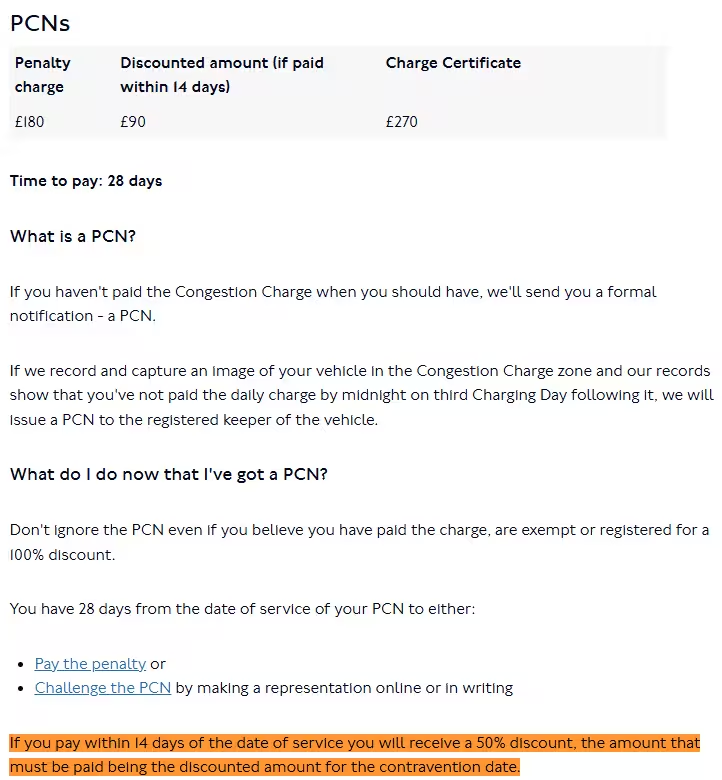
TfL’s Congestion Charge penalties table showing the £180 standard penalty, £90 early-payment reduction and £270 Charge Certificate amount.
How Can Drivers Pay the London Congestion Charge?
Transport for London provides several payment methods.
Drivers can pay through the official TfL online payment system, the TfL Pay to Drive in London app, or the available telephone payment service.
Auto Pay is particularly useful for regular users and businesses operating multiple vehicles.
Payment can be made up to 90 days in advance.
To pay online:
- Open TfL’s official Congestion Charge payment page.
- Select the payment option for the relevant journey.
- Enter the correct vehicle registration.
- Choose the applicable travel date or dates.
- Review the amount and any registered discounts.
- Complete payment and retain confirmation.
Businesses should reconcile these payments against vehicle-use records.
A driver should not assume that an account is correctly configured simply because the vehicle was registered previously.
Payment card expiry, vehicle ownership changes and incorrect registration details can create avoidable problems.
TfL also warns drivers against unofficial third-party payment websites that may impose additional fees or misrepresent the service.
How Can Businesses Reduce Their Congestion Charge Costs in 2027?
Avoiding legitimate charges is not always possible, particularly for businesses serving customers within central London.
However, reducing unnecessary chargeable journeys can have a measurable financial benefit:
- Review chargeable journey frequency: A business should separate journeys that genuinely require access to central London from those that can be completed outside the charging zone.
- Consolidate vehicle movements: Where operationally practical, combining several appointments or deliveries into one vehicle’s daily route can reduce the number of chargeable vehicles.
- Examine off-peak travel: Some businesses may be able to schedule suitable journeys outside charging hours without affecting customer service.
- Consider vehicle classification: Eligible electric vans receive a larger Congestion Charge discount than electric cars. However, switching vehicles must be assessed against full ownership and operating costs.
- Maintain Auto Pay records: Automatic payment arrangements reduce repetitive administration and enable applicable electric vehicle discounts.
- Separate parking from congestion expenditure: Parking fees, delivery-bay restrictions and central London access costs are independent considerations. A journey that avoids the Congestion Charge may still create parking expenses or penalties.
The strongest approach is to evaluate the total cost of each journey rather than focusing exclusively on the £18 daily fee.
For example, sending one vehicle on a longer route may save a Congestion Charge payment but increase driver hours and fuel costs.
A commercially sensible decision must compare the full expenditure and service requirements.
Is Paying the Congestion Charge Worth It for Businesses?
The answer depends on the commercial value generated by entering central London.
For a professional attending a high-value client meeting, an £18 charge may represent a relatively minor expense compared with the revenue associated with the appointment.
For a courier completing a low-margin delivery, however, the same fee may reduce profitability significantly.
Consider two illustrative assignments:
| Business assignment | Revenue | Congestion Charge | Revenue remaining before other costs |
| Consultancy appointment | £250 | £18 | £232 |
| Small delivery assignment | £45 | £18 | £27 |
These figures do not represent net profits because labour, fuel, parking, tax and other business costs have not been deducted.
They demonstrate why a fixed transport charge can have very different commercial consequences.
For the consultancy assignment, £18 represents 7.2% of revenue.
For the delivery assignment, it represents 40% of revenue.
Our analysis indicates that businesses with low-value individual transactions have a particularly strong incentive to consolidate jobs and manage chargeable journeys.
Organisations providing regular services inside the zone should consider including road-user charging in their pricing models where commercially and contractually appropriate.
Conclusion
The London Congestion Charge is £18 per day under the published 2026 rules, with £21 payable during the permitted later-payment period. Those rates provide the current planning baseline for 2027, subject to any subsequent official adjustment.
The most important confirmed 2027 change concerns residents’ discount eligibility from 1 March. Electric vehicle owners must also account for the revised Cleaner Vehicle Discount arrangements introduced in January 2026.
For businesses, the principal challenge is cumulative expenditure. A £18 daily payment can become thousands of pounds annually when vehicles operate regularly in central London.
Our assessment is that effective journey planning, accurate payment administration, appropriate discounts and a clear understanding of separate ULEZ and tax obligations can help motorists manage those costs without compromising legitimate business travel.
Frequently Asked Questions About the London Congestion Charge
How much is the Congestion Charge for one day in London?
The standard daily Congestion Charge is £18 when paid in advance or on the day. A £21 rate applies within the permitted later-payment window.
Will the London Congestion Charge increase in 2027?
No separate standard increase for 2027 has been confirmed as of November 2026. The published rate remains £18, while changes to residents’ discount eligibility are scheduled for March 2027.
How much is the Congestion Charge for an electric car?
An eligible electric car registered on TfL Auto Pay pays £13.50 daily under the 25% Cleaner Vehicle Discount. Without the required Auto Pay registration, the standard £18 charge generally applies.
Does the Congestion Charge apply on Sundays?
Yes. The charge normally applies on Sundays from midday until 6pm, except during the designated Christmas and New Year suspension period.
How much is the London Congestion Charge for a week?
Five chargeable days cost £90 at the standard £18 rate. Seven chargeable days cost £126. The actual amount depends on which days the vehicle enters the zone during charging hours.
Is the London Congestion Charge included in ULEZ?
No. Congestion Charge and ULEZ are separate schemes. A non-compliant car may need to pay £18 plus £12.50, making a combined daily charge of £30.50.
Can I claim the Congestion Charge as a business expense?
Charges incurred solely for qualifying business travel are generally allowable, subject to relevant tax rules. Ordinary commuting and personal travel are treated differently, and penalties are not eligible for ordinary tax relief.
Hannah is a London lifestyle and consumer writer at London Insider News, covering property, transport, local developments, cost-of-living issues and stories affecting everyday life across the capital.
More from TRANSPORT
Do Electric Cars Pay Congestion Charge in London? | 2027 Rules Explained
Yes, electric cars must now pay the London Congestion Charge. Since 2 January 2026, fully electric…
London Congestion Charge Times 2027: Daily Hours, Weekends and Free Driving Periods
The London Congestion Charge times are 7am to 6pm from Monday to Friday and 12pm to…
Is There a Congestion Charge on Sunday: Complete London Weekend Driving Rules
Yes, there is a Congestion Charge on Sunday in London. The charge normally operates from 12pm…