London Airport Parking Guide: Compare Parking Types, Costs and Transfers
Compare parking costs, long-stay options, short-stay charges and terminal transfers across London's six major airports, with practical advice for saving money.
 Hannah
London Lifestyle & Consumer Writer
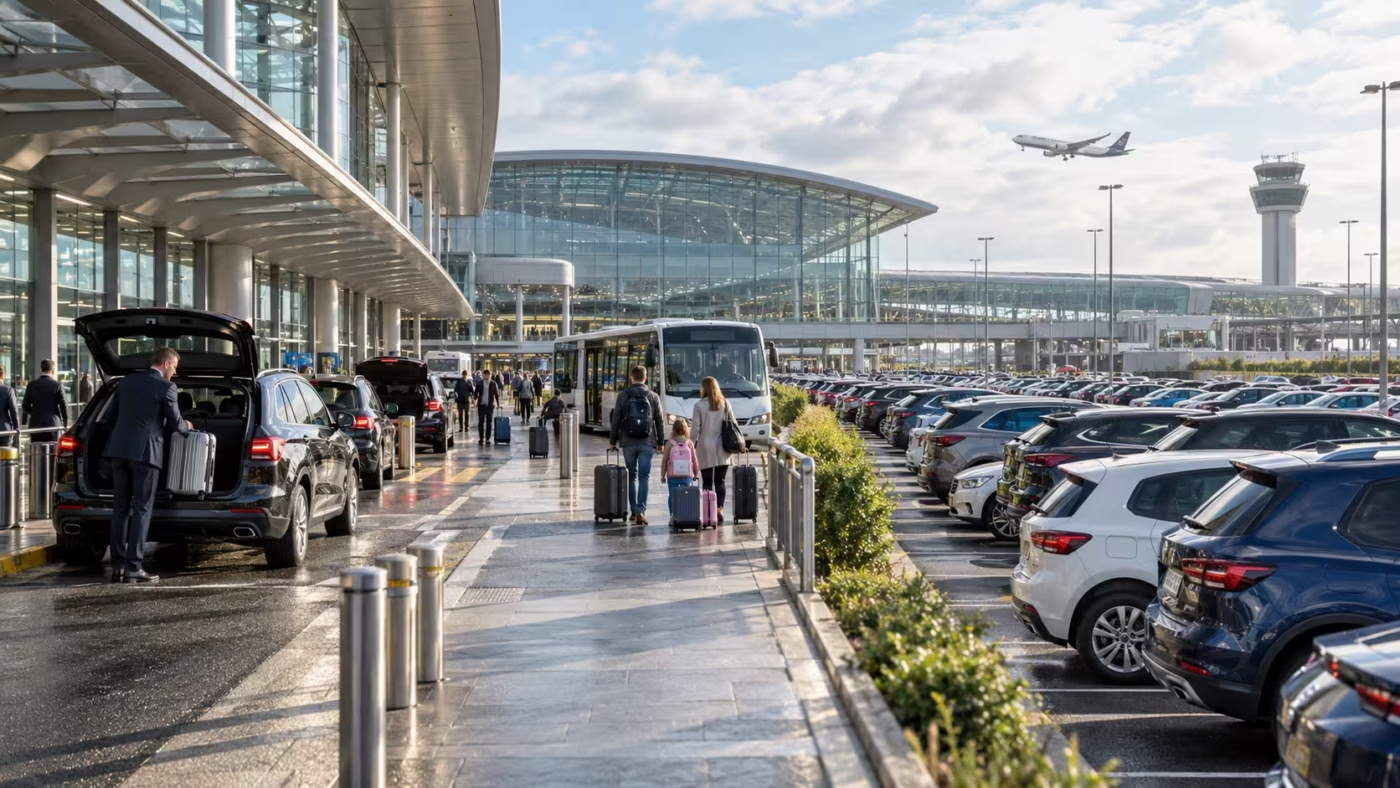
Airport parking in London can become a surprisingly expensive part of travelling, particularly for families, frequent flyers and business professionals booking at short notice.
With six major airports serving the capital, choosing between short-stay, long-stay, meet-and-greet and off-site parking requires more than comparing the advertised daily price.
Our review of official airport tariffs, parking arrangements, transfer services and consumer research shows that the total cost can change considerably depending on travel dates, terminal location, booking conditions and the time needed to reach departures.
For business travellers, an expensive parking decision can also increase company travel expenditure over multiple journeys.
This London airport parking guide compares the available options at Heathrow, Gatwick, Stansted, Luton, London City and Southend, examining their costs, convenience, transfers and financial implications.
How Much Does Airport Parking Cost in London?
Airport parking costs vary considerably across London, with prices determined by the airport, parking location, booking date, duration and service selected.
For longer trips, pre-booked long-stay parking is generally more economical than paying the short-stay gate tariff. However, that does not automatically make the cheapest advertised car park the best financial decision.
A low-cost car park may require a lengthy transfer, while a more expensive near-terminal option may offer better practical value for passengers travelling with children, mobility requirements or tight business schedules.
Our comparison of the six airports highlights the following arrangements.
| London airport | Main parking choices | Typical terminal transfer | Published price example |
| Heathrow | Terminal, Park & Ride, Priority Park & Ride, Pod, Meet & Greet, Valet | Approximately 2–15 minutes, depending on product | Terminal Parking: £8 for up to 29 minutes |
| Gatwick | Short Stay, Premium, Mid Stay, Long Stay, Valet | Short walk or approximately 5–12 minutes by shuttle | Short Stay: £8 for up to 30 minutes |
| Stansted | Short Stay, Mid Stay, Long Stay, JetParks, Meet & Greet | Short walk or approximately 7–15 minutes, depending on product | Long Stay advertised from £59.99 for an eight-day example in November 2026 |
| Luton | Terminal, Mid Stay, Long Stay | Short walk, 10-minute Mid Stay walk or approximately 10-minute Long Stay bus | Long Stay drive-up: £35 for the first day |
| London City | On-site, Premium and Valet | Short walk to terminal | Pre-booked prices vary; Pick-Up area costs £10 for up to 20 minutes |
| Southend | Budget, Standard, Premium, Superior | Short walk from on-site car parks | Budget drive-up: £50 for 2–24 hours |
Important: These are different published pricing examples, not equivalent quotes for the same duration. Most pre-booked airport parking prices change dynamically, so accurate comparisons require identical arrival and departure dates.
Why Do Airport Parking Prices Change?
Unlike a fixed annual vehicle tax or standard public transport fare, airport parking frequently operates through variable pricing.
Prices can be influenced by:
- Seasonal demand: School holidays, bank holidays and busy travel periods can increase demand.
- Booking lead time: Advance purchases may qualify for lower rates.
- Airport location: Parking immediately beside a terminal usually carries a convenience premium.
- Duration: Some products become more economical for seven-day or fourteen-day stays.
- Product availability: Lower-priced car parks can sell out before departure.
- Cancellation conditions: Flexible bookings may cost more than restricted products.
- Optional services: Valet parking, vehicle charging and additional transfer arrangements may affect the final price.
Our financial assessment is that passengers should compare the complete booking cost, rather than focusing on daily promotional figures.
A car park advertised at £8 per day may not cost exactly £56 for seven calendar days. Airport operators can calculate bookings differently, and the actual arrival and exit times may create an additional chargeable day.
What Are the Different Types of Airport Parking?
London airports provide several parking products designed around different journey requirements.
The main distinction is between how close the vehicle remains to the terminal and how much responsibility the parking operator assumes.
| Parking type | How it works | Main advantage | Main disadvantage |
| Short Stay | Park near the terminal, normally retaining keys | Quick terminal access | Expensive for extended stays |
| Long Stay | Park further away with shuttle transport | Usually better value for longer trips | Additional transfer time |
| Mid Stay | Intermediate location, depending on airport | Balance of price and access | Not available at every airport |
| Off-site Park & Ride | Park with an independent provider and transfer | Competitive advance prices | Depends on operator and transfer reliability |
| Meet & Greet | Hand vehicle to an authorised driver | Less walking and less parking preparation | Key handover and operator dependency |
| Valet | Premium assisted vehicle parking | Convenient vehicle collection and return | Higher pricing and service-specific terms |
| Hotel and Parking | Overnight hotel with parking for travel period | Convenient before early flights | Transfer and hotel conditions need checking |
Short-Stay Airport Parking
Short-stay parking is typically located close to an airport’s arrivals or departures areas.
It is particularly useful when collecting passengers, helping relatives with luggage, attending short meetings or travelling for a brief business visit.
At Heathrow and Gatwick, some terminal car parks are within a few minutes’ walk of the terminal building.
The principal disadvantage is cost.
For example, Heathrow’s published Terminal Parking drive-up tariff is £98 for a stay exceeding 12 hours and lasting up to 24 hours at terminals where that tariff applies.
A passenger who leaves a car for several days without pre-booking can therefore face substantially higher costs than someone using a suitable long-stay product.
Our assessment is that short-stay parking should usually be considered for access and convenience first, rather than long-term affordability.
Long-Stay Airport Parking
Long-stay parking is designed primarily for passengers leaving their vehicles while travelling.
These car parks are commonly located further from the terminal, with complimentary shuttle buses connecting passengers to departures and arrivals.
The financial advantage becomes particularly relevant for holidays, conferences and overseas business travel lasting several days.
However, long-stay parking requires passengers to consider more than the driving time from their homes.
The complete journey includes locating a space, unloading luggage, reaching the shuttle stop, waiting for transport and travelling to the terminal.
A ten-minute bus ride can become a considerably longer door-to-check-in journey once these additional stages are included.
Mid-Stay Airport Parking
Mid-stay parking attempts to balance convenience and affordability.
At Stansted, Mid Stay operates with a shuttle transfer, while Luton’s Mid Stay car park is approximately a ten-minute walk from the terminal.
That distinction matters because the same product name does not guarantee the same experience at different airports.
For passengers comfortable walking with luggage, Luton’s arrangement may remove the uncertainty associated with waiting for a shuttle.
However, a ten-minute walk may be less attractive during bad weather or for passengers requiring additional mobility support.
Meet-and-Greet Airport Parking
Meet-and-greet services generally allow customers to deliver their vehicles to an agreed airport location, where an authorised operator takes responsibility for parking them.
This can reduce the amount of walking and time spent looking for a parking space.
The service may appeal to business travellers, families with substantial luggage and passengers travelling during inconvenient hours.
Nevertheless, consumers should establish where their vehicle will actually be stored.
Not every meet-and-greet company operates its own airport car park. Some independent providers move vehicles to facilities outside the airport.
Before paying, we recommend checking the operator’s identity, parking location, key-handling arrangements, vehicle insurance and damage procedures.
Off-Site Park-and-Ride Parking
Independent parking operators frequently advertise competitive prices outside the airport boundary.
Customers typically drive directly to the provider’s premises and take a shuttle bus to their departure terminal.
The main attraction is cost, although the advertised savings should be balanced against transfer frequency, operating hours and business reliability.
A ten-minute transfer advertised by a provider does not necessarily include the time spent checking in, handing over keys or waiting for a bus.
For an early departure, a dependable transfer service may be more valuable than a small difference in the parking price.
Airport Hotel and Parking Packages
Hotel-and-parking packages combine accommodation before a flight with vehicle parking for the duration of the trip.
They can be particularly helpful for travellers facing long journeys to the airport or departures early in the morning.
However, the hotel package does not always include complimentary terminal transfers.
Some hotels require customers to pay separately for shuttle transport, and the vehicle may need to be moved to a different parking location after the overnight stay.
We recommend comparing the total hotel-and-parking price against booking the accommodation and parking independently.
Which Airport Parking Type Offers the Best Value?
There is no single parking product that will suit every traveller.
Our editorial assessment compares the suitability of the main parking options across different journeys.
The following percentages represent our decision-support scores, based on relative cost, terminal access, journey suitability, booking convenience and vehicle-handling considerations.
They are editorial ratings, not customer satisfaction scores, measured performance statistics or survey findings.
| Parking type | One-week budget trip | Fast terminal access | Short business trip |
| Official Long Stay | 92% | 65% | 78% |
| Independent Park & Ride | 90% | 50% | 68% |
| Terminal Short Stay | 55% | 95% | 91% |
| Premium Terminal Parking | 64% | 96% | 94% |
| Meet & Greet | 72% | 94% | 93% |
| Hotel and Parking Package | 84% | 73% | 76% |
Ratings express our assessment of use-case suitability, not the performance of a particular airport or parking operator. Individual quotes, accessibility needs and booking conditions may change the preferred choice.
For someone taking a week-long holiday, the savings associated with a suitable long-stay booking may outweigh a modest transfer inconvenience.
For a professional attending a brief overseas meeting, the business value of more convenient terminal access may justify a higher parking charge.
The key principle is to match the parking product to the purpose of the journey.
How Does Parking Work at Heathrow Airport?
<entity name removed>
Heathrow provides one of the widest selections of airport parking products in the London region.
Its options include Terminal Parking, Park & Ride, Priority Park & Ride, Meet & Greet, Valet and Terminal 5 Pod Parking.
An important change occurred in September 2025, when Heathrow renamed Short Stay Parking to Terminal Parking. Long Stay became Park & Ride, while Business Parking became Priority Park & Ride.
Older comparison websites may continue using the previous names.
Heathrow Parking Costs
Heathrow’s published Terminal Parking drive-up tariffs, effective from 6 January 2026, include:
| Duration | Drive-up charge |
| Up to 29 minutes | £8.00 |
| 30–44 minutes | £12.50 |
| 45–59 minutes | £15.50 |
| 1–2 hours | £20.00 |
| 2–3 hours | £24.00 |
| 3–4 hours | £28.00 |
| 12–24 hours | £98.00 |
These published tariffs apply to the relevant Terminal Parking product. Pre-booked longer-stay prices can be substantially different.
Park & Ride provides an alternative for passengers travelling for several days and normally involves a shuttle transfer of approximately 10–15 minutes, depending on the location and service.
Priority Park & Ride is designed around quicker transfers, although product availability can change.
Terminal 5 also offers Pod Parking, using automated transport between the car park and terminal.
Important Heathrow Terminal 4 Parking Changes
From 23 June 2026, Heathrow’s Terminal 4 multi-storey car park closed for redevelopment.
Passenger parking arrangements moved to Zone A of the Terminal 4 Park & Ride facility.
The airport provides up to two hours of free parking in Zone A, with free transfers to Terminal 4.
Passengers should not rely on older articles directing them to the closed Terminal 4 multi-storey car park.
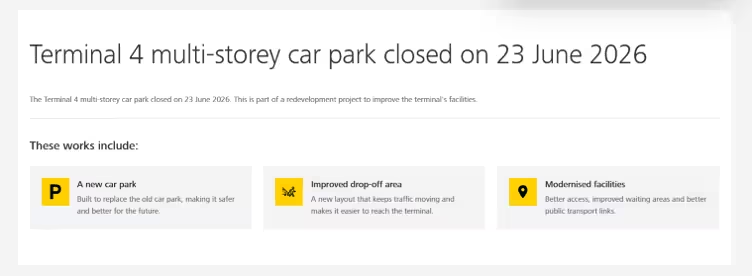
Heathrow’s official Terminal 4 redevelopment information confirms the car park closure and alternative parking arrangements introduced in June 2026.
Our assessment: Heathrow offers considerable parking flexibility, but passengers need to check the correct terminal and current product availability before booking.
How Does Parking Work at Gatwick Airport?
Gatwick serves passengers through North and South Terminals, making terminal identification particularly important.
Its official parking products include Short Stay, Premium Short Stay, Mid Stay, Long Stay and Valet services.
A major benefit of Gatwick’s parking system is the availability of both near-terminal facilities and more economical shuttle-connected car parks.
Gatwick Parking Costs
Gatwick publishes the following drive-up rates for its standard Short Stay and Long Stay products:
| Duration | Short Stay | Long Stay |
| Up to 30 minutes | £8 | Free within the first two hours |
| 31–60 minutes | £14 | Free within the first two hours |
| 1–2 hours | £18 | Free |
| 2–24 hours | Depends on duration | £38 |
| 12–24 hours | £70 | £38 |
| Each subsequent day | £70 | £32 |
For stays exceeding two hours, the Long Stay tariff applies according to the published charging bands.
These are on-the-day rates, and pre-booked prices may be lower.
The financial contrast becomes clearer as parking duration increases.
A traveller requiring several days of parking should not assume that paying the Short Stay drive-up tariff is economical merely because the terminal is close.
Gatwick Parking Transfers
Gatwick operates free shuttle buses between its Long Stay car parks and terminal buildings.
Published journey times are approximately:
- South Terminal: 5–10 minutes.
- North Terminal: 10–12 minutes.
The airport also operates a free inter-terminal shuttle between North and South Terminals.
This provides additional flexibility, although parking at the terminal corresponding to the flight will generally make the journey simpler.
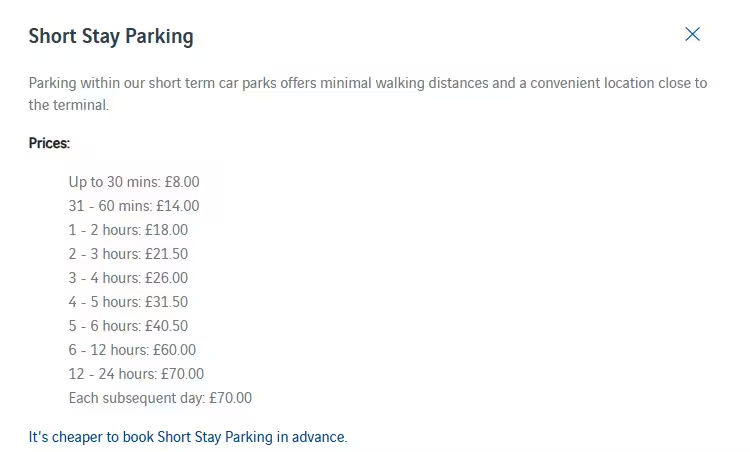
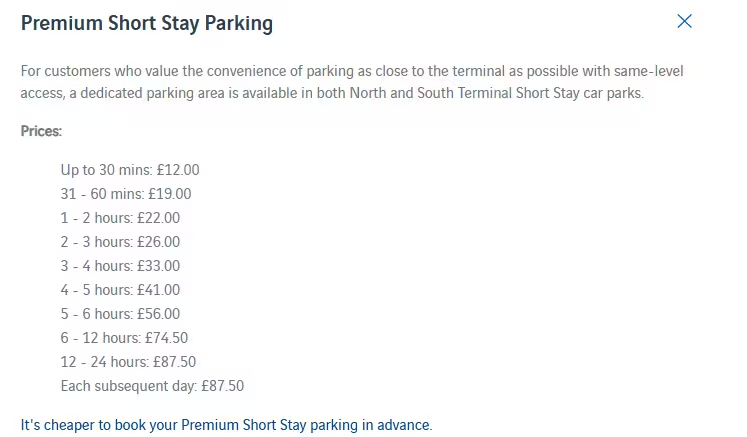
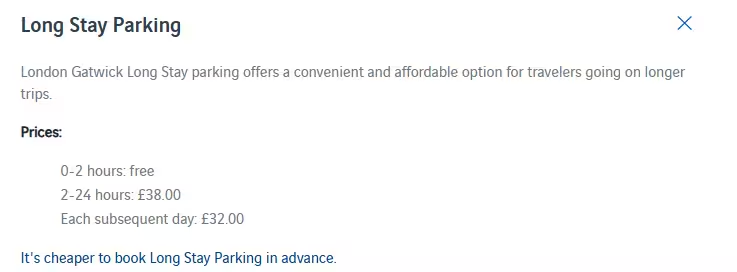
Official Gatwick drive-up parking tariffs show the difference between Short Stay and Long Stay parking, including the two-hour free Long Stay allowance.
Passengers seeking a more detailed price comparison should examine how much parking at Gatwick costs across different stays, terminals and transfer arrangements before choosing a product.
How Does Parking Work at Stansted Airport?
Stansted provides Short Stay, Mid Stay, Long Stay, JetParks and Meet & Greet parking.
For travellers using lower-cost European flights, parking can represent a meaningful proportion of the complete holiday expenditure.
Our comparison shows that Stansted customers should pay particular attention to the difference between an advertised advance-booking example and the amount payable on their own travel dates.
Stansted Parking Costs
Stansted’s official website advertises the following pre-booked examples:
| Parking type | Published example | Terminal access |
| Short Stay | From £74.99 for seven days | Approximately 1–10-minute walk |
| Mid Stay | From £64.99 for eight days | Around seven-minute shuttle journey |
| Long Stay | From £59.99 for eight days | Shuttle transfer |
| Meet & Greet | From £79 for eight days | Short terminal walk |
| JetParks | From £58.99 for eight days | Shuttle transfer |
The examples refer to specified dates in November 2026, except JetParks, which is advertised using an April 2027 stay.
JetParks closes seasonally over winter, meaning its advertised price should not be treated as an available winter booking.
Actual prices and transfer arrangements must be confirmed for the required dates.
Which Stansted Parking Option Is More Economical?
Long Stay and JetParks can appeal to customers primarily concerned with parking expenditure.
Mid Stay may provide a useful compromise where a shorter transfer is preferred.
Short Stay can be more practical for collecting passengers or travelling with substantial luggage.
Meet & Greet prioritises convenience, but customers should still examine the terms governing key handover, collection and late returns.
There are several ways to investigate cheaper parking at Stansted Airport, including advance booking, comparing alternative products and reviewing seasonal availability.
A small difference in the advertised amount should not override the importance of a suitable transfer service.
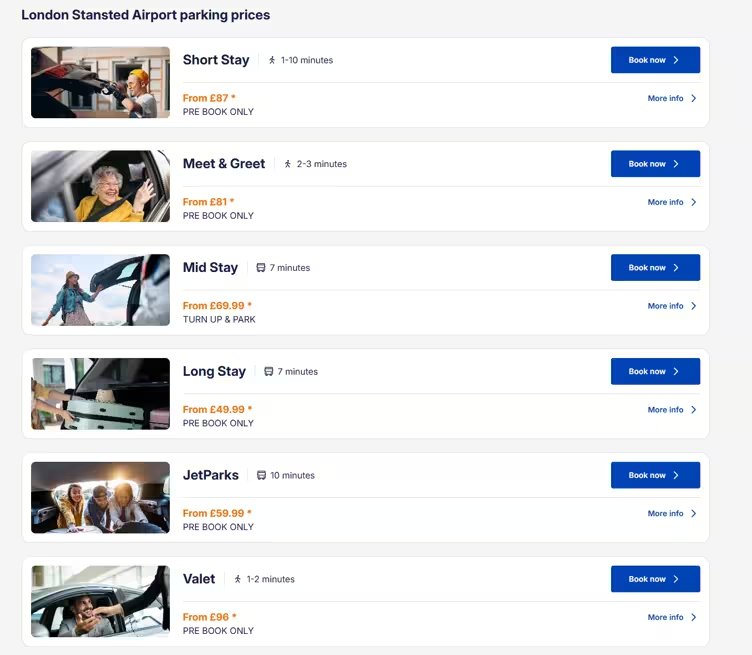
Stansted’s official parking comparison displays Short Stay, Mid Stay, Long Stay, JetParks and Meet & Greet options, with published booking examples.
Passengers should also understand how to book Stansted Airport parking correctly, particularly where an operator requires a minimum stay or applies different cancellation conditions.
How Does Parking Work at Luton Airport?
London Luton Airport provides several official parking products, including terminal car parks, Mid Stay and Long Stay.
The main difference is how passengers reach the terminal.
Mid Stay is approximately a ten-minute walk, while Long Stay provides a free shuttle service.
Luton Parking Costs
Luton’s published drive-up examples, effective from 22 June 2026, include:
| Parking product | Published tariff |
| Mid Stay | £15 for up to 60 minutes |
| Mid Stay | £40 for each subsequent day or part-day under the published tariff |
| Long Stay | First two hours free |
| Long Stay | £7 for 2–3 hours |
| Long Stay | £35 for the first day |
| Long Stay | £35 for each subsequent day or part-day |
These tariffs should not be mistaken for pre-booking quotes.
The airport advertises potential savings against its drive-up prices when booking ahead, but the actual discount depends on the product, dates and availability.
How Long Does the Luton Parking Transfer Take?
Long Stay provides an approximately ten-minute bus journey to the terminal.
Buses operate around the clock and normally run approximately every 20 minutes.
A passenger might therefore need more than ten minutes between parking and reaching departures.
Mid Stay avoids the bus journey but involves walking.
The preferred option depends on luggage, weather conditions, mobility requirements and the price difference.
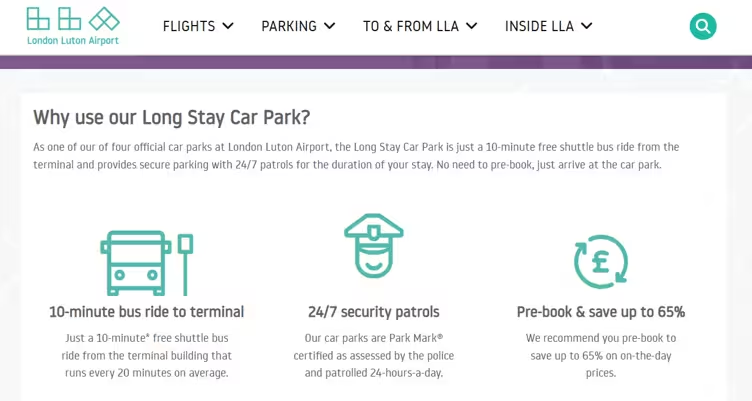
Luton’s official Long Stay car park information displays the drive-up parking tariffs, free two-hour allowance and shuttle transfer arrangements.
How Does Parking Work at London City Airport?
London City Airport is particularly relevant to travellers accessing the capital’s financial and commercial districts.
Its relatively compact layout makes terminal access an important feature of the parking experience.
Official facilities include on-site parking, premium parking and valet options.
Unlike airports with extensive remote parking facilities, London City’s principal on-site parking arrangements involve short walks rather than lengthy bus transfers.
However, that convenience does not guarantee lower prices.
What Should Business Travellers Check?
Our assessment identifies four particularly important considerations:
- Total parking cost compared with rail or DLR access.
- Walking distance between the selected parking facility and terminal.
- Flight arrival and departure times.
- Cancellation and vehicle collection conditions.
London City Airport supports pre-booking and uses vehicle registration recognition for parking entry and exit.
Actual parking prices vary with travel dates and booking arrangements.
Passengers should obtain a quote rather than treating its premium or on-site parking products as having one fixed daily price.
For comparison, the separate airport Pick-Up area currently advertises £10 for a stay of up to 20 minutes. This is a collection tariff, not a long-stay parking price.
London City Drop-Off Charges
London City also operates a charged terminal drop-off facility.
The published charge is £8 for the first five minutes, followed by £1 for each additional minute, subject to the ten-minute maximum stay.
The charge must be paid by midnight the following day.
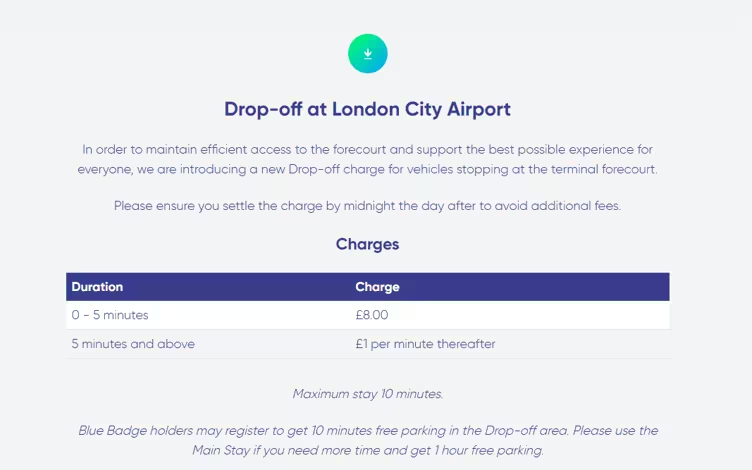
London City’s official drop-off page confirms the £8 initial charge, additional per-minute rate and payment arrangements.
How Does Parking Work at Southend Airport?
London Southend Airport offers a smaller airport parking environment, with official on-site car parks located within walking distance of the terminal.
Its parking products include Budget, Standard, Premium and Superior.
The airport’s current product names are important because some older content refers to Budget as Mid Stay, Standard as Long Stay and Superior as Short Stay.
Southend Airport Parking Costs
Southend advertises the following drive-up examples:
| Parking option | Published price |
| Budget, up to 30 minutes | £12 |
| Budget, 30–60 minutes | £25 |
| Budget, 2–24 hours | £50 |
| Standard, 0–24 hours | £55 |
| Premium, 0–24 hours | £70 |
| Superior, 10 minutes–24 hours | £80 |
Pre-booked prices may be lower.
One advantage of Southend’s official parking arrangements is that the terminal can be reached on foot without a shuttle transfer.
Passengers should nevertheless check the precise walking distance, accessible parking arrangements and opening conditions of their selected facility.
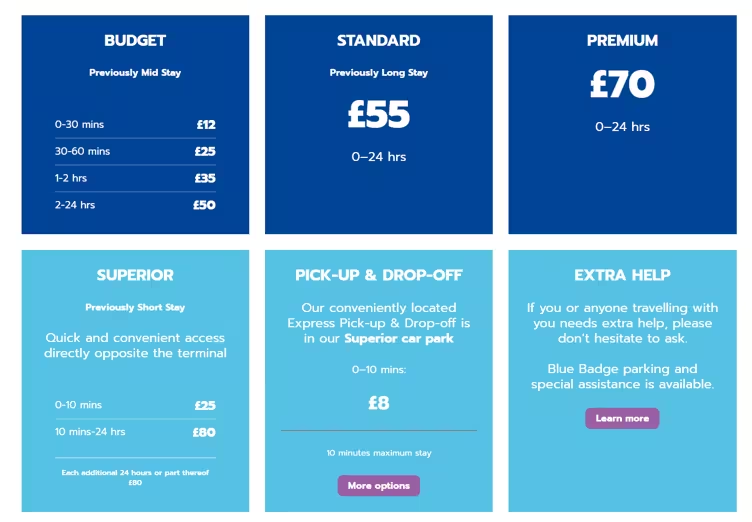
Southend’s official parking comparison shows its updated Budget, Standard, Premium and Superior parking categories and published drive-up prices.
How Much Are London Airport Drop-Off Charges?
Airport drop-off charges are separate from parking booked for a holiday or business trip.
A driver entering a designated terminal forecourt can incur a charge even if the vehicle remains there for only a short period.
Our review of the published airport charging arrangements in October 2026 found the following rates.
| Airport | Standard terminal drop-off charge | Important condition |
| Heathrow | £7 per entry | No waiting or passenger collection in the drop-off zone |
| Gatwick | £10 for the first 10 minutes | Additional charges apply for longer stays |
| Stansted | £10 for up to 15 minutes | £28 for stays exceeding 15 minutes |
| Luton | £9 for up to 12 minutes | £1 for each additional minute; maximum 30 minutes |
| London City | £8 for up to five minutes | £1 per additional minute; maximum 10 minutes |
| Southend | £8 for up to 10 minutes | Maximum 10-minute Express stay |
These are published standard charges as reviewed in October 2026. Separate rules, concessions and enforcement charges apply, and tariffs can change.
What Happens if a Drop-Off Charge Is Not Paid?
At several London airports, automatic number plate recognition cameras record vehicles entering designated drop-off areas.
The driver or responsible payer must then settle the charge through the airport’s authorised payment system.
For example, Heathrow, Gatwick, Luton, Stansted, London City and Southend operate next-day payment arrangements for their relevant barrierless drop-off products.
The exact deadline and permitted payment methods must be confirmed with the airport.
Missing the deadline can lead to a Parking Charge Notice substantially exceeding the original drop-off fee.
Heathrow’s published non-payment charge, for example, is £80, reduced to £40 if paid within 14 days.
This makes payment administration particularly important for people who regularly transport customers or passengers to airports.
For a detailed understanding of payment methods and deadlines, the Heathrow drop-off charge and Gatwick drop-off charge are best examined separately.
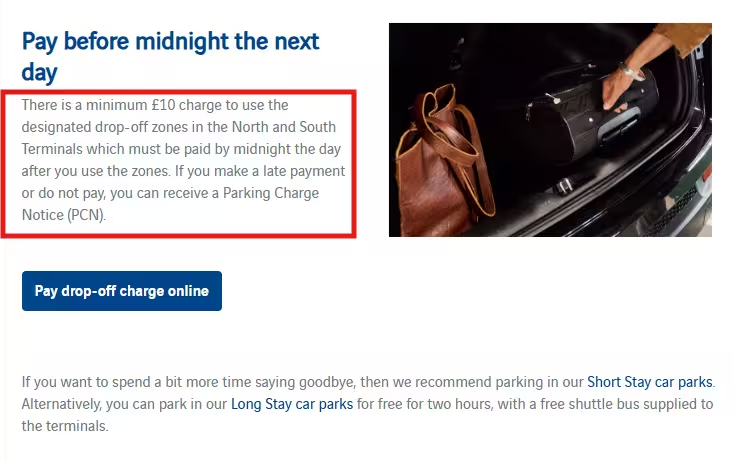
Gatwick’s official drop-off information explains its £10 minimum charge, per-minute pricing and next-day payment deadline.
Is Free Airport Parking Available in London?
Yes, several London airports provide limited free parking in designated areas.
However, these facilities are generally intended for passenger drop-offs or collections rather than free holiday parking.
| Airport | Free parking alternative | Main limitation |
| Heathrow | Park & Ride: first 29 minutes free at the applicable facilities | Shuttle transfer required |
| Heathrow Terminal 4 | Zone A: up to two hours free | Terminal 4-specific arrangement |
| Gatwick | Long Stay: up to two hours free | Shuttle required |
| Stansted | Mid Stay: up to 60 minutes free | Shuttle required |
| Luton | Long Stay: up to two hours free | Shuttle required |
| London City | Specific Blue Badge concessions | Eligibility and registration conditions |
| Southend | No general free parking allowance established in the reviewed tariff | Check current official options |
Are Free Drop-Off Areas Worth Using?
For a driver collecting a relative or transporting a passenger to the airport, a free parking area can provide a meaningful saving.
Consider a household making ten airport drop-offs or collections over a year.
Avoiding a £10 terminal fee on each occasion would save £100.
However, the financial saving should be balanced against the extra travel and transfer time.
The distinction is particularly important for passengers who have mobility limitations or require assistance.
At Stansted, the Mid Stay allowance of up to one hour provides an alternative to paying the Express Set Down charge.
The practical conditions and transfer arrangements are more important than the word “free” alone.
How Can Travellers Find Cheaper Airport Parking?
Airport parking savings generally depend on preparation, comparison and avoiding unnecessary extras.
Our review identifies several approaches worth considering.
1. Compare Prices Before Booking
A useful parking comparison should include at least three suitable products:
- Official airport long-stay parking.
- An independently operated park-and-ride facility.
- A near-terminal or meet-and-greet alternative.
Travellers should use identical entry and exit dates for each quote.
Comparing different dates, parking durations or terminal locations can produce misleading conclusions.
2. Book in Advance When the Price Is Attractive
Advance booking can produce substantial savings against drive-up rates.
However, there is no universal rule that purchasing exactly three, four or six weeks ahead will always result in the lowest price.
A better strategy is to check prices once flights are confirmed, compare acceptable alternatives and purchase when a suitable combination of price and conditions is available.
3. Review Cancellation Conditions
An inexpensive booking may become expensive if flights change.
Before payment, customers should confirm:
- Whether the booking can be cancelled.
- The final cancellation deadline.
- Whether cancellation protection costs extra.
- How amendments affect the price.
- Whether the payment is refundable or issued as credit.
A slightly higher flexible booking may offer better value when travel dates are uncertain.
4. Compare Hotel-and-Parking Packages
An airport hotel package may be attractive for early departures, especially when customers must travel a considerable distance before reaching the airport.
The comparison should include all transport between the hotel, parking facility and terminal.
5. Avoid Unnecessary Premium Services
Premium parking is useful when convenience has a genuine value.
However, travellers should not automatically purchase premium parking simply because it appears prominently in a booking system.
For a two-week holiday, the incremental cost of premium terminal parking may exceed the practical benefit.
6. Check the Final Checkout Price
A parking advertisement may not clearly communicate the whole cost until the final booking stage.
Customers should review the payable total, including any optional cancellation cover, transfer charges or service extras.
The correct comparison is the total charged to the payment card.
How Much Can Advance Booking Actually Save?
Consumer pricing investigations have identified substantial differences between drive-up and advance-booking prices at major UK airports.
For example, a January 2026 comparison by Which? reported the following long-stay parking examples for specified February half-term dates:
| Airport | On-the-day price | Price booked one month ahead | Calculated saving |
| Gatwick | £230 | £62 | 73.0% |
| Heathrow | £271 | £145 | 46.5% |
These figures illustrate how dramatically prices can differ, but they are historical research examples rather than current October booking quotations or guaranteed savings.
They should not be used to promise that every traveller can save the same percentage.
How Should Savings Be Calculated?
Use the following formula:
Parking saving (%) = (Higher comparable price − Lower comparable price) ÷ Higher comparable price × 100
Suppose one suitable parking option costs £150 and another comparable option costs £90.
The saving is:
(£150 − £90) ÷ £150 × 100 = 40%
That means a traveller saves £60 on the booking.
For a business arranging twelve similar journeys annually, a £60 reduction on every trip would result in a hypothetical annual saving of £720.
This is why airport parking decisions can become a worthwhile part of corporate travel budgeting.
Is Airport Parking Cheaper Than Using a Taxi or Train?
Driving to the airport is not always the lowest-cost option.
The correct comparison includes the full journey rather than simply the airport parking charge.
Example: Comparing Transport for Two Travellers
Consider a hypothetical seven-day trip.
| Expense | Drive and park | Return taxi | Public transport |
| Parking | £84 | £0 | £0 |
| Fuel | £30 | £0 | £0 |
| Return transport fare | £0 | £130 | £50 |
| Local connections | £0 | £0 | £10 |
| Total | £114 | £130 | £60 |
These amounts are illustrative budgeting assumptions, not live airport quotes.
In this example:
- Driving and parking costs £114.
- Two taxi journeys cost £130.
- Public transport costs £60.
Public transport is the least expensive option under these assumptions.
However, if four travellers shared the same car, driving and parking could become more competitive against individually purchased rail tickets.
The result also changes when passengers are travelling with substantial luggage or when public transport is unavailable at the required hour.
Our analysis suggests that group size, journey distance and travel time should influence the final choice.
How Should Travel Time Be Valued?
For business travellers, journey time may have a financial value.
Suppose two parking products differ by £20, but the cheaper facility adds 25 minutes to each direction of travel.
That represents 50 minutes of additional travel across the round trip.
If the employer assigns an internal planning value of £30 per hour to that employee’s time, the additional 50 minutes represent approximately £25 of time cost.
Under that assumption, the £20 parking saving is smaller than the calculated time cost.
This does not mean that all travel time is directly recoverable or billable. It demonstrates why a company may rationally choose a more expensive parking product for certain business journeys.
What Should Business Travellers Check Before Booking Airport Parking?
Airport parking can form part of a business’s wider travel and expense-management process.
For small businesses and entrepreneurs, even relatively modest recurring charges can affect expenditure.
A company arranging regular domestic and international travel should establish consistent parking approval and reimbursement procedures.
Business Parking Expenses
A practical company policy may require employees to:
- Obtain a parking quotation before travel.
- Use a preferred or approved booking provider.
- Select a parking category appropriate to the journey.
- Keep the booking confirmation and receipt.
- Explain unusually expensive parking choices.
- Report amendments, overruns and disputed charges promptly.
Can Businesses Reclaim VAT on Airport Parking?
VAT recovery depends on the business’s VAT status, the nature of the expense and whether recoverable VAT was correctly charged.
A VAT-registered business may be able to reclaim VAT on qualifying business-related off-street parking, subject to the normal input-tax rules.
The business should retain appropriate invoice evidence.
A payment confirmation that merely shows the total paid does not automatically establish the amount of recoverable VAT.
The same distinction matters for self-employed individuals calculating allowable business expenses.
Parking related to genuine qualifying business travel should be considered separately from private travel and ordinary commuting.
How Can Companies Reduce Recurring Parking Expenditure?
Businesses making frequent airport trips can monitor:
- Average parking cost per journey.
- Average cost per traveller.
- Percentage of trips booked in advance.
- Use of premium parking services.
- Unplanned extension charges.
- Parking Charge Notices resulting from administrative mistakes.
These figures allow business owners to identify avoidable expenditure without imposing unnecessarily restrictive travel arrangements.
How Safe Is Airport Parking?
The safety of a parked vehicle is an important consideration, particularly when customers use independent providers.
Low prices alone do not establish that a parking facility is well managed.
Our assessment identifies several indicators worth checking before booking.
Parking Accreditation
The UK has a police-supported safer parking accreditation framework.
Historically known through Park Mark, the initiative was updated under Safer Parking branding in 2026.
Accreditation assesses measures intended to reduce crime and improve parking environments, such as lighting, surveillance and management.
However, accreditation should not be interpreted as a guarantee that theft, damage or other incidents cannot occur.
What Should Customers Check?
Before handing over a vehicle, establish:
- Operator identity: Confirm the legal trading business and parking address.
- Vehicle location: Ask where the car will remain during the booking.
- Key security: Understand who will hold the keys.
- Vehicle movement: Check whether employees are authorised to drive the vehicle.
- Insurance: Review responsibility for damage or theft.
- Collection process: Confirm what happens if the flight arrives late.
- Customer support: Check whether assistance is available outside normal office hours.
Customers using meet-and-greet services should photograph their vehicle and record its condition before handing over the keys.
Photographs can help establish the condition of the vehicle should a dispute arise later.
What Happens if a Flight Is Delayed?
Flight delays may affect airport parking costs and vehicle collection arrangements.
A booking made for a particular exit time may not automatically include unlimited additional parking.
Some operators provide grace periods, while others charge for extra hours or days.
For example, Gatwick publishes different daily overstay tariffs across its parking products, with official Long Stay and some other products carrying lower extension charges than certain premium categories.
The precise policy depends on the booked product and the operator’s terms.
How Can Travellers Avoid Additional Charges?
Before departure, customers should confirm the process for notifying the car park of changes.
If a flight is delayed, they should:
- Check whether their booking includes an overrun allowance.
- Contact the parking provider where required.
- Review the amendment or extension process.
- Keep evidence of flight delays and revised arrival times.
- Confirm whether any additional payment is required before exiting.
The existence of a flight delay does not automatically mean the parking operator must waive charges.
Some travel insurance policies may provide relevant benefits, but coverage depends on the policy wording and circumstances.
Can Electric Vehicles Be Charged at Airport Car Parks?
Electric vehicle owners face an additional consideration when choosing airport parking.
Availability of charging infrastructure differs between airports and parking products.
A car park may advertise electric vehicle charging without guaranteeing that a suitable charger will be available throughout a booking.
Customers should check whether charging spaces are reservable, what connector and charging speed are available, and whether charging involves a separate tariff.
What Should EV Drivers Consider?
Important questions include:
- Is charging available within the booked parking product?
- Is the charger compatible with the vehicle?
- Can charging be reserved?
- Are electricity charges included in the parking price?
- Are idle fees or maximum charging durations imposed?
- Who is responsible for connecting and disconnecting the vehicle?
Drivers should avoid assuming that an ordinary airport parking booking includes a charging service.
Planning sufficient battery range for the return journey remains important.
Is Airport Parking Accessible for Disabled Travellers?
Accessibility should be evaluated separately from price.
Official airport parking facilities generally publish information about accessible spaces and assistance arrangements.
However, Blue Badge concessions, terminal walking distances and shuttle facilities differ.
For instance, Heathrow provides qualifying Blue Badge holders with a 100% discount on its terminal drop-off charge when the relevant registration conditions are met.
Gatwick also offers a drop-off charge exemption for eligible registered Blue Badge holders.
Stansted’s Express Set Down rules do not provide a general Blue Badge exemption, although other parking and assistance arrangements are available.
At Luton, the main drop-off charge is not automatically waived for Blue Badge holders, but the airport advertises alternative concessions, including eligible free parking in Terminal Car Park 1.
London City provides registered Blue Badge concessions for its drop-off facilities.
The important principle is that Blue Badge possession does not automatically create identical parking rights or free terminal drop-off access at every airport.
Passengers should check the applicable airport rules and request assistance in advance where needed.
What Happens if an Airport Parking Charge Notice Is Issued?
A parking charge is not necessarily the same thing as a council-issued penalty.
Airport car parks and drop-off facilities may be operated under contractual terms, with private parking operators issuing Parking Charge Notices where drivers allegedly fail to follow those terms.
Different enforcement mechanisms can apply depending on the location and legal basis.
What Should a Driver Check First?
A driver receiving a notice should identify:
- The organisation issuing the notice.
- The vehicle registration and alleged incident date.
- The exact location and parking conditions.
- The stated reason for the charge.
- The payment and appeal deadlines.
- The available evidence.
A notice may relate to an unpaid drop-off charge, incorrect registration details, overstaying or another alleged breach.
Can Airport Parking Tickets Be Appealed?
Yes, there may be grounds to challenge a charge, depending on the facts and applicable process.
Potential grounds can include an incorrect vehicle registration, payment evidence, unclear or inadequate signage, or circumstances showing that the charge was not correctly issued.
Private parking companies participating in accredited trade association schemes have established appeal arrangements.
Where applicable, motorists may be able to use POPLA for operators in the British Parking Association scheme or the Independent Appeals Service for operators in the International Parking Community scheme.
However, not every airport notice follows an identical legal process.
A detailed understanding of how to appeal a parking ticket requires identifying the type of notice before choosing the correct appeal route.
Similarly, the question of whether private parking tickets must be paid should not be answered by assuming that all private charges are automatically invalid.
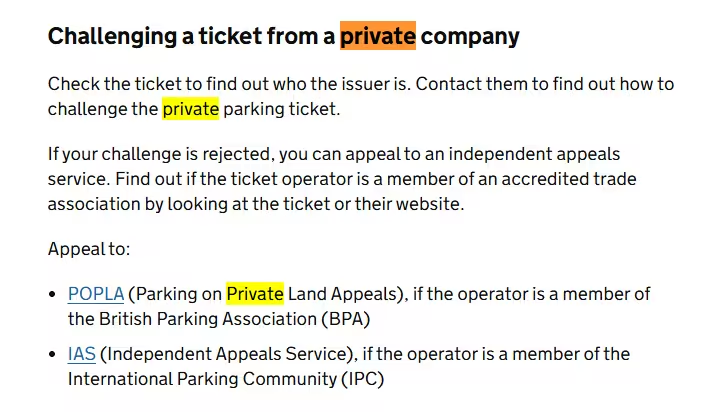
Government guidance explains the distinction between different parking notices and the relevant procedures for challenging them.
What Are the Most Common Airport Parking Booking Mistakes?
Our review identifies several preventable mistakes that can make airport parking more expensive or inconvenient.
| Common mistake | Potential consequence | Recommended action |
| Booking the wrong terminal | Longer transfers or incorrect arrival location | Confirm airline terminal before payment |
| Entering the wrong registration | ANPR recognition problems | Check every character of the registration |
| Underestimating the stay | Additional charges | Allow for scheduled arrival and realistic collection time |
| Ignoring cancellation conditions | Lost booking payment | Review terms before purchase |
| Choosing the lowest price without checking transfers | Extra travel time or missed connections | Check transfer frequency and hours |
| Assuming all Blue Badge parking is free | Unexpected charges | Check airport-specific concessions |
| Using an unverified provider | Vehicle security and service risks | Confirm operator identity and facilities |
| Failing to pay a drop-off charge | Enforcement notice | Use the official payment service within the deadline |
| Comparing prices for different dates | Misleading savings calculation | Use matching dates and times |
For consumers and businesses alike, many of these risks can be reduced through basic booking checks.
How Should Travellers Choose Airport Parking for Different Trips?
The preferred parking arrangement depends heavily on the nature of the journey.
For a Family Holiday
Families travelling for seven to fourteen days should usually compare official Long Stay with reputable independent park-and-ride options.
The number of passengers and amount of luggage will influence the practical value of the shuttle service.
A modest premium for a shorter transfer may be worthwhile when travelling with young children.
For a Two-Day Business Trip
Near-terminal parking may offer better convenience for professionals undertaking short journeys.
However, the price difference against a suitable long-stay product should still be calculated.
For an Early Morning Flight
A hotel-and-parking package may be useful where the journey from home is long.
Passengers should confirm whether terminal transport operates at the required time.
For Airport Drop-Offs
Drivers should first decide whether direct terminal access is necessary.
Where appropriate, the free designated alternatives at Heathrow, Gatwick, Stansted and Luton can reduce expenditure.
For Frequent Business Travel
Companies should compare the cumulative effect of repeated journeys.
A parking saving that appears small on a single trip may become financially significant when applied across a year of travel.
What Should Be Checked Before Paying for Airport Parking?
Use this final booking checklist before confirming any airport parking reservation.
- Airport: Confirm the correct departure airport.
- Terminal: Check the airline’s current terminal.
- Dates: Enter the complete parking duration.
- Arrival time: Allow enough time for transfers and check-in.
- Vehicle details: Verify the registration and vehicle size.
- Parking provider: Confirm the operator’s identity.
- Location: Check whether the car park is on-site or off-site.
- Transfers: Confirm travel time, frequency and operating hours.
- Keys: Establish whether the customer retains vehicle keys.
- Cancellation: Review refund and amendment conditions.
- Overstay charges: Check what happens if flights are delayed.
- Accessibility: Confirm suitable spaces and transfer assistance.
- Final price: Compare the full amount including optional extras.
- Confirmation: Save the booking reference and entrance directions.
Completing these checks can help prevent avoidable charges and last-minute travel difficulties.
Final Verdict: How Should London Airport Parking Be Compared?
London airport parking should be treated as part of the complete cost of travelling rather than an isolated fee paid immediately before departure.
For longer holidays, pre-booked long-stay and reputable off-site parking can deliver worthwhile savings. For short business trips, premium or near-terminal parking may provide better convenience and help reduce avoidable travel time.
Our comparison highlights the importance of checking individual airport arrangements rather than assuming similar parking products operate identically everywhere.
Heathrow’s Terminal 4 redevelopment, Gatwick’s free Long Stay collection allowance, Stansted’s seasonal JetParks availability and Luton’s alternative drop-off facilities demonstrate how operational details can affect both cost and convenience.
For businesses, the financial value also extends to predictable expenses, accurate records and consistent travel policies.
The most economical airport parking choice is the one that delivers a competitive total price, suitable transfers, dependable service and booking conditions appropriate to the journey.
Comparing those factors together offers a stronger basis for making the right parking decision than relying on the lowest advertised daily price alone.
Frequently Asked Questions About London Airport Parking
Is Airport Parking Cheaper When Booked in Advance?
Usually, advance booking offers better prices than drive-up parking, particularly for longer stays. Actual savings depend on the airport, dates and parking product.
Which London Airport Has the Cheapest Parking?
There is no consistently cheapest airport. Prices change according to travel dates, booking duration and availability, so equivalent quotes are necessary.
Can You Leave a Car at an Airport for Two Weeks?
Yes. Most major London airports provide long-stay parking products suitable for holidays lasting two weeks or longer, subject to booking conditions.
Is Meet-and-Greet Airport Parking Safe?
It can be a convenient option when using a reputable operator. Customers should verify parking location, accreditation, insurance and key-handling arrangements.
Can You Park for Free at Stansted Airport?
Stansted provides up to 60 minutes of free parking in its Mid Stay car park for suitable passenger drop-offs and collections. Longer stays incur charges.
Do Airport Parking Charges Include Shuttle Transfers?
Many official long-stay products include complimentary shuttle transport. Independent providers and hotel packages may have different arrangements.
Can You Get a Refund if Airport Parking Is Cancelled?
Refund eligibility depends on the booking conditions and cancellation deadline. Some products offer free cancellation, while others are more restrictive.
Hannah is a London lifestyle and consumer writer at London Insider News, covering property, transport, local developments, cost-of-living issues and stories affecting everyday life across the capital.
More from TRANSPORT
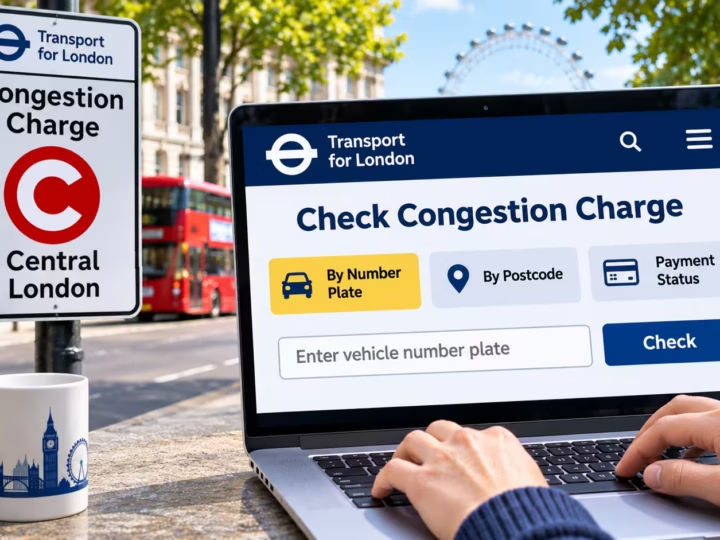
Check Congestion Charge 2027: How to Check by Number Plate, Postcode and Payment Status?
Before driving into central London, checking the Congestion Charge can prevent an £18 daily expense from…
Pay Stansted Drop Off Charge: How to Pay Online, Current Fees, Deadlines and Free Alternatives?
Drivers using London Stansted Airport's Express Set Down area must pay a drop-off charge after their…
Do I Need to Pay Congestion Charge in London? 2027 Rules, 2026 Updates, Costs and Exemptions
If you're planning to drive through central London, you may be wondering, do I need to…