Do I Need to Pay Congestion Charge in London? 2027 Rules, 2026 Updates, Costs and Exemptions
London's Congestion Charge is £18 daily, with revised electric vehicle discounts and new resident eligibility rules arriving in March 2027.
 Hannah
London Lifestyle & Consumer Writer
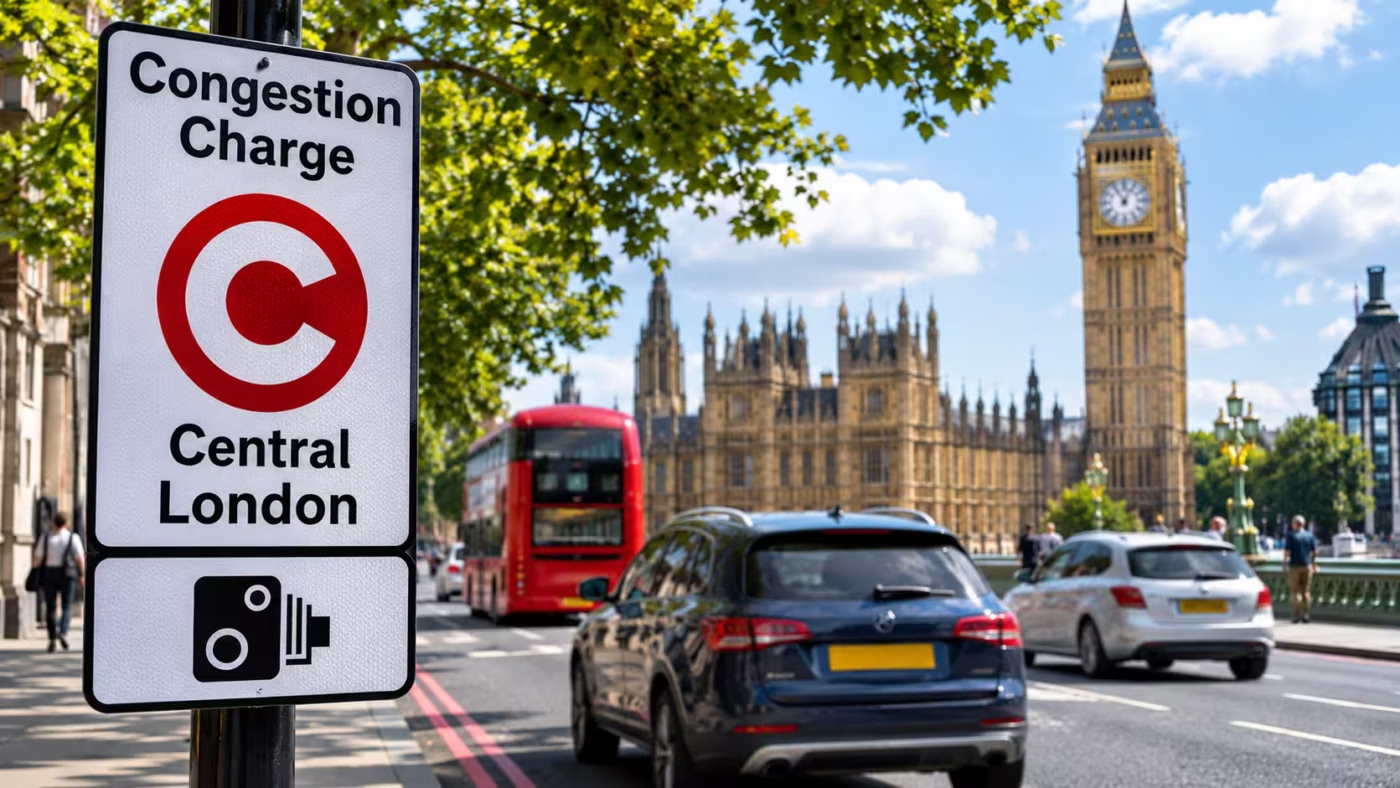
If you’re planning to drive through central London, you may be wondering, do I need to pay Congestion Charge? The answer depends on where you’re driving, what time you enter the charging zone, the vehicle you use and whether you qualify for an exemption or discount.
The London Congestion Charge increased by 20% on 2 January 2026, taking the standard daily payment from £15 to £18. Electric vehicles also lost their previous 100% Cleaner Vehicle Discount, although eligible electric cars and commercial vehicles can receive reduced charges through Auto Pay.
Further changes are confirmed for March 2027, particularly for residents applying for the 90% discount.
We analysed the published charging arrangements and their financial implications for private motorists, employees, self-employed professionals, delivery operators and businesses working in central London.
Our assessment shows that understanding the difference between the Congestion Charge, ULEZ and other road charges is essential. A driver can be liable for multiple charges on the same journey, while someone travelling outside charging hours may avoid the Congestion Charge entirely.
Do I Need to Pay Congestion Charge in London in 2027?
Yes, most drivers must pay £18 per day when driving within London’s Congestion Charge zone during charging hours, unless their vehicle is exempt or they have an approved discount.
The £18 rate was introduced in January 2026 and remains the published rate as of November 2026. Although further annual adjustments are possible, a separate standard rate increase for 2027 has not yet been confirmed.
You normally need to pay if:
- You drive a petrol, diesel or hybrid car inside the zone during charging hours.
- You drive an electric car without an applicable 100% exemption.
- You use a van or commercial vehicle within the zone.
- You drive a private hire vehicle that is not exempt.
- You are visiting London in a privately owned or hired vehicle.
- You live outside London but travel into the charging area.
You normally do not have to pay the Congestion Charge if you drive outside charging hours, remain outside the zone or use a vehicle covered by an applicable exemption.
Congestion Charge Rules at a Glance
| Category | 2026–2027 rules |
| Standard daily charge | £18 |
| Payment within three days after travel | £21 |
| Monday to Friday | 7:00am–6:00pm |
| Saturday and Sunday | 12:00pm–6:00pm |
| Bank holidays | 12:00pm–6:00pm |
| Christmas and New Year suspension | 25 December through the New Year’s Day bank holiday, inclusive |
| Electric car with Auto Pay | £13.50 |
| Electric van with Auto Pay | £9 |
| Approved residents’ discount | 90% |
| Approved Blue Badge discount | 100% |
| Standard unpaid-charge penalty | £180 |
| Penalty paid within 14 days | £90 |
The £18 charge covers one charging day, regardless of how many times the vehicle enters and leaves the zone.
How Can I Check Whether My Car Needs to Pay the Congestion Charge?
The most reliable approach is to check your destination, journey time and vehicle details before travelling.
Transport for London provides an official charging-zone map, postcode checker and vehicle payment service.
Step 1: Check Whether Your Destination Is Inside the Zone
Open the official TfL Congestion Charge zone checker.
Enter your destination’s postcode, street name or landmark.
The tool helps identify whether the location falls within the Congestion Charge area.
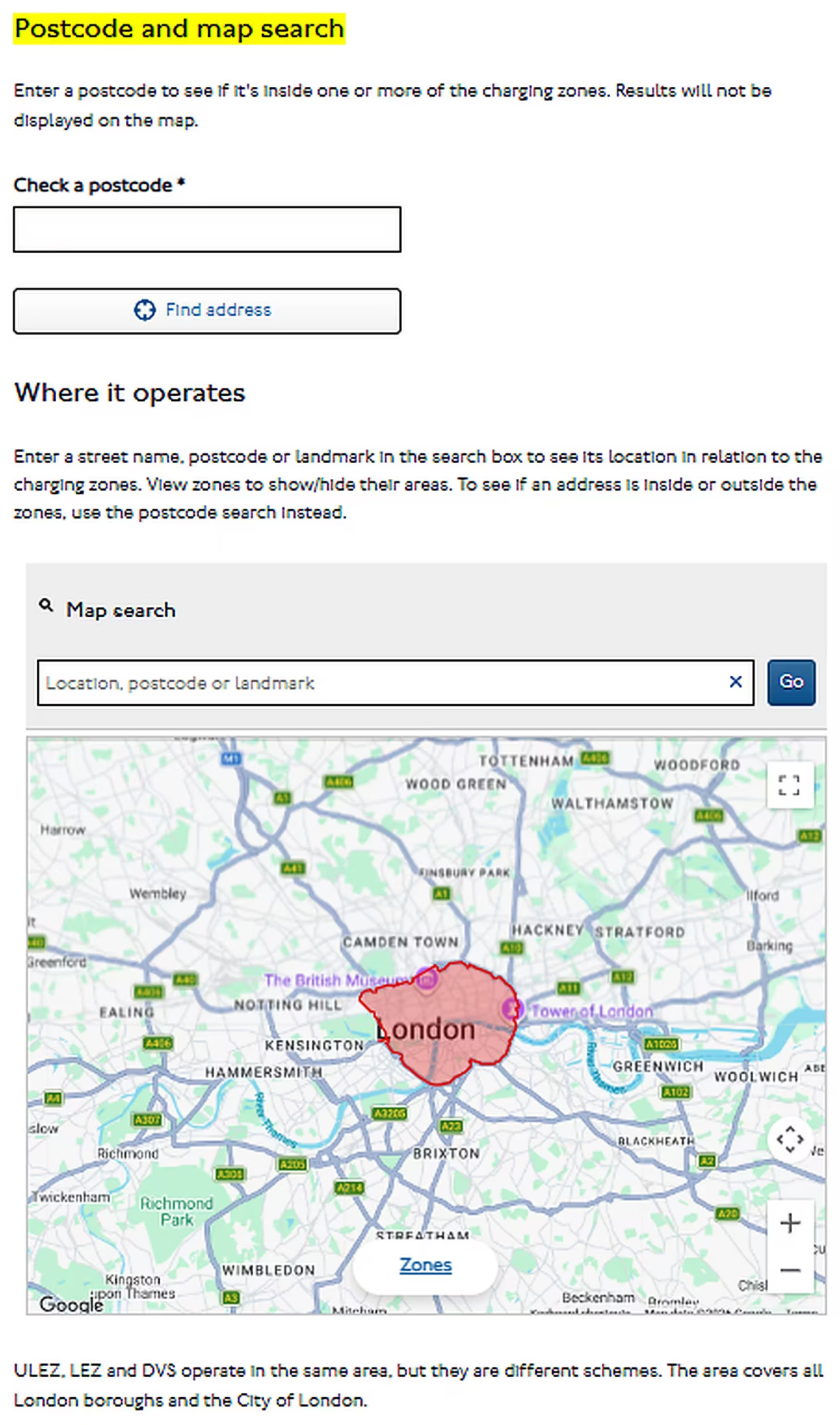
TfL’s official Congestion Charge postcode checker and zone map, showing how drivers can check whether their destination is within the charging boundary.
Step 2: Check the Time You Will Be Driving
The charge is not payable throughout the entire day.
For example, a motorist driving into central London at 6:30pm on a Wednesday does not need to pay the Congestion Charge for that journey, provided they do not drive within the zone during another charging period.
However, the ULEZ charge may still apply if the vehicle fails the emissions requirements.
Step 3: Check Your Vehicle and Discounts
Visit TfL’s official vehicle and payment service.
Enter your vehicle registration and review the applicable road-user charging arrangements.
A vehicle meeting ULEZ standards does not automatically become exempt from the Congestion Charge.
Likewise, owning an electric vehicle does not mean you can drive into the zone free of charge.
Step 4: Confirm Whether Your Discount Is Active
Discounts requiring registration must normally be approved before you can rely on them.
An electric vehicle eligible for the Cleaner Vehicle Discount must be registered with an active Auto Pay service.
A Blue Badge by itself does not automatically establish a registered Congestion Charge discount.
What Are the Congestion Charge Times in 2026 and 2027?
London’s Congestion Charge follows different schedules for weekdays and weekends.
| Day | Charging hours | Charge outside these hours |
| Monday | 7am–6pm | £0 |
| Tuesday | 7am–6pm | £0 |
| Wednesday | 7am–6pm | £0 |
| Thursday | 7am–6pm | £0 |
| Friday | 7am–6pm | £0 |
| Saturday | 12pm–6pm | £0 |
| Sunday | 12pm–6pm | £0 |
| Bank holidays | 12pm–6pm | £0 |
There is no Congestion Charge between Christmas Day and the New Year’s Day bank holiday, inclusive.
Importantly, travelling outside Congestion Charge hours does not necessarily eliminate other transport costs.
Do I Need to Pay Congestion Charge After 6pm?
No. The daily charging period finishes at 6pm.
If you drive entirely outside the applicable charging period, no Congestion Charge is payable.
For example, if you enter the zone at 6:15pm on a weekday, you do not need to pay the Congestion Charge for that journey.
Do I Need to Pay Congestion Charge on Sunday?
Yes, if you drive within the charging zone between midday and 6pm.
A Sunday morning journey before midday does not attract the Congestion Charge.
This distinction is particularly useful for families, tourists and businesses arranging weekend deliveries.
Where Is the London Congestion Charge Zone?
The Congestion Charge applies to a defined area of central London rather than the whole capital.
It covers substantial parts of Westminster and the City of London, including well-known commercial and visitor destinations.
Areas within the zone include:
- Soho
- Covent Garden
- Mayfair
- Much of the City of London
- Parts of Holborn
- Westminster and surrounding central districts
However, individual streets and boundary roads require checking.
Some roads forming the boundary allow motorists to travel around the charging area without entering it.
Our assessment is that relying on the name of a neighbourhood alone is insufficient. A destination near the edge of a charging zone may be accessible without entering the chargeable area.
For reliable journey planning, the exact postcode and route should be checked.
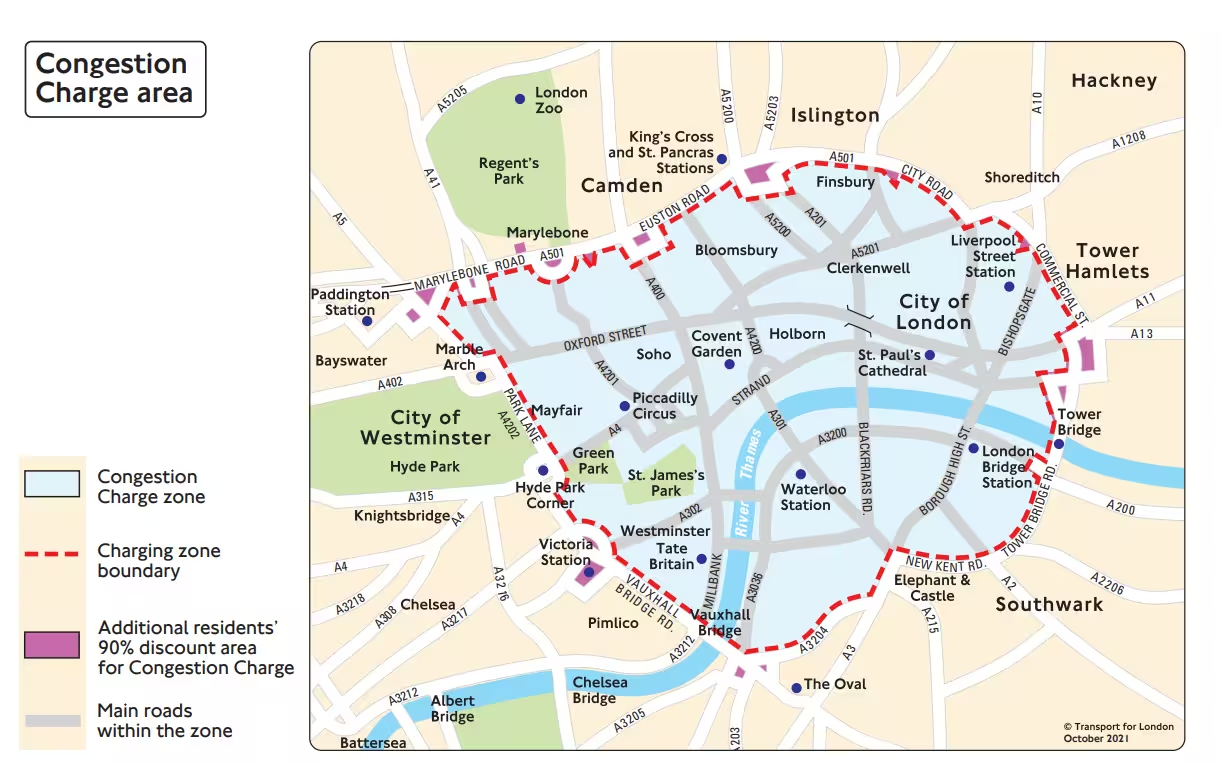
Official TfL Congestion Charge boundary map highlighting central London’s charging area and surrounding roads.
How Much Is the London Congestion Charge in 2026 and 2027?
The standard daily charge is £18 when paid in advance, on the day or through Auto Pay.
Drivers paying by midnight on the third day after travel must pay £21.
How Did the Charges Change in 2026?
| Payment category | Previous rate | Rate from January 2026 | Increase |
| Standard daily charge | £15 | £18 | 20% |
| Payment within three days | £17.50 | £21 | 20% |
| Electric car with eligible Auto Pay discount | £0 under former 100% discount | £13.50 | New daily cost |
| Electric van with eligible Auto Pay discount | £0 under former 100% discount | £9 | New daily cost |
The increase is significant for people who frequently work in central London.
Consider an employee, contractor or sole trader making 20 chargeable journeys in a month.
| Vehicle | Daily charge | 20 charging days |
| Standard petrol car | £18 | £360 |
| Standard diesel car | £18 | £360 |
| Hybrid car | £18 | £360 |
| Eligible electric car on Auto Pay | £13.50 | £270 |
| Eligible electric van on Auto Pay | £9 | £180 |
A petrol-car driver making 20 chargeable journeys each month could therefore spend £4,320 annually on the standard charge if the current tariff remains unchanged.
The same number of trips in an eligible electric car would cost £3,240, producing a £1,080 annual saving.
These calculations exclude parking, energy, fuel, vehicle depreciation and other possible road charges.
Do Electric Cars Have to Pay the Congestion Charge?
Yes. Electric cars have been subject to the Congestion Charge since January 2026, although eligible vehicles registered on Auto Pay receive a 25% reduction.
The former 100% Cleaner Vehicle Discount ended on 25 December 2025.
The replacement discount scheme began on 2 January 2026.
| Electric vehicle type | Discount | Daily amount |
| Electric car | 25% | £13.50 |
| Electric van | 50% | £9 |
| Electric HGV | 50% | £9 |
| Eligible electric quadricycle | 50% | £9 |
The discount requires active Auto Pay registration.
If an eligible electric vehicle is not registered for Auto Pay, the discounted payment does not apply.
This is one of the most important considerations for London businesses switching their fleets to electric vehicles.
A company investing in electric vans should calculate its actual road-user charging costs rather than assuming electrification eliminates them.
Are Hybrid Cars Exempt?
No. Petrol-electric hybrids and plug-in hybrid vehicles do not qualify for the new electric-only Cleaner Vehicle Discount merely because they can operate partly on electricity.
A hybrid vehicle will normally attract the standard Congestion Charge unless another exemption or discount applies.
What Will Change to the Congestion Charge in 2027?
The major confirmed change for 2027 concerns the residents’ discount.
From 1 March 2027, the general rule for new applicants is that the 90% residents’ discount will be restricted to electric vehicles.
Existing eligible discount holders retain protection, and special arrangements remain available for certain residents receiving qualifying benefits.
Changes for Existing Residents
Residents who have registered for the discount before the new rules take effect can continue receiving the 90% reduction for eligible vehicles, including petrol and diesel vehicles.
They must continue satisfying the scheme’s conditions and renewing their registration correctly.
The discount reduces the standard £18 daily amount to £1.80.
This represents a potential saving of £16.20 on each charging day.
Changes for New Residents
From March 2027, new residents’ discount applicants will generally need an eligible electric vehicle to receive the 90% reduction.
A new applicant using a petrol or diesel vehicle will normally have to pay the standard charge unless a special protection or other exemption applies.
The financial difference could be substantial.
For 20 charging days:
- An approved resident paying £1.80 per day spends £36.
- A motorist paying the standard £18 charge spends £360.
- The monthly difference is £324.
Additional Protection for Low-Income and Disabled Residents
Following consultation, TfL confirmed additional protection for residents receiving certain benefits.
Qualifying residents can continue applying for the residents’ discount with non-electric vehicles until March 2030, subject to the scheme’s requirements.
The published qualifying benefits include Universal Credit, Personal Independence Payment, Disability Living Allowance, Attendance Allowance, Carer’s Allowance, Pension Credit and Employment and Support Allowance.
This protection matters because households with limited financial resources may be unable to replace a petrol or diesel vehicle immediately.
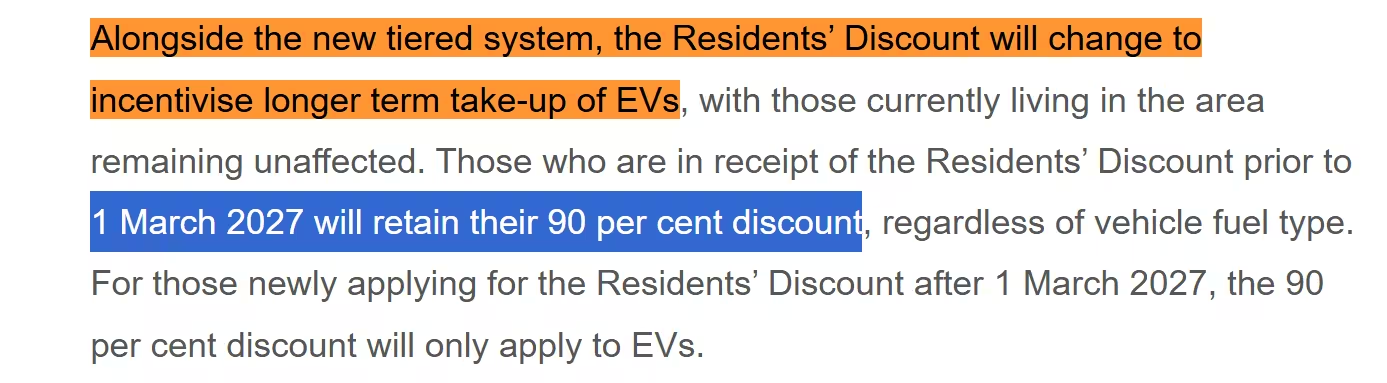
TfL’s confirmed Congestion Charge changes covering the March 2027 residents’ discount rules and additional protections for qualifying households.
Who Is Exempt From the London Congestion Charge?
Not every vehicle entering central London must pay the standard £18.
Some vehicles qualify for a full exemption, while other drivers must apply for a 100% discount.
| Driver or vehicle category | Congestion Charge treatment |
| Two-wheeled motorcycles and mopeds | Exempt |
| Eligible London-licensed taxis | Exempt |
| Qualifying emergency service vehicles | Exempt |
| Certain vehicles in the disabled taxation class | Exempt |
| Registered Blue Badge holders | 100% discount |
| Approved vehicles with nine or more seats | 100% discount or automatic exemption, depending on classification |
| Eligible back-to-base electric car club vehicles | 100% discount |
| Eligible residents | 90% discount |
| Electric cars registered on Auto Pay | 25% discount |
| Electric vans registered on Auto Pay | 50% discount |
Some categories require formal approval and a registration fee.
Do Blue Badge Holders Have to Pay?
Blue Badge holders may qualify for a 100% Congestion Charge discount.
However, they must register with TfL and receive approval.
The scheme allows eligible badge holders to register up to two vehicles normally used for their journeys.
TfL currently charges £10 for the Blue Badge discount registration, subject to its renewal arrangements.
Drivers should not assume that displaying a Blue Badge is sufficient without registration.
Do Motorcycles Have to Pay?
Two-wheeled motorcycles and mopeds are exempt from the Congestion Charge.
However, the vehicle may still attract other road-user charges.
For example, a motorcycle that fails the applicable ULEZ emissions standard may be subject to the £12.50 daily ULEZ charge.
Motorcycles can also be subject to the separate Blackwall and Silvertown tunnels charge when using those crossings.
Do Uber and Private Hire Drivers Pay?
Most private hire vehicles must pay the Congestion Charge when operating within the zone during charging hours.
Being licensed as a private hire vehicle does not provide the same automatic exemption as a qualifying London taxi.
Certain wheelchair-accessible private hire vehicles may qualify for an exemption when carrying out an eligible booking.
Electric private hire cars registered on Auto Pay may qualify for the 25% Cleaner Vehicle Discount.
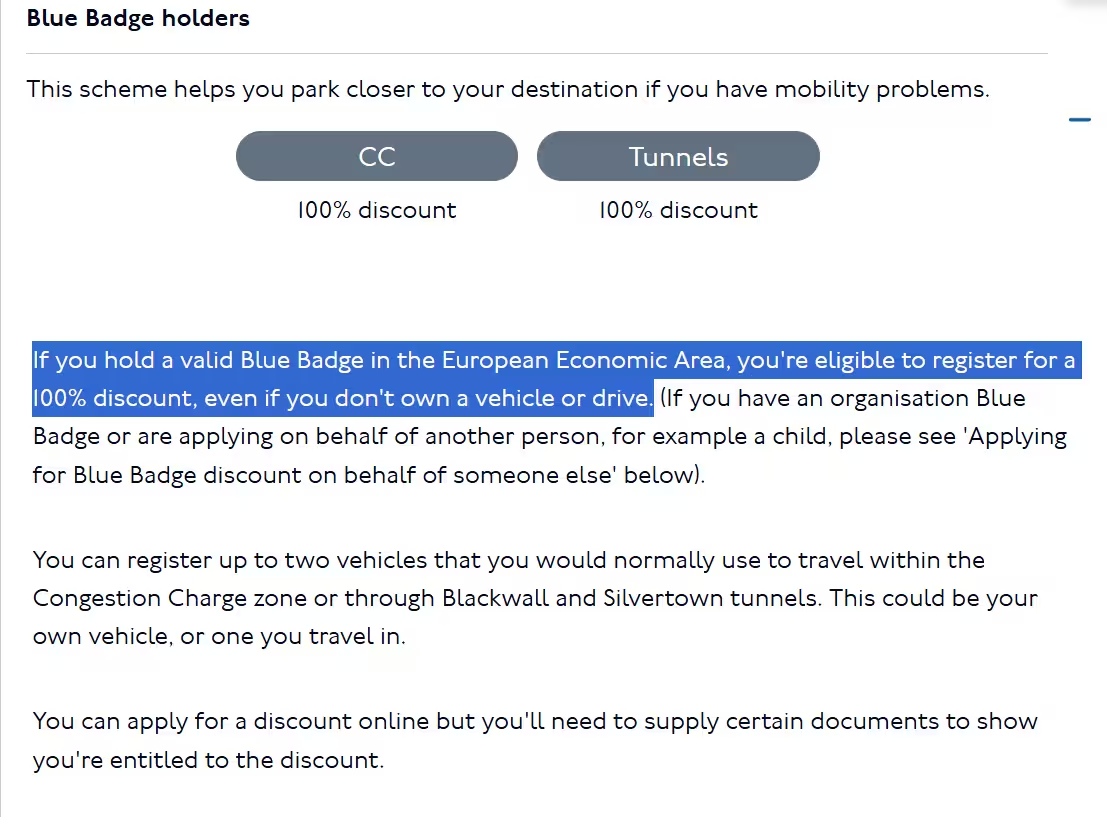
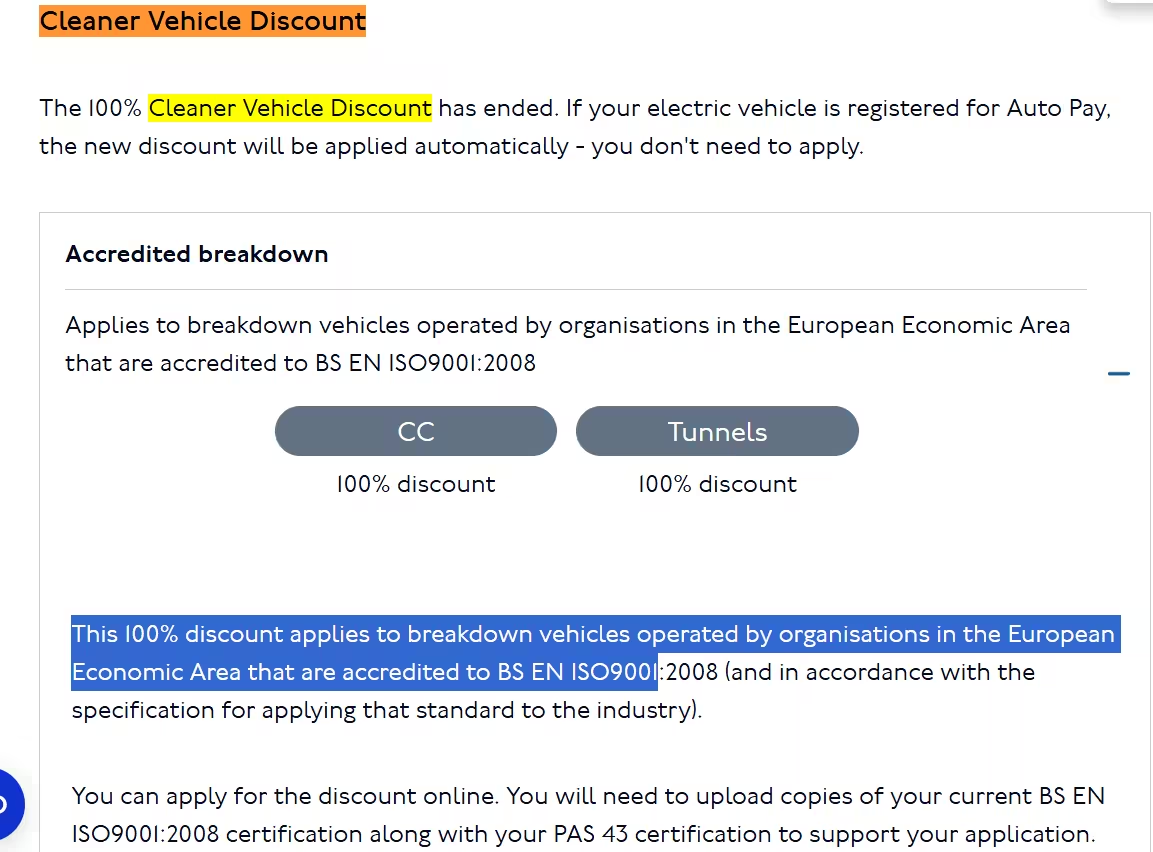
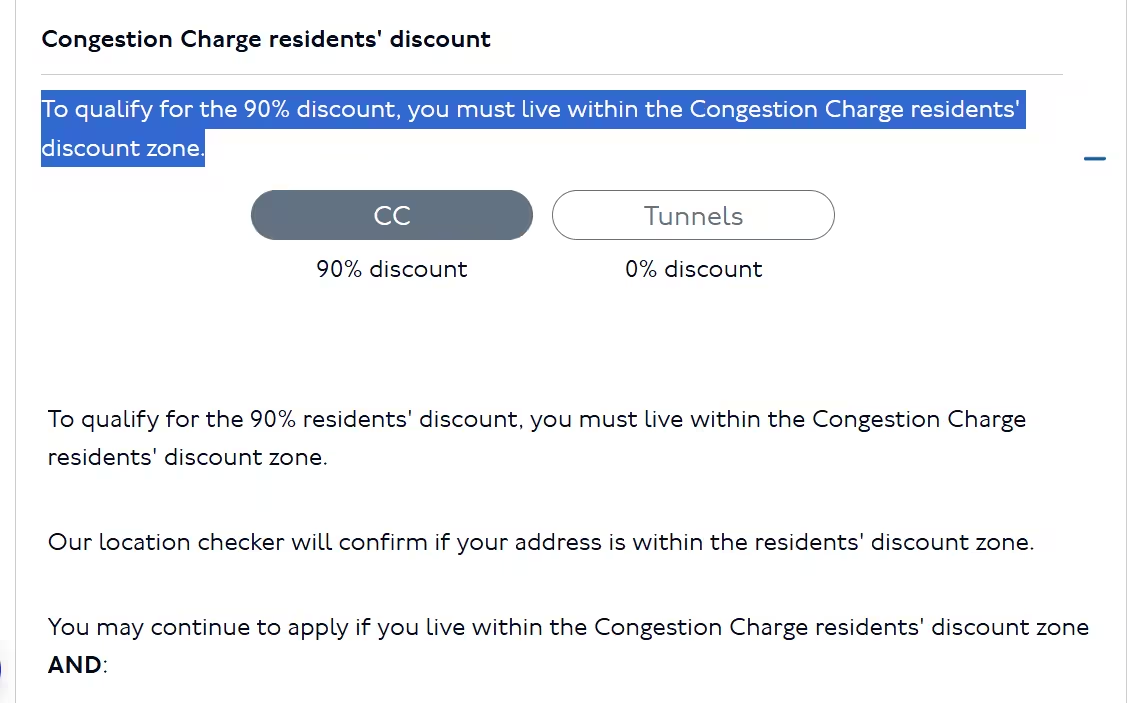
Official TfL discounts and exemptions, including Blue Badge registration, residents’ discounts, electric vehicles and qualifying vehicle categories.
Do I Need to Pay Both Congestion Charge and ULEZ?
Yes, some drivers must pay both charges on the same day.
The two schemes serve different purposes.
The Congestion Charge aims to manage traffic within central London, while ULEZ applies emissions standards over a much wider area.
| Feature | Congestion Charge | ULEZ |
| Main purpose | Reduce traffic congestion | Reduce vehicle emissions |
| Geographic coverage | Central London | All London boroughs, excluding the M25 |
| Standard daily charge | £18 | £12.50 for non-compliant vehicles |
| Operating hours | Specified daytime hours | 24 hours |
| Christmas Day | No charge | No charge |
| Vehicle eligibility | Most vehicles, subject to exemptions | Based on emissions standards and exemptions |
If a diesel car fails ULEZ requirements and enters the central London Congestion Charge zone during charging hours, both fees can apply.
Combined daily amount: £18 + £12.50 = £30.50.
Over 20 chargeable days, that could reach £610.
However, an eligible ULEZ-compliant petrol vehicle may still need to pay the £18 Congestion Charge.
This is why drivers should check each charging scheme independently.
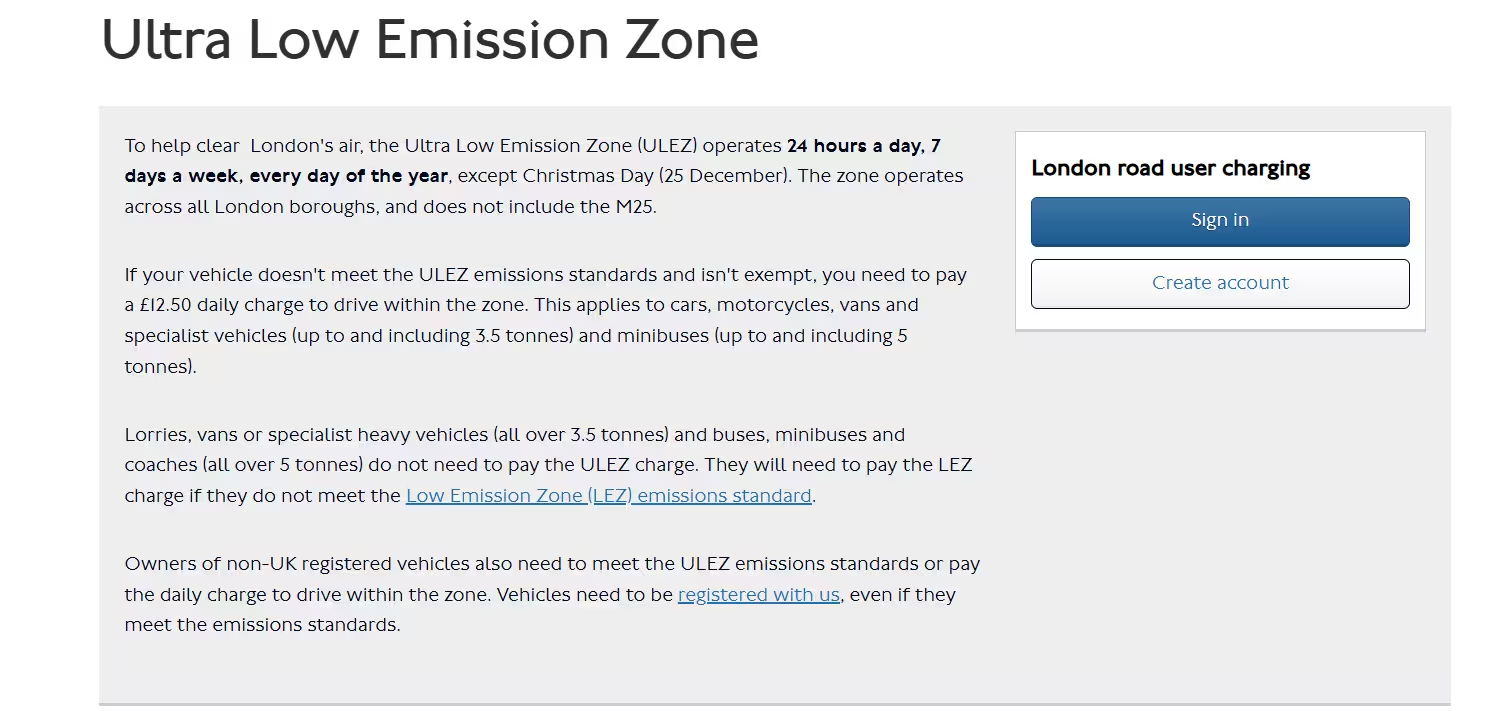
TfL’s official ULEZ vehicle checker explaining the £12.50 daily charge for vehicles that do not meet emissions standards.
How Do You Pay the Congestion Charge?
Payment can be completed through TfL’s official online service, the official mobile app or available telephone payment arrangements.
The main payment options are:
- Auto Pay: Registers the vehicle and automatically charges for applicable journeys.
- Advance payment: Pay up to 90 days before travel.
- Same-day payment: Pay £18 by midnight on the day of travel.
- Payment after travel: Pay £21 by midnight on the third day following travel.
Auto Pay is particularly useful for businesses operating several vehicles or drivers who regularly enter the charging zone.
It also allows eligible electric vehicles to receive the Cleaner Vehicle Discount automatically.
For motorists making occasional journeys, paying in advance may be sufficient.
We recommend keeping payment confirmation and checking that the correct registration number and travel date have been selected.
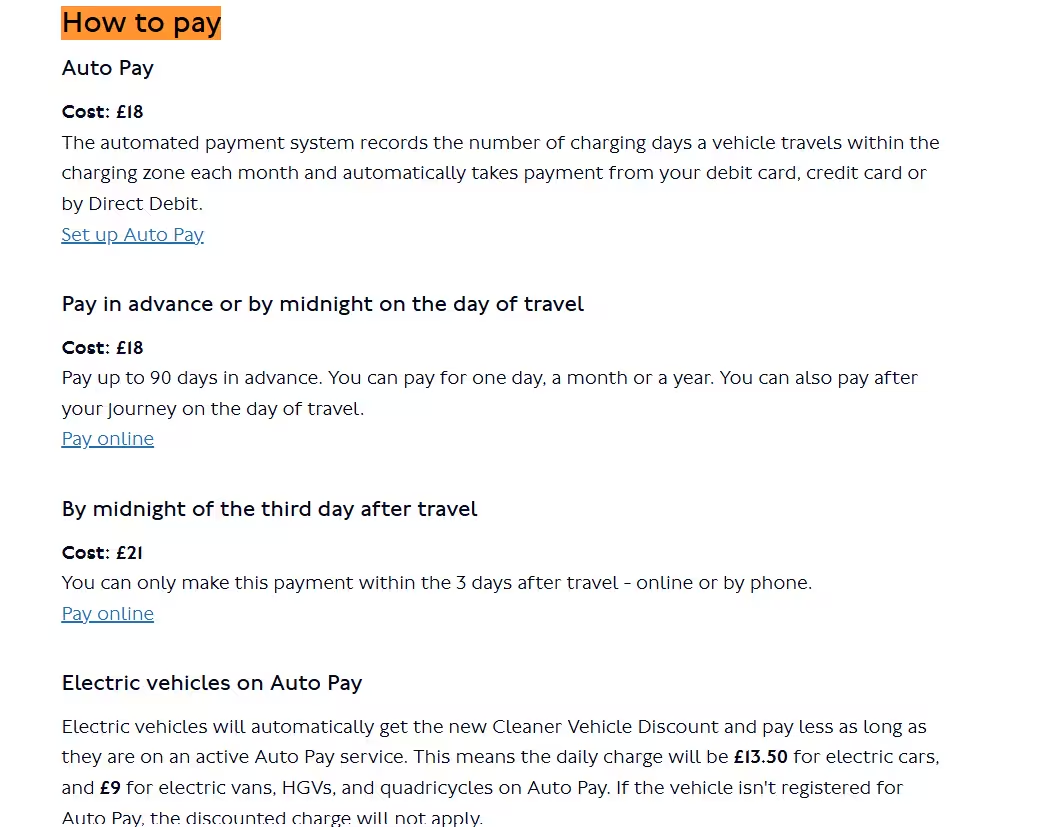
TfL’s official Congestion Charge payment options, showing the £18 standard amount, £21 post-travel payment and Auto Pay service.
What Happens If I Do Not Pay the Congestion Charge?
A driver who fails to make a required payment within the permitted period may receive a Penalty Charge Notice.
The current penalty is £180.
However, this is reduced to £90 if paid within 14 days.
If the charge remains unpaid and progresses to the Charge Certificate stage, the amount increases to £270.
| Enforcement stage | Amount |
| Standard penalty | £180 |
| Payment within 14 days | £90 |
| Charge Certificate stage | £270 |
A driver may challenge a penalty if they believe it was issued incorrectly.
Potential reasons include incorrect vehicle details, an applicable exemption, payment evidence or a vehicle not being driven in the charging zone on the alleged date.
Any challenge should follow TfL’s formal representation process and the deadline stated on the notice.
For related information about penalty procedures, motorists can also examine how to appeal a parking ticket, although a Congestion Charge PCN must be challenged through TfL’s specific enforcement arrangements rather than a council or private parking operator.
How Much Does the Congestion Charge Cost Businesses?
For employers, delivery businesses and independent contractors, road-user charging can become a predictable operating expense.
The financial effect depends on the number of charging days, vehicle type, route requirements and available discounts.
Consider a company operating four vehicles in central London for 20 charging days each month.
| Vehicle fleet | Monthly total | Annual total |
| Four standard petrol or diesel vehicles | £1,440 | £17,280 |
| Four eligible electric cars | £1,080 | £12,960 |
| Four eligible electric vans | £720 | £8,640 |
The annual calculations assume 12 months of identical charging activity and unchanged tariffs.
An eligible four-van electric fleet could therefore save £8,640 annually, representing a 50% reduction in Congestion Charge expenditure compared with four standard-rate vehicles making the same journeys.
This does not mean switching vehicles is automatically the cheapest overall option.
Businesses must also consider vehicle purchase or lease costs, insurance, charging infrastructure, maintenance, payload requirements and operational suitability.
From a commercial perspective, the Congestion Charge should be treated as one component of total fleet operating costs.
What Do Transport Professionals Say About the Changes?
The balance between reducing congestion and supporting commercial transport has been acknowledged publicly by London authorities.
In TfL’s announcement confirming the changes, Mayor of London Sadiq Khan stated:
“Keeping London moving by reducing congestion is vital for our city and for our economy.”
TfL’s Director of Strategy, Christina Calderato, also explained that the revised scheme was designed to manage congestion while allowing organisations and drivers to transition towards cleaner vehicles.
For businesses, the practical implication is clear: an electric fleet may reduce Congestion Charge expenditure, but it no longer provides an automatic zero-cost route into central London.
Can Businesses Claim Congestion Charge as a Tax Expense?
Potentially, yes.
A Congestion Charge incurred on a qualifying business journey may be deductible under the applicable tax rules.
However, normal home-to-work commuting and private journeys are treated differently from legitimate business travel.
HMRC recognises that qualifying business travel costs can include congestion charges, tolls and parking expenses.
There are also separate rules for employees whose employers pay or reimburse congestion charges.
If a company pays for an employee’s private travel, tax and National Insurance reporting obligations may arise.
Businesses should retain adequate records of the journey, date, amount, business purpose and payment.
VAT is another important distinction. The London Congestion Charge is a statutory charge outside the scope of VAT, so there is no Congestion Charge VAT to reclaim.
Penalty charges also require separate treatment. A fine should not be treated as an ordinary deductible business journey expense.
These distinctions matter when assessing the true financial cost of business travel rather than looking only at the advertised daily tariff.
Can I Avoid Paying the Congestion Charge Legally?
Yes. There are several legitimate ways to avoid or reduce the charge.
The most straightforward is to avoid driving within the charging area during chargeable hours.
For example, moving a non-urgent delivery outside the charging period may eliminate the Congestion Charge for that journey.
Another option is to plan a route that remains outside the boundary. Drivers must verify that the intended roads do not enter the charging zone.
Public transport can also be more economical for some journeys, particularly when central London parking, road charges and fuel costs are considered together.
A third approach is to establish whether the vehicle or driver qualifies for a discount.
For residents, the 90% discount may be especially valuable. For qualifying electric vehicle users, Auto Pay offers a reduced daily amount.
Which Options Offer the Biggest Percentage Savings?
| Option | Reduction in standard £18 Congestion Charge |
| Avoid driving within the zone during charging hours | 100% |
| Use a vehicle with a full exemption | 100% |
| Registered Blue Badge discount | 100% |
| Approved residents’ discount | 90% |
| Eligible electric van using Auto Pay | 50% |
| Eligible electric car using Auto Pay | 25% |
These percentages measure direct Congestion Charge savings only. They are not subjective performance ratings and do not account for other journey costs.
Do I Need to Pay Congestion Charge When Driving to Heathrow or Gatwick?
Driving to Heathrow or Gatwick does not automatically mean paying the central London Congestion Charge.
Both airports are outside the central London charging zone.
Whether a Congestion Charge applies depends on the route taken and whether the vehicle enters the charging area during the operating hours.
Drivers should also check separate airport charges.
For example, Heathrow operates its own terminal drop-off charging arrangements. Our examination of the Heathrow drop-off charge explains the payment deadlines and applicable airport arrangements.
Similarly, Gatwick has a separate terminal access fee. The Gatwick drop-off charge applies under the airport’s own conditions and should not be confused with TfL’s Congestion Charge.
For longer stays, parking costs may become a greater consideration than road-user charging. Comparing London airport parking options can help identify whether a short-stay, long-stay or alternative transfer arrangement is more economical.
The key distinction is that airport parking fees, airport drop-off charges, ULEZ and the central London Congestion Charge are separate arrangements.
Paying one does not automatically settle another.
What Common Mistakes Should London Drivers Avoid?
Several recurring misunderstandings can lead to unnecessary charges or penalties.
- Assuming electric vehicles are completely exempt: The former full Cleaner Vehicle Discount ended in December 2025. Most eligible electric cars now pay £13.50 with Auto Pay.
- Confusing ULEZ compliance with Congestion Charge exemption: A vehicle can satisfy ULEZ standards and still be liable for the £18 Congestion Charge.
- Forgetting weekend charging hours: The Congestion Charge operates from midday until 6pm on Saturdays, Sundays and bank holidays.
- Assuming discounts are automatic: Certain discounts, including the Blue Badge discount, require registration and approval.
- Paying an unofficial website: Drivers should use TfL’s authorised payment channels rather than third-party services that may add fees or mislead users.
- Ignoring the 2027 residents’ discount changes: New applicants using non-electric vehicles should check the confirmed eligibility restrictions and available protections.
- Treating parking penalties as Congestion Charge penalties: Different enforcement bodies and appeal arrangements apply.
Our assessment is that verifying the postcode, vehicle, date and payment arrangement before setting off is more reliable than attempting to resolve an unexpected penalty afterwards.
Conclusion
Whether you need to pay the Congestion Charge depends on where, when and what you drive. The standard daily fee increased to £18 in January 2026, while eligible electric vehicles now receive discounts of 25% or 50% through Auto Pay.
The next important changes arrive in March 2027, when new residents’ discount applications become more closely linked to electric vehicle ownership, with additional protections for qualifying households.
For individuals and businesses, advance planning can make a substantial financial difference. Checking the charging boundary, applying for eligible discounts and understanding separate ULEZ obligations can help reduce costs and avoid preventable penalties.
Frequently Asked Questions
Do I need to pay Congestion Charge if I live in London?
Living in London does not automatically provide an exemption. Eligible residents within the designated residents’ discount area may register for a 90% reduction, subject to the 2027 rule changes.
Do I need to pay Congestion Charge if I only drive through the zone?
Yes. Driving through the charging zone during operating hours normally triggers the charge, even if you do not stop or park.
Do I need to pay Congestion Charge if my car is parked in the zone?
Not simply because it is parked. The charge relates to driving within the zone during operating hours. If your vehicle remains parked and is not driven during those hours, the Congestion Charge is not triggered.
Do I need to pay Congestion Charge on Christmas Day?
No. TfL suspends the Congestion Charge from Christmas Day through the New Year’s Day bank holiday, inclusive. Other parking and road rules may still apply.
Do electric cars pay Congestion Charge in 2027?
Yes, under the confirmed charging arrangements. Eligible electric cars registered with Auto Pay receive a 25% discount, reducing the current £18 standard charge to £13.50.
How many days do I have to pay the Congestion Charge?
You can pay in advance, on the day of travel or by midnight on the third day after travel. The higher £21 payment applies when paying within the permitted three-day period after the journey.
Is the Congestion Charge £18 or £21?
It is £18 when paid in advance or on the day of travel, including through standard Auto Pay. The £21 amount applies when payment is made during the permitted period after travel.
Will the Congestion Charge increase again in 2027?
A further standard charge increase for 2027 has not been confirmed as of November 2026. The major confirmed 2027 update concerns new applicants for the residents’ discount.
Hannah is a London lifestyle and consumer writer at London Insider News, covering property, transport, local developments, cost-of-living issues and stories affecting everyday life across the capital.
More from TRANSPORT
Check Congestion Charge 2027: How to Check by Number Plate, Postcode and Payment Status?
Before driving into central London, checking the Congestion Charge can prevent an £18 daily expense from…
Pay Stansted Drop Off Charge: How to Pay Online, Current Fees, Deadlines and Free Alternatives?
Drivers using London Stansted Airport's Express Set Down area must pay a drop-off charge after their…
UK Highway Code Driveway Parking Rules 2027: Fines, Dropped Kerbs and New 2026 Changes
The UK Highway Code driveway parking rules are becoming increasingly important for homeowners, motorists, landlords and…