Check Congestion Charge 2027: How to Check by Number Plate, Postcode and Payment Status?
Learn how to check the Congestion Charge in London for 2027 using your number plate, postcode and payment history. Explore TfL charging hours, £18 daily fees, ULEZ rules, discounts and penalties.
 Hannah
London Lifestyle & Consumer Writer
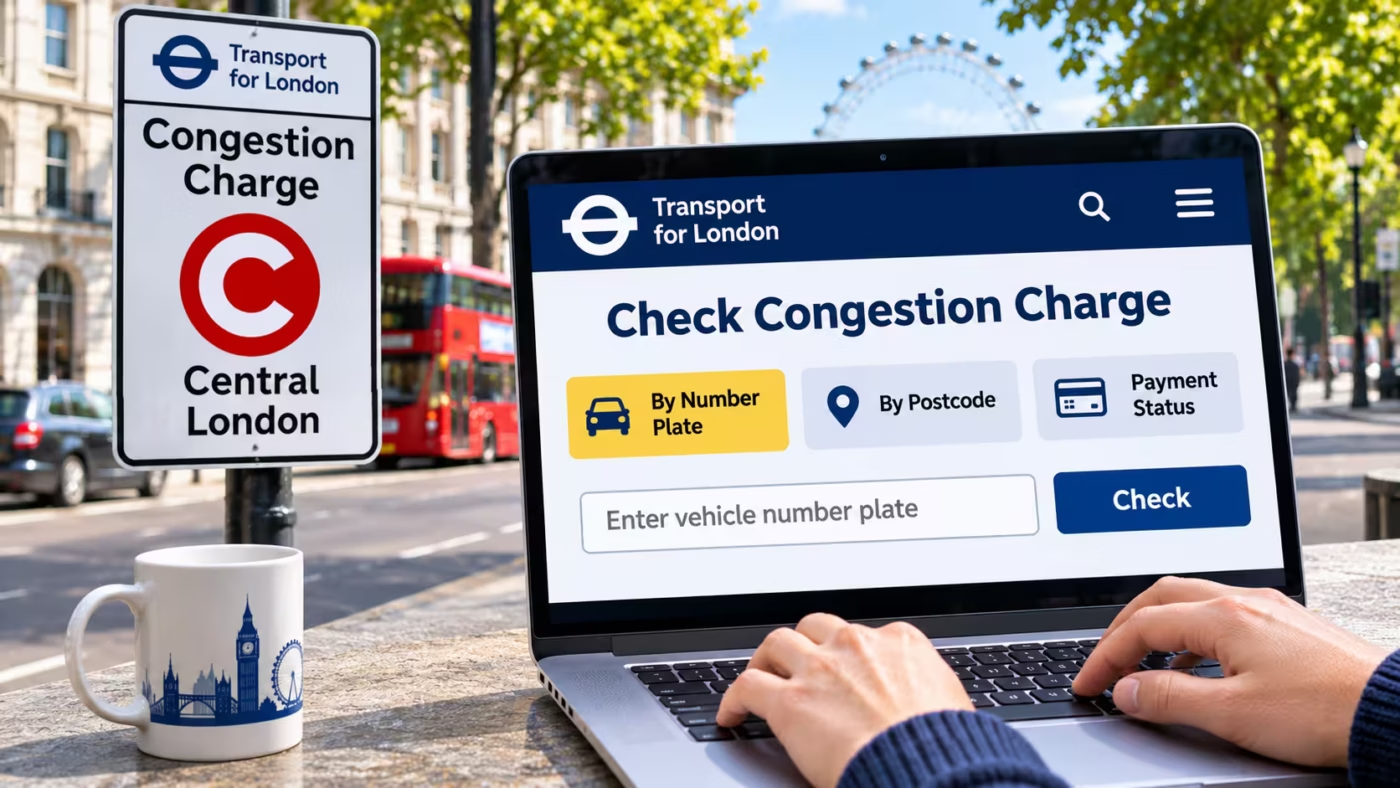
Before driving into central London, checking the Congestion Charge can prevent an £18 daily expense from becoming a £180 penalty.
However, knowing whether your vehicle is liable for the charge is not the same as confirming whether you entered the charging zone or whether a previous payment was successful.
The London Congestion Charge increased from £15 to £18 on 2 January 2026, a 20% rise. Electric vehicles also became subject to revised charging arrangements, while further changes to the residents’ discount are scheduled for 1 March 2027.
We analysed Transport for London’s published charging requirements, vehicle-checking tools, enforcement procedures and the financial implications for drivers and businesses.
Our findings highlight three separate questions that motorists must answer: Does the vehicle qualify for a discount or exemption? Was the journey made inside the charging zone during operating hours? Has the correct charge been paid?
A vehicle registration check alone cannot answer all three.
How Can You Check the Congestion Charge Online in 2027?
The most reliable way to check the London Congestion Charge is through Transport for London (TfL), which operates the official vehicle checker, zone map and payment system.
The process involves checking the vehicle, the destination and the journey date.
| Check required | What it tells you | Information needed |
| Vehicle checker | Vehicle-based charging and emissions requirements | Registration number |
| Congestion Charge zone checker | Whether an address is within the charging area | Postcode or address |
| Charging hours | Whether the charge applies at the journey time | Date and time |
| TfL account | Payment history, Auto Pay and registered discounts | Account login |
| Penalty checker | Details of an issued penalty | PCN and vehicle details |
These checks serve different purposes. For instance, a petrol car may meet every ULEZ emissions requirement but still attract the Congestion Charge when driven through central London.
Drivers who want to understand their general liability can also check whether they need to pay the Congestion Charge, including the applicable vehicle exemptions.
Step 1: Enter Your Vehicle Registration
Visit the official TfL vehicle checker.
Enter your number plate without unnecessary spaces and select whether the vehicle is registered in the UK or another country.
The checker can identify applicable vehicle-based charging requirements, including:
- Congestion Charge and Cleaner Vehicle Discount eligibility.
- Ultra Low Emission Zone (ULEZ).
- Low Emission Zone (LEZ).
- Blackwall and Silvertown tunnels charges.
- Relevant commercial vehicle safety requirements.
The displayed result is based on vehicle information and does not necessarily account for every personally registered discount or exemption.
Important: A result showing that a vehicle may be liable for the Congestion Charge does not prove that it entered the zone on a particular date.
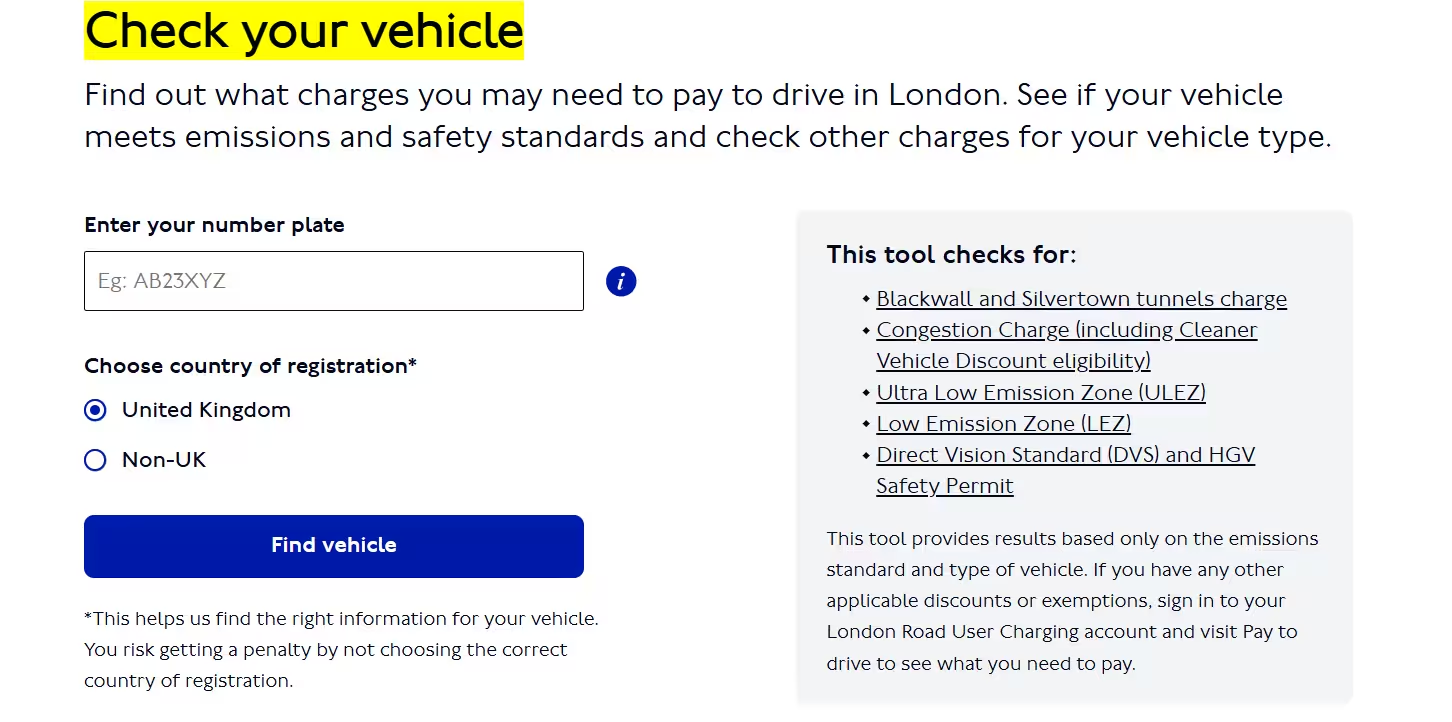
TfL’s official vehicle checker showing the registration number field and UK/non-UK vehicle selection.
Step 2: Check the Destination Postcode
Next, establish whether the route enters the actual Congestion Charge area.
Visit TfL’s official Congestion Charge zone page and enter the destination postcode into its address checker.
For greater accuracy, select the exact property or address rather than relying exclusively on a district name.
This distinction matters because a delivery to a property near the zone boundary may require payment, while travelling along certain surrounding boundary roads may not.
Step 3: Confirm the Charging Time
The Congestion Charge is not a 24-hour charge.
Under the published rules, drivers must pay when travelling within the zone during these periods:
| Day | Charging hours |
| Monday–Friday | 7am–6pm |
| Saturday | 12pm–6pm |
| Sunday | 12pm–6pm |
| Bank holidays | 12pm–6pm |
| Christmas Day to New Year’s Day bank holiday, inclusive | No Congestion Charge |
For example, driving within the zone at 6:30pm on Tuesday does not incur the Congestion Charge for that journey, provided the vehicle was not driven within the zone during charging hours that day.
However, other applicable road charges may still be payable.
Step 4: Check Your Payment Account
Drivers who have already travelled should sign into their London Road User Charging account.
Depending on the payment service used, they can review payment history, vehicle registration, Auto Pay status and previous transactions.
We recommend checking that the vehicle registration, journey date and payment confirmation match.
A saved payment card or a vehicle appearing in an account does not, by itself, prove that the relevant charge was successfully paid.
Can You Check the Congestion Charge by Number Plate?
Yes. TfL’s number plate checker identifies the charging arrangements potentially applicable to your vehicle.
However, it is important to understand its limitations.
| What you want to know | Can a number plate check establish it? |
| Whether the vehicle meets ULEZ standards | Yes, based on available vehicle information |
| Whether a vehicle may be liable for the Congestion Charge | Yes |
| Whether an electric vehicle qualifies for the Cleaner Vehicle Discount | It can help establish vehicle eligibility |
| Whether your journey entered the zone yesterday | Not through the standard vehicle checker |
| Whether you paid for a specific date | Check your payment records |
| Whether a personal discount is active | Check your TfL account |
| Whether a penalty has been issued | Use the relevant PCN service if a notice exists |
The distinction is particularly relevant to second-hand vehicle owners, employers and drivers using hired cars.
If you recently purchased a vehicle, the registration checker may not immediately reflect every change in its records. Where the information appears incorrect, contact TfL and provide the appropriate vehicle documentation.
For business fleets, we recommend confirming registration details before assigning a vehicle to a central London route.
How Can You Check If You Entered the Congestion Charge Zone?
One of the most common concerns arises after a journey when a driver cannot remember whether they crossed the boundary.
TfL does not provide a general public tool that allows motorists to enter a registration number and obtain a definitive yes-or-no record of every previous Congestion Charge zone entry.
The standard vehicle checker assesses vehicle-related charging requirements. It is not a complete historical journey checker.
If you are unsure whether you entered the zone, the most practical approach is to reconstruct your journey.
Start by identifying:
- The exact date and approximate time of travel.
- The roads used when approaching central London.
- Your destination and any intermediate stops.
- Whether you drove inside the zone or only around its boundary.
- Whether you had an active Auto Pay service.
Navigation history, delivery records, parking receipts and business mileage logs may help establish the route.
Where payment is still possible and liability remains uncertain, contact TfL before the deadline rather than assuming that no charge applies.
Can Congestion Charge Cameras Confirm a Previous Journey?
TfL uses Automatic Number Plate Recognition (ANPR) cameras to support enforcement.
These cameras record vehicle registration information when vehicles are detected in relevant charging areas.
However, ANPR does not operate as an unrestricted public journey-history service.
TfL has explained that some records are deleted after matching vehicle detections with payments and exemptions. Consequently, historical camera information may not always be available for retrospective confirmation.
Registered customers may be able to view associated journey and charging records through their accounts. This should not be confused with a universal public search of camera detections.
How Do You Check Whether a London Postcode Is Inside the Congestion Charge Zone?
The Congestion Charge covers a defined part of central London, rather than every London borough.
It includes substantial areas around Westminster, Soho, Covent Garden, Mayfair, Holborn and the City of London.
But postcode boundaries and charging-zone boundaries are not necessarily identical.
A destination described as being in Westminster or near King’s Cross should not automatically be treated as chargeable without checking the exact address and route.
Use the official TfL zone checker for an address-level result.
The TfL map also helps identify the zone boundary and nearby roads.
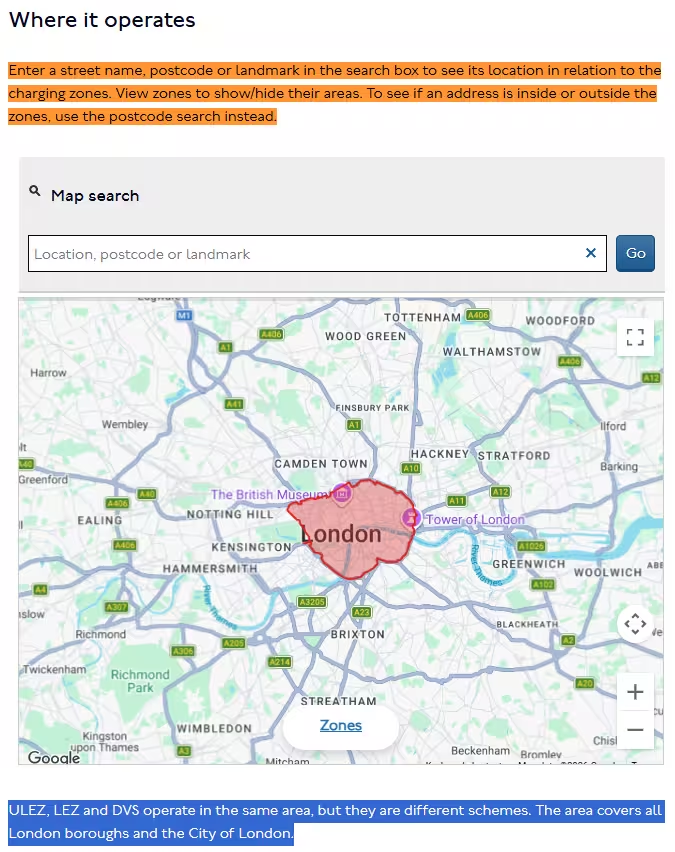
Official TfL Congestion Charge map showing the central London charging boundary and surrounding roads.
What If You Only Drive Along the Boundary?
Some roads form part of the charging-zone boundary and can be used without entering the chargeable area.
However, taking a turn into a street inside the boundary during charging hours can change the position.
A journey that starts and ends outside the zone may still attract the Congestion Charge if the driver passes through the area.
Likewise, parking outside the zone does not eliminate a charge already incurred by driving through it.
This is why the complete route matters more than the destination alone.
For drivers managing additional restrictions around residential streets, the separate driveway parking rules should also be considered when choosing a legal stopping or parking location.
How Much Is the Congestion Charge in 2027 After the 2026 Increase?
As of November 2026, the published standard Congestion Charge is £18 per charging day when paid in advance, on the day or through standard Auto Pay arrangements.
A payment made within the permitted three-day post-travel window costs £21.
The January 2026 increase was 20%, compared with the previous £15 daily rate.
| Payment or vehicle category | Published daily amount |
| Standard advance or same-day payment | £18 |
| Payment within three days after travel | £21 |
| Eligible electric car using Auto Pay | £13.50 |
| Eligible electric van using Auto Pay | £9 |
| Approved 90% residents’ discount | £1.80 |
| Registered 100% discount or exemption | £0 |
The charge applies once per charging day, regardless of how many times a vehicle enters and exits during that day.
A further standard-rate increase for 2027 had not been separately confirmed as of November 2026.
TfL’s revised framework permits future increases, potentially linked to inflation or public transport fares, but they are not automatic. Any further increase requires a decision.
For budgeting purposes, businesses should therefore use the published £18 rate as their baseline while monitoring official tariff changes.
What Changes to Congestion Charge Checks in 2027?
A significant change affecting residents is scheduled for 1 March 2027.
New applicants for the 90% Congestion Charge residents’ discount will generally need an eligible electric vehicle.
Existing approved residents’ discount holders can retain the discount for eligible vehicles, including non-electric vehicles, provided they continue meeting the requirements and renew their registrations.
Certain residents receiving qualifying low-income or disability benefits can apply to add non-electric vehicles before 4 March 2030 under the applicable transitional arrangements.
The practical consequence is that two motorists living within the same residents’ discount area may have different eligibility depending on when their discount was established and their circumstances.
For example:
| Resident situation | Potential daily charge |
| Existing approved resident retaining a 90% discount | £1.80 |
| New qualifying electric-vehicle resident with an approved 90% discount | £1.80 |
| New petrol-car resident without qualifying protection or another discount | £18 |
A resident making 20 chargeable journeys could therefore face a monthly difference of £324 between the full charge and the approved 90% discounted rate.
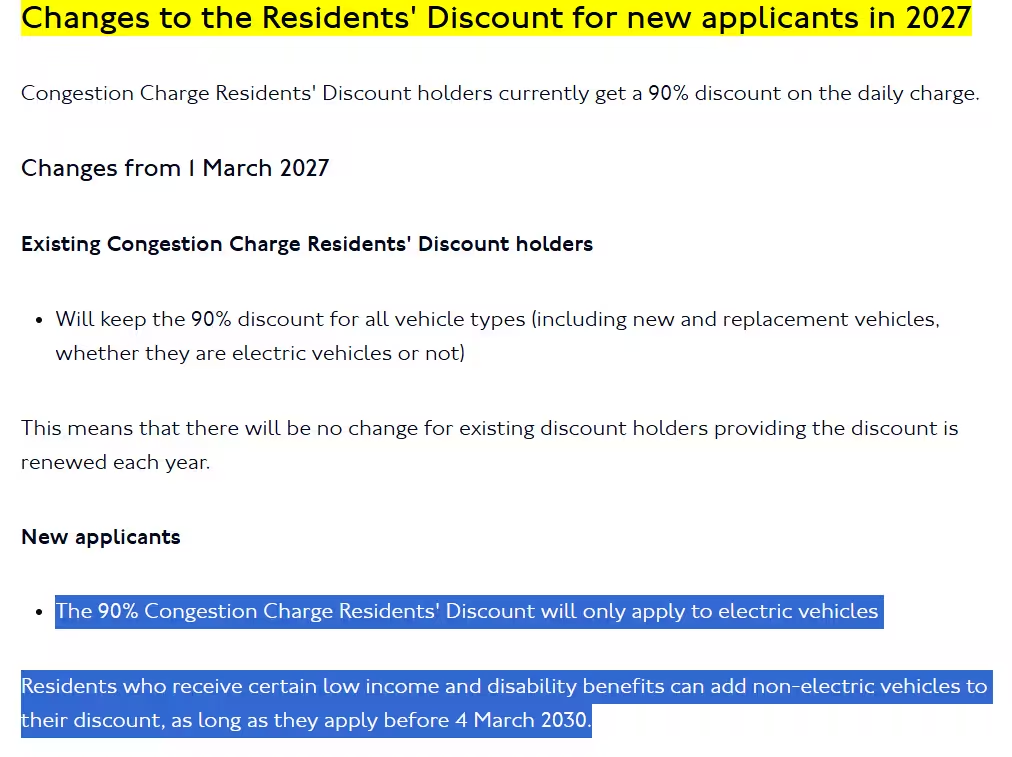
TfL’s confirmed 1 March 2027 residents’ discount changes, including eligibility for existing holders and new applicants.
Do Electric Cars Still Need to Check the Congestion Charge?
Yes. Electric vehicle owners should not assume they can enter central London without paying.
The previous 100% Cleaner Vehicle Discount ended in December 2025. From 2 January 2026, a replacement discount has applied to qualifying electric vehicles registered for Auto Pay.
An eligible electric car receives a 25% discount, reducing the daily amount from £18 to £13.50.
Eligible electric vans, HGVs and quadricycles receive a 50% discount, reducing the daily charge to £9.
These discounts require active Auto Pay registration.
For a company operating electric delivery vehicles, the difference becomes substantial over repeated journeys.
An electric van making 20 chargeable journeys in one month would incur £180 in Congestion Charge payments instead of £360 at the standard rate.
That represents a £180 monthly saving per eligible vehicle, assuming the same charging days.
However, electric vehicle discounts do not automatically remove parking costs, tunnel charges or other operational expenses.
How Can You Check If You Already Paid the Congestion Charge?
If you have already made a payment, the next task is to verify whether it covers the correct vehicle and charging date.
Drivers can review payment records through their TfL account or the official Pay to Drive in London app, where applicable.
Our recommended verification process is straightforward.
First, locate your confirmation email or payment receipt.
Next, compare the registration number with the vehicle used for the journey. A single incorrect character can create a mismatch.
Then check the date selected during payment.
Finally, verify that the payment was completed rather than merely authorised or attempted.
What If Your Bank Shows a Payment but TfL Does Not?
A bank transaction alone may not provide complete evidence of a successfully allocated road-user charge.
If the payment appears in your bank account but not in TfL’s payment history, check whether the transaction is pending or completed and contact TfL.
Retain the transaction reference, payment confirmation and the date of the journey.
Do not assume that the absence of an immediate account update confirms that payment has failed. Equally, do not assume that a pending bank authorisation proves the charge has been settled.
For employers, maintaining a shared payment register can help identify discrepancies before they become enforcement problems.
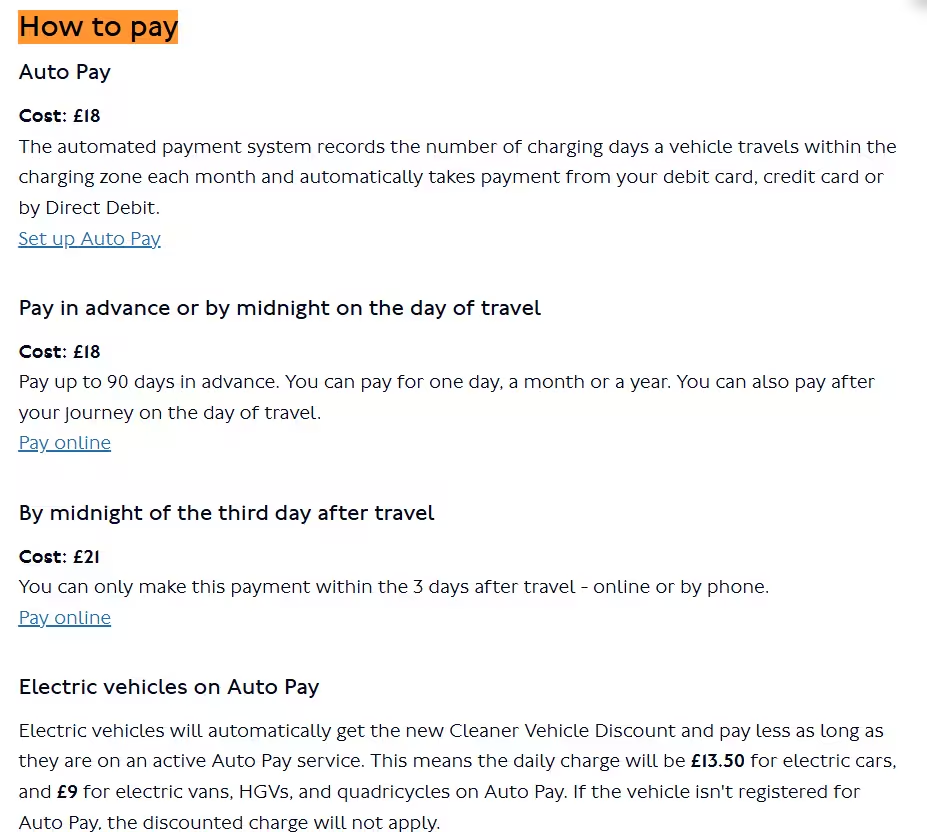
TfL’s official payment information showing Auto Pay, advance payments and the deadline for post-travel Congestion Charge payments.
What Happens If You Forgot to Pay the Congestion Charge?
Drivers can normally pay in advance, on the day of travel or by midnight on the third day after travelling.
The standard £18 payment applies when paid in advance or on the journey date.
If payment is made within the permitted three-day post-travel period, the amount is £21.
Once that deadline has passed, the driver may receive a Penalty Charge Notice.
| Enforcement stage | Amount |
| Standard Congestion Charge | £18 |
| Permitted post-travel payment | £21 |
| Penalty Charge Notice | £180 |
| Penalty paid within 14 days | £90 |
| Charge Certificate stage | £270 |
The standard penalty is ten times the £18 daily charge.
A penalty paid within the early-payment window receives a 50% reduction.
Drivers normally have 28 days from service of a PCN to pay or make formal representations. Missing subsequent enforcement deadlines can increase the amount owed.
How Do You Check or Challenge a Congestion Charge Penalty?
If a PCN arrives, check its registration number, alleged contravention date and supporting information.
You may have grounds to challenge it if the charge was correctly paid, the vehicle was exempt, you were not the keeper at the relevant time or another recognised ground applies.
Keep payment confirmation, account history and any evidence supporting the circumstances.
Motorists familiar with parking ticket appeals should remember that Congestion Charge penalties follow TfL’s road-user charging enforcement process rather than the procedures for ordinary private or council parking tickets.
A formal challenge does not guarantee cancellation, so motorists should follow the instructions and deadlines on the actual notice.
Do You Need to Check Both the Congestion Charge and ULEZ?
Yes. The Congestion Charge and Ultra Low Emission Zone are separate schemes.
The Congestion Charge principally manages traffic within a defined central London area.
ULEZ applies emissions requirements across a much larger part of London.
| Feature | Congestion Charge | ULEZ |
| Main purpose | Manage congestion | Reduce vehicle emissions |
| Coverage | Central London charging zone | All London boroughs, excluding the M25 |
| Typical daily charge | £18 | £12.50 for a non-compliant car |
| Operation | Specified daytime hours | 24 hours, except Christmas Day |
| Main vehicle test | Location, time and exemptions | Emissions standards and exemptions |
A driver using a vehicle that does not meet ULEZ standards may need to pay both charges when entering central London during Congestion Charge operating hours.
This could produce a combined daily amount of £30.50.
Over ten chargeable days, the total would be £305.
The financial implication is particularly important for older diesel vehicles used by small businesses and independent delivery operators.
For such vehicles, it is insufficient to complete only the Congestion Charge postcode check. Their ULEZ compliance must be established separately.
How Can Businesses Check Congestion Charges Across Multiple Vehicles?
For businesses, the Congestion Charge is both a transport expense and an administrative compliance responsibility.
A single £18 payment may appear relatively small. Repeated journeys across an entire fleet can create material annual expenditure.
Consider a company with four standard-rate vehicles, each operating inside the zone for 20 charging days per month.
| Fleet size | Monthly charge | Annual charge |
| One standard-rate vehicle | £360 | £4,320 |
| Two standard-rate vehicles | £720 | £8,640 |
| Four standard-rate vehicles | £1,440 | £17,280 |
| Six standard-rate vehicles | £2,160 | £25,920 |
These are illustrative calculations based on the current £18 daily rate, 20 charging days per month and 12 months of activity.
They exclude ULEZ, parking, fuel, insurance and other vehicle costs.
Our financial assessment suggests businesses should treat road-user charging as a dedicated operating-cost category rather than combining it with miscellaneous travel expenses.
A practical approach involves maintaining a record of the vehicle registration, driver, journey date, applicable zone and payment status.
Can Companies Reduce Congestion Charge Expenditure?
The largest savings generally come from reducing unnecessary chargeable driving days rather than attempting to avoid small payment-processing costs.
For example, a business operating one standard-rate vehicle for 20 chargeable days per month would spend £4,320 annually.
If scheduling improvements reduced chargeable days to 15 per month, expenditure would fall to £3,240.
That is an annual saving of £1,080, or 25%.
Businesses can consider consolidating deliveries, scheduling suitable journeys outside charging hours, using appropriate lower-cost transport arrangements or checking whether an eligible discount is available.
Mayor of London Sadiq Khan has explained in published London Assembly discussions that the purpose of the Congestion Charge is to reduce congestion.
That policy objective matters commercially: switching to a cleaner vehicle may reduce the charge, but it does not necessarily remove the cost of occupying limited road capacity in central London.
Can You Check London Congestion Charges for Hire Cars and Business Travel?
Drivers renting vehicles should establish responsibility for road-user charges before collecting the car.
A hire agreement may make the customer responsible for the Congestion Charge and any associated administration fees.
It is therefore important to check whether the vehicle is covered by an applicable payment arrangement and whether the hire company will process charges automatically.
The same principle applies to company cars and employee travel.
A vehicle may already appear on an employer’s Auto Pay account, but the driver should confirm that coverage applies to the correct dates.
For journeys involving airports, drivers should also distinguish central London’s Congestion Charge from individual airport access schemes.
The Heathrow drop-off charge, Gatwick drop-off charge and Stansted drop-off payment arrangements operate separately.
Paying one of those airport charges does not pay London’s Congestion Charge, and vice versa.
Where business travel includes several destinations, reviewing the combined airport parking and road-user charging arrangements can help avoid confusing separate payment obligations.
What Common Mistakes Should Drivers Avoid When Checking the Congestion Charge?
Several recurring misunderstandings can lead to unnecessary payments or penalties.
- Confusing ULEZ compliance with Congestion Charge exemption: A compliant car may still have to pay £18 when driven in the central charging zone.
- Assuming electric vehicles are free: Most eligible electric cars now pay £13.50 with an active Auto Pay discount.
- Checking only the destination postcode: Drivers must consider the actual route, including any streets crossed inside the zone.
- Believing a number plate search proves past entry: The standard checker determines vehicle-related requirements rather than confirming all previous camera detections.
- Selecting the wrong payment date: A payment for the incorrect date may leave the actual charging day unpaid.
- Using unofficial payment websites: Third-party services may add fees or mislead customers. The safest approach is to pay TfL directly.
- Assuming discounts apply automatically: Some exemptions and discounts require registration and approval.
For business operators, these errors can multiply across several vehicles, creating administrative problems as well as financial losses.
How Often Should You Check the Congestion Charge in 2027?
Drivers making occasional trips should complete the relevant checks before each central London journey, especially when using an unfamiliar vehicle.
Regular commuters can use Auto Pay to reduce the risk of missing manual payment deadlines, but should continue monitoring their accounts.
Businesses should establish a more structured checking routine.
| Driver type | Recommended approach |
| Occasional visitor | Check vehicle, route and hours before travel |
| Regular commuter | Verify Auto Pay and account transactions |
| Electric vehicle owner | Confirm Auto Pay discount remains active |
| Delivery driver | Check planned routes and charging days |
| Fleet operator | Reconcile vehicle records and payment statements |
| Central London resident | Monitor discount renewal and 2027 eligibility |
The frequency of checking should reflect changes in vehicles, journeys and eligibility.
For example, replacing a company van or moving into the residents’ discount area can change the applicable arrangements.
Final Thoughts
Checking the Congestion Charge in 2027 requires more than entering a number plate into an online search box.
Drivers must establish vehicle eligibility, confirm whether their route enters the central London zone during charging hours and verify that any required payment has been completed.
The 2026 increase to £18, revised electric vehicle discounts and scheduled March 2027 residents’ discount changes make accurate checking particularly important.
For households, this can prevent unnecessary transport expenditure. For employers and commercial vehicle operators, consistent checks can strengthen cost control, reduce avoidable penalties and improve journey planning.
The most effective approach is to use TfL’s official services, keep reliable payment records and reassess eligibility whenever the vehicle, journey or applicable charging rules change.
FAQs About Checking the Congestion Charge
Can I check the Congestion Charge for free?
Yes. TfL provides free online vehicle and zone-checking tools. Checking eligibility does not itself pay any applicable charge.
Can I check if I entered the Congestion Charge zone yesterday?
You can review your route and available account or journey records, but TfL’s standard number plate checker does not provide a definitive public historical-entry search.
Can I check Congestion Charge payment history?
Yes. Relevant payment and Auto Pay transactions can be reviewed through your TfL account or official app, subject to the records associated with the service used.
Does the Congestion Charge apply on Sundays in 2027?
Under the currently published timetable, it applies between 12pm and 6pm on Sundays, unless a qualifying exemption or discount applies.
How do I check whether my postcode is in the Congestion Charge zone?
Enter the postcode into TfL’s official Congestion Charge zone checker and select the exact address. Use the map to examine the surrounding route.
Will the Congestion Charge increase again in 2027?
The published standard rate is £18 as of November 2026. A further 2027 increase has not been separately confirmed, although future increases are possible under the revised framework.
What should I do if my Congestion Charge payment is missing?
Check the registration, date, receipt and bank transaction status. If the payment remains unclear, contact TfL promptly and retain supporting records.
Hannah is a London lifestyle and consumer writer at London Insider News, covering property, transport, local developments, cost-of-living issues and stories affecting everyday life across the capital.
More from TRANSPORT
Pay Stansted Drop Off Charge: How to Pay Online, Current Fees, Deadlines and Free Alternatives?
Drivers using London Stansted Airport's Express Set Down area must pay a drop-off charge after their…
Do I Need to Pay Congestion Charge in London? 2027 Rules, 2026 Updates, Costs and Exemptions
If you're planning to drive through central London, you may be wondering, do I need to…
UK Highway Code Driveway Parking Rules 2027: Fines, Dropped Kerbs and New 2026 Changes
The UK Highway Code driveway parking rules are becoming increasingly important for homeowners, motorists, landlords and…