How Much Will Universal Credit Pay Towards Private Rent in 2027? New Rates, Rules and 2026 Updates
Discover how much Universal Credit will pay towards private rent in 2027, including London LHA rates, frozen housing allowances, eligibility rules and extra rent support.
 Adam
London Business & News Writer

Universal Credit can help private tenants pay their rent through the housing costs element, but the amount depends on where they live, their household circumstances, their age and the applicable Local Housing Allowance (LHA) rate.
For 2027, the most important update is that Local Housing Allowance rates will remain frozen. The Government confirmed on 28 October 2026 that LHA rates and the benefit cap would not increase for the 2027/28 financial year.
This means renters will continue to face the same basic housing-support limits introduced in April 2024, even if their landlords increase their rent.
For example, a tenant paying £1,600 monthly rent with an applicable LHA rate of £1,200 could have an initial Universal Credit housing-cost entitlement of £1,200. This represents 75% of the rent, leaving a £400 monthly shortfall before considering other Universal Credit adjustments.
Our analysis of the confirmed benefit rules, published LHA figures and London rental arrangements shows that the biggest financial risk is treating an LHA entitlement as a guarantee that the full amount will arrive in a claimant’s bank account.
How Much Will Universal Credit Pay Towards Private Rent in 2027?
Universal Credit normally calculates private rental assistance using the lower of two amounts:
- The tenant’s actual eligible rent.
- The applicable Local Housing Allowance rate for their household and area.
The calculation can be expressed as:
Starting housing costs element = Lower of eligible rent or relevant LHA rate
However, the final Universal Credit payment may be reduced by earnings, savings, the benefit cap, deductions and other circumstances.
Consider the following examples using a hypothetical monthly LHA limit of £1,200.
| Monthly private rent | Starting housing element | Rent shortfall | Rent covered |
| £950 | £950 | £0 | 100% |
| £1,200 | £1,200 | £0 | 100% |
| £1,400 | £1,200 | £200 | 85.7% |
| £1,600 | £1,200 | £400 | 75% |
| £1,800 | £1,200 | £600 | 66.7% |
| £2,000 | £1,200 | £800 | 60% |
These are illustrative calculations before other deductions and benefit-cap restrictions.
The table demonstrates that as rent rises above the LHA limit, the percentage potentially covered by the housing element declines.
Someone paying £1,200 would theoretically have 100% of their eligible rent recognised. Someone paying £2,000 under the same LHA limit would have only 60% recognised.
This difference makes checking housing benefit entitlement essential before renting a home in London.
What Are the New Universal Credit Private Rent Changes for 2027?
The Government’s October 2026 announcement confirmed another year without an increase in Local Housing Allowance rates.
On 28 October 2026, Work and Pensions Secretary Pat McFadden confirmed:
“Local Housing Allowance rates and the benefit cap will be maintained at their current levels and not increased for 2027-28.”
This was included in the official 2027/28 benefit uprating statement.
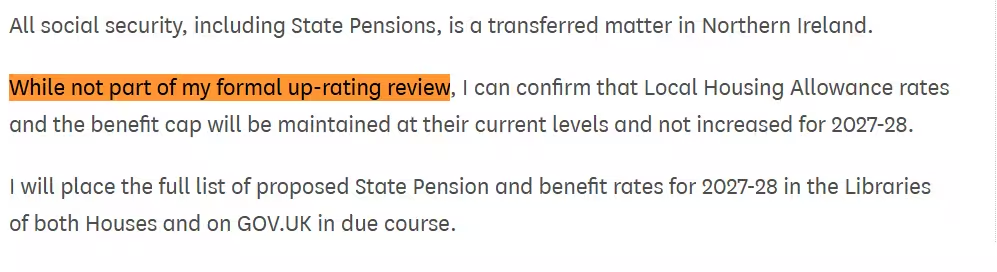
Government confirmation that Local Housing Allowance rates and the benefit cap will remain frozen in 2027/28.
What changed in 2026 and what continues into 2027?
| Rule or change | Confirmed position |
| Local Housing Allowance 2026/27 | Frozen at April 2024 rates |
| Local Housing Allowance 2027/28 | Freeze confirmed |
| Benefit cap 2027/28 | Remains at existing levels |
| Universal Credit earnings taper | Currently 55% |
| Two-child UC limit | Removed from 6 April 2026 |
| Extra housing support in England | Crisis and Resilience Fund Housing Payments since April 2026 |
| Standard UC allowance in 2027 | Set to increase; separate from LHA |
| Private rental discrimination | Benefit-based discrimination prohibited under 2026 reforms |
One important distinction is that an increase in the standard Universal Credit allowance does not automatically mean the housing costs element increases.
A claimant might receive more support through another element of Universal Credit while their maximum recognised private rent remains unchanged.
How Much Are Local Housing Allowance Rates in London for 2027?
London has several Broad Rental Market Areas (BRMAs), each with different housing allowances.
The table below contains the confirmed 2026/27 monthly rates. Because the Government has confirmed a freeze for 2027/28, these are also the expected cash limits for the new financial year, pending publication of the formal 2027/28 tables.
| London rental area | Shared rate | 1 bedroom | 2 bedrooms | 3 bedrooms |
| Central London | £829.83 | £1,439.97 | £1,793.98 | £2,160.02 |
| Inner East London | £699.50 | £1,439.97 | £1,750 | £2,160.02 |
| Inner South East London | £650 | £1,295.50 | £1,550 | £1,950 |
| Inner South West London | £685 | £1,420 | £1,700 | £2,160.02 |
| North West London | £621.33 | £1,100 | £1,350 | £1,680 |
| Outer North East London | £549.83 | £1,000 | £1,250 | £1,500 |
| Outer South London | £569.33 | £950 | £1,200 | £1,500 |
These are maximum LHA figures, not guaranteed Universal Credit payments.
The precise area applying to a property depends on its location, not simply the name of the London borough.
For example, two tenants living in different parts of London may both rent one-bedroom flats but qualify for substantially different housing allowances.
Someone entitled to the one-bedroom rate in Central London may have an LHA limit of £1,439.97, compared with £950 in Outer South London.
That is a difference of £489.97 every month, or £5,879.64 annually.
We recommend checking the exact property postcode rather than relying on a general borough-level estimate.
The complete figures can be checked in the official Universal Credit LHA rates for 2026 to 2027.
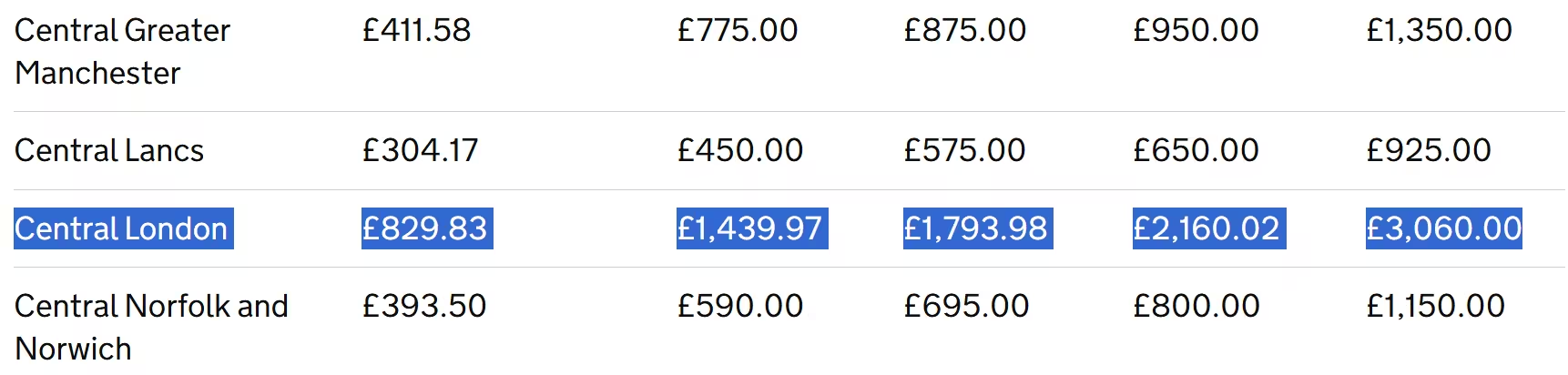
Official DWP Local Housing Allowance rates for London in 2026/27, with the same cash limits confirmed for 2027/28.
How Much of Your London Rent Could Universal Credit Cover?
Our calculations illustrate the difference between the maximum housing element and actual rent in several London areas.
| Example household | Monthly rent | LHA limit | Potential coverage | Monthly gap |
| Central London, 1-bedroom rate | £1,800 | £1,439.97 | 80% | £360.03 |
| North West London, 1-bedroom rate | £1,500 | £1,100 | 73.3% | £400 |
| Outer South London, 1-bedroom rate | £1,250 | £950 | 76% | £300 |
| Inner East London, 2-bedroom rate | £2,100 | £1,750 | 83.3% | £350 |
| Outer South London, shared rate | £1,000 | £569.33 | 56.9% | £430.67 |
Examples assume the relevant bedroom entitlement and use the LHA calculation before any reductions to the overall UC award.
The percentages highlight why geographical location matters financially.
A property with cheaper advertised rent does not necessarily produce the smallest shortfall once the applicable LHA rate is considered.
A tenant should also calculate how much of their wages or remaining Universal Credit will be needed to fund the difference.
The amount of rent affordable on a salary should therefore be considered alongside LHA limits, Council Tax, utility bills, transport and other essential expenditure.
How Does Universal Credit Decide How Many Bedrooms You Need?
The housing element is based on the number of bedrooms a household is considered to require under benefit rules.
It is not automatically based on the size of the property the claimant chooses to rent.
The normal bedroom-sharing arrangements are:
| Household members | Normal bedroom entitlement |
| Adult couple | One shared bedroom |
| Single adult aged 16 or above | One bedroom |
| Two children under 10 | Usually share regardless of sex |
| Two children under 16 of the same sex | Usually share |
| Children who cannot share under the rules | Additional bedroom as appropriate |
| Qualifying disability or overnight-care needs | Additional entitlement may apply |
Consider a couple with a daughter aged 12 and a son aged 14.
The couple would normally receive one bedroom.
Because the children are over 10 and of different sexes, they would normally qualify for separate bedrooms.
The household would therefore generally qualify for the three-bedroom LHA category.
Can disability increase the bedroom allowance?
Yes. Some households qualify for an additional bedroom because a disabled person cannot reasonably share or because a qualifying overnight carer needs accommodation.
The decision depends on the household’s circumstances and the relevant benefit and medical criteria.
Private-rent LHA is generally capped at the four-bedroom rate even if the household occupies a larger property.
How Much Will Universal Credit Pay if You Are Under 35?
Single private renters under 35 are usually subject to the Shared Accommodation Rate.
This is one of the most financially significant rules for younger claimants.
The rule can apply even when someone rents a self-contained one-bedroom flat.
For example, consider a 29-year-old private tenant in Outer South London.
- Actual rent: £1,300 per month.
- Shared Accommodation Rate: £569.33.
- Potential starting housing amount: £569.33.
- Monthly shortfall: £730.67.
- Percentage of rent recognised: approximately 43.8%.
Under this example, the tenant would need substantial additional income to cover the full rent.
Who can qualify for an exception?
Some claimants under 35 can receive the one-bedroom rate instead.
Exceptions can apply to qualifying care leavers, certain former hostel residents, people receiving specified disability benefits, victims of domestic abuse or modern slavery, and other groups covered by the regulations.
The circumstances must satisfy the relevant eligibility rules.
For people who may qualify for an exception, checking that Universal Credit has applied the correct rate can make a significant financial difference.
Will Universal Credit Pay the Full Private Rent if You Are Working?
It can recognise the full eligible rent when it falls within the applicable LHA limit, but employment income can reduce the overall Universal Credit award.
Universal Credit currently uses a 55% earnings taper.
This means that, generally, every £1 of relevant earnings reduces Universal Credit by 55p after any applicable work allowance.
Example: Working renter receiving Universal Credit
Consider a single claimant aged over 25 with the following circumstances:
| Calculation | Monthly amount |
| Standard UC allowance, 2026/27 | £424.90 |
| Eligible housing costs | £1,000 |
| Maximum UC before earnings | £1,424.90 |
| Relevant monthly earnings | £1,000 |
| Earnings reduction at 55% | £550 |
| Illustrative final UC payment | £874.90 |
Assumes no work allowance, benefit-cap reduction or other deductions. The example uses the 2026/27 standard allowance.
The earnings taper reduces the overall Universal Credit award; it does not simply lower the published LHA rate.
That distinction matters because some claimants mistakenly assume that the housing element is protected from reductions once they qualify for it.
For 2026/27, eligible households receiving housing support that qualify for a work allowance can disregard £427 of monthly earnings before the taper applies.
A work allowance normally applies where a claimant or their partner is responsible for a child or meets the qualifying health-related conditions.
What about self-employed renters?
Self-employed claimants can also qualify for help with rent.
However, their Universal Credit assessment may involve reported business income and expenditure, the minimum income floor where applicable, and other self-employment rules.
For freelancers, contractors and business owners with fluctuating income, the monthly assessment period can produce different Universal Credit payments even when the rent stays the same.
We consider this a particularly important budgeting issue: fixed housing costs and variable monthly business income do not always move together.
Will Savings Affect Universal Credit Housing Payments?
Savings and other capital can reduce a household’s entitlement.
Under the standard Universal Credit rules:
| Household capital | General treatment |
| £6,000 or less | Normally disregarded |
| More than £6,000 up to £16,000 | Can reduce UC |
| More than £16,000 | Normally prevents entitlement |
For capital between £6,000 and £16,000, Universal Credit generally assumes monthly income of £4.35 for each £250, or part of £250, above £6,000.
For example, capital of £10,000 is £4,000 above the lower limit.
That represents 16 increments of £250.
The assumed monthly income would therefore be:
16 × £4.35 = £69.60
This can reduce Universal Credit even when the capital is not producing that amount in actual interest.
Certain capital disregards and transitional protection arrangements can change the result.
Can the Universal Credit Benefit Cap Reduce Rent Support in 2027?
Yes.
The benefit cap limits the total amount of certain benefits that some households can receive.
The Government confirmed that the existing levels would remain in place for 2027/28.
| Household type | Greater London monthly cap | Outside Greater London |
| Couple, with or without children | £2,110.25 | £1,835 |
| Single parent with dependent children | £2,110.25 | £1,835 |
| Single adult without dependent children | £1,413.92 | £1,229.42 |
These caps apply to relevant combined benefits, not just the housing element.
For instance, a household could initially qualify for a relatively high LHA amount but have its eventual Universal Credit award reduced by the benefit cap.
Some households are exempt, including those meeting specified earnings, disability or caring conditions.
Under the current rules, the earnings threshold for exemption is £881 per monthly assessment period.
There can also be a nine-month grace period for qualifying people whose employment has ended or earnings have fallen.
The key point is that a high LHA rate does not override the benefit cap.
What Happens if Another Adult Lives in Your Home?
Universal Credit can reduce the housing costs element where a non-dependant adult lives with the claimant.
For 2026/27, the standard non-dependant housing-cost contribution is £96.55 per month.
This usually concerns another adult aged 21 or over who is not the claimant’s partner.
However, there are important exceptions, including circumstances involving specified disability benefits, caring responsibilities and other eligibility conditions.
It would therefore be incorrect to assume the deduction always applies simply because an adult child or family member lives at the address.
The £96.55 figure is the confirmed 2026/27 amount; any separate uprating for 2027/28 should be checked when the detailed rate tables become available.
Can Universal Credit Cover Rent for Shared Houses and Joint Tenancies?
Yes, although the calculation depends on the tenancy arrangement.
For a joint tenancy with someone who is not the claimant’s partner, Universal Credit normally considers the claimant’s eligible share of the rent and the relevant LHA rules.
For example, suppose two unrelated adults jointly rent a flat for £1,800 per month and are responsible for equal shares.
Each person’s starting rental liability would normally be £900 monthly.
Universal Credit would then assess each claimant’s circumstances, including the applicable bedroom entitlement.
A claimant under 35 may still be subject to the shared accommodation rate.
For tenants comparing properties advertised weekly, understanding what PW means in rent helps convert the advertised price to a monthly amount.
For example:
£350 weekly rent × 52 ÷ 12 = approximately £1,516.67 monthly.
Using four weeks as though they were a calendar month would understate the annual cost.
How Can You Claim Universal Credit for Private Rent?
Universal Credit housing support is usually included in the main Universal Credit claim.
A claimant must report their housing costs and provide the necessary information showing that they are responsible for paying rent.
The usual process involves:
- Signing in to or creating a Universal Credit account.
- Providing the property’s address and tenancy information.
- Reporting the rent amount and payment frequency.
- Supplying details of the landlord or letting agent.
- Providing supporting evidence when requested.
- Checking the housing costs section of the Universal Credit statement.
- Reporting relevant changes in rent or household circumstances.
Supporting evidence can include a tenancy agreement, rent book, rent statement or suitable confirmation from the landlord.
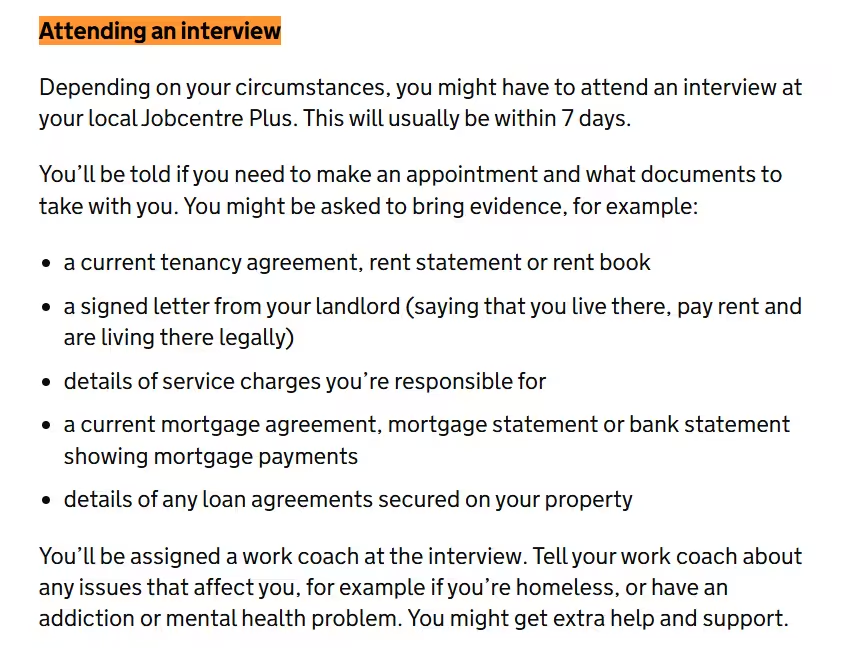
Official Universal Credit guidance explaining the information and evidence tenants may need when claiming help with housing costs.
How long does the first payment take?
The first Universal Credit payment normally arrives around five weeks after the claim begins.
This can create a cash-flow problem for tenants whose rent is due earlier.
Some claimants can request an advance, but advances generally need to be repaid from subsequent Universal Credit payments.
Renters should not assume that the first payment will reach them before their next rent deadline.
Does Universal Credit Pay Private Rent Directly to the Landlord?
Usually, the housing costs element is included in the claimant’s monthly Universal Credit payment.
The claimant is responsible for making the required payment to the landlord.
However, an Alternative Payment Arrangement can allow eligible housing payments to be made directly to the landlord.
This is commonly known as a managed payment to landlord.
It may be appropriate where a tenant is in rent arrears, has difficulty managing payments or meets other relevant criteria.
Both tenants and landlords can request consideration of this arrangement.
A direct payment does not remove the tenant’s responsibility to cover any shortfall between rent and the amount paid through Universal Credit.
What Happens if a Landlord Increases Rent in 2027?
A rent increase does not automatically result in a higher housing allowance.
This is especially significant because LHA rates are frozen for 2027/28.
Imagine a tenant whose applicable LHA rate is £1,200.
Their landlord increases the monthly rent from £1,400 to £1,540.
That is a 10% rent increase.
| Calculation | Before increase | After increase |
| Monthly rent | £1,400 | £1,540 |
| Applicable LHA | £1,200 | £1,200 |
| Starting rent shortfall | £200 | £340 |
| Rent recognised | 85.7% | 77.9% |
Although the landlord’s increase is 10%, the tenant’s rent shortfall rises by 70%.
This demonstrates how a relatively moderate percentage increase in the rent itself can produce a much larger percentage increase in the amount a tenant must find independently.
Landlords in England must also follow the statutory rent-increase process applicable to the tenancy.
For most private assured tenancies, the rules introduced in May 2026 generally restrict increases to once every 52 weeks after the initial period and require the prescribed Section 13 procedure with at least two months’ notice.
Tenants can examine how much a landlord can increase rent before accepting a proposed change.
What Extra Help Is Available if Universal Credit Does Not Cover the Full Rent?
One of the most important changes for 2026 and 2027 concerns additional assistance from local councils.
In England, Discretionary Housing Payments ended on 31 March 2026.
From 1 April 2026, the Government introduced the Housing Payment element of the Crisis and Resilience Fund.
This support is intended to help qualifying households experiencing housing-related financial difficulties.
Depending on the council’s assessment, assistance can potentially cover:
- Shortfalls between eligible rent and housing benefit support.
- Rent deposits.
- Rent in advance.
- Qualifying moving costs.
- Other housing pressures covered by the scheme.
Awards are discretionary and are not guaranteed.
The scheme operates through local authorities, and the funding framework currently covers April 2026 to March 2029.
In Scotland and Wales, Discretionary Housing Payments remain available under their respective arrangements.
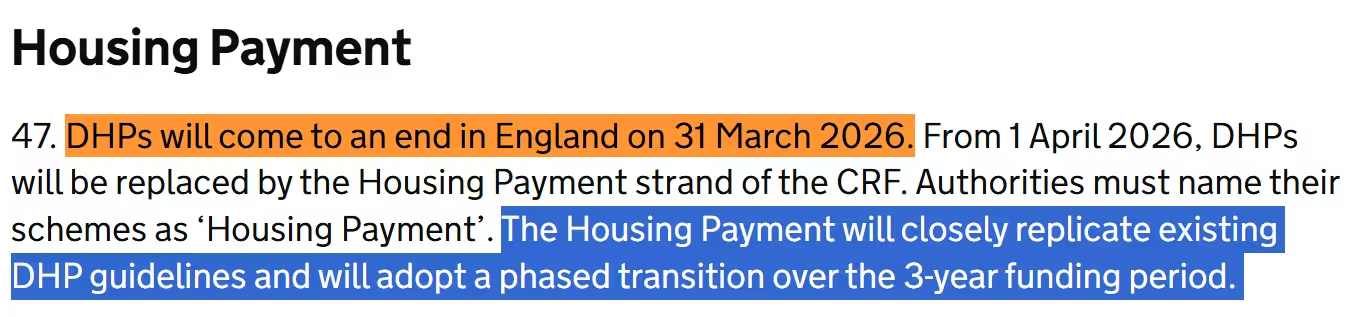
Official guidance confirming that Crisis and Resilience Fund Housing Payments replaced Discretionary Housing Payments in England from April 2026.
What should you do if you cannot afford the rent shortfall?
First, review the Universal Credit calculation to make sure the correct LHA area, bedroom entitlement and any applicable exceptions have been used.
Next, compare the shortfall against your remaining household income.
If you face immediate difficulty, contact your local council about Housing Payment assistance and seek independent debt or housing advice.
It can also be helpful to discuss payment difficulties with the landlord early rather than allowing arrears to build without communication.
Does Universal Credit Cover Council Tax, Deposits and Utility Bills?
The Universal Credit housing costs element does not automatically cover every expense associated with living in a rented property.
| Housing-related expense | General position |
| Eligible private rent | Potentially covered within LHA limits |
| Certain eligible service charges | May qualify |
| Council Tax | Separate Council Tax Reduction may be available |
| Gas and electricity | Not ordinarily part of the housing element |
| Water and broadband | Not generally covered as personal utilities |
| Tenancy deposit | May qualify for separate council assistance |
| Rent shortfall | Tenant responsible unless additional help awarded |
| Moving costs | Separate discretionary support may be available |
A tenant should calculate the full monthly living cost rather than comparing the advertised rent only with the LHA figure.
If a property is advertised as £1,500 PCM, PCM means per calendar month.
That £1,500 should be compared with the monthly Universal Credit housing figure, then additional household bills should be included in the affordability assessment.
What Did the 2026 Universal Credit Two-Child Limit Change Mean for Renters?
The two-child limit on the Universal Credit child element ended on 6 April 2026.
Eligible households can now receive a child element for each qualifying child rather than being generally restricted to the first two children.
This can improve total Universal Credit entitlement for some families.
However, two distinctions are important.
First, the removal of the limit does not automatically change the LHA rate for a particular property. Bedroom entitlement continues to follow the household composition rules.
Second, additional child elements count towards the benefit cap where it applies.
Consequently, some larger households may not receive the full increase otherwise available because their benefits are restricted by the existing cap.
For financial planning, the change should be assessed as part of the total household Universal Credit award rather than treated as an increase to the rent allowance itself.
Can Landlords Refuse Tenants Because They Receive Universal Credit?
For most private renting arrangements in England, landlords cannot reject or discourage applicants simply because they receive benefits.
The rental discrimination protections introduced in May 2026 prohibit landlords and agents from excluding applicants solely on that basis.
Landlords can still conduct legitimate affordability checks.
However, relevant benefit income must be considered appropriately rather than automatically disregarded because it comes from Universal Credit.
This distinction matters for claimants searching in London’s competitive rental market.
A claimant receiving Universal Credit may be able to demonstrate affordability through a combination of earnings, benefit entitlement and other lawful financial evidence.
The prohibition on benefits discrimination does not mean landlords must accept applicants who genuinely cannot afford a tenancy.
How Can You Check Whether Private Rent Is Affordable Before Moving?
We suggest using three financial checks before entering a tenancy.
1. Calculate the maximum eligible housing support
Find the correct LHA area using the property’s postcode.
Confirm whether the household qualifies for the shared, one-bedroom, two-bedroom, three-bedroom or four-bedroom rate.
Compare that rate against the eligible rent.
2. Calculate the realistic Universal Credit award
Consider earnings, household composition, capital, the benefit cap, non-dependant deductions and other adjustments.
The maximum LHA amount alone is not enough to determine the payment.
3. Stress-Test the Monthly Household Budget
Include regular housing costs and consider what would happen if earnings dropped or the rent increased.
For example, consider a household expecting a £300 monthly rent shortfall.
| Budget measure | Monthly amount |
| Expected rent shortfall | £300 |
| Annual equivalent | £3,600 |
| Shortfall after hypothetical 10% increase on £1,500 rent | £450 |
| New annual equivalent | £5,400 |
| Increase in annual shortfall | £1,800 |
A household that can currently afford £300 from its other income may find £450 substantially harder to manage.
This is why our analysis places more importance on the rent shortfall and total household affordability than on the headline LHA figure in isolation.
Will Universal Credit Pay More Towards Private Rent Later in 2027?
The confirmed position is that LHA cash rates are frozen for the 2027/28 financial year, beginning in April 2027.
The Government has not announced a general LHA increase for that period.
That does not mean every person’s Universal Credit payment will remain unchanged.
A claimant’s total entitlement can change because of:
- Increases to other benefit elements.
- Changes in employment income.
- Changes in household composition.
- A move to a property with a different applicable LHA rate.
- Changes in recognised bedroom entitlement.
- New eligibility for disability-related or caring support.
- Changes to other deductions or entitlement conditions.
It is therefore possible for someone’s overall Universal Credit payment to rise while their LHA limit remains frozen.
The formal 2027/28 monthly LHA tables should still be checked when published, even though the freeze has already been confirmed.
Final Verdict: How Much Will Universal Credit Pay Towards Private Rent in 2027?
Universal Credit will continue to help eligible private renters through the housing costs element, but there is no fixed national amount that applies to everyone.
The relevant calculation is normally the lower of eligible rent and the household’s applicable Local Housing Allowance rate, subject to the wider Universal Credit assessment.
The confirmed freeze for 2027/28 means households whose rent exceeds their LHA allowance cannot rely on a general increase in housing support to close the gap.
For London renters, postcode, age, bedroom entitlement and household income can change the calculation considerably.
The most reliable approach is to check the exact LHA rate, calculate the potential rent shortfall and review the full Universal Credit award before committing to a tenancy.
Frequently Asked Questions
Will Universal Credit pay £1,000 a month towards private rent?
Yes, where the claimant’s applicable LHA limit and eligible rental costs permit that amount. The eventual Universal Credit payment may still be reduced by earnings, the benefit cap or other rules.
Can Universal Credit pay £1,500 towards rent in London?
Potentially. Some London areas have two-bedroom or larger LHA limits above £1,500. However, the claimant must qualify for the relevant bedroom rate, and the final UC payment is subject to other eligibility and reduction rules.
Will Local Housing Allowance increase in April 2027?
No general increase is planned. The Government confirmed on 28 October 2026 that LHA rates would remain at existing levels for 2027/28.
Does Universal Credit pay 100% of private rent?
It can recognise 100% of eligible rent when that rent is within the applicable LHA limit. However, the claimant’s final Universal Credit award may be lower because of earnings or other reductions.
Can I get Universal Credit towards rent while working full-time?
Yes. There is no general rule preventing full-time workers from claiming Universal Credit. Eligibility depends on their income and wider household circumstances.
Does Universal Credit increase when my landlord raises rent?
Not automatically. If eligible rent already exceeds the relevant frozen LHA rate, a further rent increase normally increases the tenant’s shortfall rather than the LHA amount.
How much private rent will Universal Credit pay for a single person?
It depends on their age, location, rental liability and eligibility. Single claimants aged 35 or over generally qualify for the one-bedroom LHA category, while many younger claimants are restricted to the shared rate unless an exception applies.
Can I get help if Universal Credit does not cover all my rent?
Yes, qualifying tenants in England can apply to their council for a Crisis and Resilience Fund Housing Payment. Scotland and Wales continue to operate Discretionary Housing Payment arrangements.
Can Universal Credit help with a private rental deposit?
The ordinary housing element is designed primarily for eligible ongoing housing costs. Separate assistance for deposits may be available through the local council or other qualifying schemes.
Is Universal Credit paid directly to private landlords?
Usually not. Housing assistance is normally included in the claimant’s Universal Credit payment, although a managed payment to the landlord may be arranged in eligible circumstances.
Adam is a London business and news writer at London Insider News, covering local developments, finance, entrepreneurship and the stories shaping businesses and communities across the capital.
More from RENTING

Right to Rent Share Code 2027: How to Get, Generate and Check Your Code Online?
Updated: 4 November 2026 | 2027 Guide A Right to Rent share code is a nine-character…

How Much Housing Benefit Can I Get in 2027? UK Rates, Eligibility, Rent Calculations and 2026 Updates
How much Housing Benefit can I get in 2027? You could receive financial assistance covering up…

How Much Housing Benefit Am I Entitled to for Private Renting in 2027? Updated UK and London Guide
If you rent privately in London or elsewhere in the UK, you may qualify for financial…