How Much Can a Landlord Increase Rent in London? 2026 Rules Explained
London landlords can raise rent without a fixed percentage cap, but strict rules govern when and how increases can happen. Here’s how the 2026 rules, two-month notice period and open-market rent test affect landlords and tenants.
 Adam
London Business & News Writer
Adam
London Business & News Writer

For most private renters in London, there is no fixed legal percentage cap limiting a landlord to a 3%, 5% or 10% rent increase.
However, that does not give landlords an unrestricted right to raise the rent whenever or however they choose.
Since the Renters’ Rights Act reforms took effect in England on 1 May 2026, rent increases for most private assured tenancies have to follow a more structured statutory process.
A landlord should first discuss the proposed increase with the tenant and must then use Form 4A: Landlord’s notice proposing a new rent.
The completed Form 4A must normally be given to the tenant at least two months before the proposed increase is due to start.
This is known as the Section 13 process, and landlords must follow it every time they increase the rent, even where the tenant has already agreed to the new amount.
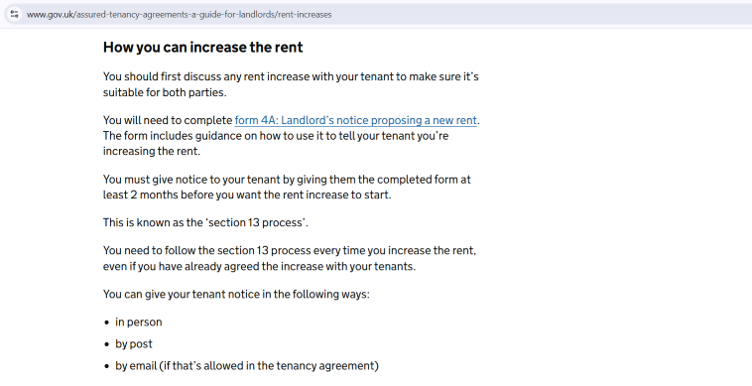
GOV.UK guidance explains that landlords must use Form 4A and give tenants at least two months’ notice when increasing rent through the Section 13 process.
The notice can be given to the tenant in person, sent by post or, where the tenancy agreement permits it, delivered by email.
Following the correct procedure does not automatically mean that any proposed amount is reasonable. A tenant can still challenge an increase if they believe the new rent is above the property’s open market rental value.
That distinction is particularly important in London, where rental values can vary significantly between boroughs and even between nearby streets. Location, transport connections, property condition, size, furnishings and specification can all influence what a comparable home would realistically achieve on the open market.
London Insider News reviewed the current post-May-2026 rules, the latest London rental figures and the financial considerations that landlords and tenants should understand before agreeing to, proposing or challenging a rent increase.
Quick Answer: How Much Can a Landlord Increase Rent?
For most private assured tenancies in London:
| Question | Current position |
| Maximum percentage increase | No fixed percentage cap |
| How often can rent rise? | Generally once every 52 weeks |
| Increase during first year? | Generally no |
| Notice required | At least two months |
| Required process | Section 13 using Form 4A |
| Can a tenant challenge it? | Yes |
| What does the tribunal consider? | Open market rent |
| Can a normal rent-review clause replace Form 4A? | No for private assured tenancies under the post-May-2026 system |
| Does higher mortgage cost automatically justify an increase? | No |
| Does London-wide rent inflation determine the legal increase? | No |
The most important point is that “no percentage cap” does not mean “no effective limit”.
A landlord might propose a 15% increase, but if comparable homes would realistically rent for only 5% more than the tenant’s existing rent, the proposed figure could be challenged.
Equally, a rent that has remained substantially below market level for several years could potentially rise by much more than annual inflation.
For renters who want to understand the wider tenancy process, London Insider News has a separate step-by-step guide to renting a home in London covering deposits, referencing, tenancy agreements and the post-May-2026 rules.
Is There a Legal Rent Increase Cap in London?
There is currently no general statutory percentage cap on private rent increases in London or elsewhere in England.
There is no rule saying that a private landlord may increase rent by only inflation, the Consumer Prices Index, 5%, 10% or another predetermined percentage.
Instead, the current system relies heavily on the property’s open market rental value.
This makes London particularly interesting because the percentage increase tells only part of the story.
Imagine two similar tenants.
Tenant A pays £2,250 a month for a property whose genuine current market value is approximately £2,350.
Tenant B pays £1,750 for a property that comparable evidence suggests would currently achieve approximately £2,250.
A £200 increase for Tenant A would represent 8.9% and could take the property above comparable market rents.
A £200 increase for Tenant B would represent 11.4%, yet the resulting £1,950 rent could still remain substantially below the property’s market level.
The larger percentage therefore is not automatically the less reasonable increase.
That is why landlords and tenants should focus less on the percentage in isolation and more on the resulting rent.
What Is the Maximum Rent a London Landlord Can Charge?
This question needs a careful answer.
A landlord can propose a new rent through the statutory process. The law does not give landlords a simple numerical ceiling such as £100 extra per month or 5% a year.
If the tenant believes the new figure is above open market rent, however, the tenant can ask the First-tier Tribunal to determine the appropriate market rent.
The tribunal assesses what the property could reasonably be expected to achieve if it were let on the open market under comparable terms.
This means market rent operates as an important practical control on excessive increases.
There is another important protection under the post-May-2026 rules: where the tenant challenges a proposed increase, the amount ultimately payable following the tribunal determination cannot be more than the amount originally proposed by the landlord.
That removes an important concern found in some older online guidance which warns tenants that challenging an increase could result in the tribunal setting an even higher rent than the landlord requested.
How Much Have London Rents Actually Increased?
Market data provides useful context, but it should never be confused with an individual property’s legal market rent.
The Office for National Statistics reported that the average private rent in London was £2,332 per month in August 2026.
London rents had increased by 3.5% over the previous 12 months, and the capital remained the most expensive region in England for private renters. At local-authority level, Kensington and Chelsea recorded an average monthly private rent of approximately £3,690 in August 2026.
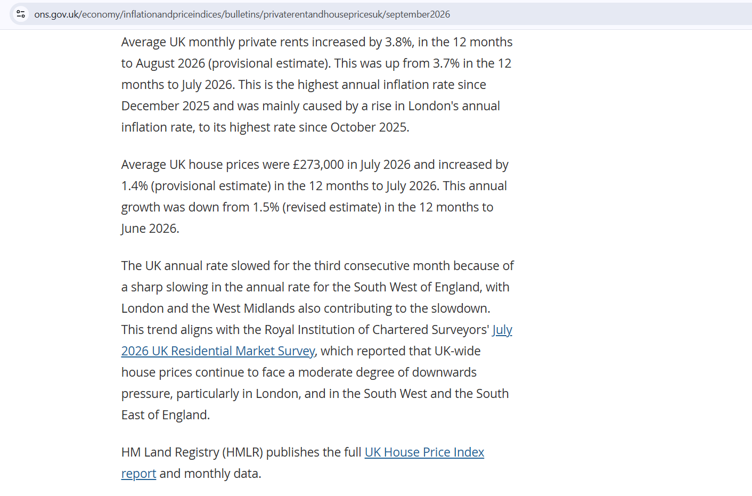
The latest ONS release showed that average UK private rents increased by 3.8% in the 12 months to August 2026, with London’s annual rental inflation rising to its highest level since October 2025.
These figures help show the wider direction of the market, but they do not create a fixed formula for individual rent increases.
That is the important distinction for both landlords and tenants. If London-wide annual rent inflation is 3.5%, that does not mean every landlord is automatically entitled to increase rent by 3.5%. Equally, it does not mean that any increase above 3.5% is automatically unlawful.
A studio in Zone 2, a two-bedroom flat near an Elizabeth line station, a suburban three-bedroom house and a room in a shared HMO all operate in very different parts of the market.
The legal question is not what happened to rents across London overall, but what the specific property would reasonably achieve on the open market.
What Does a 5%, 10%, 15% or 20% Rent Increase Actually Mean?
Percentages can look abstract until converted into pounds.
For a tenant currently paying £1,500 per month:
| Increase | New monthly rent | Extra each month | Extra each year |
| 3% | £1,545 | £45 | £540 |
| 5% | £1,575 | £75 | £900 |
| 10% | £1,650 | £150 | £1,800 |
| 15% | £1,725 | £225 | £2,700 |
| 20% | £1,800 | £300 | £3,600 |
For somebody already paying £2,500 a month, even a 5% increase adds £125 a month, or £1,500 over a full year.
London tenants should therefore convert any proposed percentage into its annual cash impact, not simply look at the headline percentage.
Where rental advertisements use monthly terminology, London Insider News also explains what PCM means in rent and how monthly rental prices work.
How Can a Landlord Increase Rent Legally in London?
For most private assured periodic tenancies under the current England system, a landlord cannot simply send a message saying the rent will be £200 higher from next month.
The statutory process matters.
A typical compliant increase now follows these stages:
- Check when the tenancy began and when rent was last increased. Rent cannot normally be increased during the first year of a new assured tenancy, and later increases are generally limited to once every 52 weeks.
- Assess the property’s current open market rent. A landlord should examine genuinely comparable properties rather than selecting the highest advertised rent in the postcode.
- Discuss the proposed change with the tenant. A commercial discussion can sometimes avoid a dispute, particularly where both sides understand the market evidence.
- Complete Form 4A. This is the prescribed landlord notice used for the Section 13 process in the private rented sector.
- Give at least two months’ notice. The proposed rent must comply with the statutory timing requirements and take effect at the beginning of an appropriate tenancy period.
- Keep evidence that the notice was served. Depending on the tenancy terms and method used, notice may be delivered personally, by post or electronically where permitted.
- Allow the tenant the opportunity to challenge the increase. A tenant who believes the proposed rent exceeds open market rent can apply to the First-tier Tribunal before the new rent is due to begin.
The official GOV.UK guidance on rent increases for landlords explains the current Section 13 procedure.
Can a Landlord Increase Rent in the First Year?
For most assured periodic tenancies covered by the new rules, no.
A landlord cannot normally increase the rent during the first 12 months of the tenancy.
This has an important commercial implication for London landlords.
The initial asking rent now deserves even more attention because a landlord who deliberately underprices a new tenancy cannot simply correct the figure three or six months later.
At the same time, aggressively pricing a property at the very top of the market can increase vacancy risk.
A landlord therefore needs to balance yield against letting speed, tenant quality, retention and expected operating costs.
The best business decision is not necessarily the highest possible advertised rent.
How Often Can a Landlord Increase Rent?
For most private assured tenants, rent can normally be increased once every 52 weeks.
That means landlords cannot use several smaller increases during the year to avoid the annual restriction.
For example, a landlord cannot generally increase rent by 3% in January and then another 4% in July.
Once the rent has been increased under the relevant process, the next increase must wait until the statutory period has passed.
The annual restriction also matters for increases made before the new system began.
Where rent was lawfully increased before 1 May 2026, including through a qualifying rent-review arrangement under the previous system, transitional rules can prevent another increase from taking effect until at least a year after that earlier increase.
How Much Notice Does a Landlord Have to Give?
Under the current rules applying to most assured periodic private tenancies, the landlord must give the tenant at least two months’ notice using Form 4A.
This is another area where renters need to be cautious about older search results.
Many articles written before the Renters’ Rights Act reforms still refer to one month’s notice for monthly tenancies.
That is no longer the correct general rule for a new Section 13 increase under the post-1 May 2026 private assured-tenancy system.
The proposed start date also matters.
Giving two months’ warning does not automatically make every notice valid. The notice and effective date still need to comply with the statutory tenancy-period requirements.
Can a Landlord Just Send a Text or Email Increasing the Rent?
Not by itself for an assured tenancy covered by the new system.
An informal message saying, “Your rent is going from £1,900 to £2,100 next month,” is not a substitute for the statutory process.
The landlord generally needs to use Form 4A and comply with Section 13.
An email may potentially be used as a method of delivering the completed notice where electronic service is permitted by the tenancy agreement, but that is different from simply writing an informal email proposing a new figure.
This distinction is particularly important because some older tenancy agreements contain clauses purporting to let a landlord increase the rent automatically.
What Happened to Rent Review Clauses?
The reforms changed this significantly.
For the private assured tenancies covered by the new regime, contractual rent-review clauses are no longer the mechanism for imposing increases.
The landlord generally needs to use the statutory Section 13 process.
That prevents landlords from drafting around the annual rent-increase protections by inserting clauses allowing rent to change every six months or automatically rise by a fixed percentage.
Older guidance telling tenants simply to check their fixed-term agreement for an inflation-linked rent-review clause can therefore be misleading when applied to a tenancy governed by the post-May-2026 system.
What Counts as “Open Market Rent” in London?
Open market rent is broadly the amount the property could reasonably be expected to achieve if it were offered to the market on comparable tenancy terms.
For a London property, that means looking beyond the borough name.
Two flats half a mile apart may have materially different rental values.
Relevant characteristics can include the precise location, nearest stations, number of bedrooms, internal size, floor level, lift access, condition, furnishings, natural light, outdoor space, parking, energy efficiency, building facilities and whether utilities or other costs are included.
A newly refurbished two-bedroom flat with a balcony beside a Tube station should not automatically be compared with an older two-bedroom flat 20 minutes away with no outside space and outstanding maintenance problems.
Likewise, comparing a furnished property with bills included against an unfurnished property where all household costs are additional can produce a misleading result.
Are Rightmove and Zoopla Listings Enough to Prove Market Rent?
Property portals can be useful evidence, but landlords and tenants should understand their limitation.
An online advertisement normally tells someone the asking rent, not necessarily the rent ultimately agreed with a tenant.
A property advertised at £2,500 may eventually be let at £2,400.
Another advertised at £2,400 may attract immediate demand at the asking price.
A stronger market assessment therefore uses several close comparables rather than one convenient advertisement.
Recent listings in the same neighbourhood, similar bedroom numbers, similar property type and broadly similar condition will generally be more informative than a London-wide average.
Does Inflation Decide How Much Rent Can Increase?
No.
Inflation can help explain why a landlord’s expenses are increasing, but it does not create a statutory formula for private rents in England.
There is no rule stating:
New rent = old rent + CPI.
A landlord might face higher repair bills, insurance, service charges, financing costs or contractor costs during an inflationary period.
Those expenses matter to the economics of running the property.
But they do not automatically establish its open market rental value.
If market rents for comparable properties have remained flat, a landlord cannot prove that a large rent increase represents market rent simply by showing that their own mortgage payments increased.
Do Higher Mortgage Rates Justify a Bigger Rent Increase?
From a landlord’s financial perspective, higher borrowing costs can create significant pressure.
A landlord whose mortgage payment has risen by £300 a month will naturally consider whether rental income needs to increase.
But the tenant’s rent is not legally calculated by adding the landlord’s mortgage bill to the existing rent.
The market-rent test looks at what the property could reasonably achieve on the rental market.
Two identical flats could have landlords with completely different financing structures.
One landlord might own the property outright.
Another might have a large variable-rate mortgage.
That does not mean the second property automatically has a higher open market rent.
Mortgage costs affect investment profitability; they do not independently determine rental value.
Can a Landlord Increase Rent Because of Repairs or Improvements?
Improvements can affect market value where they genuinely make the property more attractive compared with competing homes.
A professionally refurbished kitchen, upgraded bathroom, better energy efficiency or significant improvement to the property’s overall standard may contribute to a higher market rent.
Routine maintenance is different.
Fixing a broken boiler, dealing with leaks or carrying out repairs required to keep the property in an appropriate condition should not automatically be presented as justification for a premium rent.
There is also an important technical point where the tenant has paid for qualifying improvements themselves.
When determining market rent under the Housing Act framework, the value added by certain tenant-funded improvements can be disregarded.
A landlord should therefore be cautious about attempting to charge a tenant more because of value that the tenant personally added to the property.
Can Poor Property Condition Help a Tenant Challenge an Increase?
Potentially, yes.
Property condition can be relevant when determining what the home would realistically command on the open market.
A landlord may point to renovated flats nearby being offered at £2,400 a month, but those comparables become weaker if the tenant’s own property has persistent damp, outdated facilities, defective windows or materially inferior condition.
The strongest comparison is not simply “another two-bedroom flat in the same postcode”.
It is a genuinely similar property.
Photographs, dated repair correspondence and evidence of outstanding problems can therefore become important if a dispute reaches the tribunal.
How Does the First-Tier Tribunal Work for Rent Increases?
A tenant who receives a Section 13 rent increase notice can ask the First-tier Tribunal to determine the open market rent.
The key deadline is extremely important.
The application needs to reach the tribunal before the date on which the proposed new rent is due to start.
Waiting until after the increase takes effect can mean losing the opportunity to challenge that particular notice.
The current application fee for a post-May-2026 open-market rent determination is £47, although Help with Fees may be available to qualifying applicants.
The official GOV.UK open market rent determination service provides the current application route.
The tribunal can consider the tenancy, comparable market evidence, the property’s condition and information submitted by both landlord and tenant.
Under the current rules, a tenant challenging the increase does not face the risk of the tribunal requiring more than the amount originally proposed by the landlord.
Does the Tenant Have to Pay the Higher Rent While Waiting for the Tribunal?
Where a valid challenge has been made under the current process, the new amount does not simply become payable while the tribunal is still deciding what the appropriate rent should be.
Once the tribunal reaches its decision, the legislation determines when the new rent takes effect.
In some circumstances the tribunal can also delay the effective date where applying the normal timing rules would cause undue hardship to the tenant.
Tenants should nevertheless continue paying the existing rent when due. A dispute over a proposed increase is not permission to stop paying rent altogether.
What Should a Landlord Do Before Choosing the New Rent?
From an investment perspective, landlords should avoid treating the rent review as a simple opportunity to maximise the next month’s income.
The commercially sensible figure can be lower than the absolute maximum achievable rent.
Consider a London landlord charging £2,250 a month who believes £2,400 represents the market level.
The additional £150 would generate £1,800 of extra gross income over 12 months.
Now assume pushing the rent to the maximum causes a reliable tenant to move out.
One month’s vacancy at £2,400 immediately removes £2,400 of income.
Add an illustrative £600 for cleaning, marketing, compliance administration or other changeover costs, and the landlord is £3,000 behind.
At £150 of additional monthly rent, it would take approximately 20 months merely to recover that £3,000 difference.
That does not mean landlords should never increase rents.
It means tenant retention has a financial value.
A financially disciplined landlord should compare the incremental income from an increase against vacancy probability, re-letting costs, management time and the value of retaining a tenant with a strong payment history.
Is It Better for Landlords to Increase Rent Every Year?
Not necessarily.
Some landlords prefer smaller periodic adjustments so that rent does not become dramatically detached from the market.
Others deliberately keep good tenants below the absolute market rate because predictable occupancy and lower turnover have economic value.
The correct decision depends on the property, financing, operating costs, local demand and investment objectives.
However, after the 2026 reforms there is another factor: a landlord who chooses to increase rent can generally do so only once in the relevant annual period.
The decision should therefore be planned rather than improvised.
Should Tenants Negotiate a Rent Increase?
Often, yes.
A proposed increase does not mean there is no room for discussion.
A tenant can compare the proposed rent against close local alternatives and explain where the figure appears high.
The landlord may also have financial reasons to compromise.
A reliable tenant who pays on time, looks after the property and intends to stay may be worth more to the landlord than an extra £50 or £100 per month accompanied by the risk of a void period.
For example, where the landlord proposes increasing rent from £2,000 to £2,200, the tenant might present comparable properties at approximately £2,100 and suggest that figure instead.
Any agreed outcome should be properly documented, and landlords should still comply with the statutory rent-increase procedure.
What If the Tenant Simply Cannot Afford the Increase?
Affordability and market rent are different questions.
A rent can potentially be consistent with the local market while still becoming unaffordable for the existing tenant.
A tenant in that position should assess the financial impact before deciding whether to stay.
London Insider News’ guide on how much rent someone can realistically afford in London looks at rent alongside take-home pay, bills, commuting, debt and savings rather than relying on a single salary percentage.
From the landlord’s perspective, affordability can also matter commercially.
A maximum-market increase that creates a high risk of arrears may ultimately be less attractive than a slightly lower rent paid consistently.
Can a Landlord Evict a Tenant for Challenging a Rent Increase?
The Renters’ Rights Act significantly changed this area.
Section 21 “no-fault” eviction is no longer the normal mechanism available to private landlords under the current assured-tenancy framework.
A tenant should therefore not be removed simply because they exercised the statutory right to challenge a proposed rent increase.
A landlord who wants possession generally needs to rely on a valid legal ground and follow the appropriate possession procedure.
That does not mean tenants have immunity from eviction.
Grounds relating to matters such as serious rent arrears, landlord occupation, sale of the property or antisocial behaviour may still apply where the legal requirements are satisfied.
Challenging an excessive rent and failing to pay validly due rent are two different issues.
Are the Rules Different for Lodgers?
Yes.
Someone who lives in the landlord’s own home can have a very different legal status from a normal private tenant renting a separate flat or house.
The Section 13 rules described in this article should therefore not automatically be applied to every room rental.
People living with their landlord should first establish whether they are a tenant, excluded occupier or another type of occupier.
Similar caution is needed for regulated tenancies beginning before 15 January 1989, social housing and specialist accommodation.
The rules discussed here primarily concern the mainstream private assured-rental market in England.
Are London Rent Increases Different From the Rest of England?
The legal framework is broadly the same across England.
London does not currently have a separate general percentage cap for private assured-tenancy rent increases.
What makes London different is the market.
At £2,332 a month in August 2026, London’s average private rent remained far above the England average.
A small percentage change can therefore create a large cash increase.
A 5% rise on £900 is £45 per month.
A 5% rise on £2,500 is £125 per month.
That makes careful market comparison especially important in the capital.
Borough averages are also only a starting point. Rental values can change substantially between neighbourhoods, stations and even streets within the same borough.
How Should a Fair London Rent Increase Be Assessed?
There is no official percentage called a “fair rent increase”.
A more useful assessment considers three separate questions.
The first is legal compliance: has the landlord used the correct process, waited the required period and given sufficient notice?
The second is market evidence: what would genuinely comparable properties achieve today?
The third is commercial reasonableness: is pushing rent to the highest obtainable level financially sensible when tenant retention and vacancy risk are taken into account?
A proposal can perform differently under each test.
For example, a 10% increase might satisfy the legal timing rules but still exceed local market rent.
Another 10% increase might remain below market value because the property has been under-rented for several years.
A third might be market-supported but commercially unattractive because it is likely to cause an excellent tenant to leave.
That is why professional rent management requires more than applying a percentage to last year’s figure.
What Are the Biggest Mistakes Landlords Make When Increasing Rent?
One of the biggest mistakes is assuming that no percentage cap means a landlord can simply name any figure without consequence.
Another is relying on outdated tenancy-agreement wording rather than the current statutory procedure.
Using weak comparables can also cause problems. A luxury refurbished apartment should not be used to justify the rent of a property in materially worse condition merely because both have two bedrooms.
Landlords can also make poor financial decisions by focusing exclusively on gross rent.
An additional £100 a month produces £1,200 a year, but one avoidable void period could wipe out that benefit.
The strongest rent review therefore combines compliance, valuation and financial management.
What Are the Biggest Mistakes Tenants Make?
The opposite mistake is assuming that a large percentage increase must automatically be illegal.
It may not be.
If a property has been considerably below the open market level for years, a substantial percentage increase could still produce a rent consistent with nearby properties.
Tenants can also weaken their position by comparing unsuitable listings, missing the tribunal deadline or stopping rent payments entirely because they disagree with the new amount.
The better approach is to examine the notice, calculate the increase, research close comparables and act before the proposed start date.
Example: Is a £200 Rent Increase Legal in London?
Assume a tenant currently pays £2,000 PCM and receives a Form 4A proposing £2,200.
That is a 10% increase.
The percentage alone does not determine whether it is excessive.
Suppose genuinely comparable homes are being marketed at £2,150 to £2,300.
A £2,200 proposal may be well supported by the local market.
Now suppose similar properties are consistently around £1,950 to £2,075 and the tenant’s property is in worse condition.
The same £200 increase becomes much harder to justify as open market rent.
That example demonstrates why asking, “Can my landlord increase rent by 10%?” is the wrong starting point.
The more useful question is:
Would the new total rent be realistic for this particular property in today’s local market?
What Does the Renters’ Rights Act Mean for London Landlords Financially?
The reforms have made rental income management more structured.
Landlords can no longer rely on frequent contractual rent-review mechanisms for standard assured tenancies.
That makes pricing strategy increasingly important.
Investors need to consider expected rent growth when buying a property, not assume that rent can be adjusted whenever financing costs change.
Operating forecasts should therefore distinguish between:
- Market rent, which reflects what the property could achieve
- Passing rent, which is what the current tenant actually pays and
- Net rental income, which is what remains after relevant costs.
Those figures can be very different.
A property theoretically worth £2,500 a month on the open market but currently rented at £2,350 may still be an excellent investment if the tenant is reliable and turnover costs are low.
Conversely, achieving £2,500 does not guarantee strong profitability if mortgage interest, service charges, maintenance, insurance, management fees, tax and compliance costs consume a large part of the income.
Landlords should therefore treat rent increases as one component of portfolio management rather than as the sole answer to rising costs.
Final Verdict: How Much Can a Landlord Increase Rent in London?
There is no fixed percentage cap on how much a private landlord can propose as a rent increase in London.
But that answer on its own is misleading.
For most private assured tenancies under the rules applying since 1 May 2026, a landlord generally cannot increase rent during the first year, can normally increase it only once every 52 weeks afterwards, must use the Section 13 process with Form 4A, and must give at least two months’ notice.
If the tenant believes the resulting rent exceeds open market value, they can ask the First-tier Tribunal to determine the appropriate rent.
For London landlords, the strongest strategy is therefore not to choose an arbitrary percentage. It is to establish a defensible market value and then consider whether moving all the way to that value makes financial sense once tenant retention and vacancy risk are included.
For tenants, a 5%, 10% or even 20% increase should not be judged solely by its percentage. The relevant comparison is the resulting monthly rent against genuinely similar London properties.
With the average London private rent reaching £2,332 per month in August 2026, even modest percentage changes can have a significant impact on household budgets.
In today’s London rental market, the real answer to “how much can a landlord increase rent?” is therefore:
There is no fixed percentage ceiling, but there are strict rules on timing and procedure, and open market rent is the critical benchmark if the increase is challenged.
FAQs
Can my landlord increase my rent by 10% in London?
Potentially. There is no automatic 10% cap or ban, but the landlord must follow the correct process and the resulting rent can be challenged if it is above open market value.
Can a landlord increase rent by £200 a month?
Yes, a £200 increase is not automatically unlawful. What matters is whether the statutory process has been followed and whether the new total rent is supported by the local rental market.
Can my landlord increase rent every six months?
For most assured periodic private tenancies under the current system, no. Rent can generally only be increased once every 52 weeks.
How much notice does a landlord need to give in 2026?
For a new Section 13 increase under the current assured-tenancy system, the landlord must generally provide at least two months’ notice using Form 4A.
Can my landlord put the rent up in the first year?
For most assured periodic tenancies covered by the new rules, rent cannot normally be increased during the first 12 months.
Can I refuse a rent increase?
A tenant who believes a proposed Section 13 increase is above open market rent can challenge it through the First-tier Tribunal before the proposed new rent begins.
Is London rent capped?
There is no general London-wide percentage cap on private assured-tenancy rent increases. The statutory procedure and open-market-rent challenge provide the main controls.
Adam is a London business and news writer at London Insider News, covering local developments, finance, entrepreneurship and the stories shaping businesses and communities across the capital.
More from RENTING

How Does Rent to Buy Work? Eligibility, Costs and Finding a Home
Buying a home in the UK has become increasingly challenging for households that can afford monthly…

How Much Will Universal Credit Pay Towards Private Rent? What to Check in London
Private renters receiving Universal Credit can get help towards their rent through the housing costs element,…

What Does PW Mean in Rent? How to Compare Weekly and Monthly Prices
PW means “per week” in a rental property advert. If a London flat is advertised at…