How Much Rent Can I Afford in 2027? UK Salary Guide, London Rent Calculator and Budget Examples
Discover how much rent you can afford in 2027 based on your salary, including the 30% rule, London rental prices, affordability checks and budgeting tips.
 Adam
London Business & News Writer

How much rent can I afford? A commonly used starting point is to spend around 30% of your gross monthly income on rent, although some letting agents assess affordability using a higher threshold of approximately 40%.
Neither figure guarantees that a property is affordable once Income Tax, National Insurance, Council Tax, energy bills, transport and savings are considered.
For example, someone earning £40,000 a year would have a suggested monthly rent budget of £1,000 under the 30% rule. However, a letting agent using a 30-times-rent income test could potentially approve rent of around £1,333 per month.
That £333 difference matters when planning household finances.
London renters face additional pressure. According to the latest available Office for National Statistics private rental figures, the average monthly private rent in London reached £2,338 in September 2026, representing a 3.5% annual increase.
For anyone planning to rent during 2027, the challenge is finding a property that satisfies landlord affordability checks without compromising essential spending, financial security or longer-term savings.
We analysed official rental figures, property market research, tenant referencing practices and recent housing reforms to establish a practical way of calculating rent affordability.
Our assessment is that the most reliable calculation combines three factors: gross salary, actual take-home pay and the full cost of maintaining the tenancy.
How Much Rent Can I Afford Based on My Salary in 2027?
Your gross annual salary provides an initial benchmark for calculating affordable rent.
A simple formula is:
Annual gross salary × 30% ÷ 12 = suggested monthly rent budget
Someone earning £36,000 annually would calculate:
- Annual salary: £36,000
- 30% of salary: £10,800
- Monthly rental budget: £900
This establishes a starting point rather than a spending requirement.
For tenants with substantial childcare expenses, personal loans or unpredictable income, even 30% could be too expensive.
Conversely, someone with a larger income, limited debts and relatively low living expenses might comfortably allocate more.
Rent Affordability by Annual Salary
The table below compares the 30% budgeting benchmark with a common referencing calculation that allows rent of up to approximately 40% of gross income.
| Gross annual salary | Approx. monthly take-home | Rent at 30% gross | Rent at 40% gross |
| £25,000 | £1,793 | £625 | £833 |
| £30,000 | £2,093 | £750 | £1,000 |
| £35,000 | £2,393 | £875 | £1,167 |
| £40,000 | £2,693 | £1,000 | £1,333 |
| £45,000 | £2,993 | £1,125 | £1,500 |
| £50,000 | £3,293 | £1,250 | £1,667 |
| £60,000 | £3,780 | £1,500 | £2,000 |
| £70,000 | £4,263 | £1,750 | £2,333 |
| £80,000 | £4,746 | £2,000 | £2,667 |
| £90,000 | £5,230 | £2,250 | £3,000 |
| £100,000 | £5,713 | £2,500 | £3,333 |
Take-home calculations use the standard England 2026/27 Income Tax and employee National Insurance rates, assuming ordinary employment income and the standard Personal Allowance. They exclude pension contributions, student loan deductions, salary sacrifice and other individual adjustments. Figures are rounded. They are a planning baseline for 2027, not confirmed 2027/28 payslip figures.
The table demonstrates why rental affordability can be confusing.
A person earning £50,000 could meet a typical referencing threshold for approximately £1,667 monthly rent.
However, the 30% budgeting calculation suggests £1,250.
The higher figure is a potential approval limit, not necessarily a sensible spending target.
Our analysis suggests that renters should calculate the lower of their preferred percentage-based budget and their actual disposable-income limit before applying for a property.
What Is the 30% Rent Rule, and Should You Follow It?
The 30% rent rule is a widely recognised financial guideline suggesting that housing rent should not normally exceed approximately 30% of gross household income.
It is not a legal restriction and does not apply equally to every household.
For example, consider a tenant earning £3,000 per month before tax.
Thirty per cent of £3,000 equals £900.
That person could use £900 as an initial property-search budget, then adjust it after examining their actual monthly spending.
However, the percentage alone does not account for differences in take-home pay, household size or financial obligations.
How Different Rent Percentages Affect Your Budget?
| Rent as % of gross income | Monthly rent on £40,000 salary | Financial interpretation |
| 20% | £667 | Leaves more room for other commitments |
| 25% | £833 | Conservative starting benchmark |
| 30% | £1,000 | Common affordability guideline |
| 35% | £1,167 | Requires a closer budget review |
| 40% | £1,333 | Common upper referencing benchmark |
| 45% | £1,500 | Higher financial exposure |
These interpretations are editorial budgeting assessments, not formal credit ratings or legally established risk categories.
One important consideration is whether the percentage is calculated using gross or net income.
A property consuming 35% of gross income might consume more than 40% of take-home pay.
For a £40,000 employee taking home approximately £2,693 each month, £1,333 rent would account for almost 49.5% of take-home income.
That leaves approximately £1,360 for all other expenses.
For some households, that may be manageable. For others, it could leave insufficient money for Council Tax, transport, childcare, food and savings.
The percentage must therefore be tested against actual cash flow.
Should You Calculate Affordable Rent Using Gross or Take-Home Pay?
Gross income and take-home income serve different purposes in rental affordability.
Gross income is generally the starting point for percentage guidelines and many letting-agent referencing checks.
Take-home income is more useful for determining whether rent is sustainable in everyday life.
Imagine two employees earning the same £45,000 salary.
The first has no personal loans, works from home and receives employer pension contributions without a significant reduction in take-home pay.
The second has student loan repayments, childcare costs, a longer commute and an existing car finance agreement.
Both might satisfy the same basic letting-agent income requirement.
Their practical affordability is different because their remaining disposable income differs.
A realistic financial assessment should therefore consider:
- Income actually received after deductions.
- Regular essential household expenses.
- Debt repayments and financial commitments.
- Contributions to savings and emergency funds.
- Likely rent or household cost increases.
- Changes in employment or family circumstances.
We would not recommend setting a rental budget solely by multiplying salary by a percentage.
Instead, calculate a provisional limit from gross income and then verify it against the money genuinely available each month.
How Can You Calculate Your Maximum Affordable Rent?
The most useful approach is to work backwards from disposable income.
Use the following calculation:
Maximum affordable rent = monthly take-home income − non-rent household expenses − debt repayments − savings target − emergency allowance
The calculation must include Council Tax, utilities and other housing costs that are paid separately from rent.
Example: A London Employee Earning £45,000
Assume someone earns £45,000 annually and receives approximately £2,993 per month after standard Income Tax and National Insurance.
Their hypothetical monthly budget looks like this:
| Monthly expense | Example amount |
| Council Tax | £130 |
| Gas and electricity | £165 |
| Broadband | £30 |
| Transport | £190 |
| Groceries | £260 |
| Mobile phone and insurance | £55 |
| Debt repayments | £100 |
| Savings contributions | £300 |
| Emergency allowance | £150 |
| Personal and leisure spending | £200 |
| Total excluding rent | £1,580 |
After subtracting £1,580 from take-home income of £2,993, the renter has approximately £1,413 available for rent.
However, this is a calculated ceiling using the assumptions above.
The 30% gross-income guideline suggests £1,125, while the common 40% referencing threshold suggests £1,500.
We would treat the difference between these figures as important.
A renter choosing £1,250 rent would retain approximately £163 after the expenditure already included in the model.
A renter choosing £1,400 would retain only £13.
Although both figures might appear affordable on a salary-only calculator, the second leaves almost no additional room for underestimated expenses.
These costs are illustrative, not estimates of what every London household pays.
The financial principle is that a realistic rent budget should leave money uncommitted after the full household budget has been calculated.
How Much Rent Can You Afford in London in 2027?
London’s rental market requires a more location-specific calculation than the UK average.
The latest available ONS data for September 2026 shows considerable variation between regions and boroughs.
| Location | Average monthly private rent |
| United Kingdom | £1,406 |
| England | £1,466 |
| London | £2,338 |
| North East England | £790 |
| Bexley, London | £1,540 |
| Kensington and Chelsea, London | £3,739 |
ONS figures for September 2026, published on 21 October 2026. Figures include new and existing private tenancies.
London’s average rent was approximately 59.5% higher than England’s overall average.
The difference within London was even more substantial.
The September 2026 average in Kensington and Chelsea was approximately 143% higher than Bexley’s average.
This is why the question is not simply how much rent someone can afford in London, but which properties in which locations fit their particular income and household requirements.
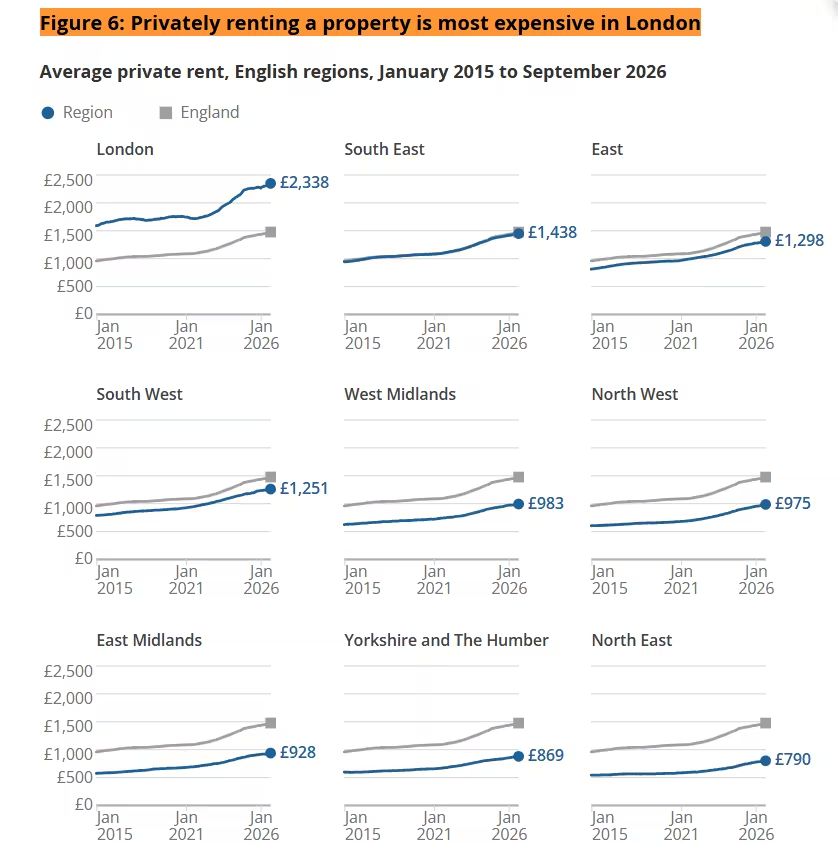
Average monthly private rents across UK regions, including London, September 2026.
What Salary Is Needed for London’s Average Rent?
Using the September 2026 London average of £2,338 per month:
Under the 30% gross-income rule:
£2,338 × 12 ÷ 0.30 = £93,520 annual household income.
Under the 40% gross-income referencing benchmark:
£2,338 × 12 ÷ 0.40 = £70,140 annual household income.
The difference is £23,380.
Neither calculation proves that the average London tenant earns these amounts.
They illustrate the gross household income required for the average rent to represent the stated percentage.
Property-market research also suggests that someone searching for a new tenancy may encounter higher rents than the ONS average.
Rightmove’s Q3 2026 Rental Price Tracker recorded an average advertised London rent of approximately £2,825 per month.
At that advertised price, the corresponding gross annual household incomes would be:
- £113,000 under the 30% guideline.
- £84,750 under the 40% referencing benchmark.
The distinction arises because ONS data includes existing tenancies, while Rightmove’s measure focuses on newly advertised properties.
Our assessment is that renters moving during 2027 should compare current listings with their budget rather than assume the existing-tenancy average represents the asking rent of a newly available home.
Why Could London Rent Remain Difficult to Afford in 2027?
Rental availability and demand can influence how many suitable properties appear within a given budget.
Richard Donnell, Executive Director of Research at Zoopla, examined these pressures in his September 2026 rental market report.
His research identified falling rental supply, stronger demand in London and increased competition for available properties. It also reported an average of 5.3 enquiries per rental home nationally.
This matters financially because households with limited budgets may have fewer suitable options when demand is concentrated in particular areas.
However, individual rental prices can move differently from market averages.
A forecast for UK rents should not be treated as a guaranteed increase for a specific London property.
How Much Should You Budget for a One-Bedroom or Two-Bedroom Home?
Property size is another essential consideration.
According to September 2026 ONS rental data, average London rents by bedroom count were approximately:
| Property size | Average monthly rent | Annual rent |
| One bedroom | £1,764 | £21,168 |
| Two bedrooms | £2,239 | £26,868 |
| Three bedrooms | £2,651 | £31,812 |
| Four or more bedrooms | £3,655 | £43,860 |
These are London-wide averages across new and existing tenancies, not guaranteed prices for currently advertised homes.
A one-bedroom property may be financially attractive to someone seeking privacy, but it typically requires one household to cover most housing expenses.
A two-bedroom property can become more affordable per person when suitable for sharing.
For example, two tenants dividing £2,239 equally would pay approximately £1,119.50 each before other bills.
That can be substantially less than renting separate one-bedroom properties.
However, flatsharing should be assessed against the actual tenancy structure.
Joint tenants may be jointly and severally responsible for the full rent, meaning one tenant could be legally pursued for more than their apparent share if another stops paying.
Is It Cheaper to Rent Alone or Share a Property?
For renters seeking to reduce expenditure, sharing can offer significant savings.
Consider a hypothetical comparison:
| Expense | Living alone | Sharing with one person |
| Individual rent | £1,750 | £1,150 |
| Council Tax contribution | £135 | £100 |
| Utilities | £170 | £100 |
| Broadband | £30 | £20 |
| Total monthly housing costs | £2,085 | £1,370 |
In this illustration, sharing reduces individual monthly housing expenditure by £715.
That equals £8,580 over twelve months.
Actual savings will vary with location, household size, bills and tenancy terms.
The calculation also highlights why room rents should be compared carefully.
Some London properties are advertised by individual room, while others use the combined rent for the entire property.
Understanding what PCM means in rent can prevent confusion when comparing monthly listings.
Similarly, a room advertised per week should be converted into a calendar-month equivalent.
The standard comparison is:
Weekly rent × 52 ÷ 12 = monthly equivalent
A room advertised at £300 weekly therefore represents approximately £1,300 per calendar month.
It does not represent £1,200 simply because four weeks equal 28 days.
Our explanation of weekly rental pricing covers the distinction between PW, PCM and per-person pricing in more detail.
How Do Letting Agents Decide Whether You Can Afford the Rent?
Letting agents commonly use affordability checks to assess whether a prospective tenant appears capable of paying the contractual rent.
A common calculation requires gross annual income to equal approximately 30 times monthly rent.
For example:
Annual income ÷ 30 = indicative referencing rent limit
A person earning £48,000 annually would calculate:
£48,000 ÷ 30 = £1,600 monthly rent.
Some landlords or referencing providers use different income thresholds, including 36 times monthly rent, or additional checks involving employment, credit history and other financial evidence.
The 30-times calculation corresponds to annual rent representing 40% of gross annual income.
Under a stricter 36-times calculation, £48,000 income would support approximately £1,333 monthly rent.
How Different Referencing Requirements Compare?
| Monthly rent | Annual income at 30× | Annual income at 36× |
| £1,000 | £30,000 | £36,000 |
| £1,250 | £37,500 | £45,000 |
| £1,500 | £45,000 | £54,000 |
| £1,800 | £54,000 | £64,800 |
| £2,000 | £60,000 | £72,000 |
| £2,500 | £75,000 | £90,000 |
These are example referencing formulas rather than universal legal requirements.
Landlords and agents may request proof of employment, payslips, bank statements, previous landlord references or self-employment records.
Some may consider guarantors where an applicant’s income is below the usual threshold.
For practical preparation, understanding how to rent a home in London can help applicants identify the documentation, references and tenancy checks commonly required.
An important financial distinction: passing a referencing check means the application satisfies that provider’s criteria. It does not demonstrate that rent will be comfortable after living expenses.
How Do Council Tax and Commuting Costs Change Rent Affordability?
The cheapest advertised rent is not always the cheapest property to live in.
London renters often compare outer-London homes with more expensive properties closer to work.
A lower rental price can be offset by higher transport expenses, Council Tax or household energy costs.
Consider two hypothetical options:
| Monthly cost | Property A | Property B |
| Rent | £1,950 | £1,700 |
| Transport | £140 | £320 |
| Council Tax | £150 | £175 |
| Utilities | £190 | £220 |
| Total | £2,430 | £2,415 |
Property B appears £250 cheaper based on rent alone.
However, after accounting for the additional costs, the effective monthly saving is only £15.
That amounts to £180 annually.
A renter might still prefer Property B because it offers additional space or access to other amenities. But the financial difference is much smaller than the advertised rents imply.
Can You Reduce Council Tax When Renting Alone?
People living alone may qualify for a 25% Council Tax discount.
For example, if the full annual Council Tax charge is £1,800, a qualifying 25% reduction would save £450 per year.
That is £37.50 per month.
The actual charge depends on the property’s valuation band, local authority and household circumstances. Students and other qualifying occupants may also be disregarded or exempt under separate rules.
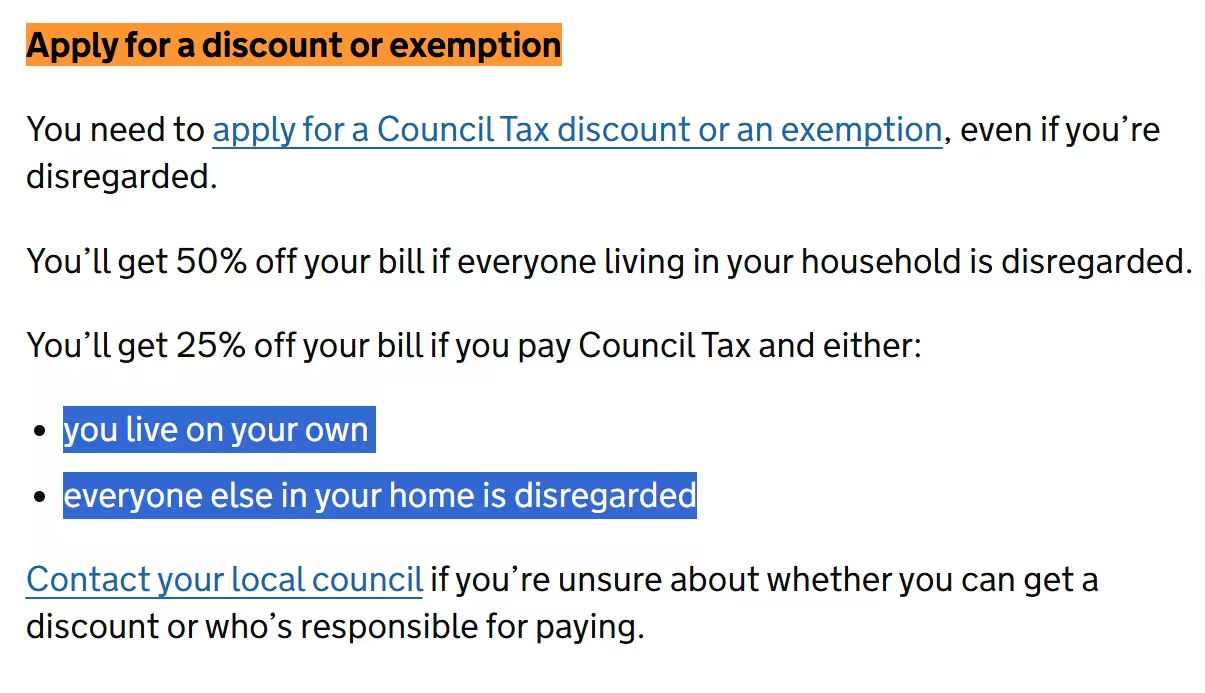
Council Tax discounts for people living alone.
How Much Money Do You Need Before Moving Into a Rental Property?
Being able to afford monthly rent does not necessarily mean someone can fund the move.
Tenants often need money for the first rental payment, security deposit, removal expenses and household setup.
For most covered private tenancies in England, a tenancy deposit is capped at five weeks’ rent when annual rent is below £50,000.
Where the annual rent is £50,000 or more, the general cap is six weeks.
Holding deposits are generally capped at one week’s rent.
Upfront Costs at Different Monthly Rent Levels
| Monthly rent | Maximum five-week deposit | First month plus deposit |
| £1,000 | £1,154 | £2,154 |
| £1,200 | £1,385 | £2,585 |
| £1,500 | £1,731 | £3,231 |
| £1,800 | £2,077 | £3,877 |
| £2,000 | £2,308 | £4,308 |
| £2,500 | £2,885 | £5,385 |
Figures use annual rent divided by 52 to calculate a week, then multiply by five. Rounded to the nearest pound. All illustrated rents fall below the £50,000 annual threshold.
The table excludes removal costs, furnishings and overlapping tenancy expenses.
A holding deposit may be credited towards the tenancy deposit or rent, depending on the arrangement. It should not automatically be counted as a separate additional expense when calculating the final amount payable.
Tenants moving from one property to another should also consider whether their existing deposit will be returned before the new deposit becomes payable.
A household may be financially capable of paying £1,500 rent every month but still struggle to produce more than £3,000 at the beginning of a tenancy.
That is a cash-flow problem, not necessarily a monthly income problem.
What Changed for Renters in 2026, and How Does It Affect 2027?
The Renters’ Rights Act introduced substantial reforms to the private rental sector in England from 1 May 2026.
These changes are particularly relevant to people planning a new tenancy in 2027.
Under the reformed framework, most existing assured shorthold tenancies became assured periodic tenancies, and new assured tenancies generally operate on a rolling basis rather than with a fixed end date.
The reforms also changed the rules governing rent in advance, rental bidding, rent increases and possession.
The main changes are explained in the official GOV.UK Renters’ Rights Act overview for tenants.
What Are the Key Changes Affecting Rental Budgets?
| Rental issue | Position under the reforms |
| Rent in advance | Generally no rent before signing; normally up to one month before a monthly tenancy starts |
| Rental bidding | Landlords cannot encourage or accept offers above the advertised rent |
| Rent increases | Normally once per year, with the first 12 months of a new tenancy protected |
| Rent increase notice | At least two months using the statutory procedure |
| Section 21 eviction | No-fault Section 21 evictions abolished for affected assured tenancies |
| Tenancy duration | Rolling assured periodic tenancies |
| Benefit discrimination | Landlords cannot refuse applicants simply because they receive benefits |
These rules principally concern relevant private assured tenancies in England. Different rules may apply to excluded arrangements, including some lodgers, student accommodation and other tenancy types.
Can a Landlord Demand Six Months’ Rent Upfront in 2027?
For new tenancies covered by the post-May-2026 rules, landlords and agents generally cannot demand or accept rent before the tenancy agreement is signed.
After signing, they can generally require no more than one month’s rent before a monthly tenancy starts.
This is an important change for renters who previously faced demands for substantial advance payments.
However, tenants still need sufficient funds for permitted deposits and their normal ongoing rental obligations.
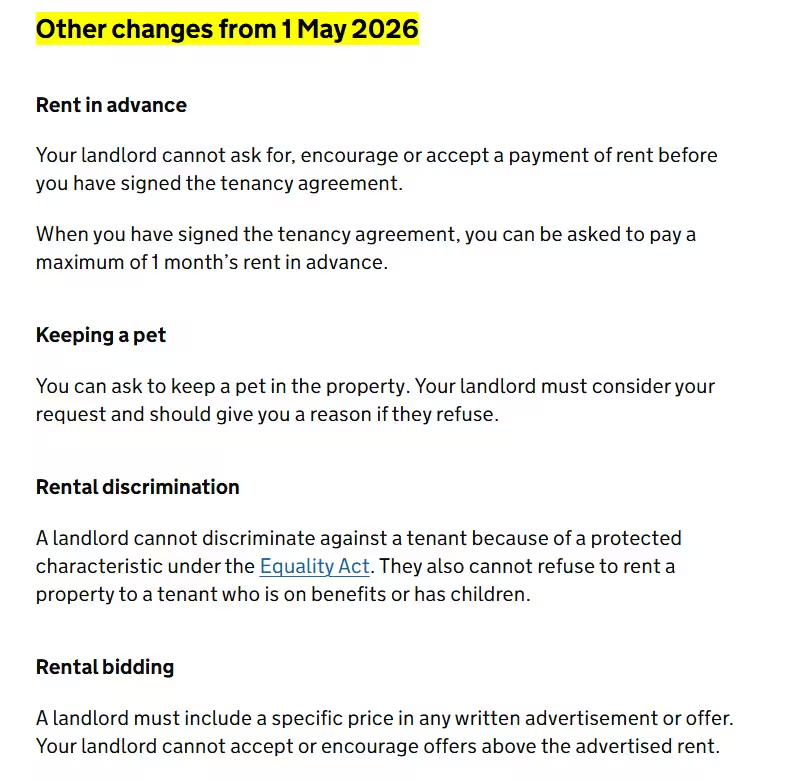
Rent-in-advance restrictions and rental bidding protections introduced on 1 May 2026.
How Much Can Rent Increase During 2027?
For most assured periodic private tenancies in England, landlords must follow the statutory rent-increase process.
They cannot normally increase rent during the first year of a new tenancy and can generally increase it only once a year afterwards.
They must also give at least two months’ notice using the prescribed process.
There is no universal legal cap restricting every private rent increase to 3%, 5% or 10%.
A tenant may challenge a proposed increase above open-market rent through the appropriate tribunal process.
Our detailed explanation of how much a landlord can increase rent examines the applicable notice and market-rent rules.
For personal budgeting, tenants should still test the effect of higher rent.
For example, on £1,500 monthly rent:
| Illustrative rent increase | New monthly rent | Additional annual cost |
| 3% | £1,545 | £540 |
| 5% | £1,575 | £900 |
| 8% | £1,620 | £1,440 |
These are hypothetical financial stress tests, not predictions of 2027 rental inflation or amounts that a landlord is necessarily entitled to charge.
Planning for possible changes can help households avoid choosing a property that becomes unaffordable after even a modest increase.
How Much Rent Can Couples and Joint Tenants Afford?
Rent affordability can be calculated using combined household income where the relevant referencing provider accepts joint applicants’ earnings.
For example, consider two people earning £36,000 each.
Their combined gross household income is £72,000.
Using the 30% guideline:
£72,000 × 30% ÷ 12 = £1,800 monthly rent.
Using a common 30-times-income referencing calculation:
£72,000 ÷ 30 = £2,400 monthly rent.
The difference is £600 per month.
That illustrates why a couple could be approved for a property that takes a substantially larger proportion of their income than they originally intended to spend.
Joint households should also assess income dependence.
A tenancy costing £2,200 per month may appear manageable while both people work full-time.
If one person loses employment, takes unpaid leave or reduces working hours, the same rent could become difficult to maintain.
We recommend calculating affordability under two scenarios: normal combined income and a temporary reduction in income.
A robust household budget should include emergency savings sufficient to accommodate a realistic interruption, rather than assuming both salaries will remain unchanged indefinitely.
How Much Rent Can Self-Employed People Afford?
Self-employed renters face a different affordability challenge because business income can fluctuate.
Turnover should never be treated as equivalent to disposable personal income.
For example, a consultant generating £70,000 annual business revenue may have significant operating expenses, tax liabilities and irregular payment schedules.
Their rental budget should be based on sustainable personal income rather than headline business revenue.
A useful method is to examine the previous 12 months of personal income and identify:
- Average monthly income after business expenses and tax provision.
- The lowest three months of income.
- Regular personal commitments.
- The amount reserved for future tax liabilities.
- Cash savings available during periods of lower demand.
A freelancer receiving £4,000 in a strong month but £1,800 in a weak month should avoid basing rent solely on the stronger figure.
Landlords and referencing companies may also request business accounts, tax calculations, bank statements or accountant confirmation.
Someone operating a growing business should distinguish between money available to spend personally and cash needed for business operations.
From a financial risk perspective, predictable monthly expenses should be funded by reasonably predictable income.
Can Universal Credit or Housing Benefit Help With Private Rent in 2027?
Eligible renters may receive assistance towards housing costs, but entitlement is not calculated using a universal percentage of the tenancy’s rent.
For most working-age private renters, housing assistance is provided through the Universal Credit housing-cost element.
The amount recognised generally depends on eligible rent, household size, location and applicable Local Housing Allowance rules, while the actual Universal Credit award is subject to wider income and eligibility calculations.
Understanding how much Universal Credit can pay towards private rent is especially important before signing a tenancy.
If the property’s contractual rent exceeds the eligible housing amount, the tenant may need to fund the difference.
What Is Changing With Local Housing Allowance in 2027?
The government confirmed in October 2026 that Local Housing Allowance rates would not be increased for the 2027/28 financial year.
In his written parliamentary statement dated 28 October 2026, Work and Pensions Secretary Pat McFadden confirmed that the rates and benefit cap would remain at their current levels for 2027/28.
This is particularly relevant because private rental prices may increase without an equivalent increase in the LHA ceiling.
For example, imagine a household with:
- Monthly contractual rent: £1,400.
- Illustrative eligible rent limit: £1,150.
- Difference: £250.
The household would need to consider how that shortfall is funded, alongside any other reductions or adjustments to its benefit entitlement.
The figures are hypothetical, not actual LHA rates for a particular London postcode.
Some households may continue to qualify for Housing Benefit under specific circumstances, including certain pension-age and accommodation-related cases.
The rules depend on the claimant’s circumstances. The distinction is explained in our review of Housing Benefit entitlement for private renting in 2027.
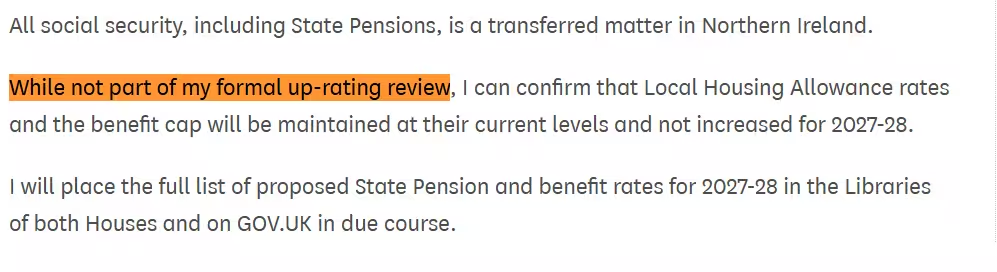
Government confirmation that Local Housing Allowance rates and the benefit cap will remain unchanged for 2027/28.
Eligible renters with a housing-cost shortfall should also ask their local council about additional help.
In England, Discretionary Housing Payments were replaced by Housing Payments under the Crisis and Resilience Fund from April 2026.
Availability and assistance depend on local eligibility rules and circumstances.
The wider question of how much Housing Benefit someone can receive is also important for households who remain eligible for that benefit.
Could London Living Rent Make Housing More Affordable?
For some London households, the solution may involve affordable housing schemes rather than conventional market-rent properties.
London Living Rent is designed to help eligible Londoners rent below market rates while building savings towards home ownership.
London City Hall’s published 2026/27 figures show an average monthly rent of approximately £1,409 for a two-bedroom London Living Rent property.
The GLA compares that amount with a December 2025 average London market rent of £2,168.
The difference is approximately £759 per month, equivalent to around £9,108 annually.
This illustrates the potential financial advantage, although it is not a direct comparison of identical homes and should not be interpreted as a guaranteed saving for every applicant.
Eligibility restrictions apply, including household income limits, London connections and housing circumstances.
London Living Rent is not available automatically to everyone whose income falls below a particular threshold.
Anyone exploring the wider pathway towards ownership can also examine how Rent to Buy works, including the differences between programmes operating in London and elsewhere in England.
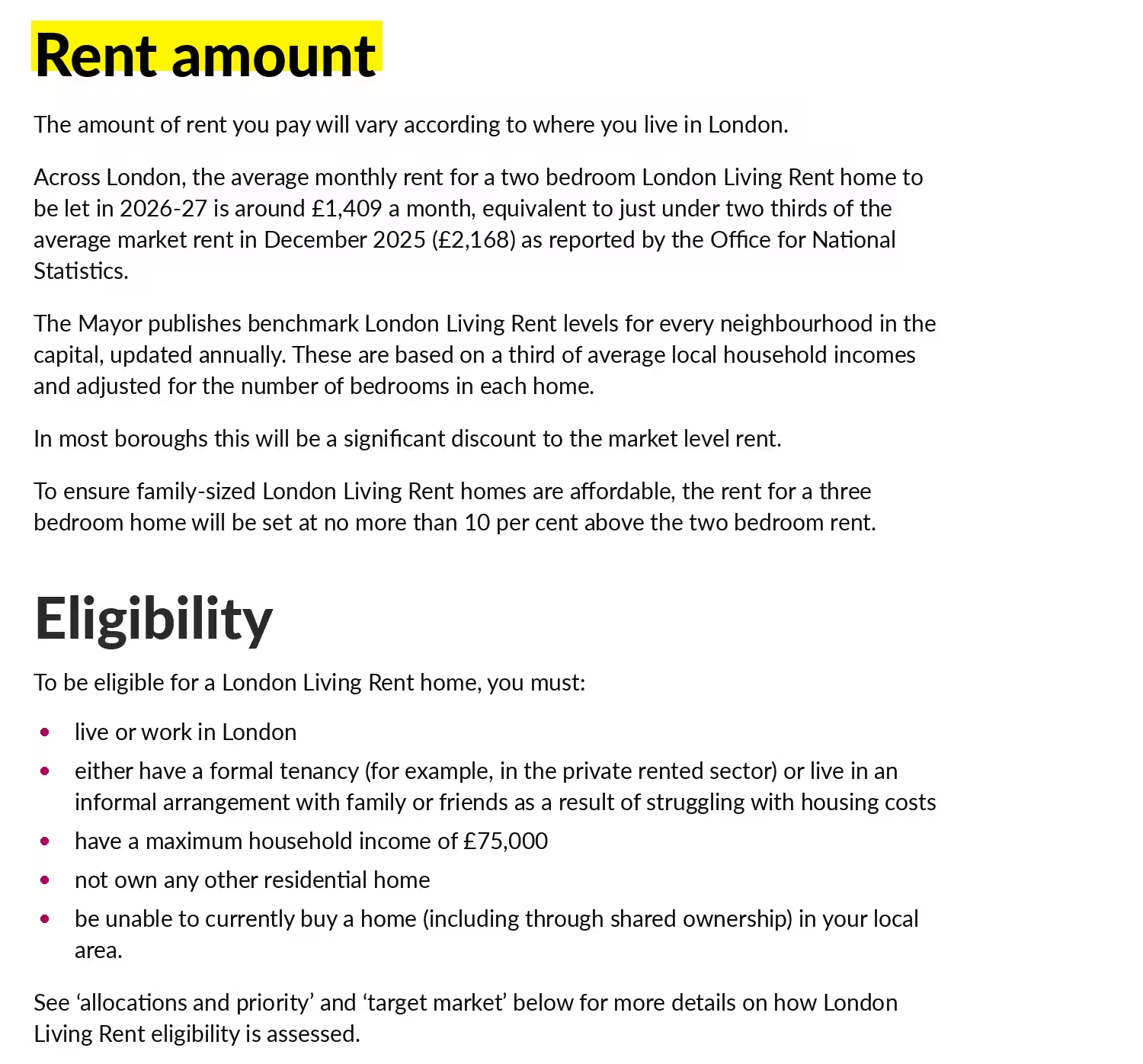
London Living Rent average monthly rents and eligibility.
How Can You Make Your Rental Budget More Sustainable in 2027?
A financially sustainable tenancy is one that can be maintained without relying on regular borrowing or consistently exhausting disposable income.
We recommend examining rent affordability across three separate dimensions.
- First, affordability at the point of application: Does the income satisfy the landlord’s referencing requirements, and can the household afford the deposit and initial rental payment?
- Second, monthly sustainability: Can the household cover rent, bills, transport, food, childcare and debt repayments while retaining capacity to save?
- Third, financial resilience: What happens when rent rises, income falls or an unexpected expense arises?
A practical process is to calculate the proposed rental cost under several scenarios.
For example, someone considering £1,500 rent could test affordability at £1,500, £1,575 and £1,620.
Those figures represent the current rent, plus illustrative 5% and 8% increases.
The renter should also investigate what happens if their take-home income temporarily falls by 10%.
If the budget becomes unsustainable after either adjustment, the tenancy may carry more financial risk than the headline salary calculation suggests.
Should You Prioritise Paying Less Rent or Saving More?
The best balance depends on the household’s financial objectives.
Someone saving towards a mortgage deposit may prefer a lower rental commitment that allows more consistent savings.
Another person may reasonably prioritise a shorter commute, better accessibility or accommodation closer to their workplace.
From a financial perspective, the important issue is whether the benefit of a more expensive property justifies its opportunity cost.
An additional £200 in monthly rent amounts to £2,400 annually.
Over three years, that is £7,200 before considering any rent changes.
That money could otherwise contribute towards emergency savings, debt repayment or a future property purchase.
The choice is not necessarily that cheaper rent is always better. It is that every additional pound spent on housing reduces the amount available for other priorities.
What Are the Most Common Rent Affordability Mistakes?
One of the most frequent mistakes is confusing the largest rent a landlord might approve with the largest rent a household should pay.
Other potentially costly mistakes include relying on gross salary rather than take-home income, failing to consider annual expenses, treating four weeks as a calendar month, overlooking Council Tax and ignoring how moving affects commuting costs.
Some renters also assume that a property with bills included automatically offers better value.
A higher inclusive rent may be worthwhile if it genuinely reduces total expenditure, but that should be established through a like-for-like comparison.
For couples, using combined income without considering what happens if one salary disappears can create additional risk.
For self-employed renters, relying on unusually strong trading months can lead to similar problems.
Finally, renters planning ahead for 2027 should avoid assuming that benefits, earnings, market rents or household costs will all increase at the same rate.
The government has confirmed a freeze in LHA rates for 2027/28, while actual market rental prices will depend on future supply, demand and local conditions.
Our findings therefore support a more cautious approach: use salary to establish a provisional rent range, use actual monthly expenditure to determine affordability, and use a financial stress test to judge resilience.
How Much Rent Can I Afford in 2027? Final Assessment
There is no universal rental budget that is suitable for every income level or household.
The 30% gross-income rule provides a useful initial benchmark, while many letting agents use a higher income threshold for referencing.
For someone earning £40,000 a year, those approaches can produce figures of £1,000 and approximately £1,333 per month respectively.
The true affordable amount depends on take-home income, household expenses, savings requirements and financial stability.
London’s rental market makes these distinctions particularly important. Average monthly private rent reached £2,338 in September 2026, while advertised rents for properties entering the market could be substantially higher.
For tenants moving in 2027, the right strategy is to calculate the total housing cost rather than focus solely on the advertised rent.
Council Tax, utilities, commuting, upfront deposits and unexpected expenditure can all change whether a tenancy is financially manageable.
The most sustainable rental arrangement is not necessarily the most expensive property someone can qualify for.
It is one that allows the household to maintain essential spending, meet its commitments and preserve sufficient financial flexibility for the future.
Frequently Asked Questions
How Much Rent Can I Afford on £30,000 a Year?
Using the 30% gross-income rule, a salary of £30,000 suggests approximately £750 monthly rent. A common referencing calculation of annual salary divided by 30 produces £1,000 per month. Actual affordability depends on take-home pay and expenses.
How Much Rent Can I Afford on £40,000 a Year?
A £40,000 gross annual salary produces a 30% rental benchmark of £1,000 per month. A common 40% gross-income referencing test gives approximately £1,333. The higher figure is not automatically comfortable or advisable.
How Much Rent Can I Afford on £50,000 a Year?
A £50,000 annual salary produces a 30% benchmark of £1,250 per month. A common 30-times-rent referencing test gives approximately £1,667. The appropriate budget will depend on deductions, debts, household bills and savings requirements.
Is Spending 40% of Income on Rent Too Much?
Not necessarily, but it represents a higher housing commitment than the commonly used 30% gross-income guideline. Its suitability depends on whether the percentage refers to gross or net income and whether sufficient money remains for all other expenses.
How Much Rent Should a Couple Pay With £60,000 Combined Income?
Thirty per cent of £60,000 gross annual household income equals £18,000 per year, or £1,500 per month. A common referencing test could produce approximately £2,000, but the couple should calculate affordability using combined take-home income and essential spending.
Will Rent Be More Expensive in London in 2027?
The average private rent in London reached £2,338 in September 2026, up 3.5% annually. Future rents will depend on local supply, demand and market conditions. No single official 2027 annual rent figure was available at the time of this update.
Does Universal Credit Pay the Full Amount of Private Rent?
It can contribute towards eligible private rental costs, but the amount is subject to Local Housing Allowance limits and wider benefit rules. Some households receive less than their contractual rent and must cover a shortfall. The government has confirmed that LHA rates will remain frozen for 2027/28.
Can I Rent a Property if My Salary Fails the Affordability Check?
Possibly. Some landlords or referencing companies consider guarantors, joint incomes, employment evidence or other circumstances. Approval depends on the provider’s actual criteria, and the tenant should still independently assess whether the rent is financially sustainable.
Adam is a London business and news writer at London Insider News, covering local developments, finance, entrepreneurship and the stories shaping businesses and communities across the capital.
More from RENTING

Right to Rent Share Code 2027: How to Get, Generate and Check Your Code Online?
Updated: 4 November 2026 | 2027 Guide A Right to Rent share code is a nine-character…

How Much Housing Benefit Can I Get in 2027? UK Rates, Eligibility, Rent Calculations and 2026 Updates
How much Housing Benefit can I get in 2027? You could receive financial assistance covering up…

How Much Housing Benefit Am I Entitled to for Private Renting in 2027? Updated UK and London Guide
If you rent privately in London or elsewhere in the UK, you may qualify for financial…