Right to Rent Share Code 2027: How to Get, Generate and Check Your Code Online?
Learn how to get and check a Right to Rent share code in 2027, including the latest 2026 Home Office updates, 90-day validity, landlord responsibilities, verification rules and penalties.
 Adam
London Business & News Writer

Updated: 4 November 2026 | 2027 Guide
A Right to Rent share code is a nine-character code that allows landlords and letting agents in England to verify a prospective tenant’s immigration status using the Home Office online checking service. The code is valid for 90 days, can be reused during that period and is free to generate.
For tenants preparing to rent in 2027, understanding how to obtain and share the correct code can prevent delays during property applications.
For landlords, carrying out checks correctly is a legal compliance requirement, with potential civil penalties reaching £20,000 per occupier for repeat breaches.
The rules also changed during 2026. Updated Home Office guidance introduced on 1 October 2026 strengthened digital identity verification requirements, expanded acceptable digital evidence and clarified how landlords should handle eVisas and registered verification providers.
Our analysis of official immigration guidance, landlord compliance requirements and published property-sector commentary shows that the main challenge is not generating the code itself. It is ensuring the correct checking method is used, evidence is retained and follow-up checks are completed where necessary.
This guide explains the process for 2027, based on the latest confirmed 2026 rules, including eligibility, costs, verification, common problems, penalties and practical considerations for London renters.
What Is a Right to Rent Share Code?
A Right to Rent share code is a digital verification code issued through the UK Home Office’s immigration status service.
It allows a landlord or letting agent to check whether a prospective tenant has permission to rent residential accommodation in England.
Rather than relying solely on physical immigration documents, eligible tenants can generate a share code linked to their digital immigration record.
The landlord uses the code together with the tenant’s date of birth to access the official verification result.
| Feature | Right to Rent share code details |
| Issuing authority | UK Home Office |
| Code length | 9 characters |
| First character | R |
| Validity | 90 days |
| Application fee | £0 |
| Number of uses | Unlimited within validity |
| Required information | Share code and date of birth |
| Applicable location | England |
| Main purpose | Verify eligibility to rent |
| Official service | GOV.UK |
A key distinction is that a share code is not a visa, tenancy agreement or independent immigration permission. It simply allows an authorised checker to view information from the Home Office system.
For example, someone relocating to London on a Skilled Worker visa may use an eVisa-linked share code to demonstrate their right to rent a flat.
The landlord can then complete the required verification before granting the tenancy.
How Do You Get a Right to Rent Share Code Online in 2027?
Getting a share code is generally straightforward for people who already have access to their UKVI account or eligible immigration details.
The government provides an official online service for generating the code.
Step 1: Visit the Official GOV.UK Service
Open the Right to Rent share code service.
This page explains who can use the digital checking process and what information is required.
Select Start now to begin.
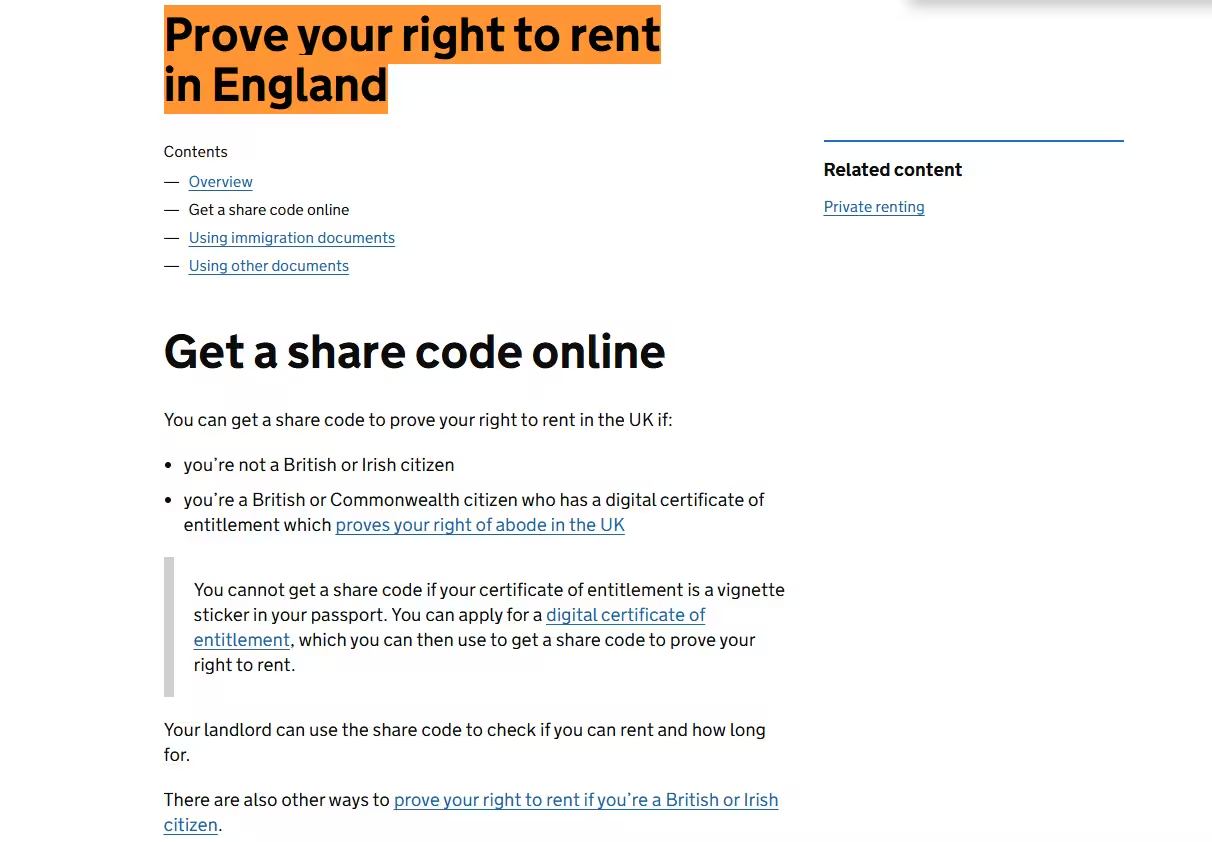
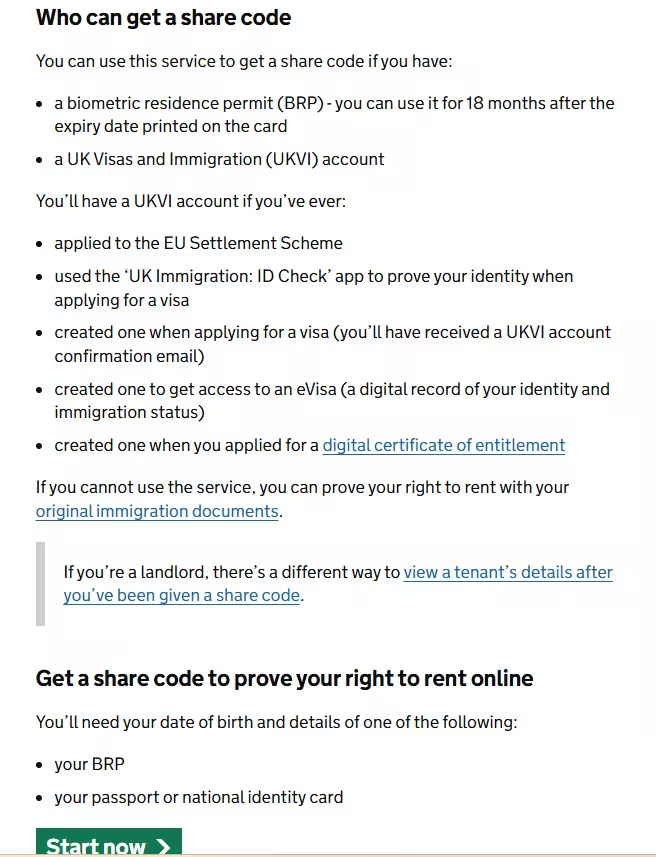
Official GOV.UK Right to Rent share code service showing the eligibility information and Start now button.
Step 2: Enter Your Identity Information
The service asks users to confirm their identity using eligible immigration account details.
Depending on their circumstances, this may include:
- Passport details
- National identity card details
- Biometric Residence Permit (BRP) information
- Date of birth
- UKVI account authentication
A person may be able to use an expired BRP to access their digital status within the period permitted by the Home Office. However, the physical BRP itself is not acceptable proof of the right to rent.
Step 3: Choose the Correct Sharing Purpose
After accessing the relevant immigration status service, choose the option to prove your right to rent in England.
This is important because the Home Office issues different share codes for different purposes.
The correct Right to Rent code begins with the letter R.
Step 4: Generate Your Share Code
Once the process is completed successfully, the service generates a nine-character code.
The tenant can provide this code to the landlord or letting agent, together with their date of birth.
Step 5: Share the Code Securely
The landlord can use the code through the separate Home Office checking service.
Tenants should share the code and required identity details only with the relevant landlord, authorised letting agent or another party legitimately conducting the check.
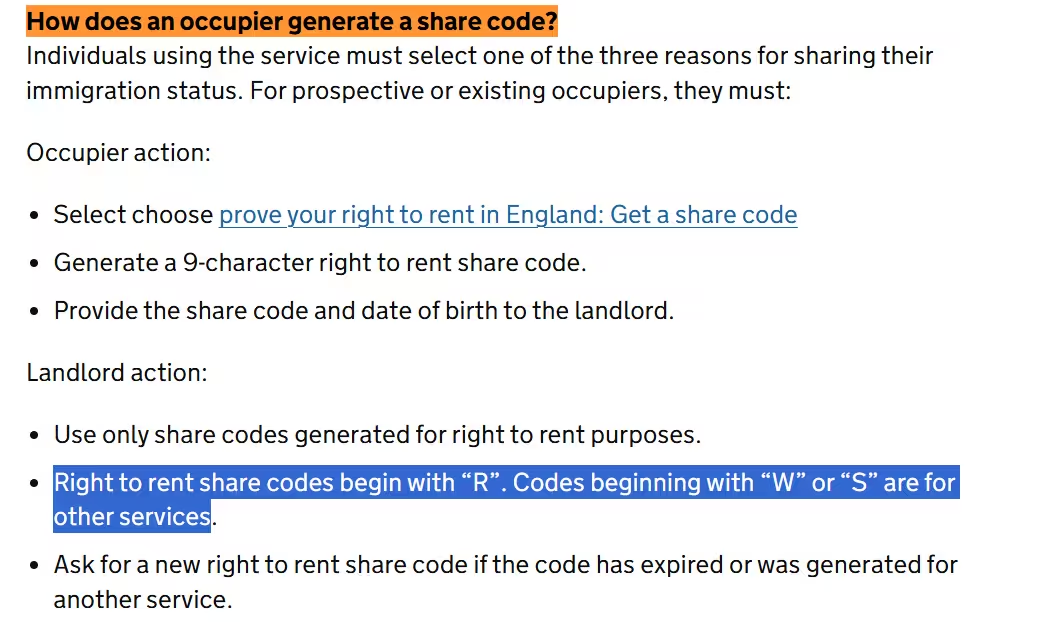
Home Office guidance illustrating how a tenant generates a nine-character Right to Rent share code.
Who Needs a Right to Rent Share Code?
Not everyone renting in England needs a share code.
The appropriate method depends on nationality, immigration status and the documents available.
A share code is commonly relevant to people with digital immigration status, including those with an eVisa and many people covered by the EU Settlement Scheme.
| Tenant category | Typical verification method |
| British citizen | Accepted identity documents or registered digital verification service |
| Irish citizen | Accepted identity documents or registered digital verification service |
| Skilled Worker visa holder with eVisa | Right to Rent share code |
| Student visa holder with eVisa | Right to Rent share code |
| Graduate visa holder with eVisa | Right to Rent share code |
| EU settled status holder | Home Office online check |
| EU pre-settled status holder | Home Office online check |
| Indefinite Leave to Remain holder | Digital or accepted documentary evidence, depending on status |
| Person awaiting an immigration decision | Share code, acceptable evidence or Home Office checking service, as applicable |
| Person with a physical BRP | Online check rather than relying on the card itself |
British and Irish citizens generally demonstrate their right to rent using accepted documents rather than a share code.
For example, a British passport may establish an unlimited right to rent, even where the passport has expired, provided it meets the applicable manual-checking requirements.
The choice of method should reflect the person’s actual circumstances, rather than assumptions based on nationality.
What Changed in Right to Rent Checks During 2026?
The most important confirmed developments for landlords preparing for 2027 relate to the government’s October 2026 updates.
The Home Office introduced updated landlord guidance and statutory codes of practice effective from 1 October 2026.
These changes strengthen the rules governing digital verification services and reflect the wider transition towards eVisas.
Registered Digital Verification Providers
Where landlords use a digital verification service provider (DVSP) to complete prescribed checks, the provider must be appropriately registered and authorised for Right to Rent verification.
Providers must meet the relevant digital identity trust framework and supplementary-code requirements.
Landlords should not assume that any commercial identity-checking platform automatically meets the legal requirements.
Wider Digital Document Verification
The updated framework supports additional forms of acceptable digital evidence.
Registered providers may verify eligible British and Irish passports, including certain passports that expired within the previous six months, subject to the specific technological and verification requirements.
This six-month allowance relates to the relevant digital verification process. It should not be confused with the separate manual document rules.
Growing Use of eVisas
The Home Office’s transition towards digital immigration status continued during 2026.
From 1 July 2026, visa vignettes ceased to be issued as evidence of immigration permission under the updated arrangements.
Where a person holds only an eVisa, landlords must use the prescribed online checking route to establish the relevant statutory protection.
Existing valid documents may still be usable in particular circumstances specified in the guidance.
Stronger Anti-Discrimination Guidance
The 2026 code also emphasises consistent treatment of prospective tenants.
Landlords must not reject applicants simply because they have time-limited immigration permission or because they use a different legally accepted verification method.
These are confirmed changes. As of 4 November 2026, we have not identified a separate 2027 rule replacing the current share-code process.
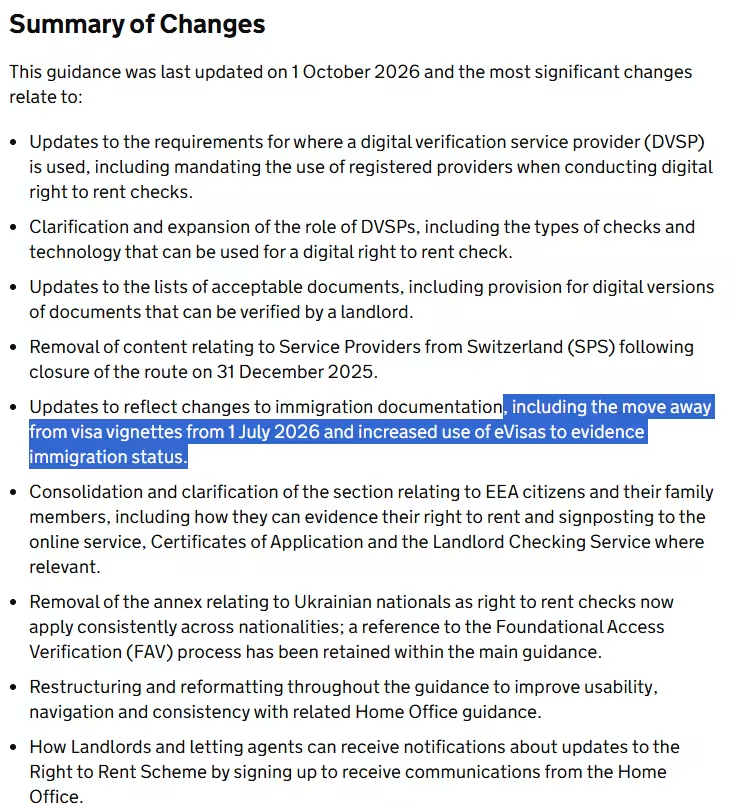
Updated Home Office Right to Rent guidance effective from 1 October 2026, highlighting the changes to digital verification.
How Can Landlords Check a Right to Rent Share Code?
A tenant generating a valid code is only the beginning of the process.
To establish a statutory excuse against a civil penalty, the landlord must conduct the prescribed check.
The landlord should access the official Check a tenant’s right to rent service.
The Three-Step Verification Process
1. Enter the Tenant’s Details
The landlord enters the nine-character share code and tenant’s date of birth.
2. Confirm Identity and Eligibility
The service displays the tenant’s relevant immigration information and photograph.
The landlord must confirm that the result relates to the person who intends to occupy the property.
This identity comparison can be completed in person, by live video call or through an eligible registered verification provider using the prescribed method.
3. Retain Evidence
The landlord must save the relevant online profile page, including the verification result and checking date.
Simply receiving a code or viewing a screenshot supplied by a tenant does not satisfy the prescribed online process.
| Checking requirement | Why it matters |
| Valid R share code | Confirms the correct checking service |
| Matching date of birth | Allows the record to be accessed |
| Photograph comparison | Helps prevent identity fraud |
| Official Home Office result | Establishes the relevant immigration eligibility |
| Check completion date | Demonstrates when verification occurred |
| Saved verification record | Supports compliance evidence |
| Follow-up deadline | Helps maintain statutory protection |
This process is particularly important for private landlords who manage properties without a letting agent.
Anyone planning to rent out a house should treat immigration eligibility checks as part of the wider legal onboarding process, alongside referencing, property safety and deposit arrangements.
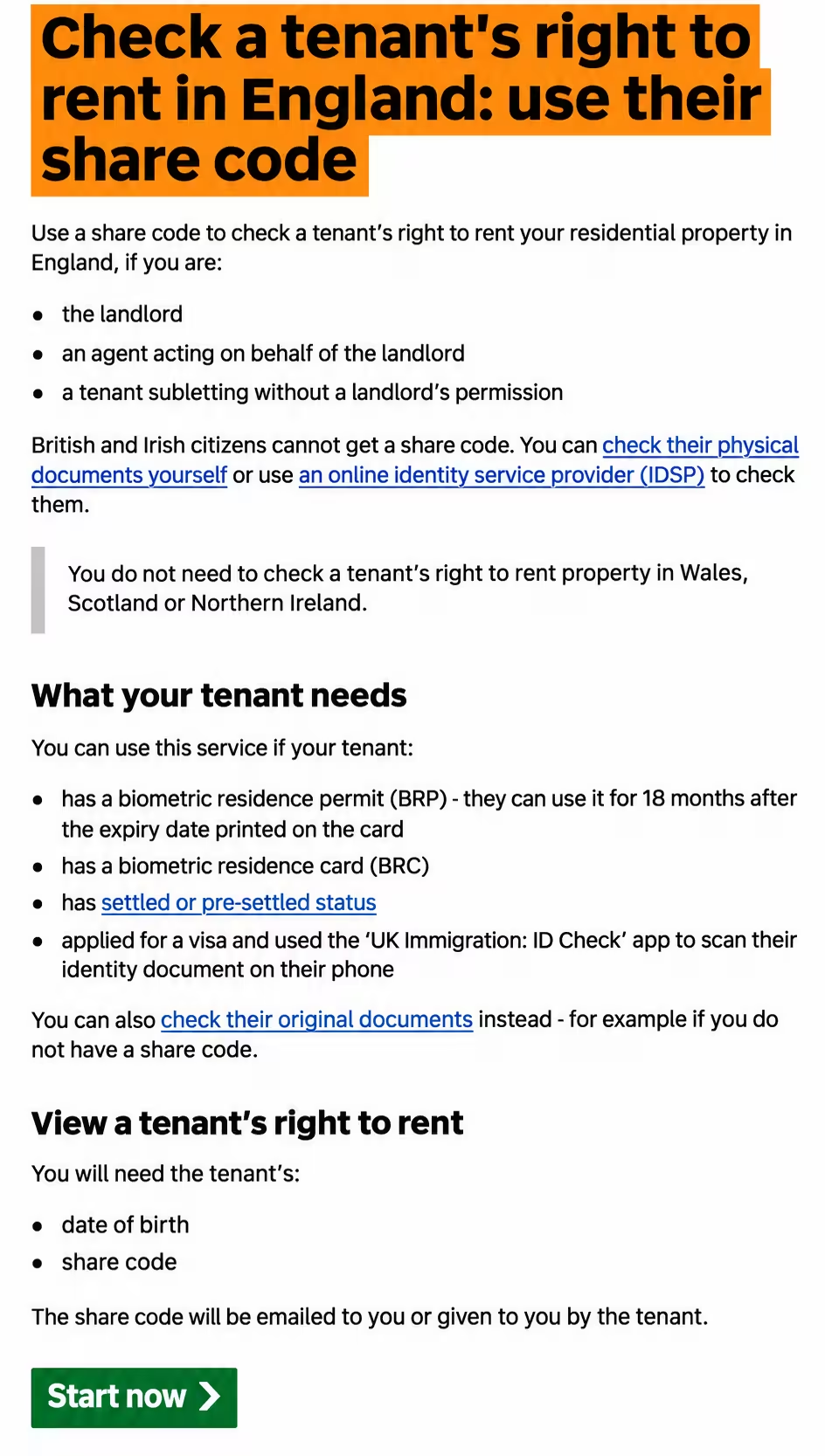
Official Home Office landlord verification service for checking a tenant’s Right to Rent share code.
How Long Does a Right to Rent Share Code Last?
A Right to Rent share code remains valid for 90 days from the date it is generated.
It can be used multiple times during that period.
A tenant viewing several properties therefore does not necessarily need to generate a separate code for every landlord.
However, once the 90-day period ends, the code can no longer be used for a new verification.
| Situation | What happens |
| Code generated today | Valid for 90 days |
| Two landlords need verification | Same code can be reused while valid |
| Code expires before checking | Generate another code |
| Tenant’s visa is extended | Generate or provide updated evidence when required |
| Tenancy continues beyond 90 days | No automatic new code required solely because the old code expires |
| Landlord must perform a follow-up check | Fresh verification may be required |
A common misunderstanding is that the expiration of the share code means the tenant’s immigration permission has ended.
These are two separate matters.
The code controls how long a particular verification reference can be used. The tenant’s immigration permission is governed by the actual status recorded by the Home Office.
For landlords, the relevant follow-up date is determined by the statutory excuse and the verification result, not simply by the code’s 90-day lifespan.
Is a Right to Rent Share Code Free?
Yes. Generating a Right to Rent share code through the official Home Office service costs £0.
There is also no Home Office fee for landlords using the official share-code checking service.
Some commercial referencing and digital identity verification companies may charge landlords for wider services.
These costs are separate from obtaining a government share code.
| Service | Cost |
| Generate official share code | Free |
| Renew expired share code | Free |
| Landlord checks code on GOV.UK | Free |
| Use existing code again within 90 days | Free |
| Optional commercial identity verification | Provider-dependent |
| Optional tenancy referencing package | Provider-dependent |
Our financial assessment is that the official verification service itself should not create an additional application cost for tenants.
However, landlords may incur administrative expenses when managing compliance, storing records or purchasing optional property-management services.
It is also important to distinguish the government share code from a tenancy deposit, rent in advance or other lawful tenancy-related payments.
For London renters comparing properties, the advertised PCM rent remains a separate financial consideration.
How Do Right to Rent and Right to Work Share Codes Differ?
The Home Office operates different verification services for renting, employment and other immigration-status purposes.
These codes are not interchangeable.
| Code type | Starts with | Purpose |
| Right to Rent | R | Verify residential renting eligibility |
| Right to Work | W | Verify employment eligibility |
| Other immigration-status sharing | S | Other permitted status checks |
A landlord cannot use a Right to Work code beginning with W as a substitute for a Right to Rent code.
Likewise, a prospective employer should not use a Right to Rent code to complete employment verification.
For example, an international employee relocating to London may need two different codes: one for their employer and one for their prospective landlord.
The same immigration status may underpin both checks, but the Home Office requires the appropriate verification route for each purpose.
Our assessment is that checking the first character before sending the code is one of the simplest ways to avoid unnecessary administrative delays.
Can a Landlord Refuse a Tenant Without a Share Code?
A landlord cannot automatically reject someone merely because they cannot produce a share code.
The correct action depends on whether the person can demonstrate their right to rent through another prescribed method.
British and Irish citizens generally do not use the share-code system.
Certain other applicants may have acceptable original immigration documents, while others require a Home Office verification through the Landlord Checking Service.
The updated 2026 anti-discrimination guidance makes clear that landlords must apply checks consistently and avoid treating prospective tenants less favourably because of their nationality or the type of acceptable evidence they provide.
A tenant with a legitimate right to rent should not be excluded simply because their eligibility must be confirmed through an alternative process.
Timothy Douglas, Head of Policy and Campaigns at Propertymark, highlighted the challenges associated with digital immigration reform in published commentary during 2025, stressing that “it is vital that they continue to engage with the sector to ensure the reforms are fit for purpose.”
That observation remains relevant as landlords adapt to the updated digital verification requirements.
From a business perspective, effective compliance should protect landlords without unnecessarily restricting the pool of eligible tenants.
What Happens If Your Right to Rent Share Code Is Not Working?
Several common issues can prevent a landlord from completing verification.
These problems do not necessarily mean the tenant lacks immigration permission.
| Problem | Possible explanation | Recommended action |
| Invalid share code | Incorrect characters or wrong code type | Check the code and generate an R code |
| Expired code | More than 90 days have passed | Generate a new code |
| Date of birth mismatch | Incorrect information entered | Confirm the date of birth |
| UKVI login problem | Account access issue | Use UKVI account recovery or support |
| Incorrect immigration details | Digital record may contain an error | Report the problem to UKVI |
| No share code available | Status may require another checking method | Consider accepted evidence or the Landlord Checking Service |
| Status under review | Outstanding immigration application or appeal | Follow the prescribed verification route |
Problems With an eVisa
If a tenant can access their eVisa but the information is wrong, they should use the Home Office’s official error-reporting process.
Examples include:
- Incorrect date of birth
- Incorrect immigration status
- Missing or inaccessible immigration information
- An inability to generate a share code despite having an accessible eVisa
The Home Office aims to resolve most reported eVisa errors within five working days, although complex cases can take longer.
Landlords should not attempt to bypass required checks by accepting a tenant’s account screenshot as proof.
When the Landlord Checking Service Is Needed?
The Home Office Landlord Checking Service provides an alternative means of verifying eligibility in specified situations.
It may be appropriate when a person has an outstanding immigration application, appeal or another status that requires Home Office confirmation.
The service generally aims to respond within two working days.
A positive response can establish a time-limited statutory excuse, normally lasting 12 months from the date specified in the notice.
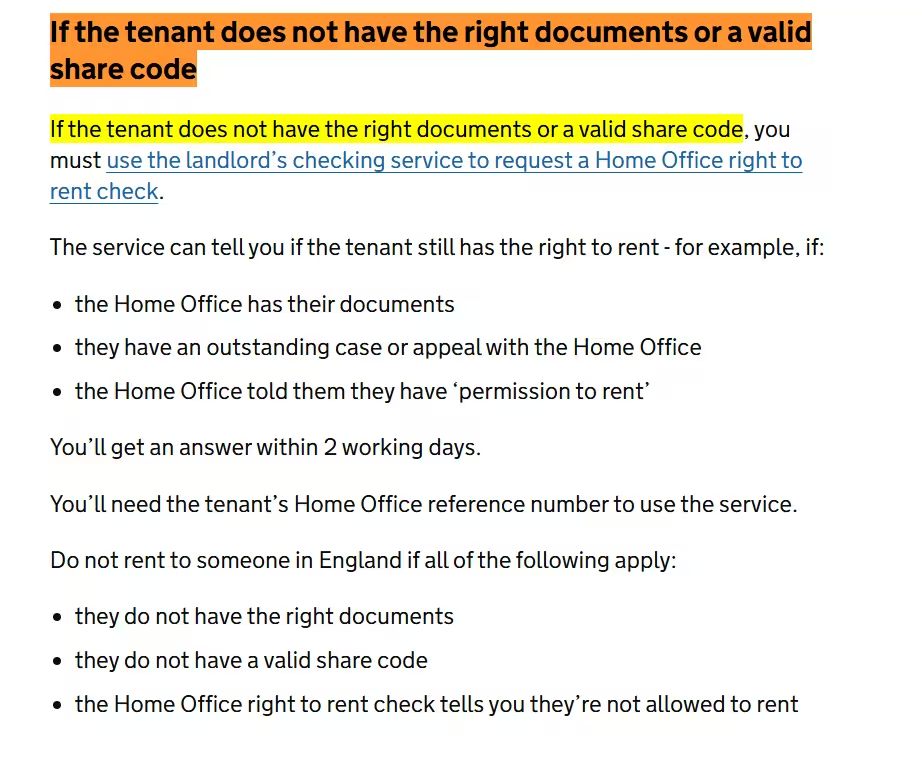
Home Office guidance explaining when landlords should use the Landlord Checking Service if a tenant cannot provide a valid share code or acceptable documents.
When Must Landlords Carry Out Right to Rent Checks?
Timing is a critical part of compliance.
The Home Office distinguishes between applicants with an unlimited right to rent and those with time-limited permission.
For an unlimited right to rent, checks can generally be conducted at any time before entering into the tenancy agreement.
For someone with time-limited permission, the prescribed initial check must be completed no earlier than 28 calendar days before the tenancy agreement is entered into.
This is not necessarily the same as 28 days before moving in.
Follow-Up Requirements
Landlords must carry out follow-up verification where required to maintain their statutory excuse.
The appropriate deadline depends on the status and evidence involved.
| Immigration position | Follow-up requirement |
| British or Irish citizen with unlimited right | Normally none |
| Indefinite Leave to Remain | Normally none once unlimited right verified |
| EU settled status | Normally none |
| EU pre-settled status under the applicable EUSS checking rules | Normally no repeat check after a prescribed initial check |
| Time-limited visa | Follow the applicable statutory excuse or online-check deadline |
| Positive Right to Rent Notice | Normally after 12 months, if the tenant remains |
| New permission granted after earlier limited status | Verify as required to maintain the statutory excuse |
The important distinction is between a tenant’s immigration permission and the duration of the landlord’s statutory excuse.
They may not always expire on the same date.
Landlords should therefore rely on the applicable Home Office checking result and guidance rather than assume every tenant needs a repeat check when their original visa date approaches.
What Are the Penalties for Not Completing Right to Rent Checks?
Landlords in England can face significant civil penalties when they rent to an individual who is disqualified because of their immigration status and fail to establish the required statutory excuse.
The penalty framework distinguishes between lodgers and other occupiers, as well as first and repeat breaches.
| Breach category | First breach | Repeat breach within 3 years |
| Lodger | £5,000 | £10,000 |
| Other residential occupier | £10,000 | £20,000 |
These amounts apply per disqualified person, subject to the Home Office’s assessment and the statutory framework.
For example, a repeat breach involving two disqualified residential occupiers could potentially create £40,000 in civil penalty exposure.
That is an illustrative calculation, not an automatic penalty for every administrative mistake.
The Home Office must assess the circumstances, including whether the landlord established a valid statutory excuse.
Can a Landlord Receive a Penalty Reduction?
The framework includes a Faster Payment Option for eligible first breaches.
Where the prescribed conditions are met, paying within the required 21-day period can reduce the penalty by 30%.
| Initial penalty | 30% reduction | Reduced amount |
| £5,000 | £1,500 | £3,500 |
| £10,000 | £3,000 | £7,000 |
The option does not generally apply to repeat breaches or where the relevant instalment-payment arrangements apply.
A landlord should review the penalty notice and the available objection or appeal procedures before deciding how to respond.
For anyone operating a letting business, the financial comparison is substantial: the official Right to Rent check is free, whereas an avoidable compliance failure may create thousands of pounds in liability.
Who Is Responsible When a Letting Agent Manages the Property?
A landlord may appoint a letting agent to perform Right to Rent checks.
However, responsibility should be agreed and recorded in writing.
The agreement should specify whether the agent is responsible for:
- Initial eligibility verification
- Collecting relevant documentation
- Saving the verification evidence
- Monitoring follow-up deadlines
- Making required Home Office reports
Where responsibility is properly transferred to an agent in writing, the applicable civil penalty liability can rest with that agent.
Without a clear written arrangement, landlords should not simply assume the agent has accepted legal responsibility.
The distinction also matters for rent-to-rent businesses, subletting arrangements and individuals who take in lodgers.
Someone subletting accommodation may become responsible for conducting checks unless the superior landlord agrees in writing to accept that responsibility.
Property investors assessing a rental business should therefore consider verification compliance alongside cash flow, maintenance, insurance and legal administration.
Do Right to Rent Checks Apply to Every Person Living in a Property?
The scheme generally applies to adults aged 18 or over who will occupy relevant accommodation as their only or main home.
Checks are required regardless of the person’s nationality.
Children do not ordinarily need an individual Right to Rent check.
For a shared rental property, the landlord should identify all adult occupiers who fall within the checking requirement, rather than limiting checks to whichever person signs the agreement first.
This can be especially relevant in London’s house-share market, where properties may be occupied by several unrelated adults.
A person renting a room should also understand the difference between legal eligibility, affordability and tenancy arrangements.
Those are separate parts of the wider London rental process.
The Right to Rent Scheme applies in England. It does not currently impose equivalent immigration-status checking obligations on private landlords in Scotland, Wales or Northern Ireland.
How Should Landlords Store Right to Rent Records?
Record keeping is essential because landlords may need to demonstrate that the prescribed verification was performed correctly.
A landlord conducting an online check should retain a clear copy of the verification profile page, including the photograph and date.
The records must be kept securely for the duration of the tenancy and for at least one year after it ends.
They must then be securely destroyed.
From an operational perspective, landlords can reduce the likelihood of missed checks by maintaining a controlled compliance register.
| Record | Purpose |
| Tenant identifier | Connects the record with the correct occupier |
| Verification date | Confirms when the check was completed |
| Checking method | Identifies the prescribed route used |
| Verification result | Records the eligibility confirmation |
| Evidence location | Allows authorised retrieval |
| Follow-up deadline | Helps prevent expiry of statutory protection |
| Record destruction date | Supports data retention compliance |
Such records should be accessible only to appropriately authorised people.
Landlords should also follow applicable data protection requirements and avoid keeping unnecessary copies of sensitive documents.
How Useful Is the Digital Right to Rent System for Landlords and Tenants?
Our editorial assessment considers the official system’s cost, functionality, documentation requirements and accessibility.
These ratings are editorial judgments, not survey findings, verified user-satisfaction statistics or results of hands-on platform testing.
| Assessment area | Editorial rating | Reason |
| Cost transparency | 100% | Official share-code generation and checking are free |
| Code reusability | 95% | One code can be used repeatedly for 90 days |
| Compliance documentation | 95% | Official verification output provides a record |
| Process clarity | 90% | Separate tenant and landlord services provide defined steps |
| Accessibility | 75% | Digital access problems and immigration-record errors can create difficulties |
The strongest advantages are the absence of government checking fees and the ability to verify eligible immigration status through a central system.
However, a convenient digital process does not eliminate the need for judgement.
Landlords must still verify the individual’s identity, retain the correct evidence and handle exceptional cases appropriately.
An online verification system is only as effective as the compliance process surrounding it.
What Should Tenants and Landlords Prepare for in 2027?
The October 2026 changes provide the confirmed regulatory starting point for planning Right to Rent checks in 2027.
Tenants expecting to relocate should ensure their UKVI information is accurate and accessible.
For applicants who depend on digital immigration evidence, identifying account problems before beginning a property search may help avoid administrative delays.
Landlords should review their processes against the latest Home Office requirements, particularly where third-party digital identity services are used.
Our recommended priorities are:
- Confirm that the correct Right to Rent evidence is requested for each applicant.
- Verify any outsourced digital-checking provider’s applicable registration.
- Complete checks within the required timeframe.
- Keep official verification evidence securely.
- Monitor follow-up deadlines and changes to immigration status.
- Apply the same fair checking standards to all prospective adult tenants.
For tenants, immigration eligibility is only one part of moving into rented accommodation.
It is also worth assessing rental affordability before committing to a property.
Likewise, households receiving eligible assistance can separately consider Universal Credit support towards private rent.
Neither household income nor benefit entitlement replaces the legal requirement to complete the appropriate immigration-status checks.
Conclusion
A Right to Rent share code remains an important part of the residential letting process in England as tenants and landlords prepare for 2027. The free nine-character code lasts 90 days and enables the Home Office to confirm whether an eligible person can rent accommodation.
The October 2026 guidance introduced clearer digital verification requirements and stronger safeguards against discrimination. For landlords, completing checks correctly, retaining evidence and meeting follow-up deadlines can prevent substantial financial exposure.
For tenants, the priority is ensuring digital immigration records are accurate and generating the correct R-prefixed code. Both parties should follow current Home Office guidance rather than outdated checking procedures.
Frequently Asked Questions
How do I get a Right to Rent share code in 2027?
Visit the official GOV.UK Right to Rent service, sign in using eligible immigration details and select the option to prove your right to rent in England. The system will generate a nine-character code.
How long is a Right to Rent share code valid?
A code remains valid for 90 days from generation. It can be used multiple times during that period, and a fresh code can be generated free of charge after expiry.
Can I use my Right to Work share code for renting?
No. A Right to Rent share code begins with R, while a Right to Work code begins with W. Landlords must use the correct code with the prescribed Home Office checking service.
Do British citizens need a Right to Rent share code?
British citizens generally prove their eligibility using accepted identity or nationality documents. A passport or another prescribed checking method can establish their unlimited right to rent.
Can I rent in England without a share code?
Yes, if you can demonstrate eligibility through another legally accepted method. In specified circumstances, a landlord can obtain verification through the Home Office Landlord Checking Service.
What happens if my visa expires during a tenancy?
The landlord may need to conduct a follow-up check before the relevant statutory excuse expires. An in-time immigration application may preserve existing rights while a decision is pending, subject to the applicable rules.
Does a landlord need a new share code every 90 days?
No. The code’s expiration does not automatically require another check. Follow-up verification depends on the tenant’s immigration position and the statutory excuse or deadline specified by the Home Office.
Can a letting agent check my Right to Rent share code?
Yes. An authorised letting agent can use the Home Office checking service. Where responsibility for compliance is transferred to the agent, the arrangement should be recorded in writing.
Do Right to Rent checks apply in Scotland or Wales?
No. The Home Office Right to Rent Scheme currently applies to eligible private residential accommodation in England. Scotland, Wales and Northern Ireland do not operate the same scheme.
Is generating a Right to Rent share code completely free?
Yes. The official Home Office share-code service is free for tenants, and landlords can verify codes through GOV.UK without paying a government checking fee.
Adam is a London business and news writer at London Insider News, covering local developments, finance, entrepreneurship and the stories shaping businesses and communities across the capital.
More from RENTING

How Much Housing Benefit Can I Get in 2027? UK Rates, Eligibility, Rent Calculations and 2026 Updates
How much Housing Benefit can I get in 2027? You could receive financial assistance covering up…

How Much Housing Benefit Am I Entitled to for Private Renting in 2027? Updated UK and London Guide
If you rent privately in London or elsewhere in the UK, you may qualify for financial…

How Much Can a Landlord Increase Rent in London? 2026 Rules Explained
For most private renters in London, there is no fixed legal percentage cap limiting a landlord…