London Congestion Charge Times 2027: Daily Hours, Weekends and Free Driving Periods
Plan your journey through central London with the latest Congestion Charge operating hours, 2027 bank holiday schedules, payment deadlines and practical ways to avoid unnecessary charges.
 Hannah
London Lifestyle & Consumer Writer
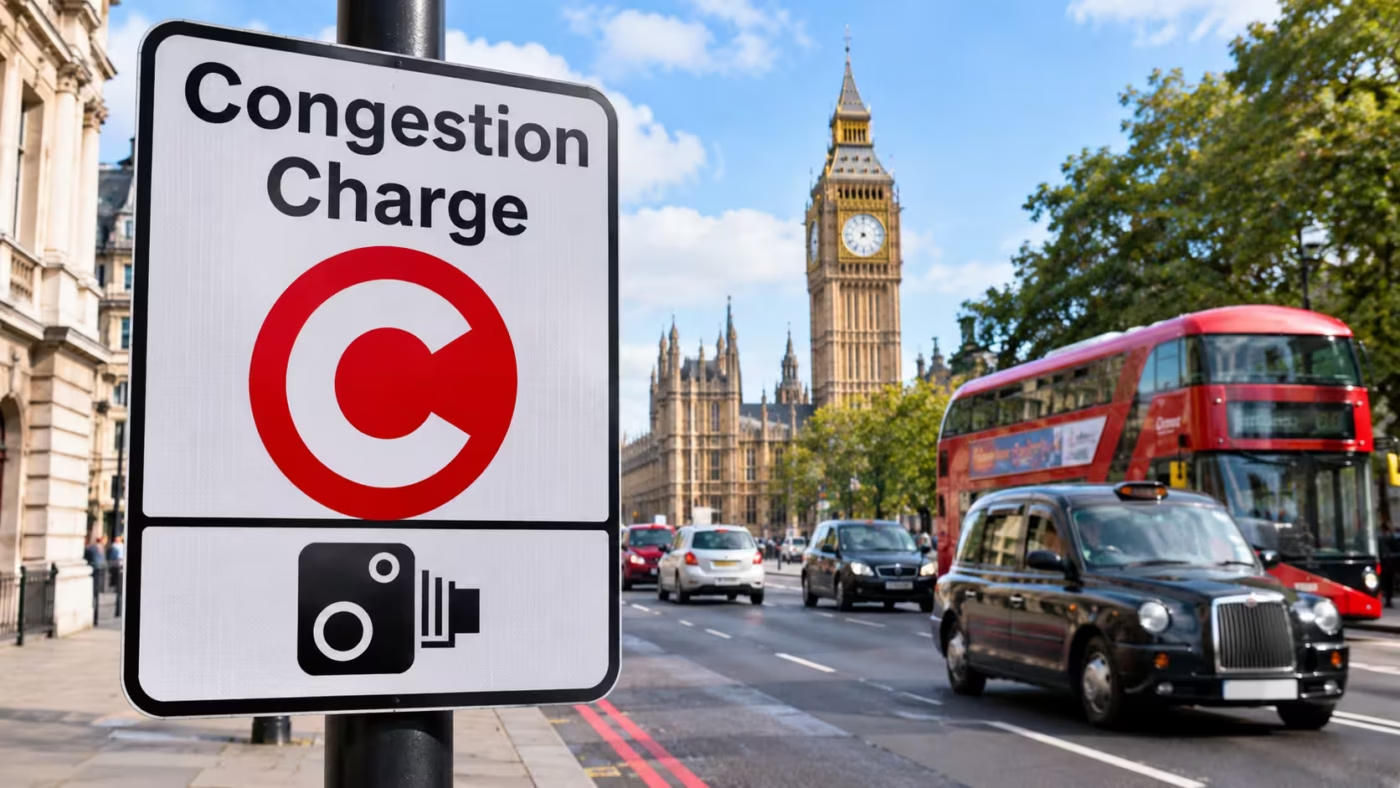
The London Congestion Charge times are 7am to 6pm from Monday to Friday and 12pm to 6pm on Saturdays, Sundays and bank holidays.
Motorists driving within the designated central London charging zone during these hours generally need to pay a daily fee of £18 unless they qualify for an exemption or discount.
The Congestion Charge does not operate overnight or during the annual festive suspension between Christmas Day and the New Year’s Day bank holiday, inclusive.
Although the standard daily charge increased from £15 to £18 in January 2026, the regular operating hours remain unchanged under the currently published rules for journeys planned in 2027.
Understanding when the charge starts and finishes can help commuters, tourists, delivery drivers and business owners reduce unnecessary travel expenses and avoid penalties.
What Are the London Congestion Charge Times?
The London Congestion Charge operates seven days a week, with different starting times for weekdays and weekends.
Transport for London (TfL) manages the scheme to discourage unnecessary vehicle journeys through central London during busy periods.
The following table shows the current charging hours and when motorists can drive without incurring the Congestion Charge.
| Day | Congestion Charge Times | Congestion Charge-Free Hours |
| Monday | 7am – 6pm | Midnight – 7am and 6pm – midnight |
| Tuesday | 7am – 6pm | Midnight – 7am and 6pm – midnight |
| Wednesday | 7am – 6pm | Midnight – 7am and 6pm – midnight |
| Thursday | 7am – 6pm | Midnight – 7am and 6pm – midnight |
| Friday | 7am – 6pm | Midnight – 7am and 6pm – midnight |
| Saturday | 12pm – 6pm | Midnight – 12pm and 6pm – midnight |
| Sunday | 12pm – 6pm | Midnight – 12pm and 6pm – midnight |
| Bank holidays | 12pm – 6pm | Midnight – 12pm and 6pm – midnight |
| Christmas festive suspension | No charge | 24 hours |
On an ordinary week without bank holidays, the Congestion Charge operates for 67 hours out of a possible 168 hours.
This means approximately 60% of the week falls outside normal Congestion Charge operating hours. However, other road-user charges and parking restrictions may still apply during these periods.
Motorists can confirm the latest operating hours through the official TfL Congestion Charge page.
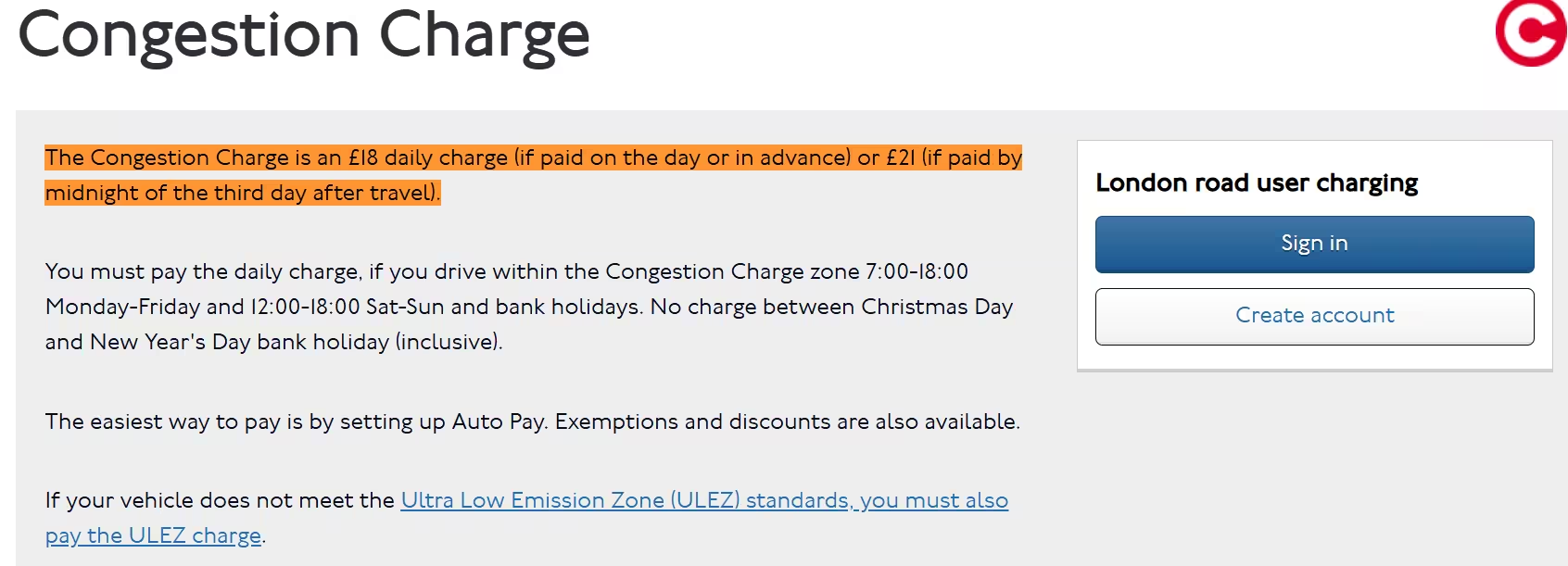
TfL confirms London Congestion Charge operating hours, daily fees and the Christmas holiday suspension.
How Do London Congestion Charge Times Work on Weekdays?
Between Monday and Friday, the Congestion Charge operates for 11 hours each day, beginning at 7am and ending at 6pm, except when a bank holiday or festive suspension applies.
This period covers the morning commute, daytime commercial activity and part of the evening rush hour.
Drivers who complete their journeys within the charging zone before 7am or travel exclusively after 6pm do not normally need to pay the Congestion Charge.
However, the time a journey begins is not necessarily the deciding factor. What matters is whether the vehicle is driven within the charging zone while charging is active.
Understanding Weekday Journey Times
| Journey Scenario | Congestion Charge Payable? |
| Enter and leave the zone at 5am–6.30am | No |
| Enter at 6.45am and continue driving until 7.15am | Yes |
| Drive through central London at 9am | Yes |
| Enter the zone at 3pm and leave at 7pm | Yes |
| Enter the zone for the first time at 6.30pm | No |
| Drive within the zone at 11pm | No |
These examples assume a normal weekday and a vehicle without an exemption or discount.
For commuters travelling close to the beginning or end of charging hours, allowing additional time for unexpected traffic delays can help prevent an otherwise charge-free journey from becoming chargeable.
What Are the London Congestion Charge Times on Saturdays and Sundays?
The weekend Congestion Charge operates between 12pm and 6pm on both Saturdays and Sundays.
Unlike weekdays, motorists have the entire morning to travel within the charging zone without incurring the Congestion Charge, provided they complete their driving before midday.
The later starting time can benefit visitors travelling to central London for shopping, entertainment, sightseeing or family commitments.
| Weekend Travel Time | Charging Status |
| 7am – 9am | No Congestion Charge |
| 9am – 11.59am | No Congestion Charge |
| 12pm – 2pm | Charge applies |
| 2pm – 4pm | Charge applies |
| 4pm – 6pm | Charge applies |
| After 6pm | No Congestion Charge |
A shorter charging period does not mean a cheaper daily fee.
A motorist making a chargeable journey on Saturday or Sunday generally pays the same standard £18 as someone travelling during weekday charging hours.
Drivers planning weekend visits can read our detailed guide on whether there is a Congestion Charge on Sunday for further information about weekend driving requirements.
Does the London Congestion Charge Apply on Bank Holidays?
Yes, the London Congestion Charge normally operates on bank holidays between 12pm and 6pm, even when the bank holiday falls on a Monday or Friday.
The main exception is the festive suspension covering Christmas Day through the New Year’s Day bank holiday.
London Congestion Charge Times for 2027 Bank Holidays
| Bank Holiday | Date | Congestion Charge Times |
| New Year’s Day | 1 January 2027 | No charge |
| Good Friday | 26 March 2027 | 12pm – 6pm |
| Easter Monday | 29 March 2027 | 12pm – 6pm |
| Early May Bank Holiday | 3 May 2027 | 12pm – 6pm |
| Spring Bank Holiday | 31 May 2027 | 12pm – 6pm |
| Summer Bank Holiday | 30 August 2027 | 12pm – 6pm |
| Christmas Day | 25 December 2027 | No charge |
| Boxing Day | 26 December 2027 | No charge |
| Christmas substitute bank holiday | 27 December 2027 | No charge |
| Boxing Day substitute bank holiday | 28 December 2027 | No charge |
These timings are based on the current charging arrangements and published England and Wales bank holiday dates.
Motorists should check for any operational changes closer to their journey.
Bank holidays are therefore not automatically free driving days in central London. Planning a morning journey instead of an afternoon visit could save motorists the standard daily charge.
When Is the London Congestion Charge Suspended Over Christmas and New Year?
The Christmas and New Year period provides the longest regular suspension of the London Congestion Charge.
TfL has confirmed that the charge will not operate from Friday, 25 December 2026, until Friday, 1 January 2027, inclusive.
Normal weekend charging arrangements resume on Saturday, 2 January 2027.
| Date or Period | Charging Hours |
| 24 December 2026 – Christmas Eve | 7am – 6pm |
| 25 December 2026 – Christmas Day | No charge |
| 26–31 December 2026 | No charge |
| 1 January 2027 – New Year’s Day | No charge |
| 2 January 2027 – Saturday | 12pm – 6pm |
| 3 January 2027 – Sunday | 12pm – 6pm |
| 4 January 2027 – Monday | 7am – 6pm |
Under the existing annual suspension rules, the following festive break is expected to run from 25 December 2027 through 3 January 2028, which is the New Year’s Day substitute bank holiday.
However, drivers should confirm TfL’s festive travel arrangements nearer the time.
It is particularly important to remember that ULEZ has a different Christmas exemption.
ULEZ normally stops operating only on Christmas Day rather than throughout the entire festive period.
Can You Enter London Before the Congestion Charge Starts and Leave After It Ends?
Yes. Motorists can enter the Congestion Charge zone before charging begins, park their vehicle during the day and leave after 6pm without incurring the Congestion Charge, provided the vehicle is not driven within the zone during operating hours.
For example, a commuter who enters central London at 6.30am, parks at 6.45am and drives home at 6.30pm would not normally need to pay the Congestion Charge.
However, moving the vehicle during the charging period, even for a short journey, can trigger the daily fee.
How Parking Affects Congestion Charge Liability?
| Driving and Parking Scenario | Charge Payable? |
| Arrive at 6am, park all day and leave at 7pm | No |
| Arrive at 6am and move the vehicle at 10am | Yes |
| Arrive on Saturday at 10am and leave at 7pm | No |
| Arrive on Saturday at 11am and leave at 3pm | Yes |
| Park inside the zone overnight without driving | No |
| Drive between two car parks during charging hours | Yes |
The examples assume that the vehicle has no applicable exemption or discount.
The Congestion Charge applies to driving rather than simply having a stationary vehicle parked within the zone.
Nevertheless, parking fees, controlled parking restrictions and other road charges must be considered independently.
Why Do London Congestion Charge Hours End at 6pm?
The Congestion Charge is designed to manage traffic demand rather than impose a continuous fee for driving in central London.
The selected operating hours cover periods when road space is heavily used by commuters, commercial vehicles, buses and other road users.
Discussing the purpose of the charging scheme during the May 2025 consultation, Seb Dance, London’s Deputy Mayor for Transport, stated:
“Keeping London moving by reducing congestion is vital for our city and for our economy.”
The relationship between charging hours and traffic patterns was also examined during a London Assembly Mayor’s Question Time in March 2026.
London Assembly Member Caroline Russell highlighted research from the Clean Cities Campaign showing that vehicle entries into the Congestion Charge zone were approximately 56% higher between 6pm and 7pm than between 8am and 9am on weekdays.
| Weekday Period | Recorded Vehicle Entries |
| Morning, 8am – 9am | 3,955 |
| Evening, 6pm – 7pm | 6,170 |
| Difference | 2,215 additional entries |
Responding on 27 March 2026, Mayor of London Sadiq Khan acknowledged that an increase in traffic after charging hours is partly expected because the financial deterrent to driving has been removed.
He also explained that TfL continues to review road-user charging schemes to ensure they support London’s wider transport strategy.
This highlights an important consideration for motorists: travelling after 6pm may reduce direct motoring expenses, but it does not necessarily guarantee quieter roads or shorter journey times.
How Much Does the London Congestion Charge Cost During Operating Hours?
The standard Congestion Charge increased from £15 to £18 on 2 January 2026, representing a 20% increase.
The £18 daily fee remains the currently published standard rate for planning journeys in 2027, although future tariff adjustments are possible.
The charge is not calculated according to how long a vehicle spends within the zone. A five-minute journey during operating hours can attract the same daily charge as several hours of driving.
| Payment Type | Current Charge |
| Payment in advance | £18 |
| Same-day payment | £18 |
| Standard Auto Pay charge | £18 |
| Payment by midnight on the third day after travel | £21 |
| Eligible electric car registered with Auto Pay | £13.50 |
| Eligible electric van, HGV or quadricycle registered with Auto Pay | £9 |
| Standard Penalty Charge Notice | £180 |
| Penalty paid within 14 days of service | £90 |
Motorists can enter and leave the charging zone multiple times on the same day without paying the daily Congestion Charge again for the same vehicle.
For a complete breakdown of the latest prices, electric vehicle discounts and upcoming changes, see how much the London Congestion Charge costs.
Where Do the London Congestion Charge Times Apply?
The charging hours apply only within the designated central London Congestion Charge zone, rather than across the whole of Greater London.
The zone covers many of London’s major commercial, government, entertainment and shopping districts.
Areas wholly or partly within the charging zone include:
- Westminster
- Soho
- Covent Garden
- The City of London
- Holborn
- Mayfair
- Fitzrovia
- Bloomsbury
- Waterloo
The exact boundaries vary between streets, meaning that not every address within a particular neighbourhood is necessarily chargeable.
Motorists should also consider their complete driving route. A destination outside the charging zone does not prevent a charge from applying if the route passes through it during operating hours.
How to Check Whether Your Destination Is Inside the Zone?
TfL provides an official Congestion Charge zone map and postcode checker that helps drivers establish whether their destination falls within the charging area.
Enter the destination postcode, review the result and examine the surrounding roads before planning your journey.
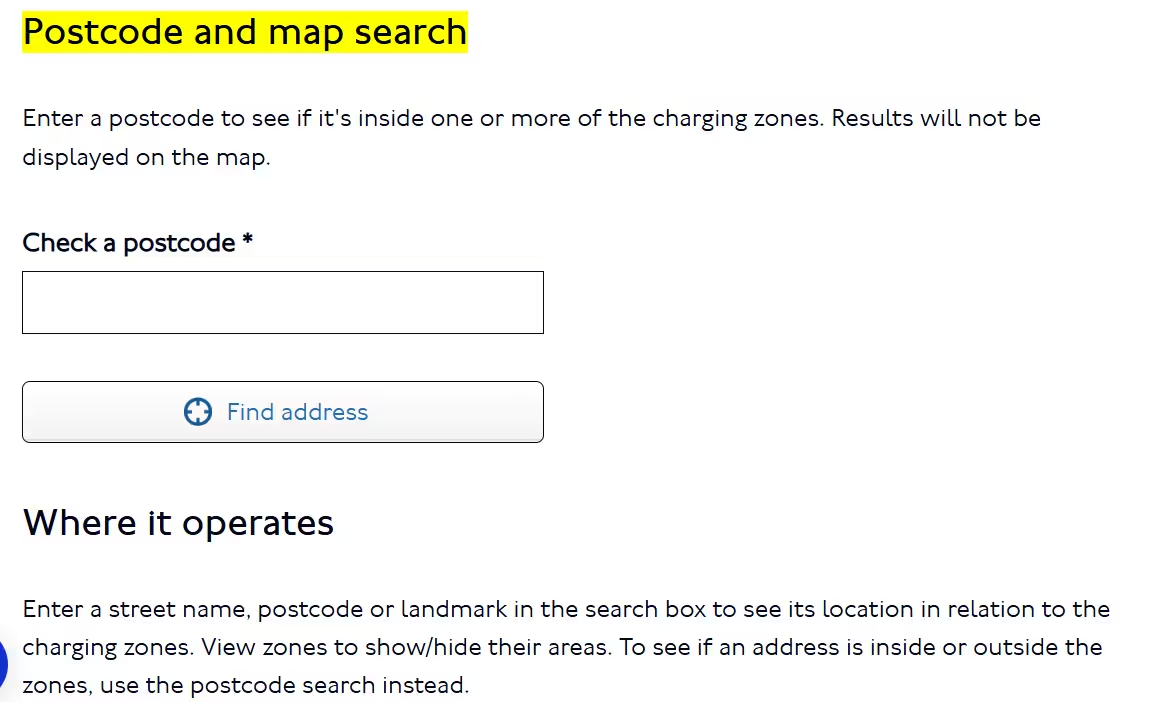
TfL’s official map and postcode search help drivers identify the London Congestion Charge zone.
What Is the Difference Between Congestion Charge and ULEZ Operating Times?
One of the most common mistakes motorists make is assuming that driving outside Congestion Charge hours means they are exempt from all London road-user charges.
The Congestion Charge and Ultra Low Emission Zone (ULEZ) are separate schemes operating under different requirements.
The Congestion Charge focuses on reducing traffic volumes in central London, whereas ULEZ aims to improve air quality by encouraging the use of vehicles that meet emissions standards.
| Charging Scheme | Operating Times | Main Purpose |
| Congestion Charge | 7am–6pm weekdays; 12pm–6pm weekends and bank holidays | Reduce central London congestion |
| ULEZ | 24 hours a day, except Christmas Day | Reduce vehicle emissions |
| Low Emission Zone (LEZ) | 24 hours a day throughout the year | Reduce emissions from applicable larger vehicles |
| Blackwall Tunnel Charge | 6am–10pm, except Christmas Day | Manage tunnel traffic |
| Silvertown Tunnel Charge | 6am–10pm, except Christmas Day | Manage tunnel traffic |
For example, a non-ULEZ-compliant car driven through central London at 8pm may avoid the £18 Congestion Charge but still incur the £12.50 ULEZ charge.
The same vehicle travelling at 2pm could face both charges.
| Example Journey | Congestion Charge | ULEZ | Total |
| Compliant car at 10am on Monday | £18 | £0 | £18 |
| Non-compliant car at 10am on Monday | £18 | £12.50 | £30.50 |
| Non-compliant car at 8pm | £0 | £12.50 | £12.50 |
| Compliant car at 8pm | £0 | £0 | £0 |
| Eligible electric car on Auto Pay during charging hours | £13.50 | £0 | £13.50 |
These illustrations exclude parking charges, tunnel fees and other applicable expenses.
Understanding whether you need to pay the London Congestion Charge should therefore form only one part of your journey planning.
How Can Businesses Save Money by Planning Around Congestion Charge Times?
For businesses making frequent deliveries, servicing commercial premises or transporting employees across central London, the Congestion Charge can become a considerable operational expense.
The impact is particularly noticeable for small businesses that operate vehicles within the zone several times a week.
Potential Business Savings
The following examples illustrate the standard Congestion Charge costs that could be avoided if a business successfully reschedules selected chargeable driving days entirely outside operating hours.
| Chargeable Days Avoided | Weekly Savings | Annual Savings Based on 48 Working Weeks |
| 1 day per week | £18 | £864 |
| 2 days per week | £36 | £1,728 |
| 3 days per week | £54 | £2,592 |
| 4 days per week | £72 | £3,456 |
| 5 days per week | £90 | £4,320 |
For a business operating five vehicles, avoiding three charging days per vehicle each week could produce potential annual savings of £12,960 over 48 working weeks.
However, these are gross theoretical savings rather than guaranteed reductions in operating costs.
Businesses should also assess employee overtime, customer availability, delivery restrictions, fuel consumption and additional overnight working expenses.
Practical strategies include:
- Scheduling early-morning deliveries before 7am where permitted.
- Arranging evening collections after 6pm.
- Combining multiple deliveries into a single chargeable day.
- Using ULEZ-compliant vehicles to reduce additional emissions charges.
- Registering eligible electric commercial vehicles with Auto Pay.
- Using consolidation centres outside the charging zone where commercially practical.
For many businesses, optimising delivery schedules may be more cost-effective than making immediate changes to an entire vehicle fleet.
When Do You Need to Pay the London Congestion Charge?
Motorists do not have to complete payment before entering the charging zone. However, the applicable fee increases if payment is delayed beyond the day of travel.
The standard £18 charge is available when paying in advance or on the day of the journey.
Drivers who pay after travelling have until midnight on the third day following their journey, but the charge increases to £21.
| Journey Day | Standard £18 Payment Deadline | Final £21 Payment Deadline |
| Monday | Monday midnight | Thursday midnight |
| Tuesday | Tuesday midnight | Friday midnight |
| Wednesday | Wednesday midnight | Saturday midnight |
| Thursday | Thursday midnight | Sunday midnight |
| Friday | Friday midnight | Monday midnight |
| Saturday | Saturday midnight | Tuesday midnight |
| Sunday | Sunday midnight | Wednesday midnight |
The final deadline is based on TfL’s published payment guidance, rather than the daily 6pm closing time of the charging scheme.
Drivers can use TfL’s online payment service, official mobile app or Auto Pay system to manage their charges.
Auto Pay can be particularly useful for regular motorists and businesses because it automatically records applicable charging activity and bills the registered payment method.
What Happens if You Drive During Congestion Charge Times Without Paying?
TfL uses automatic number plate recognition cameras to identify vehicles travelling within the charging zone.
If a vehicle is recorded during chargeable hours and the required payment is not made within the permitted period, the registered keeper may receive a Penalty Charge Notice (PCN).
| Enforcement Stage | Amount |
| Standard unpaid daily charge | £18 |
| Payment within the permitted later-payment period | £21 |
| Penalty Charge Notice | £180 |
| Discounted penalty within 14 days of service | £90 |
| Charge Certificate stage | £270 |
The standard £180 penalty is ten times the original £18 daily charge.
Motorists who receive a PCN but believe the charge was incorrectly issued can submit a representation to TfL with supporting evidence.
Relevant evidence may include payment confirmations, proof of an applicable exemption or information establishing that the vehicle was not driven within the zone during chargeable hours.
Drivers should never ignore a formal penalty notice, even if they believe it has been issued incorrectly.
What Is the Best Time to Drive Into London Without Paying the Congestion Charge?
The most suitable time depends on the journey purpose, destination and flexibility of the motorist’s schedule.
For weekday commuters, travelling before 7am or after 6pm can avoid the Congestion Charge. Weekend visitors have additional flexibility because charging does not begin until midday.
| Type of Motorist | Potential Charge-Free Travel Period |
| Weekday commuter | Before 7am or after 6pm |
| Weekend shopper | Before 12pm or after 6pm |
| Evening restaurant visitor | After 6pm |
| Commercial delivery driver | Early morning or evening |
| Bank holiday visitor | Before 12pm or after 6pm |
| Christmas and New Year visitor | Throughout the festive suspension |
Avoid scheduling journeys too close to the beginning of charging hours.
Traffic congestion, roadworks and unexpected diversions could result in a vehicle remaining within the zone when charging begins.
The best journey is not necessarily the one with the lowest Congestion Charge expense. Motorists should consider overall journey duration, parking availability, fuel costs and alternative public transport options before travelling.
FAQs About London Congestion Charge Times
What time does the London Congestion Charge start?
The Congestion Charge starts at 7am on ordinary weekdays and 12pm on Saturdays, Sundays and bank holidays.
Is the London Congestion Charge free after 6pm?
Yes. Driving after 6pm does not normally attract a Congestion Charge, provided the vehicle was not driven within the zone during charging hours earlier that day.
Is the London Congestion Charge free before 7am?
Yes, the charge does not operate before 7am on weekdays. On weekends and bank holidays, the charge-free morning period continues until midday.
Do I pay the Congestion Charge if I enter before 7am but leave after 7am?
Yes, if you continue driving within the charging zone after 7am on an ordinary weekday, the daily Congestion Charge generally applies.
Can I park inside the Congestion Charge zone all day without paying?
Yes, provided you do not drive the vehicle within the zone during operating hours. Separate parking fees and restrictions may still apply.
Does the Congestion Charge apply 24 hours a day?
No. The Congestion Charge operates during specified daytime hours. ULEZ, however, operates around the clock except on Christmas Day.
Do I pay twice if I enter the Congestion Charge zone more than once?
No. The Congestion Charge is a daily fee per vehicle, regardless of how many chargeable journeys that vehicle makes within the zone on the same day.
Hannah is a London lifestyle and consumer writer at London Insider News, covering property, transport, local developments, cost-of-living issues and stories affecting everyday life across the capital.
More from TRANSPORT
Do Electric Cars Pay Congestion Charge in London? | 2027 Rules Explained
Yes, electric cars must now pay the London Congestion Charge. Since 2 January 2026, fully electric…
Is There a Congestion Charge on Sunday: Complete London Weekend Driving Rules
Yes, there is a Congestion Charge on Sunday in London. The charge normally operates from 12pm…
How Much Is London Congestion Charge in 2027? Daily Costs, 2026 Price Rise and New Rules
The London Congestion Charge is £18 per day for most drivers entering the central London charging…