Do Electric Cars Pay Congestion Charge in London? | 2027 Rules Explained
 Hannah
London Lifestyle & Consumer Writer
Yes, electric cars must now pay the London Congestion Charge. Since 2 January 2026, fully electric cars have no longer been entitled to the previous 100% exemption.
Instead, eligible electric cars registered with Transport for London’s (TfL) Auto Pay service receive a 25% discount, reducing the daily charge from £18 to £13.50.
This means an electric vehicle that previously entered central London without paying the Congestion Charge can now face significant additional running costs.
The new system also affects electric vans, private hire vehicles and businesses operating zero-emission fleets. Further changes are confirmed for March 2027, particularly for residents applying for the 90% discount.
However, electric cars generally remain exempt from London’s Ultra Low Emission Zone (ULEZ) charge because they produce no tailpipe emissions.
Understanding these separate rules is essential for anyone driving an electric vehicle into central London.
How Much Is the Congestion Charge for Electric Cars in 2026 and 2027?
The standard London Congestion Charge increased from £15 to £18 on 2 January 2026.
At the same time, TfL introduced a new tiered Cleaner Vehicle Discount, allowing eligible electric vehicles to pay reduced daily rates through Auto Pay.
The following charges apply under the published arrangements as of November 2026.
| Vehicle type | Discount | Daily Congestion Charge |
| Fully electric car with Auto Pay | 25% | £13.50 |
| Fully electric car without Auto Pay | None | £18 |
| Electric van with Auto Pay | 50% | £9 |
| Electric HGV with Auto Pay | 50% | £9 |
| Eligible electric quadricycle with Auto Pay | 50% | £9 |
| Petrol or diesel car without another discount | None | £18 |
| Hybrid car without another discount | None | £18 |
| Vehicle with approved 90% residents’ discount | 90% | £1.80 |
The discounted electric vehicle rates apply only where the vehicle is eligible and registered with Auto Pay.
Drivers paying the standard charge after their journey, within the permitted three-day payment window, face a higher £21 charge instead of £18.
The confirmed 2027 arrangements retain the £13.50 electric-car rate based on the currently published £18 standard charge. However, TfL has introduced a process under which future charge increases may be considered, so drivers should check the latest rate before travelling.
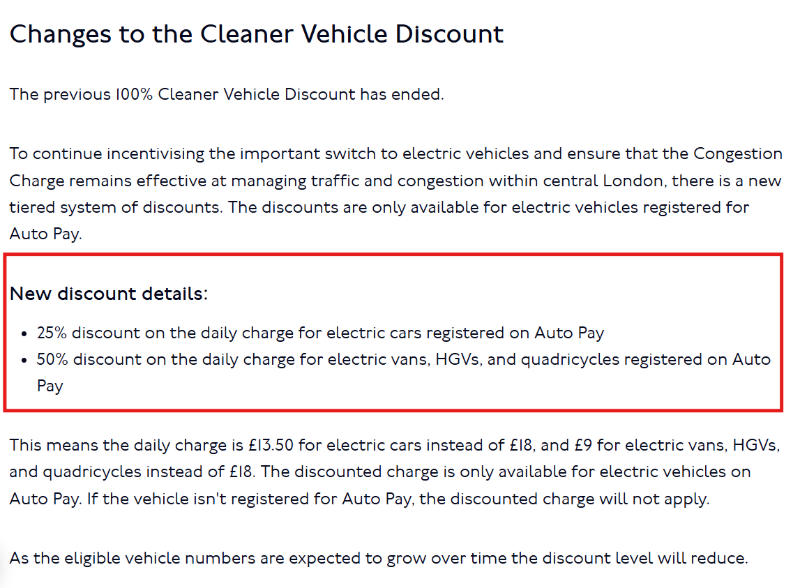
TfL confirms the revised Congestion Charge rates for electric vehicles.
Why Did London Remove the Congestion Charge Exemption for Electric Cars?
The previous 100% Cleaner Vehicle Discount ended on 25 December 2025, with the replacement discount system introduced on 2 January 2026.
Previously, qualifying zero-emission vehicles could travel through the central London charging zone without paying the daily charge.
However, the growing number of electric vehicles created a policy challenge for TfL.
Although electric cars produce no exhaust emissions, they still occupy road space and contribute to traffic congestion.
TfL’s assessment suggested that retaining the previous arrangements without changes could result in around 2,200 additional vehicles using the charging zone on an average weekday.
The revised charging structure therefore attempts to balance two objectives:
- Encouraging motorists and businesses to replace petrol and diesel vehicles with electric alternatives.
- Preventing increasing electric vehicle ownership from undermining congestion reduction efforts.
Christina Calderato, TfL’s Director of Strategy, explained in the November 2025 announcement that controlling traffic and congestion was essential to maintaining London’s transport network and economic activity.
She presented the changes as a balance between managing congestion and supporting the transition towards cleaner vehicles.
However, the decision has also attracted criticism from motoring organisations.
Edmund King, President of the AA, warned that removing the full electric vehicle exemption could send mixed messages to motorists considering switching to electric vehicles.
He argued that incentives remained important for encouraging adoption, particularly among drivers still uncertain about switching.
These contrasting professional perspectives highlight the central policy issue: electric vehicles help reduce exhaust emissions, but they do not eliminate road congestion.
When Do Electric Cars Have to Pay the Congestion Charge?
Electric vehicle drivers only need to pay the Congestion Charge when they drive within the designated charging zone during operating hours, unless another exemption applies.
The charging period depends on the day of the week.
| Day | Charging hours |
| Monday to Friday | 7am–6pm |
| Saturday | 12pm–6pm |
| Sunday | 12pm–6pm |
| Bank holidays | 12pm–6pm |
| Christmas Day through the New Year’s Day bank holiday | No Congestion Charge |
For example, someone driving an electric car into central London at 10am on a Tuesday will normally pay £13.50 if registered with Auto Pay.
However, the same driver entering the zone at 7pm on Tuesday will not face the Congestion Charge, provided they do not drive within the zone during charging hours.
The daily charge applies regardless of how often the vehicle enters or leaves the zone on the same charging day.
For a detailed breakdown of weekday and weekend operating hours, see our guide to London Congestion Charge times.
Where Does the Congestion Charge Apply?
The Congestion Charge operates within a designated part of central London rather than across the entire capital.
The charging area includes locations within or around:
- Westminster
- Soho
- Covent Garden
- Mayfair
- The City of London
- Holborn
- Waterloo
Drivers should use TfL’s postcode checker and official zone map because not every road in a broader neighbourhood necessarily falls inside the charging boundary.
This is especially important for electric vehicle owners visiting unfamiliar offices, hotels, restaurants or commercial premises.
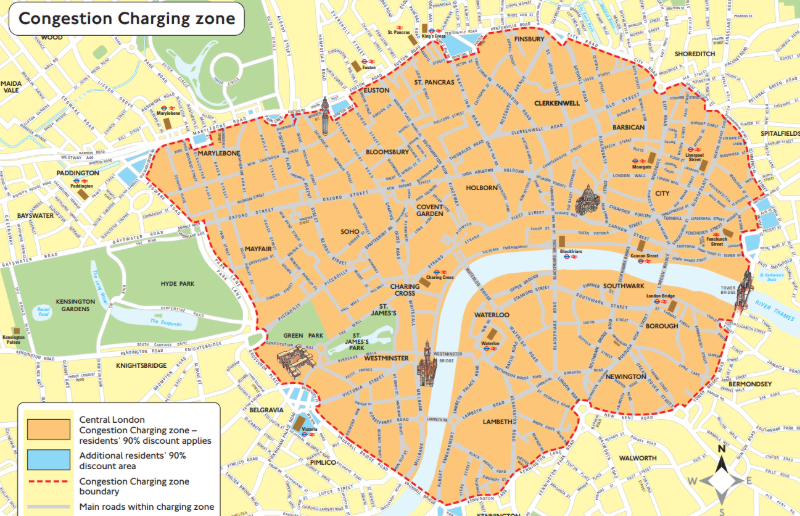
Official TfL map showing where electric vehicle drivers may need to pay the Congestion Charge.
How Can Electric Car Drivers Get the 25% Congestion Charge Discount?
Electric vehicle owners must register their vehicle with TfL’s Auto Pay system to receive the 25% Cleaner Vehicle Discount.
Simply owning an electric car does not automatically provide the discounted rate if it is not registered for Auto Pay.
The registration process is straightforward.
Step 1: Create a TfL Road User Charging Account
Visit TfL’s official website and create a London Road User Charging account.
You will need to provide your personal details and establish your account credentials.
Step 2: Register for Auto Pay
After creating your account, activate the Auto Pay service.
Auto Pay automatically handles applicable Congestion Charge payments when your registered vehicle drives within the charging zone.
TfL does not charge a registration fee for Auto Pay.
Step 3: Add Your Electric Vehicle
Enter your vehicle registration number and ensure that its information is correct.
TfL uses vehicle registration data to identify eligible electric vehicles.
For most UK-registered eligible electric vehicles, no separate Cleaner Vehicle Discount application is required.
Step 4: Add Your Payment Details
Connect a valid payment method to the service.
When your registered electric car is recorded driving within the zone during charging hours, TfL applies the relevant discounted charge automatically.
Drivers who already have an active Auto Pay account with the correct electric vehicle registered generally do not need to apply again.
Important: Owners of non-UK-registered electric vehicles must ensure their vehicles are registered with TfL and added to Auto Pay before qualifying for the discount.
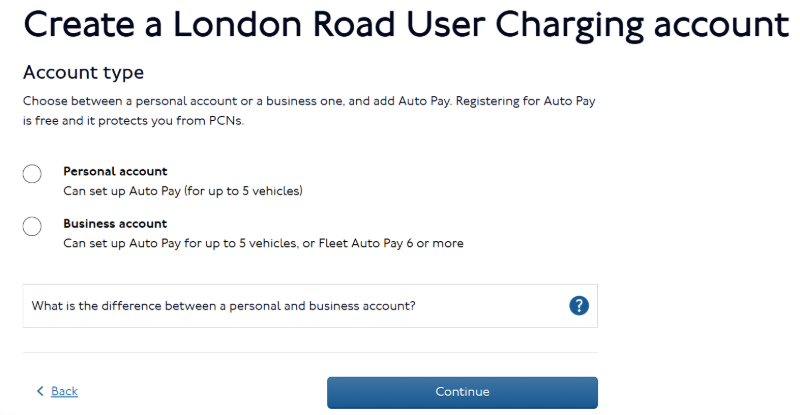
How electric vehicle drivers can register for the 25% Congestion Charge discount through TfL Auto Pay.
Do Electric Cars Have to Pay ULEZ as Well as the Congestion Charge?
Fully electric cars generally do not have to pay London’s ULEZ charge because they meet the scheme’s emissions requirements.
However, ULEZ and the Congestion Charge are separate charging systems.
ULEZ focuses on reducing harmful vehicle emissions, while the Congestion Charge is intended to reduce traffic volumes in central London.
| Feature | Congestion Charge | ULEZ |
| Main objective | Reduce traffic congestion | Reduce vehicle emissions |
| Coverage | Central London charging zone | Across London’s boroughs |
| Standard daily charge | £18 | £12.50 for non-compliant cars |
| Fully electric cars | Normally pay £13.50 with Auto Pay | Normally £0 |
| Operating hours | Specific daily hours | 24 hours, except Christmas Day |
| Main eligibility consideration | Location, time and discounts | Vehicle emissions compliance |
For example, a fully electric car travelling into central London during charging hours may pay £13.50 in Congestion Charge fees but nothing for ULEZ.
A non-ULEZ-compliant diesel car making the same journey could pay £18 for the Congestion Charge plus £12.50 for ULEZ, bringing the combined total to £30.50.
The electric vehicle therefore retains a financial advantage, even though its previous full Congestion Charge exemption has ended.
Before travelling, drivers can check the Congestion Charge using their vehicle details and destination.
Which Electric Vehicles and Drivers Qualify for Different Discounts?
Not every vehicle using electric power receives the same Congestion Charge treatment.
The applicable discount depends on vehicle classification, registration and whether other exemptions have been approved.
Fully Electric Cars
Eligible battery-electric cars receive the 25% Cleaner Vehicle Discount when registered on Auto Pay.
This applies across qualifying electric car models rather than being restricted to particular manufacturers.
Electric Vans and Commercial Vehicles
Eligible electric vans and HGVs receive a larger 50% discount.
This reduces the daily charge to £9 under the current £18 standard rate.
The difference is particularly relevant to delivery companies, tradespeople and businesses operating electric commercial fleets.
Hybrid and Plug-in Hybrid Cars
Hybrid and plug-in hybrid vehicles do not qualify for the new electric-only Cleaner Vehicle Discount simply because they can operate using battery power.
Unless another approved discount or exemption applies, they generally pay the standard Congestion Charge.
Electric Private Hire Vehicles
Electric private hire vehicles are covered by the revised charging arrangements.
Eligible vehicles registered with Auto Pay can receive the 25% electric-car discount.
However, drivers should not assume that private hire licensing provides an automatic exemption. Distinct rules apply to certain licensed taxis and qualifying wheelchair-accessible private hire vehicles.
Electric Car Club Vehicles
A separate 100% discount is available for eligible back-to-base electric car club vehicles.
These are approved car club vehicles collected from and returned to the same designated parking bay within the Congestion Charge zone.
The discount does not automatically cover every electric hire car or car-sharing arrangement.
What Will Change for Electric Car Owners in March 2027?
From 1 March 2027, TfL is changing eligibility for new applications to the Congestion Charge Residents’ Discount.
The existing discount reduces the daily Congestion Charge by 90%, meaning eligible residents currently pay £1.80 rather than £18.
However, eligibility will increasingly depend on whether a resident uses an electric vehicle.
| Resident category | Rules from March 2027 |
| Existing approved residents’ discount holders | Retain 90% discount, including for non-electric vehicles, subject to renewal |
| New applicants with eligible electric vehicles | Can qualify for the 90% discount |
| New applicants with petrol or diesel vehicles | Generally cannot qualify under the standard new-applicant rules |
| Eligible low-income or disabled residents | Special provisions can allow qualifying non-electric vehicles until March 2030 |
Existing discount holders can continue receiving the 90% reduction, provided they renew their registration annually and remain eligible.
New applicants using non-electric vehicles generally lose access to the standard residents’ discount from March 2027.
However, TfL has introduced additional protections for qualifying residents receiving certain benefits, including Universal Credit, Personal Independence Payment, Attendance Allowance and Pension Credit.
These residents may be able to register a non-electric vehicle under the special arrangements before 4 March 2030, subject to the applicable eligibility requirements.
This distinction matters for residents considering replacing their vehicle or moving into central London’s charging zone.
Someone already registered under the residents’ scheme may be treated differently from a new applicant applying after the rule change.[
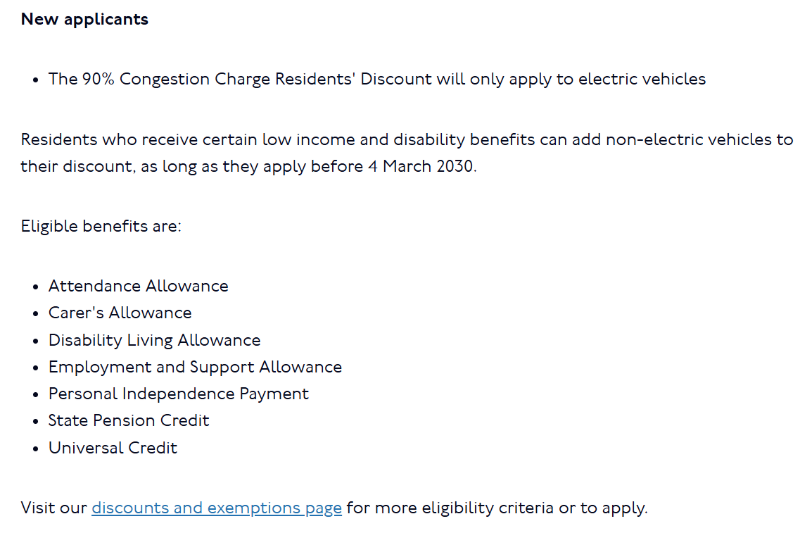
TfL’s confirmed changes to the Congestion Charge Residents’ Discount from March 2027.
How Much Could Electric Car Drivers Pay Every Month?
Although the daily discounted charge is £13.50, the financial impact becomes more substantial for motorists regularly travelling into central London.
For employees, self-employed professionals and businesses, the total cost depends on the number of chargeable driving days.
The following examples assume an eligible electric car registered with Auto Pay and no additional exemption.
| Chargeable days | Electric car cost | Standard car cost | EV saving |
| 1 day | £13.50 | £18 | £4.50 |
| 5 days | £67.50 | £90 | £22.50 |
| 10 days | £135 | £180 | £45 |
| 20 days | £270 | £360 | £90 |
| 240 days | £3,240 | £4,320 | £1,080 |
For an electric vehicle owner travelling into central London for 20 chargeable days each month, the Congestion Charge alone could cost £270 monthly.
Over 12 months, that represents £3,240 if the same 20-day monthly pattern continues.
Although this is £1,080 cheaper annually than paying the standard £18 charge for the same 240 days, it represents a substantial additional expense compared with the previous full electric vehicle exemption.
These calculations exclude charging electricity, parking, insurance, servicing and other applicable road-user charges.
For business owners, the main consideration is no longer whether an electric company car avoids the Congestion Charge entirely, but how its discounted charge affects total operating expenditure.
Businesses with employees regularly visiting central London may need to reconsider vehicle allowances, journey scheduling and reimbursement policies.
For further information about daily fees and other driving costs, read our guide on how much the London Congestion Charge costs.
Will Electric Vehicle Congestion Charge Discounts Reduce Again in 2030?
Yes. TfL has confirmed a further reduction in electric vehicle discounts from 4 March 2030.
The changes are intended to reflect the expected growth in electric vehicle ownership.
| Vehicle type | Current discount | Discount from 4 March 2030 |
| Electric cars | 25% | 12.5% |
| Electric vans | 50% | 25% |
| Electric HGVs | 50% | 25% |
| Electric quadricycles | 50% | 25% |
If the standard daily Congestion Charge remained at £18, a 12.5% discount would result in a daily electric-car charge of £15.75 from March 2030.
Under the same assumption, eligible electric vans and HGVs would pay £13.50 daily.
However, these are illustrative figures rather than guaranteed 2030 prices because the standard Congestion Charge could change before then.
This makes the long-term financial outlook important for businesses investing in electric fleets and motorists calculating future ownership costs.
How Can Electric Car Owners Avoid Unnecessary Congestion Charge Costs?
Electric car owners can reduce avoidable expenditure by understanding the charging schedule, checking eligibility and ensuring their TfL account is correctly configured.
Practical steps include:
- Activate Auto Pay: Ensure your electric vehicle receives the 25% discount.
- Check the zone boundary: Confirm whether your intended journey enters the charging area.
- Plan travel times: Driving entirely outside charging hours can avoid the Congestion Charge.
- Check additional exemptions: Blue Badge holders and certain other drivers may qualify for separate discounts.
- Review travel frequency: Compare the total cost of driving with public transport alternatives.
- Keep vehicle details updated: Changes to number plates or vehicles should be reflected in your TfL account.
The distinction between paying for a single day and regularly entering the zone is particularly important.
A driver visiting central London occasionally may find the £13.50 charge manageable, while someone travelling into the zone every working day could face annual costs running into thousands of pounds.
Weekend travel also requires attention because the Congestion Charge operates on both Saturdays and Sundays between midday and 6pm.
For specific weekend examples, see our guide explaining whether there is a Congestion Charge on Sunday.
Frequently Asked Questions
Are Electric Cars Exempt From the London Congestion Charge in 2027?
No. Under the currently confirmed arrangements, eligible electric cars registered with Auto Pay pay £13.50 rather than the standard £18 daily charge. Certain separately approved exemptions and discounts may still apply.
Do Tesla Cars Pay the Congestion Charge?
Yes. Tesla vehicles are subject to the same rules as other fully electric cars. An eligible Tesla registered with TfL Auto Pay receives the 25% discount.
Can Electric Cars Drive Through Central London for Free?
Yes, when the journey takes place entirely outside Congestion Charge operating hours, or if an applicable full exemption covers the vehicle. Fully electric cars also generally avoid ULEZ charges.
Do Electric Cars Pay the Congestion Charge on Sundays?
Yes, if they are driven within the charging zone between 12pm and 6pm on Sunday. Eligible electric cars on Auto Pay pay the discounted daily rate.
Does an Electric Car Automatically Get the Congestion Charge Discount?
No. The current Cleaner Vehicle Discount requires an eligible vehicle to be registered with TfL Auto Pay. Once correctly registered, the discount is applied automatically without a separate application.
Is the Electric Car Congestion Charge Discount Going Away in 2030?
The discount is not scheduled to disappear completely in March 2030. Instead, the discount for electric cars will reduce from 25% to 12.5%, while eligible electric vans and HGVs will receive a 25% discount.
Hannah is a London lifestyle and consumer writer at London Insider News, covering property, transport, local developments, cost-of-living issues and stories affecting everyday life across the capital.
More from TRANSPORT
London Congestion Charge Times 2027: Daily Hours, Weekends and Free Driving Periods
The London Congestion Charge times are 7am to 6pm from Monday to Friday and 12pm to…
Is There a Congestion Charge on Sunday: Complete London Weekend Driving Rules
Yes, there is a Congestion Charge on Sunday in London. The charge normally operates from 12pm…
How Much Is London Congestion Charge in 2027? Daily Costs, 2026 Price Rise and New Rules
The London Congestion Charge is £18 per day for most drivers entering the central London charging…