What Is Ground Rent? Meaning, Costs and UK Leasehold Rules in 2026
 Adam
London Business & News Writer

Ground rent is one of the most misunderstood costs associated with owning a leasehold property in the UK.
Although it may initially appear to be a small annual payment, certain lease agreements contain escalating charges that can affect affordability, mortgage approval and property resale value.
For London homeowners, understanding ground rent has become particularly important as the government progresses with reforms intended to address expensive and restrictive leasehold arrangements.
So, What Is Ground Rent, Who Pays It, and Is It Still Legal in 2026?
Our analysis of UK property legislation, government announcements, leasehold guidance and housing-market considerations explains how ground rent works, how much leaseholders may pay and what changes are expected.
The key distinction is that most qualifying new residential leases no longer attract financial ground rent, while many existing leaseholders remain responsible for charges specified in older agreements.
What Is Ground Rent in the UK?
Ground rent is a payment that a leasehold property owner may be required to make to their freeholder or landlord under the terms of the lease.
It is traditionally associated with the right to occupy a property built on land owned by another party.
When someone purchases a leasehold flat, they acquire a legal interest in the property for a specified number of years rather than owning the freehold of the land and building outright.
The lease may require them to pay ground rent throughout the lease term.
For example, someone purchasing a London flat for £400,000 might inherit an older lease requiring £300 in annual ground rent.
That payment is separate from the mortgage, service charges, Council Tax and other property ownership expenses.
Importantly, the freeholder does not have to provide a specific maintenance service in exchange for ground rent.
The main characteristics include:
- Contractual obligation: The requirement originates from the lease agreement.
- Periodic payment: Ground rent is commonly charged annually or half-yearly.
- Variable amounts: Charges can be fixed, nominal or subject to increases.
- No direct service: Ground rent is not a payment for cleaning, repairs or building maintenance.
- Legal implications: Failure to pay validly demanded ground rent can result in debt recovery or other legal proceedings.
Ground rent is predominantly relevant to leasehold properties in England and Wales. Different property ownership and tenancy arrangements apply in Scotland and Northern Ireland.
How Does Ground Rent Work on a Leasehold Property?
Ground rent operates through the contractual relationship between the leaseholder and the landlord.
The lease specifies the amount payable, payment frequency and any provision allowing future increases.
A freeholder may own the land and building, while individual leaseholders hold long-term interests in their flats.
In some developments, an intermediate landlord or management structure may also be involved.
Example of Ground Rent on a London Flat
Consider a hypothetical leasehold apartment purchased for £450,000.
| Property Expense | Annual Cost |
| Ground rent | £350 |
| Service charge | £2,400 |
| Buildings insurance contribution | Included in service charge |
| Council Tax | £1,800 |
| Total listed annual charges | £4,550 |
The figures are illustrative, not London market averages.
The homeowner would pay £4,550 annually for these listed obligations, excluding mortgage repayments, energy bills, internal maintenance and other expenses.
Ground rent represents approximately 7.7% of the total listed annual charges in this example.
Although the ground rent may appear relatively small, its long-term affordability depends on whether the lease permits increases.
A £350 fixed annual payment has a very different financial profile from one that doubles periodically.
Our financial assessment suggests that buyers should examine the entire ground rent schedule rather than rely on the initial amount advertised by the estate agent.
What Is the Difference Between Ground Rent and Service Charge?
Ground rent and service charges are separate financial obligations, although both may appear on the same leasehold property statement.
| Feature | Ground Rent | Service Charge |
| Purpose | Contractual payment under the lease | Funding building management and services |
| Paid to | Landlord, freeholder or authorised collecting agent | Landlord or managing agent |
| Covers repairs | No specific service required | Normally includes qualifying maintenance |
| Payment frequency | Usually annually or half-yearly | Monthly, quarterly or annually |
| Can increase | According to lease terms and applicable law | According to lease provisions and recoverable costs |
| Applies to new leases | Generally restricted to peppercorn rent | Can still apply |
| Can be challenged | Invalid demands and unlawful charges may be disputed | Reasonableness and payability can be challenged |
What Does a Service Charge Cover?
Service charges may fund:
- Cleaning of communal corridors and staircases.
- Lift maintenance and servicing.
- Communal electricity.
- Buildings insurance.
- Roof and external building repairs.
- Fire safety maintenance.
- Managing agent services.
- Contributions to reserve or sinking funds.
Unlike ground rent, service charges are connected with expenditure incurred in managing, maintaining or repairing the property.
Ground rent should also not be confused with an estate rentcharge, which may affect some freehold houses on privately managed estates.
How Much Is Ground Rent in the UK?
There is no single annual ground rent amount applicable to every leasehold property.
The charge depends on the original agreement, when the lease was granted and any review provisions.
Older leases may require relatively modest amounts such as £50 or £100 annually, while some contain substantially higher or escalating charges.
Our comparison below shows how different annual ground rents translate into monthly property ownership costs.
| Annual Ground Rent | Monthly Equivalent | Total Over 20 Years |
| £0 | £0 | £0 |
| £50 | £4.17 | £1,000 |
| £100 | £8.33 | £2,000 |
| £250 | £20.83 | £5,000 |
| £350 | £29.17 | £7,000 |
| £500 | £41.67 | £10,000 |
| £1,000 | £83.33 | £20,000 |
These calculations assume that the charge remains unchanged for 20 years. They exclude inflation, discounting, lease variations and future legislative changes.
A property with £500 annual ground rent would therefore create £10,000 in nominal payments over 20 years if the charge remained fixed.
However, even that calculation understates the possible burden where a lease contains regular increases.
Can Ground Rent Increase Every Year?
Ground rent can increase where the lease contains a valid review provision permitting it.
The freeholder cannot simply introduce an arbitrary increase without contractual or legal authority.
Our review identified three important charging structures.
Fixed Ground Rent
The annual amount remains unchanged unless the lease is lawfully varied.
For example, £150 per year may continue throughout the relevant lease period.
This provides greater predictability for long-term budgeting.
Inflation-Linked Ground Rent
Some leases increase ground rent by reference to inflation, commonly using the Retail Prices Index (RPI).
Suppose the annual ground rent is £250 and the lease permits increases reflecting RPI movements at specified review dates.
The payment may become more expensive as the relevant index increases.
The exact calculation depends on the lease wording and review mechanism.
Doubling Ground Rent
Some older leasehold agreements require ground rent to double every 10, 15, 20 or 25 years.
These clauses can produce disproportionately large long-term obligations.
For example, a ground rent starting at £250 and doubling every 10 years would develop as follows if the contractual mechanism operated without modification.
| Period | Annual Ground Rent | Increase From Initial Rent |
| Years 1–10 | £250 | 0% |
| Years 11–20 | £500 | 100% |
| Years 21–30 | £1,000 | 300% |
| Years 31–40 | £2,000 | 700% |
Over those 40 years, the hypothetical total would reach £37,500, compared with £10,000 under a fixed £250 annual charge.
That represents an additional £27,500.
This is a demonstration of an unrestricted doubling clause, not a forecast of what leaseholders will actually pay. Proposed legislation could restrict these increases before the full period has elapsed.
Nevertheless, it illustrates why mortgage lenders and conveyancing solicitors examine ground rent review clauses carefully.
Is Ground Rent Still Legal in 2026?
Yes. Ground rent remains legally payable under many existing residential leases in England and Wales.
However, the Leasehold Reform (Ground Rent) Act 2022 changed the position for most newly granted qualifying long residential leases.
The legislation took effect on:
- 30 June 2022: Most new qualifying residential long leases.
- 1 April 2023: Qualifying leases of retirement properties.
For leases within the legislation, ground rent is generally limited to one peppercorn per year, which has effectively zero monetary value.
Certain exceptions and special rules apply, including particular business leases, community housing arrangements, financial products and shared ownership leases.
An important distinction is the date the lease was originally granted, not necessarily the date someone purchases the property.
Someone buying a resale flat in 2026 could still acquire a lease first granted in 2015 and remain liable for its contractual ground rent.
The 2022 legislation does not automatically remove the charge simply because ownership changes.
The government’s Leasehold Reform (Ground Rent) Act 2022 guidance explains the restrictions applying to qualifying new leases.
Will Ground Rent Be Abolished in the UK?
The government has announced further reforms intended to reduce ground rent obligations for existing leaseholders.
On 27 January 2026, proposals were published to introduce a £250 annual ground rent cap, followed by a peppercorn rent after 40 years.
These measures form part of the proposed Commonhold and Leasehold Reform legislation.
As of October 2026, the £250 cap is a proposal, not an existing statutory cap.
The expected implementation timetable remains subject to legislation and parliamentary approval, with late 2028 identified as a possible commencement period.
What Would the £250 Ground Rent Cap Mean?
Under the proposed structure:
- Qualifying existing ground rents above £250 would generally be reduced to the cap.
- Ground rents already below £250 would not automatically increase to that amount.
- Contractual increases would be subject to the proposed maximum.
- After 40 years under the proposed system, the maximum would become a peppercorn.
- Limited exemptions may apply depending on the final legislation.
The government has also considered the treatment of certain quid pro quo leases, where a higher ground rent was agreed in exchange for a lower upfront purchase premium.
How Much Could Leaseholders Save?
Consider three hypothetical properties with existing annual ground rents.
| Current Annual Ground Rent | Proposed Maximum | Potential Annual Saving | Percentage Reduction |
| £300 | £250 | £50 | 16.7% |
| £500 | £250 | £250 | 50% |
| £1,000 | £250 | £750 | 75% |
These figures illustrate the proposed cap only. They are not savings currently guaranteed by law.
The calculations assume that the properties qualify, no exemption applies and existing rents remain otherwise unchanged.
What Have Property Experts Said?
Sarah Cardell, Chief Executive of the Competition and Markets Authority (CMA), welcomed the proposals in January 2026 and stated:
“CMA action has freed thousands of homeowners from doubling ground rents.”
Her comments reflect the competition regulator’s previous intervention against unfair or potentially problematic ground rent terms.
Martin Boyd, Chair of the Leasehold Advisory Service, also described the draft legislation as:
“a significant milestone for leaseholders”
Both comments were published alongside the government’s official ground rent reform announcement.
Our assessment is that the reform could materially improve affordability and saleability for affected homes, but leaseholders should not stop paying validly demanded contractual ground rent while the legislation remains pending.
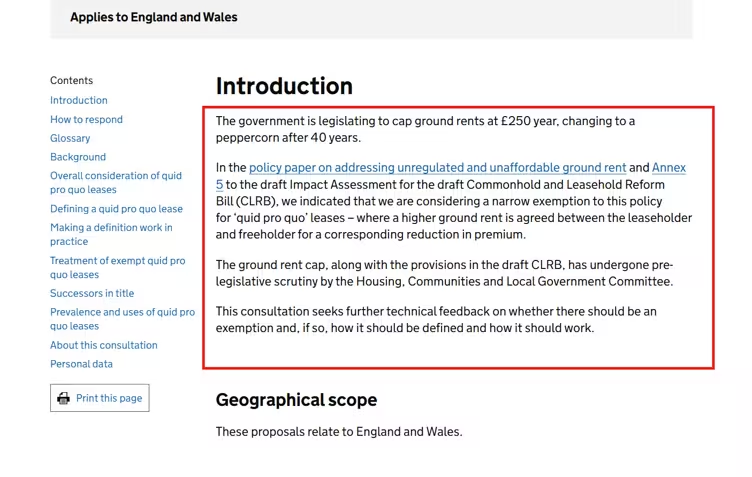
UK Government announcement dated 27 January 2026 outlining the proposed £250 annual ground rent cap and future peppercorn rent arrangements.
How Does Ground Rent Affect Property Value?
Ground rent can influence a leasehold property’s marketability because prospective buyers and mortgage lenders assess the long-term financial obligations contained in the lease.
A modest, fixed payment may have relatively limited implications.
A high ground rent or aggressive review clause can create greater difficulties.
Three factors are particularly important.
Mortgage Lender Requirements
Mortgage lenders assess more than a purchaser’s income and deposit.
They also consider whether the property offers acceptable security for the loan.
A lease containing rapidly increasing ground rent can make the property less attractive as mortgage security.
Some lenders scrutinise ground rents exceeding 0.1% of the property’s value, although this is not a universal legal threshold or identical lending rule across all providers.
For example:
- Property value: £400,000.
- Annual ground rent: £500.
- Ground rent as a proportion of value: 0.125%.
That figure exceeds the 0.1% benchmark used in some lender assessments.
It does not automatically mean that a mortgage will be refused, but the lender may require additional investigation or changes to the lease.
Reduced Buyer Demand
Properties with complicated or expensive ground rent provisions may attract fewer potential purchasers.
Buyers can be concerned about future payments, lender restrictions and the cost of obtaining a lease variation.
A leasehold flat may therefore become harder to sell even where the annual ground rent appears manageable today.
Negotiations Over the Purchase Price
Where ground rent terms create a demonstrable financial disadvantage, purchasers may seek a price reduction or ask the seller to resolve the issue before completion.
However, there is no standard percentage by which every affected flat loses value.
The impact depends on mortgage availability, the lease term, local market conditions and the cost of correcting the relevant clause.
Our property-finance assessment is that the combination of ground rent, service charges and the remaining lease term is more informative than any single figure.
Is Ground Rent a Problem for London Property Owners?
Ground rent has particular relevance in London because leasehold ownership is common among flats and converted properties.
A buyer may face several significant ongoing expenses alongside the mortgage.
For example, a hypothetical £500,000 London apartment could have the following costs:
| Cost | Annual Amount |
| Ground rent | £400 |
| Service charge | £3,000 |
| Reserve fund contribution | £600 |
| Total annual leasehold-related charges | £4,000 |
The listed costs are illustrative and exclude mortgage repayments, Council Tax and household bills.
The £4,000 annual total is equivalent to approximately £333 per month.
For buyers evaluating affordability, such charges can make a material difference to disposable income.
London residents comparing long-term ownership with continuing to rent should understand that ground rent is different from the ordinary monthly payment made under a residential tenancy.
The wider process of renting a home in London involves tenancy deposits, landlord obligations and recurring residential rent rather than ownership-related ground rent.
Ground rent becomes relevant when acquiring a leasehold ownership interest.
Does the £1,000 Ground Rent Rule Still Apply in London?
Older property guidance frequently refers to ground rent thresholds of £250 outside London and £1,000 within Greater London.
Those figures were historically important because certain long residential leases could fall within assured tenancy rules when the rent exceeded the applicable threshold.
This became known as the assured tenancy trap.
However, the legal position changed on 27 December 2025.
Under provisions introduced by the Renters’ Rights Act 2025, long leases exceeding 21 years are no longer treated as assured tenancies merely because of the ground rent payable.
This removed the specific assured tenancy possession risk associated with those historical thresholds.
Consequently, it would be misleading to suggest that every London flat with ground rent above £1,000 in 2026 automatically faces the old assured tenancy trap.
The distinction remains important because other mortgage criteria, contractual obligations and leasehold enforcement rules can still affect a property.
Buyers should not confuse historical tenancy thresholds with the government’s separate proposed £250 ground rent cap.
Do Tenants Have to Pay Ground Rent?
Ordinary private tenants generally do not pay ground rent directly to a freeholder merely because they rent a flat.
Ground rent is normally an obligation associated with the long leasehold interest held by the property owner.
For example, consider a privately rented London apartment.
The landlord owns the leasehold interest and lets the property to a tenant under a residential tenancy agreement.
The landlord may be required to pay ground rent under the head lease, while the tenant pays the agreed residential rent under the tenancy.
The landlord may take property ownership expenses into account when setting rental prices, but that does not automatically make ground rent a separate legal payment owed by the tenant.
This distinction is especially relevant for first-time buyers who previously rented privately.
People considering discounted pathways towards home ownership can also compare how Rent to Buy works, because a tenant’s obligations during the renting stage differ from the costs of buying a leasehold property.
How Do You Pay Ground Rent?
For older leasehold properties where ground rent is payable, the landlord must generally issue a valid written demand before the payment becomes due.
Section 166 of the Commonhold and Leasehold Reform Act 2002 establishes formal requirements for ground rent demands.
A valid notice should identify:
- The amount of ground rent due.
- The leaseholder’s details.
- The period covered by the charge.
- The payment date.
- The person or organisation receiving payment.
- The landlord’s or managing agent’s relevant details.
- The legally required supporting information.
The payment date must generally fall between 30 and 60 days after the demand is given and cannot precede the date permitted by the lease.
What Happens If You Receive an Incorrect Demand?
If a demand appears incorrect, the leaseholder should examine the lease and notice before paying a disputed amount.
A demand that does not satisfy the statutory requirements may not make the ground rent immediately payable.
However, the contractual liability may still exist, and a valid demand could subsequently be issued.
A leaseholder should therefore not assume that an invalid notice permanently cancels the debt.
What Happens If You Do Not Pay Ground Rent?
Ignoring a valid ground rent demand can create financial and legal consequences.
The landlord may seek to recover unpaid sums through the appropriate legal process.
Depending on the lease and circumstances, the leaseholder may also face contractual interest or recoverable administrative costs.
Although the assured tenancy trap was removed in December 2025, other leasehold enforcement mechanisms remain relevant.
The government’s proposed replacement of existing forfeiture rules has not yet fully taken effect.
Leaseholders should therefore treat non-payment seriously rather than assume that reforms have removed every enforcement risk.
Can a Freeholder Claim Unpaid Ground Rent From Previous Years?
Ground rent arrears may generally be recoverable for up to six years, subject to the relevant legal rules.
This creates a potential problem when a freeholder has not collected rent for several years and subsequently issues demands.
For example, annual ground rent of £250 could represent £1,500 across six unpaid years.
The enforceability of the amount depends on the lease, valid demands, limitation rules and any relevant legal defences.
Our financial recommendation is to keep copies of demands, receipts and payment records rather than relying on an informal understanding that ground rent is no longer being collected.
Can You Reduce or Remove Ground Rent?
Leaseholders may have several options for reducing or eliminating ground rent, depending on the property and legal circumstances.
These include statutory lease extensions, negotiated lease variations and purchasing the freehold.
1. Extend the Lease Through the Statutory Process
Qualifying leaseholders can use a formal statutory procedure to extend their lease.
Under the statutory framework currently applicable to qualifying flats, a lease extension generally adds 90 years to the remaining term and reduces ground rent to a peppercorn.
The leaseholder must pay a premium and relevant professional costs.
This can resolve an escalating ground rent problem, but the financial benefit should be weighed against the extension cost.
The Leasehold and Freehold Reform Act 2024 provides for further changes, including longer 990-year extensions, but important provisions have not yet commenced.
2. Negotiate a Deed of Variation
A leaseholder may negotiate with the freeholder to change an existing ground rent provision.
A deed of variation can replace a problematic clause with more acceptable terms.
However, the freeholder may request a premium or contribution towards legal costs.
Mortgage lender consent or other formalities may also be necessary.
Any proposal should be reviewed by a qualified conveyancing solicitor before it is accepted.
3. Buy the Freehold
In certain circumstances, qualifying leaseholders may collectively purchase the freehold of their building.
This process is known as collective enfranchisement.
Once the freehold is acquired, participating leaseholders may be able to restructure their leases and address ground rent obligations.
However, buying a share of the freehold does not automatically remove every existing ground rent clause.
The lease documents must be amended appropriately where necessary.
4. Consider Future Ground Rent Reforms
The proposed £250 cap could provide significant relief to qualifying leaseholders with high annual charges.
However, waiting may not be appropriate if a mortgage offer, lease extension deadline or property transaction requires an immediate solution.
A decision should consider both the possible benefits of future legislation and the financial risks of delay.
Is a Peppercorn Ground Rent Better Than Paying £250?
A peppercorn ground rent generally means there is no financial ground rent liability.
From the leaseholder’s perspective, it offers greater certainty over that particular cost.
To compare different arrangements, we developed an editorial scoring framework based on cost predictability, exposure to future increases, administrative complexity and potential mortgage concerns.
Our Ground Rent Arrangement Ratings
| Ground Rent Arrangement | Editorial Rating | Financial Assessment |
| Peppercorn ground rent | 98% | No financial ground rent payment |
| Fixed nominal ground rent | 90% | Highly predictable ongoing cost |
| Fixed £250 annual ground rent | 83% | Predictable but remains a recurring liability |
| Inflation-linked ground rent | 64% | Potentially increasing long-term expense |
| Ground rent doubling every 25 years | 43% | Greater long-term cost uncertainty |
| Ground rent doubling every 10 years | 15% | Substantial escalation and potential mortgage concerns |
About these ratings: These are illustrative editorial assessments of financial favourability, not consumer-survey percentages, independently measured lender acceptance rates or predictions of property value.
The ranking reflects the greater financial certainty associated with a zero or fixed charge.
Actual lender decisions and property values depend on the individual lease and wider circumstances.
What Should Buyers Check Before Purchasing a Leasehold Property?
Ground rent due diligence should begin before a purchaser exchanges contracts.
A solicitor should review the lease and explain the relevant obligations in plain language.
Our analysis recommends checking the following details.
| Check | Why It Matters |
| Original lease grant date | Helps determine which ground rent legislation applies |
| Current annual ground rent | Establishes immediate financial liability |
| Rent review clause | Identifies future increases |
| Review frequency | Shows when the charge may change |
| Remaining lease term | Affects mortgageability and extension costs |
| Service charge history | Reveals separate ongoing ownership expenses |
| Reserve fund position | Helps assess potential future expenditure |
| Unpaid ground rent | Identifies arrears and completion adjustments |
| Lender requirements | Establishes whether the lease is acceptable security |
| Existing deed of variation | Confirms whether problematic terms have been amended |
Buyers should also request an explanation of any unusually worded escalation clause.
A lease containing a low initial charge is not automatically financially favourable.
The potential future payment schedule matters just as much as the amount due in the first year.
Does Ground Rent Affect Buy-to-Let Property Investment?
Ground rent forms part of the ongoing expense structure for leasehold investment properties.
Landlords must consider it alongside mortgage financing, service charges, maintenance, insurance, letting-agent fees and periods without tenants.
For example, assume an investor receives £24,000 in annual gross rent from a London apartment.
The property incurs the following illustrative annual expenses:
| Expense | Annual Amount |
| Ground rent | £500 |
| Service charge | £2,500 |
| Letting and management fees | £2,400 |
| Repairs and maintenance provision | £1,200 |
| Total listed expenses | £6,600 |
| Income after listed expenses | £17,400 |
This calculation excludes mortgage finance, tax, vacancies, some insurance arrangements and other possible costs.
The listed expenses consume 27.5% of gross rental income.
Ground rent alone represents approximately 2.1% of the gross annual rent in this example.
From an investment perspective, the bigger issue may not be the immediate expense but the effect of escalating lease terms on refinancing and selling the asset.
A property offering attractive rental income may still become a poor investment if unfavorable lease conditions restrict access to mortgage finance or make disposal more difficult.
Is Ground Rent an Outdated Property Charge?
Ground rent originated within the traditional leasehold ownership system.
Historically, it provided an income stream to the freeholder in exchange for granting a long lease over land or property.
However, the modern residential property market has raised questions about whether recurring ground rent provides an appropriate benefit to homeowners.
Unlike service charges, ground rent does not require the landlord to deliver a specific service.
This difference has contributed to concerns about the fairness of high and escalating charges.
Government reforms increasingly favour limiting ground rent and expanding alternatives such as commonhold.
Under commonhold ownership, individual flat owners hold their units on a freehold basis, while shared parts of the building are managed collectively through a commonhold association.
The proposed reforms aim to make commonhold a more practical alternative to traditional leasehold arrangements.
Nevertheless, commonhold does not eliminate the cost of maintaining shared buildings.
Owners must still contribute towards legitimate management, repair and maintenance expenditure.
Conclusion
Ground rent remains an important consideration for anyone buying, owning or investing in leasehold property in the UK.
Although most qualifying new residential leases have effectively zero financial ground rent, older leasehold agreements can still require annual payments and contain provisions for future increases.
Our review highlights three major financial considerations: the current cost of the charge, how the lease allows it to change and whether the terms could restrict mortgage availability or resale opportunities.
The government’s proposed £250 annual cap and eventual transition to peppercorn rent could substantially improve the position for many existing leaseholders, but those changes are not yet in force.
For London property buyers and homeowners, the most practical approach is to review the lease carefully, understand the complete ownership costs and obtain professional advice before committing to expensive or escalating ground rent arrangements.
FAQs About Ground Rent
Is Ground Rent Paid Monthly or Yearly?
Ground rent is commonly paid annually or half-yearly, although the actual payment frequency depends on the lease agreement.
Can You Own a Flat Without Paying Ground Rent?
Yes. Many qualifying new residential leases have peppercorn ground rent, while some older leases also contain nominal or zero-payment arrangements.
Does Ground Rent Stop When You Pay Off Your Mortgage?
No. Paying off a mortgage does not automatically remove ground rent obligations contained in a lease.
Who Collects Ground Rent on a Leasehold Flat?
Ground rent is usually collected by the freeholder, an intermediate landlord or an authorised managing agent acting on the landlord’s behalf.
Can You Challenge an Unfair Ground Rent Clause?
Potentially. Leaseholders may be able to dispute unlawful charges, negotiate lease amendments or pursue appropriate legal remedies depending on the circumstances.
Does Buying a Share of Freehold Remove Ground Rent?
Not automatically. Existing lease provisions may need to be amended even after leaseholders acquire a share of the freehold.
Will Existing Ground Rent Automatically Become £250 in 2026?
No. The proposed £250 cap has not yet become law, and existing contractual obligations generally continue until the applicable legal position changes.
Adam is a London business and news writer at London Insider News, covering local developments, finance, entrepreneurship and the stories shaping businesses and communities across the capital.
More from BUYING & LEASEHOLD

What Is a Turnkey Property? Meaning, Costs, Benefits and Investment Risks in the UK
A turnkey property is a home that is fully completed, renovated or prepared for immediate occupation,…

What Is Peppercorn Rent? | Meaning, Costs and UK Leasehold Rules in 2026
Peppercorn rent is a nominal ground rent, legally defined under the Leasehold Reform (Ground Rent) Act…

How Does Rent to Buy Work? Eligibility, Costs and Finding a Home
Buying a home in the UK has become increasingly challenging for households that can afford monthly…