What Is Peppercorn Rent? | Meaning, Costs and UK Leasehold Rules in 2026
 Adam
London Business & News Writer

Peppercorn rent is a nominal ground rent, legally defined under the Leasehold Reform (Ground Rent) Act 2022 as one peppercorn per year. In practice, it means that most qualifying new residential leaseholders in England and Wales cannot be charged monetary ground rent.
Although the arrangement sounds unusual, peppercorn rent has become an important feature of UK property ownership, particularly for leasehold flats in London. It can eliminate an ongoing property expense and reduce uncertainty surrounding future ground rent increases.
Our review of government legislation, leasehold guidance and published housing statistics examines how peppercorn rent works, who qualifies, whether existing leaseholders benefit, and what the latest reforms mean for buyers and investors in 2026.
What Does Peppercorn Rent Mean in Property?
Peppercorn rent is a symbolic amount of rent included in a lease agreement rather than a commercially significant annual payment.
Historically, a landlord could grant a lease in exchange for a token consideration, such as a peppercorn, instead of demanding a substantial rental payment.
The arrangement developed from longstanding English property and contract practices, where nominal consideration could recognise an agreement between two parties.
Today, peppercorn rent is particularly relevant to long residential leasehold properties.
Under the Leasehold Reform (Ground Rent) Act 2022, the permitted ground rent for most new qualifying residential leases is one actual peppercorn annually.
This effectively gives the ground rent a monetary value of zero.
For example, imagine somebody purchasing a newly built leasehold flat in London for £450,000.
The lease might state:
Ground rent: One peppercorn per annum, if demanded.
In this arrangement, the buyer does not owe £1, £10 or £250 in annual ground rent. No monetary ground rent can legally be charged under the regulated lease.
However, the buyer may still be responsible for service charges, insurance contributions and other legitimate property expenses.
The distinction matters because peppercorn rent does not mean the property is free to occupy or maintain.
Why Is It Called Peppercorn Rent?
The expression comes from the historical use of peppercorns as items of value in legal agreements.
Pepper was once a valuable imported commodity. Over time, the expression became associated with a token payment that carried symbolic rather than substantial financial value.
A peppercorn rent could therefore recognise a landlord and leaseholder relationship without creating a meaningful annual financial burden.
Historically, a nominal contractual rent might also have been expressed as a small monetary sum or another symbolic item.
However, those historical practices should not be confused with the specific statutory meaning introduced in 2022.
For qualifying leases covered by the modern legislation, peppercorn rent means one peppercorn annually, not simply any small amount of money.
How Does Peppercorn Rent Work in the UK?
The process depends on whether the property is covered by the Leasehold Reform (Ground Rent) Act 2022.
In a typical qualifying residential transaction:
- A buyer purchases a long leasehold interest in a house or flat.
- The lease identifies the landlord or freeholder and the leaseholder’s rights.
- The ground rent clause is restricted to one peppercorn annually.
- The leaseholder does not make monetary ground rent payments.
- Other lawful obligations, including service charges where applicable, continue.
For example, a buyer might purchase a London apartment with a 999-year lease.
The purchase price could be £500,000, while its annual peppercorn ground rent has effectively zero financial value.
The buyer owns the leasehold interest for the contractual term, rather than owning the freehold automatically.
A peppercorn arrangement does not remove the landlord’s ownership interest or the obligations in the lease.
Does the Leaseholder Have to Pay an Actual Peppercorn?
Technically, the 2022 Act defines peppercorn rent as one actual peppercorn annually.
However, the government does not expect landlords to demand physical peppercorns in normal property transactions.
There is no obligation on landlords to collect the peppercorn rent.
Furthermore, landlords cannot charge administration fees for collecting a peppercorn rent that is restricted by the Act.
In practical financial terms, the arrangement therefore produces no ordinary monetary ground rent bill.
Can a Landlord Charge £1 Instead?
Not where the lease is regulated by the 2022 Act and the charge is prohibited ground rent.
Although £1 might seem negligible, it is still a monetary payment rather than the statutory peppercorn rent.
Some older leases and arrangements outside the Act may contain nominal monetary rents.
The lease’s legal status and applicable legislation determine whether those payments remain enforceable.
What Does the Leasehold Reform (Ground Rent) Act 2022 Say?
The Leasehold Reform (Ground Rent) Act 2022 introduced significant restrictions on ground rent in England and Wales.
The legislation came into force on 30 June 2022 for most new qualifying long residential leases.
For qualifying retirement home leases, the restrictions began on 1 April 2023.
The Act generally applies to new long residential leases exceeding 21 years where a premium, normally the purchase price, is paid, subject to the statutory conditions and exceptions.
| Property or lease situation | General ground rent position |
| Qualifying new residential lease granted from 30 June 2022 | Peppercorn rent |
| Qualifying new retirement home lease granted from 1 April 2023 | Peppercorn rent |
| Existing residential lease granted before the relevant commencement date | Existing lawful contractual rent may continue |
| Statutory flat lease extension | Peppercorn rent under the existing statutory extension regime |
| Qualifying voluntary extension of an older lease | Original ground rent may continue for the original term; extended portion must be peppercorn |
| Shared ownership lease | Peppercorn on the leaseholder’s owned share; rent may remain on the landlord’s share |
| Certain commercial and excepted leases | Different contractual rules may apply |
There are also transitional provisions, including some leases completed under binding contracts entered into before the relevant commencement date.
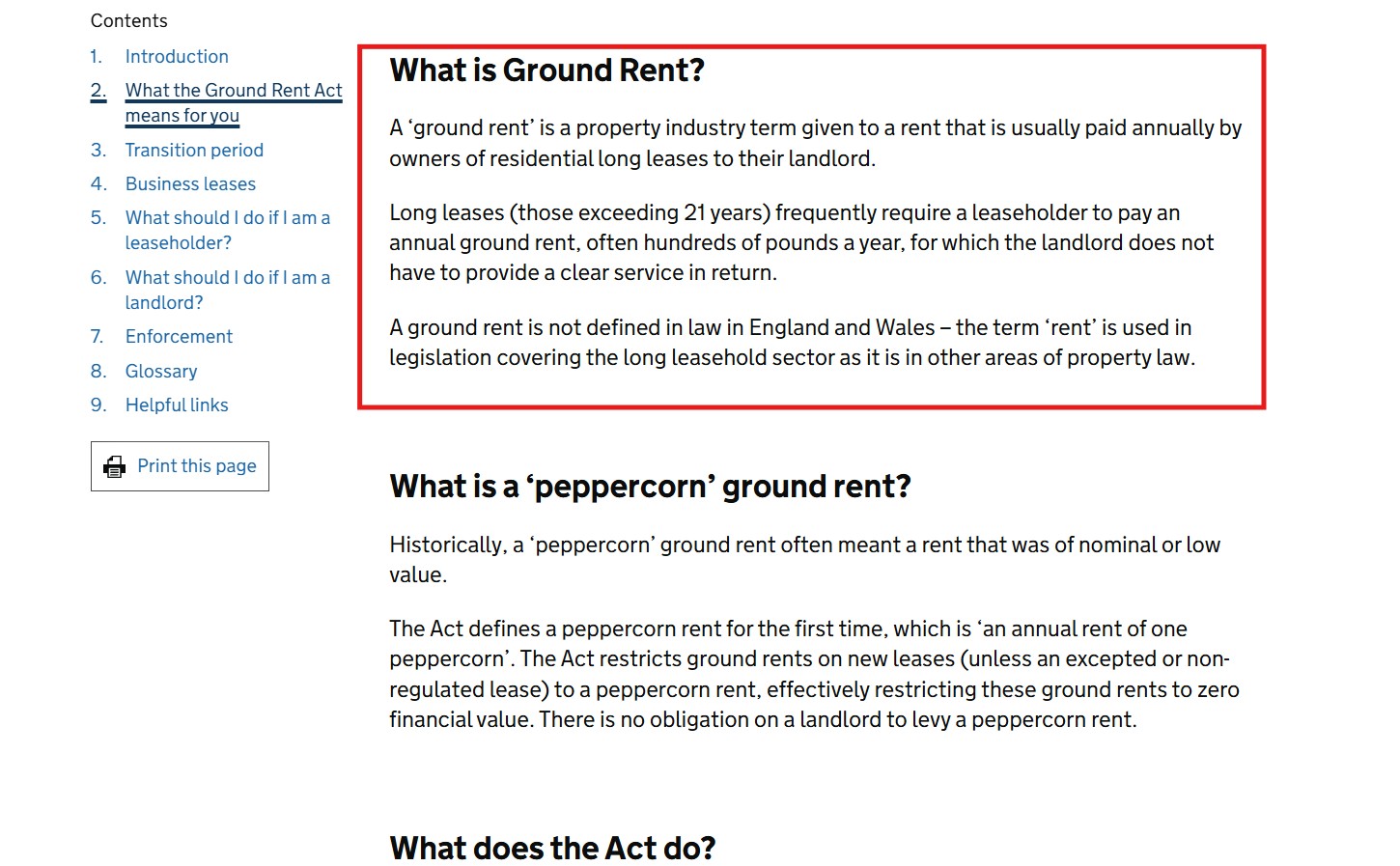
GOV.UK guidance explaining the Leasehold Reform (Ground Rent) Act 2022, including commencement dates and the meaning of peppercorn rent.
The legislation aims to prevent buyers of qualifying new homes from becoming responsible for escalating ground rents that provide no clearly identifiable service in return.
It also creates enforcement mechanisms where landlords unlawfully demand or retain prohibited payments.
How Much Is Peppercorn Rent Compared With Normal Ground Rent?
Peppercorn ground rent has an effective monetary value of £0 per year.
By comparison, older residential leases may require fixed or escalating annual payments.
The financial difference becomes more significant over longer ownership periods.
| Annual ground rent | Cost over 10 years | Cost over 25 years |
| Peppercorn (£0 monetary value) | £0 | £0 |
| £100 | £1,000 | £2,500 |
| £250 | £2,500 | £6,250 |
| £400 | £4,000 | £10,000 |
| £600 | £6,000 | £15,000 |
Illustrative calculations assume ground rent remains unchanged throughout each period. They exclude inflation, discounting, property purchase costs and service charges.
For a leaseholder otherwise required to pay £400 annually, a peppercorn arrangement eliminates £4,000 of nominal ground rent payments over ten years.
That represents a 100% reduction in monetary ground rent for the comparison.
However, it does not mean the household’s overall property expenditure falls by 100%.
What Happens When Ground Rent Doubles?
Older leases sometimes contain review clauses allowing ground rent to increase at fixed intervals.
Consider an illustrative lease with an initial ground rent of £250, doubling every ten years.
| Period | Annual ground rent |
| Years 1–10 | £250 |
| Years 11–20 | £500 |
| Years 21–30 | £1,000 |
| Years 31–40 | £2,000 |
An arrangement like this can create substantial long-term liabilities.
It may also make the property less attractive to purchasers and mortgage lenders, depending on the lease terms and the lender’s requirements.
Our financial assessment is that eliminating escalating ground rent offers two advantages: lower predictable expenditure and reduced exposure to future contractual increases.
What Is the Difference Between Peppercorn Rent and Service Charges?
This is one of the most important distinctions for London property buyers.
Ground rent and service charges are separate financial obligations.
Ground rent is generally a payment required under the lease without the landlord necessarily providing a specific service in return.
A service charge contributes towards services, repairs, maintenance and management expenses associated with the property or building.
| Feature | Peppercorn ground rent | Service charge |
| Main purpose | Nominal rent under the lease | Paying for building-related services and expenditure |
| Typical monetary amount | £0 for regulated leases | Depends on the building and lease |
| Automatically removed by 2022 Act? | Monetary ground rent restricted for qualifying leases | No |
| Can change annually? | Not into monetary ground rent under the regulated lease | May vary according to lawful costs and lease provisions |
| Covers communal cleaning? | No | May do |
| Covers lift maintenance? | No | May do |
| Covers building insurance? | No | May do, depending on the lease |
Can Service Charges Still Be Expensive?
Yes.
A leasehold flat could have peppercorn ground rent but substantial service charges.
For example:
- Property purchase price: £475,000
- Ground rent: £0
- Annual service charge: £3,000
- Annual reserve fund contribution: £500, if separately payable
- Total illustrated annual building-related charges: £3,500
These figures are hypothetical, not London market averages.
The buyer has eliminated monetary ground rent but still faces meaningful ongoing expenditure.
For flats in buildings with lifts, concierge facilities, substantial communal areas or major maintenance requirements, the cost of services can be a significant part of the ownership budget.
Buyers should therefore request service charge accounts, current budgets, reserve fund information and details of planned major works.
Our assessment is that a peppercorn rent is financially attractive, but the service charge position often deserves equally careful scrutiny.
How Important Is Peppercorn Rent for London Property Buyers?
Peppercorn rent has particular significance in London because leasehold ownership is widespread across the capital.
According to official government statistics published in May 2026, there were approximately 4.90 million leasehold dwellings in England in 2024–25, representing around 20% of the housing stock.
London had the highest regional concentration.
| Housing measure | Official figure |
| Leasehold dwellings across England | 4.90 million |
| Share of England’s housing stock that was leasehold | 20% |
| Leasehold dwellings in London | 1.44 million |
| Share of London dwellings that were leasehold | 39% |
| Share of all leasehold dwellings in England that were flats | 69% |
These figures help explain why leasehold reform is particularly relevant to London’s apartment market.
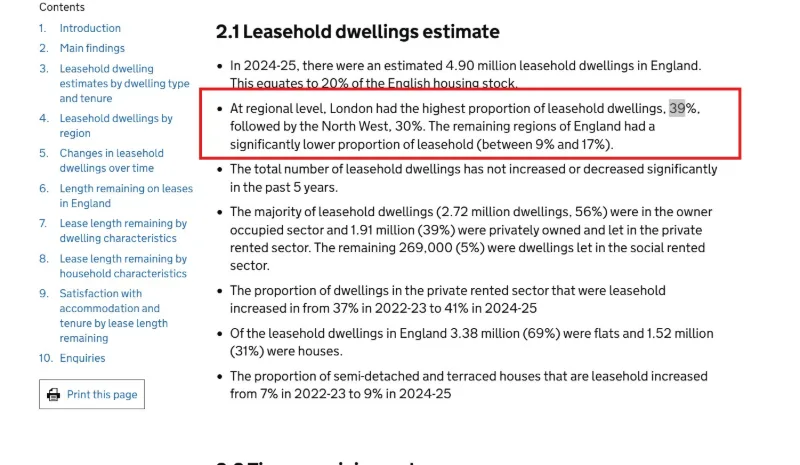
Official government statistics published on 21 May 2026 showing that 39% of London’s housing stock was leasehold in 2024–25.
Why Does This Matter for Investors?
From a property investment perspective, ground rent is one element of the ongoing ownership cost.
A landlord purchasing a leasehold flat to rent out must consider the acquisition price, mortgage terms, service charges, maintenance, insurance, compliance responsibilities and any contractual ground rent.
Peppercorn rent can remove one of those expenses.
However, it does not automatically improve investment performance if the property has unusually high service charges or substantial maintenance liabilities.
Investors also need to distinguish between the ground rent they might owe as leaseholders and the residential rent they receive from their tenants.
People researching the private rental market can explore how to rent a home in London to understand the separate rules governing residential tenancies, rental payments and tenant responsibilities.
Does Peppercorn Rent Apply to Existing Leasehold Properties?
No, the 2022 legislation does not automatically convert every existing residential lease to peppercorn ground rent.
This is a particularly important point for homeowners purchasing older flats.
If a lease was granted before 30 June 2022, its existing ground rent obligations may remain enforceable.
Purchasing that property in 2026 does not normally create a new lease merely because the ownership changes.
For example, consider a London flat with a lease originally granted in 2015.
The agreement requires £300 annual ground rent.
If the property is sold to a new leaseholder in 2026, the existing contractual ground rent may continue, even though the buyer completed their purchase after the 2022 Act came into force.
The relevant question is therefore not simply when the buyer purchases the property.
It is when the lease was granted, whether the relevant statutory conditions are met and whether any exceptions apply.
Prospective buyers should ask their conveyancer to examine the lease’s history and the current ground rent provisions.
Will Existing Ground Rents Be Capped at £250 in 2026?
The government announced further leasehold reform proposals on 27 January 2026.
The proposed changes would generally cap ground rents on existing qualifying residential leases at £250 annually, before transitioning to peppercorn rent after 40 years.
However, as of 9 October 2026, this wider cap is a proposal rather than a general rule already in force.
The government published a draft Commonhold and Leasehold Reform Bill in January 2026 and subsequently undertook pre-legislative scrutiny.
The proposed ground rent cap could take effect in late 2028, subject to parliamentary approval and the final legislative timetable.
Consequently, homeowners should not assume their existing ground rent has already been reduced.
How Much Could Existing Leaseholders Save?
Consider hypothetical existing annual ground rents under the proposed £250 cap.
| Current annual ground rent | Proposed capped amount | Annual reduction | Percentage reduction |
| £250 | £250 | £0 | 0% |
| £350 | £250 | £100 | 28.6% |
| £500 | £250 | £250 | 50% |
| £750 | £250 | £500 | 66.7% |
| £1,000 | £250 | £750 | 75% |
These examples illustrate the possible effect if the proposed cap comes into force substantially as announced and applies to the leases concerned.
They are not current legal entitlements.
The proposals also contemplate specific exemptions or adjustments, including consideration of certain arrangements where buyers paid a lower upfront premium in return for a higher ground rent.
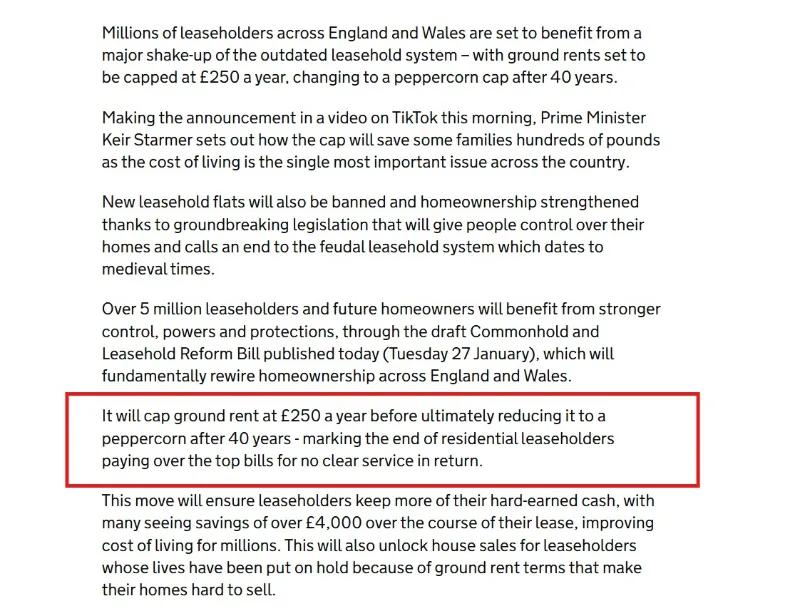
GOV.UK announcement of 27 January 2026 setting out the proposed £250 annual ground rent cap and transition to peppercorn rent after 40 years. The proposal had not yet become generally operative law as of 9 October 2026.
What Have Property Industry Experts Said?
Martin Boyd, Chair of the Leasehold Advisory Service, described the draft reforms in the government’s January 2026 announcement as:
“This is a significant milestone for leaseholders and marks the beginning of the end for the leasehold system as we know it.”
The statement reflects the potential importance of the wider reform programme, rather than confirmation that every proposed measure is already in force.
From our analysis, the distinction between enacted legislation and future policy is essential for making accurate financial decisions.
Can Peppercorn Rent Be Introduced Through a Lease Extension?
Yes. Certain lease extension arrangements can reduce ground rent to a peppercorn.
However, the outcome depends on whether the extension follows the statutory process or is privately negotiated.
Statutory Lease Extensions
Under the statutory route currently available to qualifying flat leaseholders, the existing lease can generally be extended by 90 years, with ground rent reduced to a peppercorn.
A premium and associated professional costs may still be payable.
The two-year ownership requirement for starting a statutory extension was removed from 31 January 2025, making the process accessible sooner to qualifying new owners.
Voluntary Lease Extensions
A voluntary extension is negotiated directly with the freeholder.
Where a voluntary replacement lease is regulated by the 2022 Act, the existing ground rent may continue during the remaining period of the original lease, but the additional term is restricted to peppercorn rent.
Suppose a flat has 75 years remaining and an annual ground rent of £250.
The owner negotiates an extension.
The new lease could retain the original ground rent during the original 75-year period, while applying peppercorn rent to the additional years.
The parties may also negotiate more favourable arrangements.
What About the 990-Year Lease Extension Reform?
The Leasehold and Freehold Reform Act 2024 provides for a future system offering 990-year statutory lease extensions with no monetary ground rent.
However, the relevant changes require further implementation.
Government guidance updated in September 2026 confirmed that technical regulations and legislative steps were still necessary.
Therefore, the proposed 990-year arrangement should not be described as the existing standard statutory entitlement.
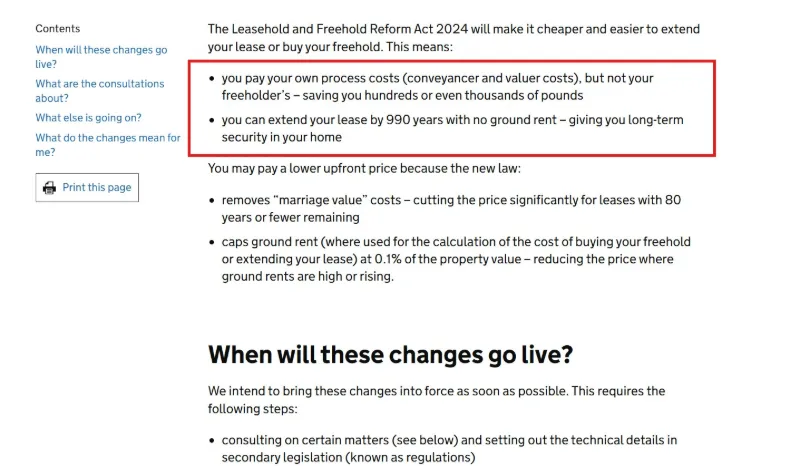
September 2026 GOV.UK explanation of planned 990-year lease extensions, the zero-ground-rent provisions and the remaining implementation steps.
Is Peppercorn Rent Available Under Shared Ownership?
Shared ownership has different rent arrangements from outright leasehold ownership.
In a typical shared ownership purchase, the buyer owns a percentage of the property’s value and pays rent on the remaining share held by the housing provider.
For new regulated shared ownership leases, the peppercorn restriction generally applies to the leaseholder’s owned share.
The housing provider can continue charging rent on its retained share.
For example, consider a shared ownership property valued at £400,000.
The buyer purchases a 40% share worth £160,000.
The housing provider retains 60%, worth £240,000.
The buyer may have peppercorn ground rent attributable to the owned share but still pay rent on the provider’s 60% share.
That continuing rent is not prohibited merely because the lease contains a peppercorn provision.
This distinction is particularly relevant when comparing shared ownership with discounted rental routes such as Rent to Buy and London Living Rent.
Both can support progression towards home ownership, but they involve different legal structures and financial obligations.
Does Peppercorn Rent Apply to Commercial Properties?
Peppercorn rent can appear in commercial property agreements, but the statutory regime for new residential ground rents should not be applied automatically to business leases.
Historically, nominal rents have sometimes been used in commercial or community arrangements where the parties wish to grant occupation rights without charging ordinary market rent.
For example, a property owner might agree to let a building to a community organisation for a nominal annual rent.
However, the commercial agreement still needs to set out important responsibilities such as repairs, insurance, rates, permitted use and termination.
The 2022 Act also contains an exception for certain qualifying business leases involving residential accommodation.
For the exception to apply, specific statutory conditions must be met.
Simply operating a home-based business does not automatically make an ordinary residential lease exempt.
Commercial landlords and tenants should obtain advice based on the actual agreement rather than assuming that peppercorn rent automatically removes other liabilities.
Can Peppercorn Rent Affect Property Value and Mortgage Approval?
It can influence the overall attractiveness of a leasehold property, although the financial effect depends on several factors.
Mortgage lenders consider the property as security for the loan.
Their assessment may include the remaining lease term, ground rent provisions, service charges and restrictions contained in the lease.
How Can Ground Rent Affect Mortgage Eligibility?
A lease that contains frequent or substantial ground rent increases may cause concerns for some lenders.
For example, a lender might examine a lease containing ground rent doubling provisions before deciding whether the terms meet its lending criteria.
A peppercorn ground rent removes the concern about escalating monetary ground rent, but it does not resolve every leasehold issue.
A flat with peppercorn rent and a very short remaining lease could still face mortgage or resale difficulties.
Does Peppercorn Rent Increase a Property’s Value?
Not automatically.
Two otherwise similar flats may attract different buyer interest if one carries onerous ground rent obligations and the other has peppercorn rent.
However, determining any premium requires evidence from comparable sales, valuations and market conditions.
Our assessment is that peppercorn rent can support marketability and predictable ownership costs, but buyers should not assume that it guarantees a particular increase in property value.
What Happens if a Landlord Illegally Charges Ground Rent?
The 2022 Act contains enforcement provisions for prohibited ground rent payments on regulated leases.
A landlord who breaches the legislation can face a financial penalty ranging from £500 to £30,000, depending on the circumstances and enforcement decision.
Where a prohibited payment has been taken, the landlord or relevant recipient may also be required to refund it.
How Can Leaseholders Challenge an Incorrect Charge?
The recommended approach is to:
- Check the lease: Establish its commencement date, legal status and contractual ground rent provisions.
- Review the legislation: Determine whether the lease qualifies for the peppercorn restriction.
- Contact the landlord: Request an explanation and correction of any prohibited charge.
- Request repayment: Where prohibited ground rent has been paid, seek its refund. The Act includes a 28-day repayment requirement.
- Seek enforcement assistance: Report unresolved suspected breaches through the Citizens Advice consumer service for referral to Trading Standards.
- Consider the tribunal: Where appropriate, apply to the First-tier Tribunal (Property Chamber) for a recovery order or relevant determination.
A leaseholder should not assume every unexpected payment is prohibited ground rent.
Service charges, insurance contributions and other contractual liabilities may need to be assessed under different legislation.
What Should Buyers Check Before Purchasing a Peppercorn Rent Property?
A peppercorn clause is positive from a ground rent perspective, but it should form only one part of the conveyancing review.
We recommend examining the following matters before exchanging contracts.
| Property check | Why it matters |
| Original lease grant date | Helps determine whether the 2022 Act applies |
| Current ground rent wording | Confirms the amount and potential review provisions |
| Remaining lease term | Can affect valuation, mortgageability and extension costs |
| Annual service charges | Reveals continuing maintenance expenditure |
| Reserve fund | Indicates whether money is being collected for future works |
| Planned major repairs | Could create substantial additional costs |
| Building insurance | Establishes payment responsibilities and coverage |
| Restrictions on alterations or letting | May affect renovation or investment plans |
| Landlord and managing agent information | Helps assess management arrangements |
| Disputes and arrears | Can reveal potential legal or financial complications |
Buyers should also establish whether the lease contains restrictions affecting future use of the property.
For example, an investor intending to let the flat must check whether subletting requires consent.
Equally, a buyer considering refurbishment should review the lease’s alterations provisions.
Our view is that the best property decision is based on the full cost and legal structure of ownership, rather than the ground rent figure alone.
Is Peppercorn Rent Good for Leaseholders?
For buyers of qualifying new residential leasehold properties, peppercorn rent is generally financially favourable because it removes ordinary monetary ground rent obligations.
However, its usefulness differs depending on the leaseholder’s circumstances.
Our Editorial Assessment
The following ratings are editorial judgements based on the legal scope and financial effect of peppercorn rent, not customer survey results or independently measured market performance.
| Assessment area | Editorial rating | Explanation |
| Ground rent cost certainty on new regulated leases | 5/5 | Monetary ground rent is effectively eliminated |
| Protection against escalating ground rent on covered leases | 5/5 | Prevents monetary ground rent increases under the regulated lease |
| Protection against service charge increases | 1/5 | Peppercorn rules do not automatically control service charges |
| Automatic benefit to existing older leaseholders | 1/5 | The 2022 Act does not generally extinguish their existing rent |
| Simplification of leasehold buying decisions | 4/5 | Removes one potential cost concern, although the wider lease remains important |
These scores deliberately distinguish between the benefits of peppercorn rent and the wider limitations of leasehold ownership.
The strongest financial benefit is the removal of monetary ground rent on covered leases.
The principal limitation is that other ownership costs and legal restrictions remain.
What Are the Most Common Misunderstandings About Peppercorn Rent?
Several misconceptions can lead to inaccurate assumptions when purchasing property.
Peppercorn rent means the home is rent-free in every respect.
Not necessarily. It normally refers to ground rent, not all other payments.
Every existing leaseholder stopped paying ground rent in 2022.
Incorrect. Older leases are not automatically converted by the Act.
Peppercorn rent means owning the freehold.
Incorrect. The property can remain leasehold.
The £250 ground rent cap is already fully operational in 2026.
Incorrect. The wider existing-lease cap remained a legislative proposal as of 9 October 2026.
Service charges cannot increase on a peppercorn lease.
Incorrect. Lawful service charges can still change according to expenditure and the applicable rules.
All future lease extensions automatically last 990 years.
Incorrect. The new statutory framework requires further implementation.
Understanding these distinctions helps buyers avoid confusing a valuable ground rent protection with a complete reform of the leasehold system.
Final Assessment
Peppercorn rent is a valuable protection for qualifying new residential leaseholders because it removes the obligation to pay monetary ground rent.
In London, where a substantial proportion of the housing stock is leasehold, this protection is particularly relevant to flat buyers and property investors.
However, peppercorn rent should not be confused with the absence of all property expenses.
Existing ground rent obligations, service charges, lease extension premiums, maintenance expenditure and mortgage requirements must still be considered.
Our overall assessment is that peppercorn rent provides strong cost certainty within its legal scope, while the wider 2026 leasehold reform proposals could eventually extend some protection to owners of older properties.
Until those further reforms become law and take effect, the individual lease remains the starting point for understanding what a property owner must pay.
Frequently Asked Questions
Is Peppercorn Rent the Same as Zero Ground Rent?
For a qualifying regulated residential lease, peppercorn rent effectively means zero monetary ground rent. The statutory definition remains one peppercorn annually.
Can a Freeholder Demand a Physical Peppercorn?
A lease may provide for an actual peppercorn, but government guidance makes clear that landlords are not expected to collect one in practice.
Do You Pay Council Tax on a Peppercorn Rent Property?
Yes, council tax liability is determined separately. A peppercorn ground rent arrangement does not create an automatic council tax exemption.
Does Peppercorn Rent Affect Stamp Duty?
Peppercorn ground rent does not automatically exempt a purchase from Stamp Duty Land Tax. Liability depends on the applicable property transaction and tax rules.
Can Peppercorn Rent Be Changed to £250?
A regulated lease cannot simply have prohibited monetary ground rent introduced by a landlord. The separate proposed £250 cap concerns older leases that may currently have monetary ground rent obligations.
Is Peppercorn Rent Better Than Freehold?
They are different concepts. Peppercorn rent removes or reduces a ground rent liability, while freehold concerns the nature of property ownership. A peppercorn lease may still carry service charges and leasehold restrictions.
Adam is a London business and news writer at London Insider News, covering local developments, finance, entrepreneurship and the stories shaping businesses and communities across the capital.
More from BUYING & LEASEHOLD

What Is a Turnkey Property? Meaning, Costs, Benefits and Investment Risks in the UK
A turnkey property is a home that is fully completed, renovated or prepared for immediate occupation,…

What Is Ground Rent? Meaning, Costs and UK Leasehold Rules in 2026
Ground rent is one of the most misunderstood costs associated with owning a leasehold property in…

How Does Rent to Buy Work? Eligibility, Costs and Finding a Home
Buying a home in the UK has become increasingly challenging for households that can afford monthly…