Aldi and Lidl Land Agreements CMA Rules 2026: What Changes for Supermarkets, Businesses and Shoppers?
The CMA has introduced new land agreement rules for Aldi and Lidl in 2026, aiming to prevent anti-competitive property restrictions, improve supermarket competition and offer UK shoppers greater choice.
 Adam
London Business & News Writer
Aldi and Lidl are facing a significant change in how they can control supermarket locations across the UK after the Competition and Markets Authority (CMA) confirmed new restrictions on their land agreements on 22 October 2026.
The decision brings both discount retailers under the Groceries Market Investigation (Controlled Land) Order 2010, a competition framework already applied to Tesco, Sainsbury’s, Asda, Morrisons and other established supermarket operators.
Our analysis of the CMA’s final decision, grocery market data, retailer submissions and property-related implications indicates that this is more than a technical regulatory change.
It could influence how supermarkets negotiate commercial leases, acquire development sites and compete for customers in particular neighbourhoods.
The regulator’s findings are particularly significant because Aldi and Lidl have developed into two of Britain’s largest grocery retailers, together accounting for approximately 19.4% of the Great Britain grocery market in the 2026 data examined by the CMA.
For shoppers, the intended benefit is greater supermarket choice. For developers and commercial property owners, the decision could create opportunities to challenge certain restrictions that previously complicated retail developments.
However, the new designation does not automatically cancel every existing agreement or guarantee cheaper groceries.
What Are the New Aldi and Lidl Land Agreement CMA Rules?
The CMA has formally designated Aldi Stores Limited, Lidl Great Britain Limited and Lidl Northern Ireland Limited as Large Grocery Retailers (LGRs).
This means they are now subject to controls designed to prevent major supermarkets from using certain property agreements to restrict competitors from opening nearby stores.
The rules mainly concern restrictive covenants and long-term exclusivity arrangements.
Under the framework, designated supermarkets face restrictions on introducing land agreements that prevent other businesses from retailing groceries. Certain exclusivity arrangements cannot be enforced beyond the permitted five-year period.
The CMA can also assess relevant existing restrictions through its established review procedures.
Key Facts About the October 2026 Decision
| Key Detail | Confirmed Position |
| Regulator | Competition and Markets Authority |
| Final decision date | 22 October 2026 |
| Legislation | Groceries Market Investigation (Controlled Land) Order 2010 |
| Newly designated retailers | Aldi, Lidl GB and Lidl NI |
| Original designated supermarket groups | 7 |
| Main restrictions | Certain restrictive covenants and long-term exclusivity arrangements |
| General exclusivity limit | 5 years, subject to the Order’s provisions |
| UK food and grocery market value | Estimated £222.7 billion |
| Intended outcome | Greater local competition and consumer choice |
The distinction between the original legislation and the latest decision is important.
The CMA has not introduced an entirely new supermarket land law in October 2026. It has extended an existing regulatory framework to three additional grocery retail businesses.
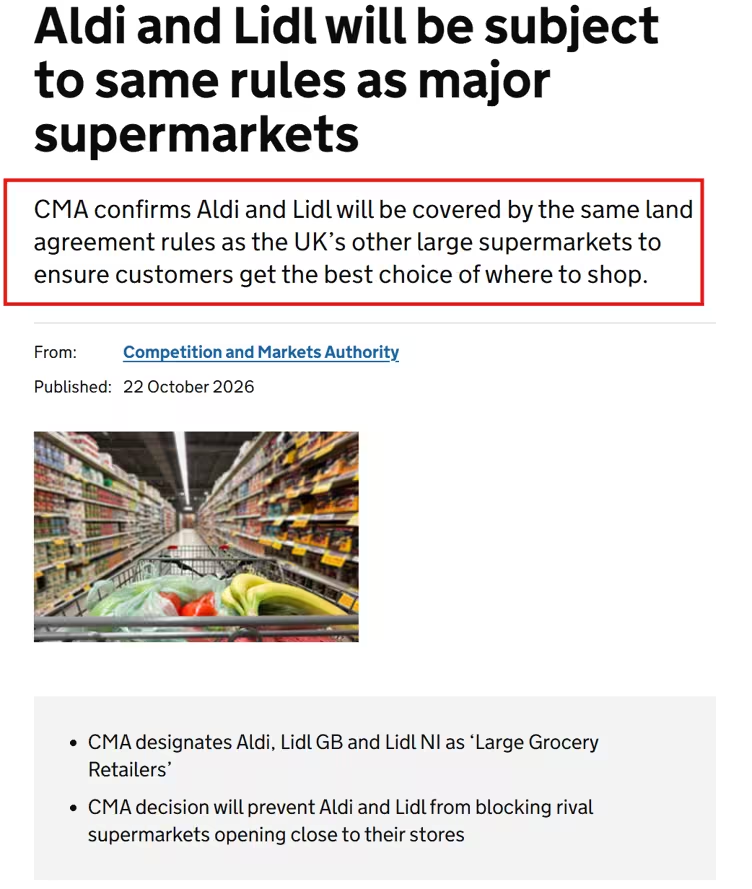
Official CMA announcement published on 22 October 2026 confirming that Aldi, Lidl Great Britain and Lidl Northern Ireland are designated Large Grocery Retailers under the Controlled Land Order.
Why Has the CMA Decided to Include Aldi and Lidl?
The central reason is that the British grocery market has changed substantially since 2010.
When the Controlled Land Order was introduced, Aldi and Lidl were classified as Limited Assortment Discounters because their stores generally offered fewer product lines than traditional full-range supermarkets.
Their comparatively restricted ranges formed part of the justification for treating them differently.
But their businesses have expanded in several important respects.
1. Aldi and Lidl Now Operate Extensive Store Networks
The CMA’s final report recorded 1,085 Aldi stores and 1,016 Lidl GB stores as of 28 February 2026, alongside 44 Lidl NI stores.
A substantial majority exceed the 1,000-square-metre net sales area threshold relevant to the definition of a larger grocery store.
2. Both Retailers Offer a Full Grocery Range
Although Aldi and Lidl still stock fewer individual products than many conventional supermarkets, the CMA concluded that their ranges cover the major grocery categories needed for a regular household shop.
Aldi and Lidl typically use simpler ranges, private-label products and comparatively standardised store formats to maintain operational efficiency.
The regulator’s assessment recognised that a smaller number of individual product lines does not necessarily mean the business is no longer competing as a mainstream grocery retailer.
3. Both Have Integrated Grocery Purchasing Operations
The CMA also assessed how both businesses purchase products.
Aldi and Lidl have established purchasing functions that obtain groceries directly from suppliers, supported by wider group sourcing arrangements.
This satisfies another important criterion for Large Grocery Retailer designation.
Our assessment is that the CMA has placed greater emphasis on how the businesses actually operate and compete today, rather than retaining a classification based on their business models more than 15 years ago.
How Big Are Aldi and Lidl in the UK Supermarket Market?
The commercial scale of Aldi and Lidl is a central part of the decision.
According to the 2026 Worldpanel figures examined in the CMA’s final report, Aldi held 10.8% of grocery spending in Great Britain, while Lidl GB accounted for 8.6%.
Together, that represents approximately 19.4% of the market.
Aldi and Lidl Market Share Comparison
| Retailer | Great Britain Market Share | Market Position |
| Aldi | 10.8% | Fourth largest |
| Lidl GB | 8.6% | Fifth largest |
| Combined | 19.4% | Combined share, not a single company |
These figures relate to the 12-week period ending 17 May 2026. They are not full-year UK-wide market shares.
The growth becomes more apparent when compared with 2020:
- Aldi increased from 8.5% to 10.8%, a rise of approximately 27.1% relative to its original share.
- Lidl GB increased from 5.4% to 8.6%, representing approximately 59.3% relative growth.
- Their combined market share increased from 13.9% to 19.4%, a gain of 5.5 percentage points.
These are substantial changes in competitive position.
From a business perspective, supermarket scale is not measured purely by revenue. The location of stores, geographic coverage, supply-chain capacity and ability to influence competitors’ pricing strategies also matter.
The CMA’s review identified evidence that established supermarket groups benchmark their prices against Aldi and Lidl, further demonstrating the influence these discounters now exercise.
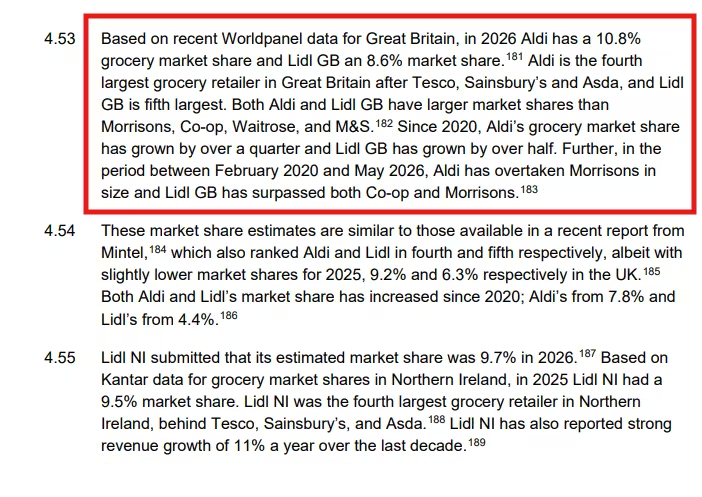
CMA Final Decisions Report, section 4.53, showing Aldi’s 10.8% and Lidl GB’s 8.6% grocery market shares and their rankings among Britain’s largest supermarkets.
What Types of Land Agreements Are Restricted Under the CMA Rules?
To understand the financial and commercial significance of the decision, it is necessary to distinguish between the two main forms of land restriction.
Restrictive Covenants
A restrictive covenant is a contractual restriction affecting how a property or particular area of land can be used.
For example, a supermarket might sell land adjoining one of its stores but seek to prevent the purchaser from using that property for competing grocery retail.
Such arrangements can affect the potential uses and commercial attractiveness of a development site.
Under the Controlled Land Order, designated retailers are generally prohibited from entering into certain new covenants that prevent grocery retailing, subject to specific exceptions.
The Order recognises exceptions involving land supporting grocery operations, such as car parks, service yards and access roads, alongside certain other circumstances.
Consequently, not every commercial property restriction is automatically prohibited.
Long-Term Exclusivity Agreements
An exclusivity agreement can give a retailer the sole right to sell groceries within a particular shopping centre, retail development or other qualifying location.
For example, imagine a supermarket secures a lease within a retail park and negotiates a clause preventing the landlord from renting other units to competing grocery retailers.
The arrangement may initially offer commercial protection.
However, the Controlled Land Order restricts the enforcement of qualifying exclusivity arrangements beyond the permitted five-year period.
The precise legal treatment depends on the type of agreement, relevant dates and provisions of the Order.
Practical Comparison of Land Agreement Rules
| Land Arrangement | Regulatory Position |
| New covenant preventing grocery retail competition | Generally prohibited for designated retailers, subject to exceptions |
| Qualifying exclusivity arrangement within the permitted period | May be allowed |
| Qualifying exclusivity extending beyond five years | Enforcement beyond the permitted period is restricted |
| Existing land restriction | May require review or a CMA competition test |
| Ordinary supermarket property ownership | Remains permitted |
| Grocery store expansion | Remains permitted, subject to normal requirements |
A particularly important point for landlords is that the regulations do not prevent Aldi or Lidl from buying or leasing commercial properties.
They restrict particular methods of using those agreements to obstruct grocery competition.
How Many Aldi and Lidl Land Agreements Could Be Affected?
One of the most revealing parts of the CMA’s findings concerns the information provided by Aldi and Lidl about their existing land portfolios.
In 2025, the regulator requested information on restrictive covenants and exclusivity arrangements.
The retailers conducted reviews of their agreements and identified differing proportions containing potentially relevant restrictions.
Results of the Land Agreement Reviews
| Retailer | Agreements Examined | Agreements Containing Reported Restrictions |
| Aldi | 10% sample | 50–60% of the sample |
| Lidl GB | 10% sample | 10–20% of the sample |
| Lidl NI | All existing agreements | 20–30% |
These results need careful interpretation.
The percentages describe reported restrictions within the agreements examined, not the proportion of agreements the CMA has found to be unlawful.
The CMA has explicitly stated that it has not completed a detailed legal assessment of those agreements.
For Aldi, the published percentage also includes information that has been redacted. Lidl GB and Lidl NI did not clearly specify whether every reported restriction concerned grocery retailing.
It would therefore be inaccurate to suggest that 50–60% of Aldi’s entire property portfolio breaches competition law.
Nevertheless, the figures demonstrate why compliance reviews may become commercially important.
If a retailer’s property portfolio contains agreements requiring amendment, the process could involve legal reviews, negotiations with property owners and changes to contractual arrangements.
For commercial landlords, identifying restrictions early could prevent unnecessary delays when marketing retail space or negotiating with prospective tenants.
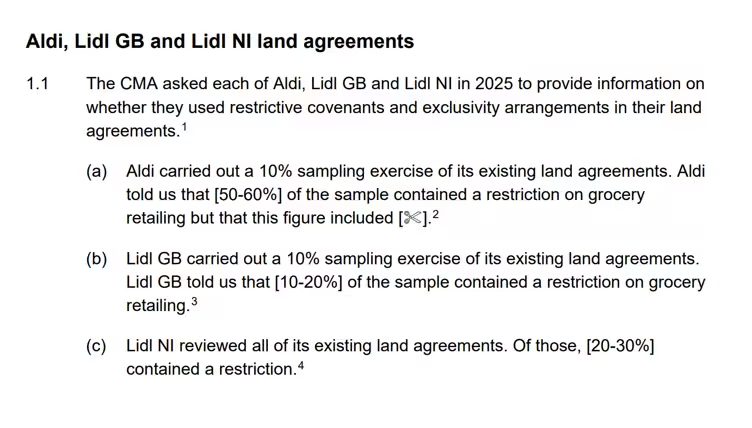
CMA Final Decisions Report showing the proportions of Aldi, Lidl GB and Lidl NI land agreements identified by the retailers as containing restrictions. These are not confirmed breaches.
What Could the New Rules Mean for Commercial Landlords and Property Developers?
Our business and property analysis identifies several areas in which the CMA ruling could influence future decisions.
Greater Flexibility in Retail Development
A property developer planning a new shopping centre or retail park may have greater freedom to consider competing grocery tenants where a prohibited restriction would otherwise have prevented them.
For instance, a landlord may own multiple commercial units within a development anchored by a large supermarket.
If an existing arrangement prevents the landlord from letting another unit to a grocery competitor, the landlord can investigate whether the restriction is permissible.
Removing an unlawful restriction could increase the range of prospective tenants.
However, the economic benefit depends on local tenant demand, planning permission, unit size and the financial strength of prospective occupiers.
Potential Changes to Property Valuation
Property investors often assess commercial real estate using its expected income, tenant quality, vacancy risk and permitted uses.
A site restricted to a narrow category of tenants may have fewer potential occupiers than an otherwise comparable unrestricted property.
If a legally prohibited restriction can be removed, the property’s leasing flexibility may improve.
But it would be inappropriate to assume a fixed percentage increase in commercial property value.
Our assessment is that any valuation impact must be determined at an individual-site level.
Additional Legal and Compliance Costs
Supermarket operators may need to review their property portfolios to identify contracts that create regulatory concerns.
The work can involve internal property teams, commercial solicitors, landlords and specialist competition lawyers.
A business could face additional expenditure even where its agreements are ultimately found compliant.
These are potential compliance costs rather than published financial liabilities imposed on Aldi or Lidl by the latest decision.
How Could the CMA Rules Affect Supermarket Development in London?
London presents an interesting case because new grocery developments compete for a limited supply of appropriately located commercial property.
High development costs, residential density, local planning requirements and competition from convenience stores can all influence where supermarkets choose to expand.
In April 2026, Aldi announced a £40 million investment programme involving eight new stores in London and surrounding areas.
The announced locations included Hanworth, Willesden, Watford, Marble Arch, Hoxton, Orpington West, Epsom and Stepney Green.
The company also announced plans to refurbish existing stores in Enfield and Kilburn.
Jonathan Neale, Managing Director of National Real Estate at Aldi UK, explained the commercial challenge in the retailer’s official expansion announcement:
“too many Londoners don’t have an Aldi within easy reach.”
His comment illustrates why site availability matters to supermarket operators.
In areas where there is substantial customer demand but limited appropriate commercial space, restrictive property agreements can present an additional obstacle to potential entrants.
However, the CMA ruling does not mean that announced Aldi developments have been accelerated, approved or made more profitable as a direct result.
Those outcomes would require separate evidence.
For shoppers, having multiple supermarket options nearby can be commercially meaningful because branches differ in their ranges, pricing strategies, promotional offers and operating schedules.
Even established retailers such as Sainsbury’s have different opening times across London branches, illustrating why the number of accessible stores is only one measure of consumer choice.
From our perspective, the more useful question is whether a household has practical access to competing supermarkets that meet its shopping needs.
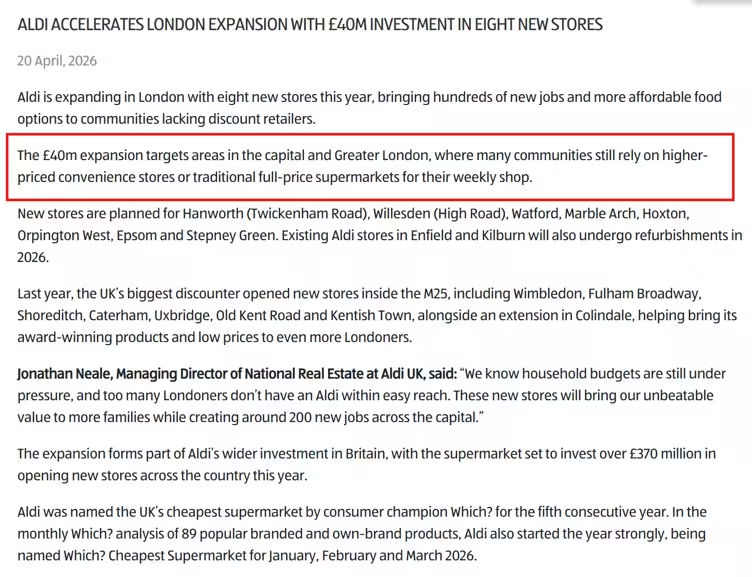
Official Aldi UK announcement dated 20 April 2026 outlining its £40 million London expansion programme, eight planned store locations and the comments of Managing Director Jonathan Neale.
Will Aldi and Lidl Have to Stop Opening New Supermarkets?
No. The CMA’s ruling does not prevent either retailer from continuing its UK expansion strategy.
Aldi and Lidl remain free to acquire suitable commercial sites, negotiate leases and open additional stores, subject to planning requirements and other applicable laws.
The restriction concerns anti-competitive terms within certain land agreements, rather than supermarket growth itself.
Both businesses have previously expressed confidence in their continuing expansion plans.
During the August 2026 consultation period, Aldi indicated that the proposed change would not affect its long-term plans to open hundreds of stores across the country.
Lidl similarly indicated that it expected to maintain its growth momentum.
The final decision should therefore be understood as a change in the rules governing competition between supermarkets, not a requirement for either business to reduce its store network.
From a financial standpoint, expansion will still depend on factors including development expenditure, expected sales per store, distribution capacity, labour availability and investment returns.
Could the CMA Decision Lead to Lower Grocery Prices?
The regulator’s objective is to encourage competition that benefits shoppers through greater choice and potentially more attractive prices.
But there is an important distinction between creating better competitive conditions and guaranteeing lower prices.
The impact of a new supermarket depends on local circumstances.
If a neighbourhood currently has only one convenient grocery retailer, an additional store could create an incentive for existing businesses to compete more actively.
Retailers may respond through promotional pricing, product-range adjustments, investment in store facilities or improved service.
However, food inflation, supplier costs, wages, property expenses and transport costs will continue to influence supermarket pricing.
Example of Potential Household Savings
Consider a hypothetical household spending £100 per week on groceries.
| Illustrative Saving | Weekly Saving | Annual Saving |
| 2% | £2 | £104 |
| 5% | £5 | £260 |
| 8% | £8 | £416 |
| 10% | £10 | £520 |
The calculations assume spending remains at £100 per week before savings and repeat for 52 weeks.
These figures illustrate the financial significance of different potential price reductions. They are not CMA forecasts or predicted outcomes of the land agreement ruling.
Our financial assessment is that consumers should evaluate their actual shopping basket rather than assume that competition reform will deliver a particular percentage reduction.
Shopping affordability also depends on targeted promotions and eligibility.
For example, Sainsbury’s £3 fruit and vegetable scheme illustrates how retailer-specific programmes can affect household grocery spending independently of wider changes to competition rules.
What Have Other Supermarkets Said About the CMA Decision?
The CMA’s final report provides useful evidence of how established grocery businesses view Aldi and Lidl’s competitive position.
Morrisons, Waitrose and Iceland submitted representations supporting the proposal to designate the discount retailers under the Controlled Land Order.
Their support is commercially significant because these companies already compete with Aldi and Lidl for grocery customers.
Morrisons argued that both discount retailers operate extensive store networks, offer full grocery ranges and compete directly with established supermarkets.
The submissions also highlighted Aldi and Lidl’s influence over competitors’ pricing and expansion strategies.
An important distinction is that Aldi and Lidl had participated in the earlier evidence-gathering process, but the CMA reported that they did not submit representations in response to the August provisional decisions.
The regulator’s published report records that they did not wish to take up the opportunity for a further meeting on those provisional findings.
What Has the CMA Said?
Juliette Enser, Executive Director for Competition Enforcement and Markets at the CMA, summarised the intended consumer benefit of the final decision:
“This will help level the playing field and make sure shoppers get the best choice of products and prices in their area.”
Our interpretation is that the ruling addresses a regulatory imbalance that had emerged as Aldi and Lidl expanded.
The original land controls remained applicable to established supermarket operators, while the discount retailers’ earlier classification had excluded them.
The latest decision brings their treatment more closely into line with their present position in the grocery market.
Have Other Supermarkets Previously Broken the Land Agreement Rules?
Yes. The CMA has previously identified breaches of the Controlled Land Order involving several established grocery retailers.
These cases demonstrate why land agreement compliance is an ongoing business issue rather than a purely theoretical legal requirement.
Tesco: 23 Breaches Identified in 2020
The CMA reported that Tesco had entered into or maintained 23 non-compliant property arrangements.
These included three restrictive covenants and 20 exclusivity arrangements.
Tesco subsequently committed to corrective action and improvements in its internal processes.
Sainsbury’s: 18 Breaches Identified in 2023
The CMA identified 18 breaches involving Sainsbury’s land agreements.
The retailer agreed to take action to address the problematic arrangements.
Asda: 14 Breaches Identified in 2023
The regulator also identified 14 breaches involving Asda.
The CMA reported that the restrictions identified in those agreements had been removed.
These historical examples show that even established supermarket businesses can encounter compliance difficulties when property contracts contain restrictive provisions.
They do not establish that Aldi or Lidl has committed equivalent breaches. The October 2026 decision concerns their designation under the Order, rather than a final finding that the sampled agreements are unlawful.
Our Assessment: How Significant Are the CMA Rules for UK Business?
We evaluated the potential effects of the ruling across competition, property development, business compliance and consumer outcomes.
The ratings below are our editorial assessments of the likely significance of each area, using a 0–100 scale.
They are not CMA ratings, consumer-survey results or statistically measured probabilities.
CMA Rules 2026: Business Impact Ratings
| Assessment Area | Editorial Impact Rating | Our Interpretation |
| Regulatory consistency across major supermarkets | 95% | Substantial improvement in applying existing rules to expanding retailers |
| Importance of property compliance | 92% | Strong reason for designated retailers to review relevant agreements |
| Potential benefit for commercial landlords | 86% | Greater flexibility where prohibited restrictions can be addressed |
| Opportunity for competing supermarkets | 84% | Possible improvement in access to suitable local retail sites |
| Long-term consumer choice | 82% | Positive potential where restrictions had prevented entry |
| Immediate grocery price reductions | 40% | No guaranteed direct effect on shelf prices |
| Immediate changes to existing store networks | 30% | The ruling does not require store closures or restructuring |
Our analysis indicates that the strongest immediate effects are likely to involve regulatory obligations and property-contract scrutiny.
Consumer benefits may take longer to become visible because even an unrestricted commercial site requires suitable tenants, investment and potentially planning approval.
Why We Rate Regulatory Consistency Highly?
For more than a decade, seven major supermarket operators were specifically covered by the land agreement framework.
Aldi and Lidl subsequently grew into direct competitors of comparable commercial significance.
The CMA has now determined that their current operations meet the relevant criteria.
Aligning regulatory treatment with the actual structure of the grocery market reduces the inconsistency between established supermarket operators and large discount chains.
Why Our Immediate Price Impact Rating Is Lower?
Supermarket prices are influenced by multiple factors.
Changing a property agreement does not necessarily result in a new store opening immediately.
Even when another retailer enters the local market, the effect on household spending will depend on consumer shopping patterns and how competing businesses respond.
We therefore consider the ruling potentially more important for long-term competition than for any immediate reduction in grocery bills.
What Should Property Developers and Business Owners Do Now?
The change gives businesses with interests in supermarket property agreements a reason to review relevant contractual restrictions.
A practical compliance process should include the following steps.
Step 1: Identify Relevant Property Agreements
Review leases, development agreements, property transfers and restrictive covenants involving Aldi, Lidl or other designated supermarket operators.
Step 2: Examine Grocery Exclusivity Terms
Determine whether any clause prevents a landlord or property owner from permitting another grocery retailer to occupy nearby commercial space.
Step 3: Check the Duration of Restrictions
Particular attention should be paid to agreements involving exclusivity periods exceeding five years.
The applicable dates, contractual wording and legal exceptions matter.
Step 4: Examine Whether an Exception Applies
Some restrictions are expressly permitted under the Order.
A contract should not automatically be treated as unlawful merely because it refers to grocery retailing.
Step 5: Obtain Specialist Legal Advice
Commercial property solicitors and competition lawyers can help determine whether an arrangement falls within the Order.
Where necessary, the parties may also consider the CMA’s competition-test procedure.
Step 6: Consider the Financial Consequences
Property owners should assess whether removing a prohibited restriction could improve the site’s leasing flexibility, development prospects or income potential.
Any estimated financial benefit should be based on realistic tenant demand and property-specific evidence.
Step 7: Keep a Record of the Compliance Review
Document the relevant contracts, legal advice, findings and any amendments agreed with counterparties.
Maintaining records can help businesses demonstrate that they have considered their obligations.
The CMA provides a formal process for relevant businesses to request an assessment of particular restrictions where the Order applies.
What Is the Timeline of the Aldi and Lidl CMA Investigation?
The 2026 review developed through several stages before reaching its final outcome.
| Date | Development |
| 12 March 2026 | CMA launched invitation to comment |
| 13 April 2026 | Initial consultation closed |
| 5 May 2026 | Responses to the initial consultation published |
| 7 August 2026 | CMA published provisional decisions |
| 7 September 2026 | Deadline for responses to provisional findings |
| 22 October 2026 | CMA published final designation decisions |
The case is now recorded as closed.
That does not mean every individual property agreement has been examined or that the CMA’s continuing compliance and enforcement responsibilities have ended.
It means the designation assessment has reached its final decision.
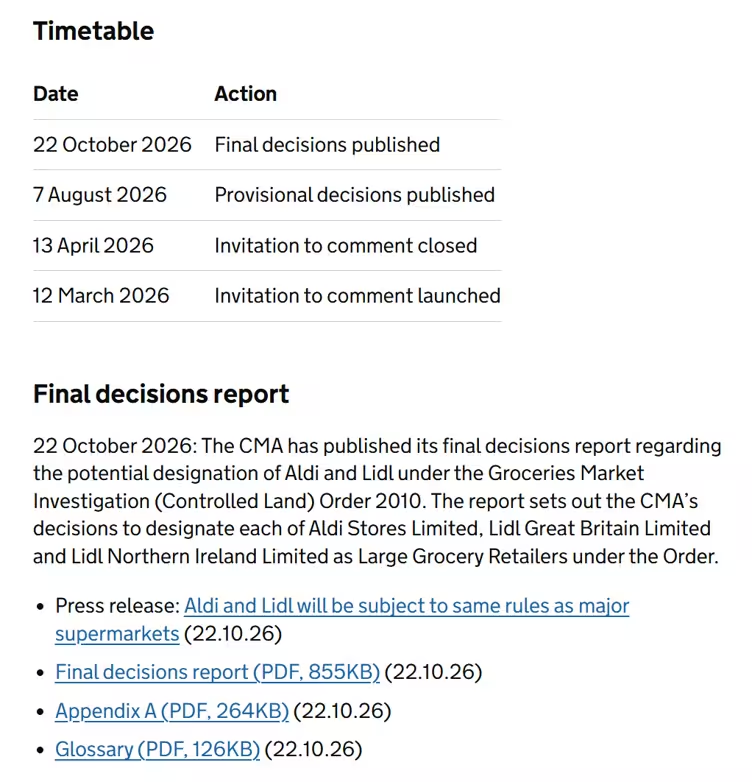
CMA case timetable showing the progression from the March 2026 consultation to the final decisions published on 22 October 2026.
What Happens Next for Aldi, Lidl and the UK Grocery Market?
We believe the most important developments to watch will concern compliance, supermarket expansion and local competition.
Property Portfolio Reviews
Aldi and Lidl may need to examine contractual arrangements to establish which are compliant, which fall within exceptions and which require further legal action.
The scale and timing of any such work have not been publicly quantified in the final announcement.
Greater Scrutiny of Future Agreements
New property transactions involving designated retailers will need to be structured with the Controlled Land Order in mind.
Legal teams may pay closer attention to covenants and exclusivity provisions at the negotiation stage.
Potential Opportunities for Other Grocery Retailers
Where existing restrictions can lawfully be challenged, competitors may gain opportunities to assess sites that were previously difficult to develop.
This could benefit larger supermarket groups as well as some smaller grocery businesses.
Increased Attention to Local Competition
The practical benefits are likely to vary geographically.
Neighbourhoods already served by several competing grocery retailers may see limited immediate differences.
Areas with fewer realistic shopping options could benefit more if restrictions had previously prevented additional stores from opening.
The financial outcome will ultimately depend on whether competition reform translates into actual investment and customer choice.
Conclusion: A Significant Change in UK Supermarket Competition
The October 2026 CMA decision marks an important development in the regulation of Britain’s grocery market.
Aldi and Lidl have grown from comparatively small discount operators into major retailers with extensive store networks, significant market shares and considerable influence over supermarket pricing.
The regulator has concluded that their market position now justifies applying the land agreement restrictions already governing established supermarket groups.
Our assessment is that the decision has three principal implications: more consistent regulation of large grocery businesses, greater scrutiny of commercial property agreements and the potential for stronger competition in local supermarket markets.
For business owners and developers, the practical priority is understanding whether relevant agreements comply with the Controlled Land Order.
For consumers, the potential advantage is improved access to competing supermarkets over time.
Ultimately, the success of the ruling will be measured not simply by the number of agreements reviewed, but by whether the regulatory framework allows grocery businesses to compete more freely and shoppers to benefit from greater choice.
Frequently Asked Questions About Aldi and Lidl Land Agreement CMA Rules
What Are the CMA’s New Rules for Aldi and Lidl in 2026?
On 22 October 2026, the CMA designated Aldi, Lidl GB and Lidl NI as Large Grocery Retailers under the Controlled Land Order 2010. They must now comply with the relevant land agreement restrictions.
Does the CMA Decision Mean Aldi and Lidl Broke the Law?
No. The designation itself is not a finding that either retailer breached the Order. The CMA identified potentially relevant existing restrictions but had not completed individual legal assessments.
Can Aldi and Lidl Still Open New Supermarkets?
Yes. The ruling does not prohibit new stores or restrict normal supermarket expansion. It controls certain land agreements that could obstruct grocery competitors.
Are Aldi and Lidl Banned From Using Exclusivity Agreements?
Not all exclusivity arrangements are banned. The Order restricts qualifying arrangements, including enforcement beyond the permitted five-year period.
Will Grocery Prices Fall Because of the CMA Rules?
Lower prices are a potential long-term benefit of stronger competition, but there is no guaranteed percentage reduction or immediate financial saving for shoppers.
Do the CMA Rules Apply in Northern Ireland?
Yes. Lidl Northern Ireland Limited has been separately designated under the Order. Aldi does not currently operate stores in Northern Ireland.
Can Landlords Challenge Existing Aldi or Lidl Property Restrictions?
Potentially. Relevant landowners, developers and competitors can seek a review of qualifying restrictions through the CMA’s established procedures.
Why Were Aldi and Lidl Previously Exempt?
They were originally treated as Limited Assortment Discounters because their ranges were considered significantly narrower than those of conventional large supermarkets.
How Much Market Share Do Aldi and Lidl Have?
The CMA’s 2026 evidence recorded Great Britain grocery market shares of 10.8% for Aldi and 8.6% for Lidl GB, equivalent to approximately 19.4% combined.
When Did the CMA Make Its Final Decision?
The CMA published its final decisions on 22 October 2026, following consultations and provisional findings earlier in the year.
Adam is a London business and news writer at London Insider News, covering local developments, finance, entrepreneurship and the stories shaping businesses and communities across the capital.
More from BUSINESS
Aldi Opening Times 2026: What Time Does Aldi Open and Close Today?
Aldi opening times are an important consideration for households planning their weekly grocery shopping, particularly as…
Sainsbury Opening Times 2026: What Time Does Sainsbury’s Open and Close Today?
Sainsbury’s opening times vary considerably across the UK, with larger supermarkets, Sainsbury’s Local convenience stores and…

The Cauldron London: Founders, Reviews and Why It Closed?
For several years, The Cauldron London was one of the capital's more unusual examples of experiential…