Sainsbury’s £3 Fruit and Veg Rule: 2026 £18 Voucher Conditions and 2027 Updates
Discover Sainsbury’s £3 fruit and veg rule, offering eligible NHS Healthy Start families up to £18 in vouchers. Check the 2026 registration deadline, Nectar eligibility, seven-day redemption rules, qualifying foods and possible 2027 updates.
 Hannah
London Lifestyle & Consumer Writer

Sainsbury’s £3 fruit and veg rule is a six-week supermarket support scheme offering eligible NHS Healthy Start customers up to £18 towards fruit, vegetables, beans and pulses. However, the offer is not available to every shopper, and its registration deadline has already passed.
Sainsbury’s launched the latest promotion on 20 October 2026, introducing weekly £3 eGift Cards for qualifying families during the Christmas shopping period.
The key update is that applications closed at 11:59pm on 9 November 2026. Customers who registered successfully can receive their first voucher from 18 November, provided they meet the retailer’s eligibility requirements.
There is currently no confirmed extension or replacement £3 scheme for 2027.
We analysed the retailer’s published eligibility criteria, NHS Healthy Start payment rules and the financial value of the promotion for households facing rising living costs.
Our findings show that the headline £18 benefit is useful but conditional. Missing a weekly redemption deadline can prevent further vouchers, while customers who did not previously use their Nectar and Healthy Start cards together are excluded from this trial.
What Is Sainsbury’s £3 Fruit and Veg Rule?
The Sainsbury’s £3 fruit and veg rule refers to a targeted Healthy Start top-up rather than a general £3 discount available to everyone buying groceries.
Under the 2026 trial, eligible customers can receive one £3 eGift Card each week for a maximum of six weeks.
The cards are intended to help purchase selected nutritious foods during a period when many households face increased Christmas expenditure.
| Scheme detail | Confirmed 2026 position |
| Retailer | Sainsbury’s |
| Type of support | Weekly promotional eGift Card |
| Weekly value | £3 |
| Maximum number | 6 |
| Total possible value | £18 |
| Announcement date | 20 October 2026 |
| Registration deadline | 9 November 2026, 11:59pm |
| First voucher scheduled | 18 November 2026 |
| Final vouchers due | By 23 December 2026 |
| Voucher redemption rule | Within 7 days of issue |
| Minimum qualifying spend | £3 |
| Eligible countries | England, Wales and Northern Ireland |
| New 2027 promotion | Not announced as of November 2026 |
The offer operates separately from the NHS Healthy Start allowance. It does not represent a permanent increase in government benefit payments.
From a household-finance perspective, the promotion should be considered a short-term contribution towards food expenditure, not recurring income that can reliably support a family’s budget throughout 2027.
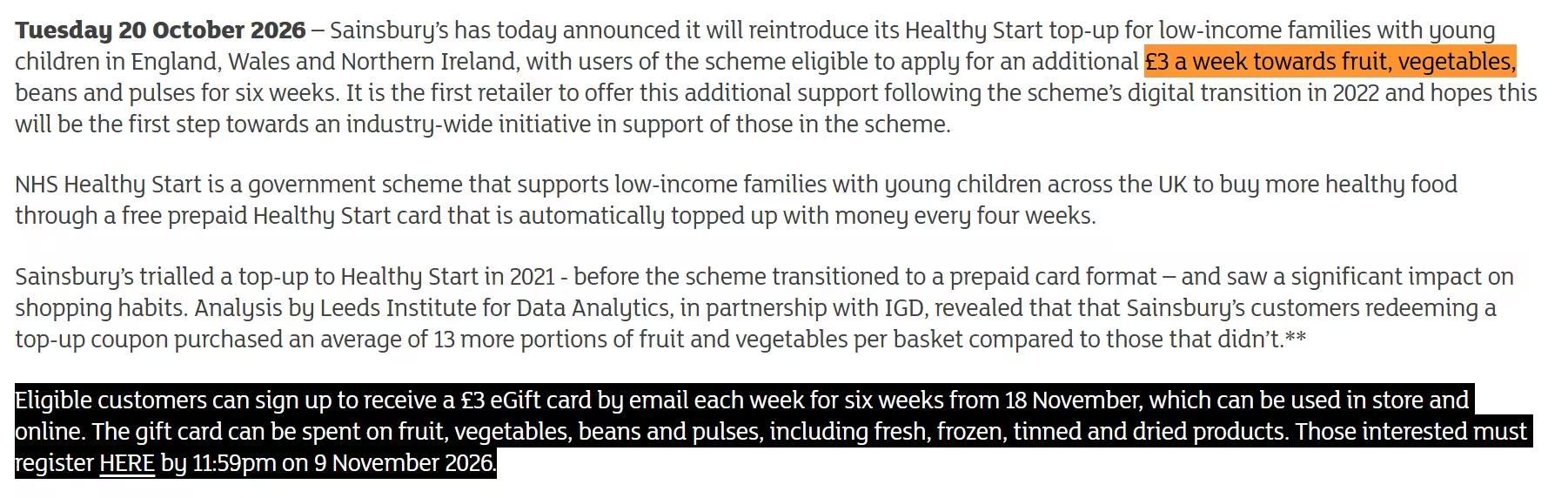
Sainsbury’s official October 2026 announcement confirming its six-week £3 Healthy Start top-up, maximum £18 value and registration deadline.
Who Qualifies for Sainsbury’s £3 Fruit and Veg Offer?
Sainsbury’s introduced specific eligibility conditions to select participants for the 2026 trial.
Customers needed to satisfy all the following requirements:
- Hold a valid NHS Healthy Start Mastercard.
- Hold a Nectar loyalty card.
- Have shopped at Sainsbury’s between 20 October 2025 and 20 October 2026, inclusive.
- Have used their Healthy Start Mastercard and Nectar card in the same qualifying transaction during that period.
- Have registered before 11:59pm on 9 November 2026.
- Have provided the correct identifying information for the supermarket to verify their eligibility.
The historical transaction requirement is particularly important.
A customer who already receives Healthy Start payments but did not use both cards together during the qualifying period does not meet the conditions of this Sainsbury’s promotion.
Likewise, becoming a Nectar member after 20 October 2026 cannot retrospectively establish an eligible purchase during the trial’s qualifying period.
Does Everyone Receiving Universal Credit Qualify?
No. Universal Credit entitlement alone does not establish eligibility for the additional £3.
The NHS Healthy Start scheme has its own qualifying conditions, and Sainsbury’s has imposed additional requirements for this particular offer.
Some Universal Credit households qualify for NHS Healthy Start. Others do not, depending on income and family circumstances.
Even an eligible Healthy Start household would be excluded from the retailer’s trial if it had not met the relevant Nectar-card transaction requirement.
This distinction matters because the phrase “£3 fruit and veg rule” can suggest a wider supermarket discount than the published conditions actually provide.
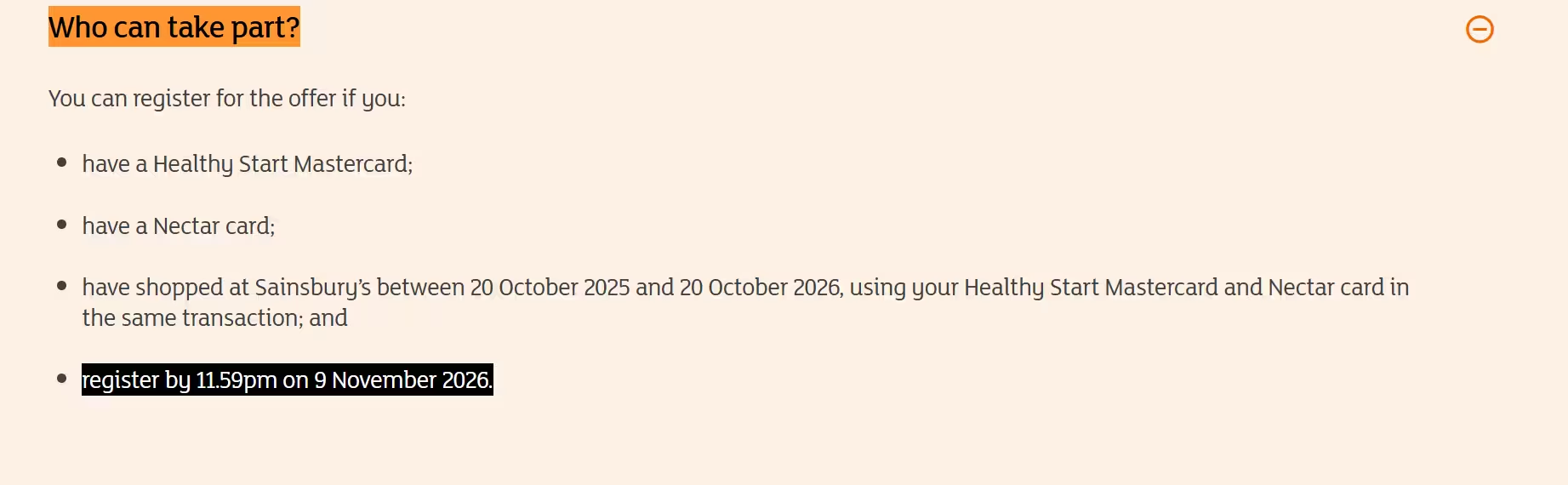
Official Sainsbury’s Healthy Start eligibility checklist showing the Healthy Start Mastercard, Nectar card, previous transaction window and 9 November 2026 deadline.
Is Sainsbury’s £3 Fruit and Veg Offer Available in 2027?
As of 11 November 2026, Sainsbury’s has not announced a new £3 weekly Healthy Start promotion for 2027.
The confirmed offer relates to the six-week period beginning in November 2026.
There are three separate considerations for customers planning ahead.
- First, the 2026 registration window has closed: The previous application form should not be treated as an open registration route for 2027.
- Second, vouchers may still be issued during November and December 2026: Customers already accepted into the scheme must meet the weekly conditions to continue receiving them.
- Third, the supermarket may evaluate the results before making future decisions: Its official information explains that lessons from the trial may help it explore wider support.
This creates the possibility of future initiatives, but does not establish that another £3 payment, an £18 Christmas offer or a permanent scheme will operate in 2027.
What Could Change in 2027?
Any future version would need a fresh announcement setting out the applicable conditions.
Potential areas for review include:
- Whether the scheme returns.
- Whether the previous Nectar transaction requirement changes.
- Whether new customers can participate.
- Whether the value or number of vouchers changes.
- Whether the seven-day redemption condition continues.
- Whether additional supermarkets introduce similar support.
These are possible areas of future review, not confirmed changes.
Our assessment is that the original article should remain accessible throughout 2027, with new developments added only when supported by official information.
How Does the Seven-Day Rule Affect the £18 Payment?
One of the most financially significant conditions is the requirement to redeem each eGift Card within seven days of issue.
Eligible customers can receive a £3 voucher each week, but they must successfully use that voucher within the permitted period to qualify for the following week’s voucher.
Therefore, the total £18 should not be regarded as guaranteed once a customer has registered.
For example:
| Vouchers successfully received and used | Total value |
| 1 | £3 |
| 2 | £6 |
| 3 | £9 |
| 4 | £12 |
| 5 | £15 |
| 6 | £18 |
The table illustrates cumulative values, not a promise that every participant will receive all six vouchers.
A customer who misses the first redemption deadline will not receive the second voucher under the published rules.
The promotional cards also cannot simply be accumulated for a larger Christmas shopping trip because continuing eligibility depends on timely redemption.
What Is the Financial Risk of Missing a Voucher?
Consider a customer who qualifies for the initial payment but forgets to redeem it.
Although the initial £3 eGift Card was issued, the customer may lose the opportunity to receive the remaining five vouchers.
Those five future vouchers represent £15, or approximately 83.3% of the maximum £18 benefit.
This is why the seven-day condition matters as much as the advertised value.
Families who normally complete one large fortnightly shopping trip may need to plan a qualifying purchase during each seven-day window.
However, arranging an additional journey solely to redeem a £3 card may not be financially sensible if travel expenses outweigh the saving.
We recommend combining the voucher redemption with an existing grocery visit wherever practical.
Customers can check Sainsbury’s opening times before planning an eligible in-store purchase.
What Can You Buy With Sainsbury’s £3 Fruit and Veg Vouchers?
Sainsbury’s restricts the 2026 eGift Cards to specified fruit, vegetables, beans and pulses.
The offer covers eligible fresh, frozen, tinned and dried products.
However, foods that shoppers might reasonably associate with vegetables are not necessarily included.
| Food category | Promotional eligibility |
| Fresh apples, pears and similar fruit | Eligible |
| Fresh qualifying vegetables | Eligible |
| Frozen qualifying vegetables | Eligible |
| Tinned qualifying fruit and vegetables | Eligible |
| Dried beans and pulses | Eligible |
| Potatoes | Excluded |
| Yams and cassava | Excluded |
| Plantain | Excluded |
| Baked beans | Excluded |
| Coconut | Excluded |
| Fruit juice and smoothies | Excluded |
| Dressed salads | Excluded |
| Vegetable burgers | Excluded |
| Cauliflower cheese | Excluded |
| Breaded mushrooms | Excluded |
Products with added sugar or several non-vegetable ingredients may also fall outside the promotion.
The retailer’s official terms should take precedence when a product’s eligibility is uncertain.
Why Are Some Vegetables Excluded?
The promotion has a specific product eligibility list; it is not a general discount across the entire produce department.
Its exclusions should not be interpreted as a statement that every excluded food is inherently unhealthy.
For example, potatoes can form part of a balanced diet, but they are specifically outside this promotional offer.
The distinction is between the retailer’s voucher conditions and broader nutritional guidance.
Consumers should also remember that the standard NHS Healthy Start scheme and the Sainsbury’s top-up have different permitted purchases.
A qualifying product under one scheme is not automatically eligible under the other.
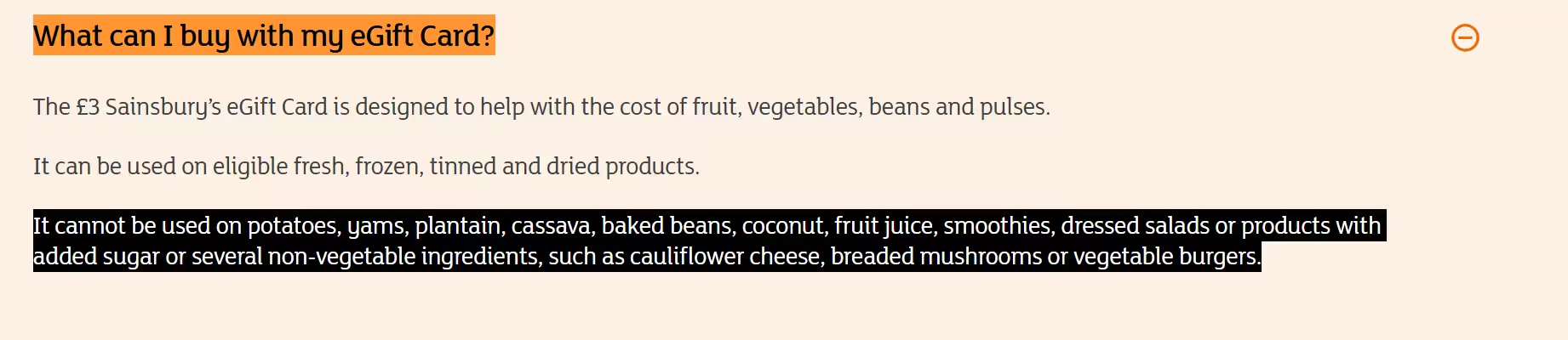
Sainsbury’s published product restrictions identifying eligible fruit, vegetables, beans and pulses alongside excluded products.
How Much Money Can Families Actually Save?
The potential £18 benefit can be more meaningful when assessed as a percentage of a household’s existing grocery expenditure.
Our calculations illustrate how the same £3 weekly voucher provides a different proportionate saving depending on normal spending.
| Weekly grocery budget | Potential £3 reduction as % of budget | Six-week potential saving |
| £20 | 15% | £18 |
| £30 | 10% | £18 |
| £40 | 7.5% | £18 |
| £50 | 6% | £18 |
| £75 | 4% | £18 |
| £100 | 3% | £18 |
These are illustrative calculations assuming the household already plans to spend at least £3 weekly on eligible products, receives all six vouchers and incurs no additional costs.
For someone spending £30 a week on groceries, a £3 contribution is equivalent to 10% of that budget.
For a household spending £100, the same contribution represents 3%.
The absolute cash value is identical, but the proportionate financial benefit differs.
This demonstrates why targeted food support may have a greater relative impact on households operating with smaller budgets.
Does the £3 Voucher Always Reduce Spending by £3?
Not necessarily.
The effective saving depends on how the household shops.
A customer planning to buy £5 of eligible vegetables and fruit could potentially reduce their out-of-pocket payment by £3, subject to the voucher terms.
However, a customer who changes their spending habits, buys unwanted products or pays additional travel or delivery charges may receive a smaller net financial benefit.
Consider three illustrative cases:
| Shopping situation | Voucher value | Extra cost caused by redemption | Net financial gain |
| Existing grocery trip | £3 | £0 | £3 |
| Separate journey costing £1.50 | £3 | £1.50 | £1.50 |
| Separate journey costing £3 | £3 | £3 | £0 |
These examples assume that all purchased items are otherwise necessary and eligible.
An additional £3 expense would eliminate the immediate monetary benefit even though the customer had successfully redeemed the voucher.
The strongest financial outcome comes when the promotional amount replaces spending the household would otherwise have undertaken.
How Does Sainsbury’s Extra £3 Compare With NHS Healthy Start Payments?
The government-funded Healthy Start scheme provides eligible families with money towards certain nutritious foods.
Unlike Sainsbury’s temporary eGift Card, the ordinary Healthy Start payment operates through a prepaid Mastercard funded every four weeks.
The published NHS rates in November 2026 are:
| Qualifying circumstance | Weekly NHS Healthy Start payment | Equivalent four-week payment |
| Pregnancy from 10 weeks | £4.65 | £18.60 |
| Child under 1 | £9.30 | £37.20 |
| Child aged 1 to under 4 | £4.65 | £18.60 |
Amounts depend on the number and circumstances of qualifying family members.
The additional Sainsbury’s £3 is equivalent to:
- 64.5% of a standard £4.65 weekly Healthy Start amount.
- 32.3% of a standard £9.30 weekly Healthy Start amount.
These percentages compare the retailer’s weekly top-up with individual standard NHS payment rates. They are not percentage increases to every recipient’s total household entitlement.
Example: Family With a Child Under One
Imagine a household eligible for the standard £9.30 weekly Healthy Start amount for one child under one.
If it also qualifies for the supermarket promotion, its combined nominal weekly food assistance during the offer would be:
£9.30 NHS Healthy Start + £3 Sainsbury’s voucher = £12.30.
That is approximately 32.3% more than the original £9.30 amount.
However, the extra £3 arrives through a retailer-specific voucher, not through an increase to the NHS card balance.
The two amounts have different purchasing rules and redemption arrangements.
Full details of the standard allowance are available through the official NHS Healthy Start payment guidance.
Can Families Still Apply for NHS Healthy Start After the Sainsbury’s Deadline?
Yes. The end of Sainsbury’s promotional registration period does not mean the government’s NHS Healthy Start scheme has ended.
Eligible households can continue to apply for Healthy Start under the government scheme rules.
For Universal Credit households, standard online application requirements generally include:
- Being more than 10 weeks pregnant or being responsible for at least one child under four.
- Receiving Universal Credit.
- Having family monthly take-home employment earnings of £408 or less.
Other qualifying benefits and special eligibility arrangements may apply, so applicants should check the full official requirements.
The £408 threshold refers to monthly earned income, not total Universal Credit received and not weekly wages.
This distinction is important because the application rules can otherwise be misunderstood.
Families receiving qualifying income-related benefits should review their entitlement rather than assuming they must wait for another Sainsbury’s promotion.
Is the Scheme Available in Scotland?
The Sainsbury’s 2026 promotion covers England, Wales and Northern Ireland.
Scotland operates a separate Best Start Foods scheme rather than the standard NHS Healthy Start arrangement.
Scottish households should check the applicable Scottish benefit rules rather than relying on the eligibility conditions for this Sainsbury’s trial.
Why Did Sainsbury’s Introduce the £3 Healthy Start Top-Up?
The 2026 offer forms part of a longer-running supermarket initiative to support healthier diets and improve access to affordable nutritious food.
Sainsbury’s originally trialled an additional Healthy Start incentive in 2021, before the NHS programme transitioned from paper vouchers to prepaid cards.
According to research conducted by the Leeds Institute for Data Analytics in partnership with IGD, customers redeeming the earlier top-up coupon purchased an average of 13 more portions of fruit and vegetables per basket than shoppers who did not redeem it.
That is a reported difference in purchasing behaviour, rather than conclusive proof of long-term dietary improvements.
The retailer announced a wider healthy-eating strategy in June 2026.
Its stated objectives include increasing fruit, vegetable and fibre consumption by 2030 and making healthier food choices more accessible.
The business has also introduced Full on Fibre labelling across hundreds of products and highlighted the role of affordable staple foods in improving diets.
Nilani Srithran, Sainsbury’s Head of Healthy & Sustainable Diets, said when announcing the October campaign:
“We’ve seen the difference extra support can make for families on Healthy Start”
This observation reflects the retailer’s experience from its earlier trial.
The central commercial question is whether a targeted voucher programme can improve access to nutritious food while remaining practical for low-income customers.
Is Sainsbury’s £3 Offer Good Value? Our Financial Assessment
We assessed the promotion against four factors: potential cash value, accessibility, flexibility and ease of redemption.
The scores below are editorial assessments, not shopper-survey findings or published supermarket ratings.
| Review category | Editorial rating | Assessment |
| Potential value against a small grocery budget | 85% | £3 can represent a meaningful proportion of essential food spending |
| Accessibility | 35% | Eligibility depends on previous card use and registration within a limited window |
| Product flexibility | 60% | Fresh, frozen, tinned and dried options are included, but several everyday foods are excluded |
| Redemption convenience | 45% | Seven-day use and continued weekly qualification create practical restrictions |
| Overall editorial assessment | 56% | Targeted support with useful financial potential but substantial eligibility and timing limitations |
Our overall score is the equally weighted average of the four editorial category scores, rounded to a whole percentage. These ratings are our qualitative judgement rather than an independently measured programme performance score.
The scheme performs most strongly when a household already buys eligible food at Sainsbury’s every week.
It becomes less convenient when participation requires extra journeys, altered shopping routines or access to products that the household would not ordinarily purchase.
The eligibility structure also limits its reach.
A customer may be among the households most in need of nutritional support but remain outside the trial because they did not previously shop using the specified combination of cards.
This is a substantial design consideration for any future 2027 programme.
Could the Promotion Affect Supermarket Competition in 2027?
Sainsbury’s programme demonstrates how supermarkets can use targeted assistance to differentiate themselves beyond headline shelf prices.
Loyalty programmes, own-label products, promotions and supermarket locations all influence how households choose where to shop.
However, the most important comparison remains the overall cost of the goods a family needs.
A £3 voucher provides limited value if a customer must incur higher costs elsewhere to use it.
Competition among supermarkets may encourage retailers to improve pricing and promotional structures.
Our examination of the Aldi and Lidl land agreements and CMA rules also highlights how store availability and local competition can influence consumer choice.
For families comparing supermarkets, we recommend assessing the full basket rather than relying on a single promotion.
The budget supermarket tuna comparison provides another example of how own-label pricing and product quality can differ between retailers.
However, tuna itself is not a qualifying food under Sainsbury’s £3 fruit and veg voucher.
Could Other Retailers Introduce Similar Offers?
It is possible, but no equivalent 2027 nationwide retailer scheme should be assumed without an official announcement.
Anna Taylor, Executive Director of The Food Foundation, welcomed Sainsbury’s top-up and said:
“We hope will be industry wide support to those on the scheme.”
Her comments reflect a wider argument that nutritional support becomes more accessible when it is available across several retailers rather than confined to one supermarket.
From a retail economics perspective, broader participation could reduce the need for customers to change their usual shopping location to access assistance.
Whether that happens will depend on future retailer decisions, programme funding and government policy.
How Should London Families Budget for Food in 2027?
The most sensible approach is to distinguish guaranteed income and benefits from occasional retailer promotions.
A temporary £3 voucher may reduce food expenditure during a particular week. It should not be included as reliable recurring support in a long-term family budget.
This is especially relevant for London households managing high housing costs alongside groceries, energy and childcare.
Families receiving Universal Credit may need to examine how much Universal Credit pays towards private rent before estimating the amount available for other essential expenses.
Similarly, understanding how much rent is affordable on a salary helps show how housing expenditure affects household disposable income.
Households eligible for other forms of housing assistance may also benefit from checking how much Housing Benefit they can receive.
These forms of support have different eligibility requirements and should not be confused with supermarket vouchers.
Practical Ways to Protect Your Grocery Budget
A small food budget benefits from consistent spending controls.
- Check price per kilogram or 100g: Larger packaging is not always cheaper on a unit-price basis.
- Compare fresh and frozen produce: Frozen vegetables can provide useful flexibility where fresh food might spoil before being used.
- Plan purchases around existing meals: Avoid choosing additional products solely because they are discounted.
- Monitor loyalty-card conditions: A promotional price may require a card or apply only to certain products.
- Keep food and delivery costs separate: Convenience charges can reduce savings.
- Review existing benefits: Check the government Healthy Start scheme even when a retailer promotion has ended.
These measures do not guarantee a particular percentage saving, but they can help households identify unnecessary expenditure.
What Should Registered Customers Do From 18 November 2026?
Customers who successfully registered before the deadline should prepare for the voucher distribution period.
The first £3 eGift Cards are scheduled to be issued from 18 November 2026, with final cards expected by 23 December.
Our recommended process is straightforward:
- Step 1: Check the registered email address: Look for the Sainsbury’s promotional eGift Card, including in spam or junk folders.
- Step 2: Confirm the issue and expiry dates: Each card must be redeemed within seven days to retain eligibility for the next weekly payment.
- Step 3: Check which foods qualify: Choose eligible fruit, vegetables, beans or pulses, rather than assuming all products in the vegetable department are included.
- Step 4: Make a qualifying purchase worth at least £3: The retailer’s terms specify a minimum spend when using the promotional eGift Card.
- Step 5: Redeem within the relevant period: If shopping online, ensure the delivery takes place within the dates stated in the eGift Card or offer terms.
- Step 6: Monitor the following week’s email: Participants who meet the rules may receive another £3 voucher, up to the six-voucher maximum.
Customers experiencing problems with the promotion can contact Sainsbury’s through the support information on its official Healthy Start page.

Sainsbury’s official FAQs explaining the 18 November start, seven-day redemption requirement, maximum six eGift Cards and December 2026 final issue period.
Final Verdict: Is Sainsbury’s £3 Fruit and Veg Rule Worth It?
The Sainsbury’s £3 fruit and veg rule provides up to £18 of targeted grocery assistance for qualifying Healthy Start customers during November and December 2026.
Our financial analysis shows that £3 can represent a considerable percentage of a smaller weekly grocery budget. For a household spending £30 a week, it is equivalent to 10% of that spending, assuming full redemption against necessary eligible purchases.
However, the value is constrained by the original eligibility requirements, the 9 November registration deadline and the seven-day voucher redemption rule.
The most important update for customers is that the 2026 registration period is closed, while the voucher programme is scheduled to begin on 18 November.
For 2027, there is no confirmed equivalent Sainsbury’s promotion. Households should continue checking their entitlement to NHS Healthy Start and other appropriate support rather than treating the £3 supermarket top-up as permanent financial assistance.
Frequently Asked Questions
Is Sainsbury’s giving everyone £3 for fruit and vegetables?
No. The 2026 promotion is restricted to eligible NHS Healthy Start customers who met the retailer’s Nectar, transaction-history and registration conditions.
Can I still apply for Sainsbury’s £3 fruit and veg vouchers?
The registration deadline for the 2026 offer passed at 11:59pm on 9 November 2026. No late-registration arrangement has been confirmed.
Will Sainsbury’s offer £3 fruit and veg vouchers in 2027?
There is no confirmed repeat promotion for 2027 as of November 2026. Any new scheme would require an official announcement.
Is the total £18 paid at once?
No. Qualifying participants can receive up to six separate £3 eGift Cards. Receiving the next voucher depends on redeeming the previous one within seven days.
Can I use the £3 voucher on potatoes?
No. Potatoes are among the foods specifically excluded under the published promotional conditions.
Do I need a Nectar card to qualify?
Yes. The 2026 trial required previous use of both a Nectar card and Healthy Start Mastercard in the same qualifying Sainsbury’s transaction.
Does Sainsbury’s £3 replace NHS Healthy Start payments?
No. The supermarket’s promotional eGift Cards are separate from the standard NHS Healthy Start benefit.
Hannah is a London lifestyle and consumer writer at London Insider News, covering property, transport, local developments, cost-of-living issues and stories affecting everyday life across the capital.
More from LONDON NEWS

Nationwide UK Property Price Drop: Will House Prices Fall Further in 2027? Latest 2026 Figures and Forecasts
The Nationwide UK property price drop has become an increasingly important issue for homeowners, first-time buyers,…

Discontinued Cadbury Chocolate Back in UK: Nostalgic Favourite Returns After 18 Years as Shoppers Celebrate
Discontinued Cadbury chocolate is back in the UK, with the return of nostalgic favourites including Astros…
Which Budget Supermarket Tuna Beat John West? Full Taste Test Results and 2027 Buying Guide
Tesco Tuna Chunks in Spring Water was the budget supermarket tuna that beat John West in…