Heathrow Drop-Off Charge: Payment, Deadlines and Practical Alternatives
Heathrow drop-off charge is £7 in 2026. Find out how to pay, payment deadlines, late-payment penalties, Blue Badge exemptions and free parking alternatives at all Heathrow terminals.
 Hannah
London Lifestyle & Consumer Writer
Dropping someone off at Heathrow Airport may take only a few minutes, but using the terminal forecourt comes with a charge that drivers must pay separately. From 1 January 2026, the Heathrow drop-off charge increased to £7 per visit, applying to designated drop-off areas outside Terminals 2, 3, 4 and 5.
Unlike a conventional car park, the terminal drop-off zones have no payment barriers or ticket machines. Automatic number plate recognition cameras record vehicles entering, and motorists must pay online, by telephone or through an automatic payment account.
Our analysis of Heathrow’s published charging arrangements, free parking facilities and business travel costs highlights several important distinctions. Drivers can avoid the £7 fee by using designated Park & Ride facilities, although parking limits and transfer arrangements differ between terminals.
Understanding the payment deadline, available exemptions and alternatives can prevent a short airport journey from becoming an unnecessarily expensive one.
How Much Is the Heathrow Drop-Off Charge in 2026?
Heathrow Airport currently charges £7 every time a vehicle enters a designated terminal drop-off zone.
The charge increased from £6 to £7 on 1 January 2026, representing a 16.7% price increase.
Unlike some airports that charge according to the number of minutes spent at the terminal, Heathrow applies a flat fee for each entry.
| Charge or condition | Current arrangement |
|---|---|
| Standard drop-off fee | £7 per entry |
| Previous fee | £6 |
| Percentage increase in 2026 | 16.7% |
| Payment deadline | Midnight on the following day |
| Payment methods | Online, telephone or AutoPay |
| Operating period | 24 hours, every day |
| Unpaid charge | £80 Parking Charge |
| Reduced Parking Charge | £40 if paid within 14 days |
| Free alternative | Designated Park & Ride parking |
| Blue Badge concession | 100% discount when correctly registered |
The £7 fee applies to each entry, not each passenger.
For example, dropping off three family members travelling together in one vehicle requires a single £7 payment. However, making three separate journeys into the terminal drop-off area would cost £21.
A vehicle that exits and re-enters the chargeable forecourt also incurs another payment, even when the second visit takes place shortly after the first.
This distinction is particularly important for airport transfer businesses, taxi operators and company drivers making several terminal visits during the same working day.
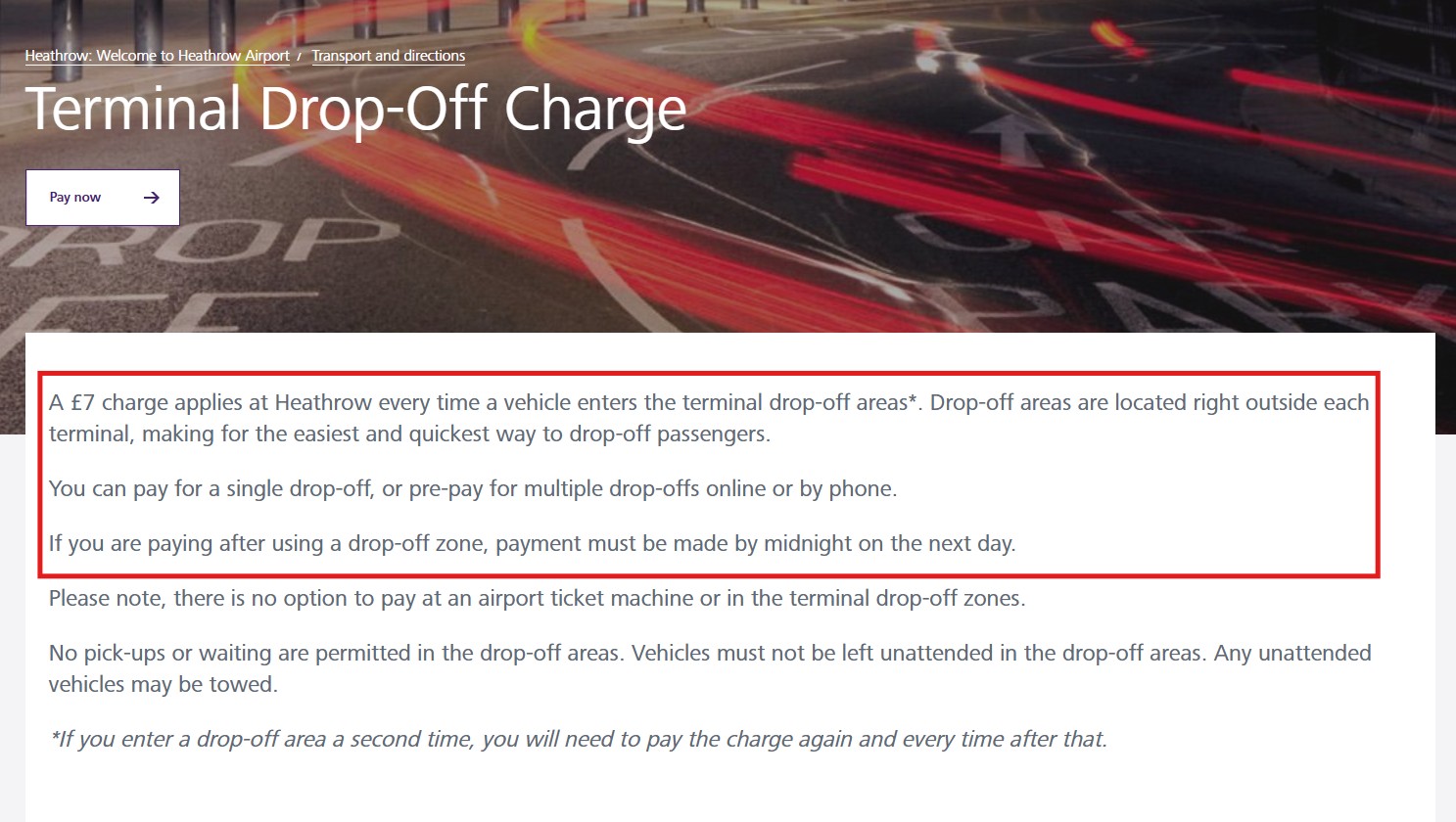
Heathrow Airport’s official terminal drop-off information confirms the £7 charge, payment deadline and payment methods.
How Does the Heathrow Terminal Drop-Off Charge Work?
Heathrow operates a barrierless charging system at designated terminal forecourts.
Motorists do not collect a ticket when entering the drop-off area. Instead, automatic number plate recognition (ANPR) cameras record the vehicle registration number.
The system operates throughout the year, including weekends and bank holidays.
The process is straightforward:
- Drive towards the appropriate terminal.
- Follow signs for the designated passenger drop-off area.
- Enter the forecourt, where cameras record the vehicle registration.
- Stop in an authorised lane and allow passengers to unload.
- Leave the area promptly without waiting.
- Pay the applicable charge within the permitted deadline.
Importantly, the charge is triggered by entering the designated zone, not by the number of minutes spent there.
A driver who enters the wrong terminal drop-off area and leaves without unloading passengers should not assume that no payment is required.
This is a common misunderstanding with barrierless airport charging systems. The vehicle movement itself is recorded, meaning the payment obligation can arise even when the planned drop-off does not take place.
Does the Charge Apply at Every Heathrow Terminal?
Yes. The standard terminal drop-off charge is the same at Terminals 2, 3, 4 and 5.
| Heathrow terminal | Standard drop-off charge | Free parking alternative |
|---|---|---|
| Terminal 2 | £7 | Park & Ride, first 29 minutes |
| Terminal 3 | £7 | Park & Ride, first 29 minutes |
| Terminal 4 | £7 | Park & Ride Zone A, up to 2 hours |
| Terminal 5 | £7 | Park & Ride, first 29 minutes |
The free parking arrangements are not identical across Heathrow.
Terminal 4 currently operates a special arrangement because its former multi-storey car park closed for redevelopment in June 2026.
Travellers should therefore check the correct terminal before deciding whether to use the chargeable forecourt or a free alternative.
How Can Drivers Pay the Heathrow Drop-Off Charge?
Drivers can pay the Heathrow drop-off charge online, through an automated telephone payment service or by setting up AutoPay.
The most important requirement is that the correct vehicle registration is associated with the payment.
Paying Online
The authorised payment platform is operated by APCOA on Heathrow’s behalf.
Drivers can access the payment service at:
https://heathrowdropoff.apcoa.com/
To pay online:
- Open the authorised Heathrow drop-off payment website.
- Select the option to pay for a recent or future drop-off.
- Enter the vehicle registration number.
- Check that the registration and vehicle details are correct.
- Provide the requested payment information.
- Complete the card transaction and retain the confirmation.
When paying for a visit that has already taken place, select the appropriate previous-visit option.
Heathrow warns motorists to distinguish letters from similar-looking numbers when entering a registration. Confusing the letter O with the number 0, for example, can cause payment problems.
Customers can normally make a guest payment without creating a permanent account.
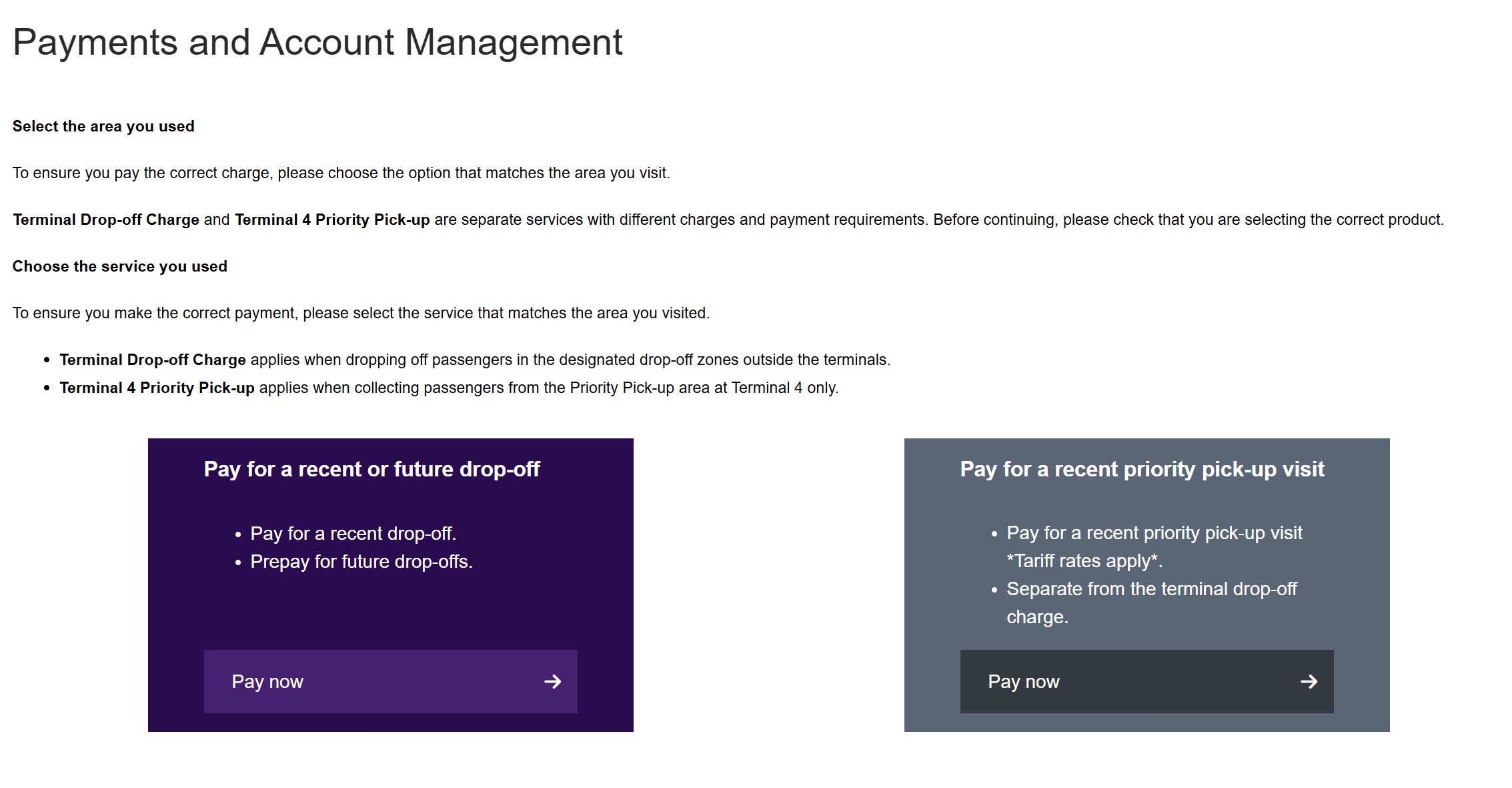
The authorised Heathrow terminal drop-off payment platform allows motorists to pay for previous or future visits using their vehicle registration.
Paying by Telephone
Drivers who prefer not to use the online system can use Heathrow’s automated payment line.
Automated payment number: 0330 008 5600
The automated payment service accepts card payments.
Motorists should have their vehicle registration number and payment card available before calling.
Cash payments, cheques and payment at airport ticket machines are not accepted for the terminal drop-off charge.
Setting Up AutoPay
AutoPay is particularly useful for people who visit Heathrow regularly.
Once the relevant vehicle has been registered and automatic payments are active, the system charges the registered payment card when that vehicle enters a terminal drop-off zone.
Personal accounts can be used for individual vehicles, while business accounts support multiple registered vehicles.
Our financial assessment is that AutoPay offers its greatest benefit through payment administration rather than direct savings.
The charge remains £7 per entry, but properly maintained automatic payments reduce the risk of missing deadlines and incurring additional charges.
However, customers must ensure that their registered card remains valid, payment transactions are successful and vehicle details are up to date.
When Is the Heathrow Drop-Off Charge Payment Deadline?
The Heathrow drop-off charge must be paid by 11:59pm on the calendar day after entering the drop-off area.
This is not simply a rolling 24-hour period.
For example:
| Date of drop-off | Payment deadline |
|---|---|
| Monday | Tuesday, 11:59pm |
| Tuesday | Wednesday, 11:59pm |
| Friday | Saturday, 11:59pm |
| Saturday | Sunday, 11:59pm |
| Sunday | Monday, 11:59pm |
A driver entering Heathrow at 8am on Monday has until the end of Tuesday to pay.
Someone entering at 11pm on Monday also has until the end of Tuesday.
The deadline is determined by the calendar day of entry rather than the precise time the vehicle visited.
This distinction matters for drivers who assume they can delay payment until exactly 24 hours after their journey.
The charge is also payable following visits on weekends and public holidays. The next-day deadline does not automatically move to the next working day.
Our recommendation is to pay immediately after leaving Heathrow or arrange payment in advance.
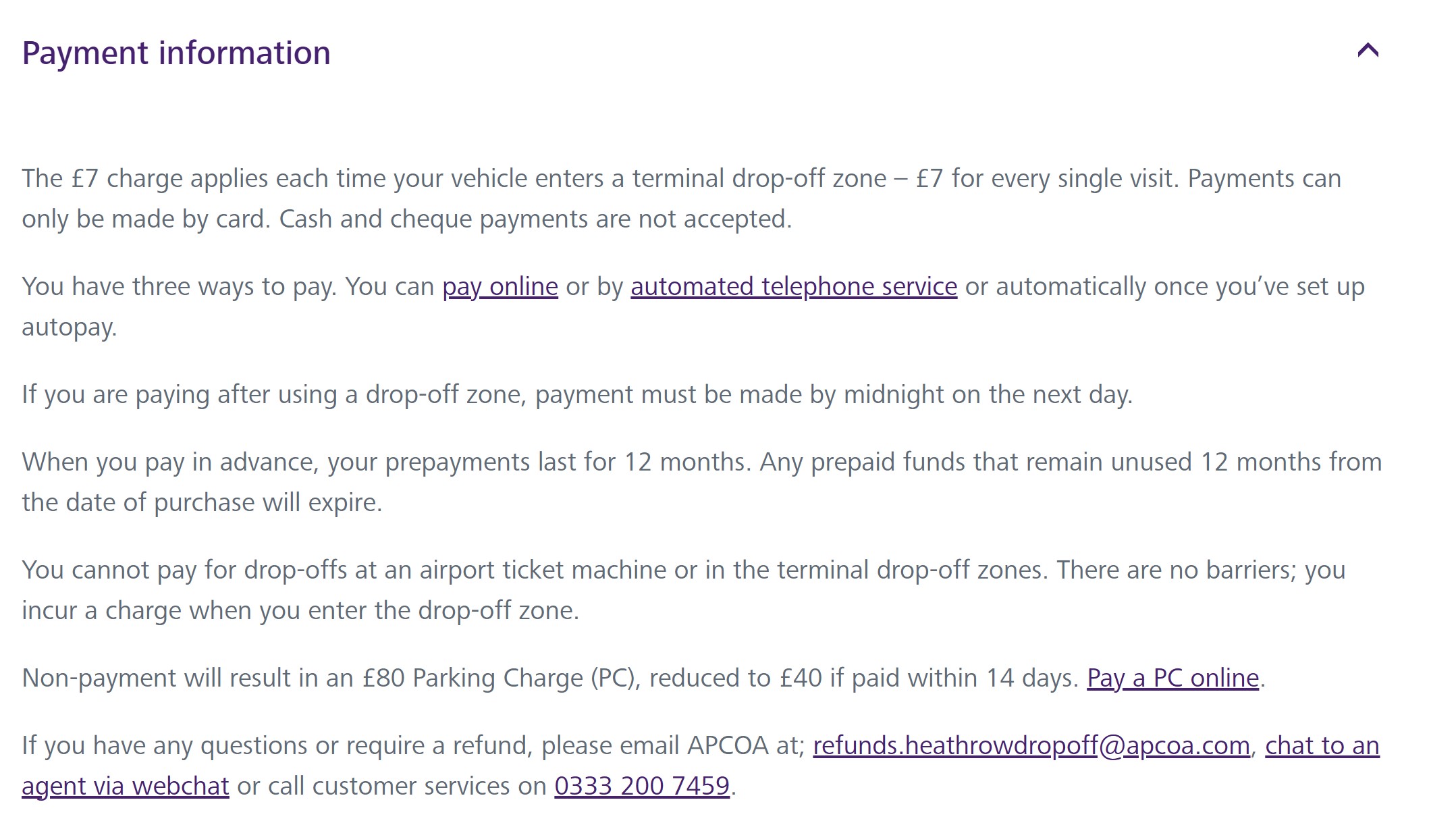
Heathrow’s official payment conditions specify that drop-off charges must be settled by midnight on the day following the visit.
What Happens If You Forget to Pay the Heathrow Drop-Off Charge?
Missing the payment deadline can result in an £80 Parking Charge, reduced to £40 when paid within the initial 14-day discount period.
However, there is an important additional procedure that drivers should understand.
If You Missed the Deadline but Visited Within the Last Seven Days
APCOA currently provides a late-payment contact process for drivers who missed the usual deadline.
According to its published Heathrow guidance, customers contacting the operator within seven days of their visit may still be able to settle the matter for the original £7 amount.
The process is not an automatic extension of the normal deadline.
APCOA explains that a Parking Charge will still be generated, but the operator can monitor its issue and arrange for the amount to be reduced to £7 where the late-payment request meets its conditions.
Drivers should email:
LatePayment.heathrowdropoff@apcoa.com
The email must include the vehicle registration number and the date of the visit.
The operator states that generating the Parking Charge can take up to 15 days. Once it becomes available in the system, APCOA sends payment instructions.
This is an important distinction because motorists should not assume that simply making an ordinary late payment will automatically cancel an enforcement notice.
Drivers who missed the deadline should contact the operator promptly and retain their correspondence.
What If More Than Seven Days Have Passed?
APCOA states that late-payment requests cannot be considered after the seven-day period.
Where the original charge remains unpaid, a Parking Charge will be issued.
At that stage, motorists can pay the applicable amount or challenge the notice if they believe it was issued incorrectly.
The published standard charges are:
| Circumstance | Amount |
|---|---|
| Correct payment within deadline | £7 |
| Eligible late-payment arrangement accepted by APCOA | £7 |
| Parking Charge paid within 14 days | £40 |
| Full Parking Charge | £80 |
The £40 reduced amount is approximately 5.7 times the original £7 fee.
At £80, the financial exposure rises to approximately 11.4 times the standard drop-off charge.
For households and businesses managing travel costs, these differences demonstrate why payment administration is just as important as the original tariff.
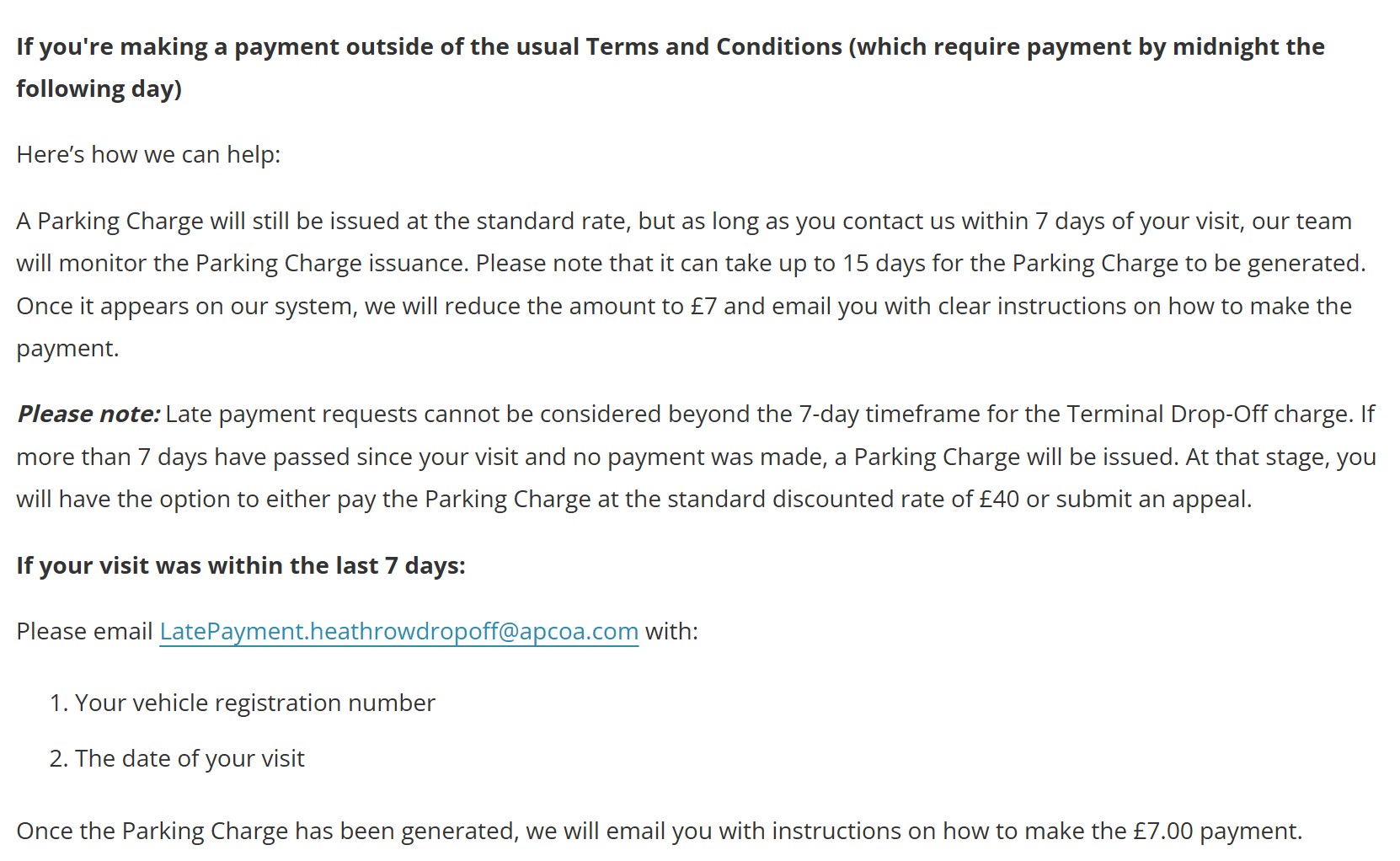
APCOA’s Heathrow help centre explains the seven-day late-payment contact procedure and the circumstances in which a £7 settlement may still be arranged.
Can You Challenge a Heathrow Drop-Off Parking Charge?
Yes. Drivers receiving a Parking Charge that they believe is incorrect can submit an appeal through the procedure shown on their notice.
APCOA manages the relevant payment and enforcement administration on Heathrow’s behalf.
Potential grounds for a challenge include an incorrect vehicle registration, a payment that was made but not correctly allocated, or evidence that the vehicle did not enter the relevant charging area.
However, an appeal should be based on genuine evidence rather than an assumption that a brief visit is exempt.
Before appealing, drivers should collect the payment receipt, bank transaction record, vehicle registration, visit date and any relevant correspondence.
APCOA’s general published guidance provides a 28-day appeal period from the issue of the notice. The actual notice should be checked for its specific instructions and deadlines.
A Heathrow Parking Charge should not be confused with a council-issued Penalty Charge Notice. Different rules and appeal routes can apply.
Drivers should also avoid ignoring correspondence while investigating the matter. An unresolved charge can become more expensive if enforcement progresses.
Is There a Free Alternative to Heathrow’s £7 Drop-Off Charge?
Yes. Heathrow provides designated Park & Ride facilities where drivers can drop off passengers without paying the standard terminal forecourt charge.
For ordinary private vehicles using Terminals 2, 3 and 5, the published free parking allowance is 29 minutes.
Passengers then use the free airport shuttle bus to reach the terminal.
However, the convenience differs from a direct terminal drop-off.
Passengers must transfer their luggage to the shuttle bus and allow additional time before reaching check-in.
Free Park & Ride at Terminals 2, 3 and 5
Heathrow’s standard free drop-off arrangement at these terminals is designed for short visits.
Drivers should follow the airport’s Park & Ride signs rather than entering the terminal forecourt.
The free period applies to the time the vehicle spends in the designated car park, not the time passengers spend travelling to departures.
Heathrow’s general parking guidance states that shuttle buses normally run every 15 minutes, although drivers should check current operating arrangements.
The airport also states that the free drop-off facility at these locations is not available to private-hire and trade vehicles, and that re-entry is restricted for the following 24 hours.
For families travelling with heavy luggage or passengers with limited mobility, the shuttle arrangement may require more planning than a direct drop-off.
Nevertheless, using an eligible free facility instead of paying £7 represents a 100% saving on the terminal drop-off fee.
Terminal 4 Has a Different Free Parking Arrangement
Heathrow Terminal 4 underwent an important parking change in June 2026.
The terminal’s former multi-storey car park closed on 23 June 2026 as part of a redevelopment project.
As a result, passenger parking moved to Zone A of Terminal 4 Park & Ride.
Zone A currently offers up to two hours of free parking.
This makes Terminal 4 different from the shorter free allowances available at the other Heathrow terminals.
The dedicated Zone A shuttle normally operates every five minutes between 4am and 11:30pm, although passengers should verify arrangements for journeys outside those hours.
Heathrow also provides assistance facilities for passengers requiring additional support.
The two-hour free period applies specifically to Zone A. It should not be assumed to apply to Zones B, C and D.
After two hours, the applicable Park & Ride parking tariffs become payable.
For drivers who need to accompany someone towards the terminal, this arrangement can be significantly more practical than a brief forecourt drop-off.
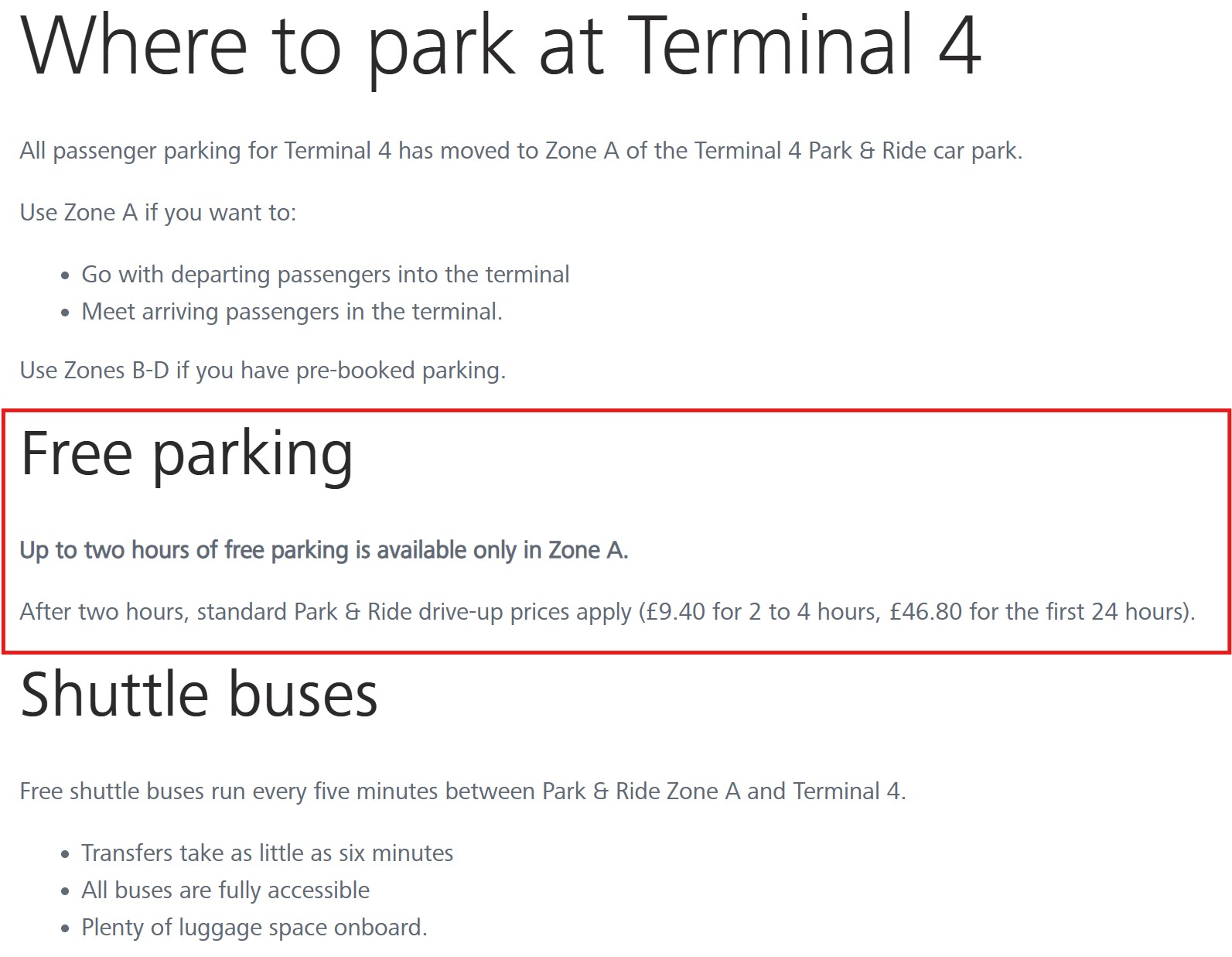
Heathrow’s official Terminal 4 redevelopment information confirms the two-hour free parking allowance in Park & Ride Zone A.
Is Heathrow Terminal Parking Better Than Using the Drop-Off Zone?
Drivers who need to park and enter the terminal should distinguish the £7 drop-off charge from Heathrow’s separate Terminal Parking tariffs.
Terminal Parking, previously called Short Stay Parking, allows motorists to park their vehicles rather than simply unload passengers.
For Terminals 2, 3 and 5, Heathrow’s published drive-up tariffs effective from 6 January 2026 include:
| Parking duration | Terminal Parking charge |
|---|---|
| 0–29 minutes | £8 |
| 30–44 minutes | £12.50 |
| 45–59 minutes | £15.50 |
| 1–2 hours | £20 |
| 2–3 hours | £24 |
| 3–4 hours | £28 |
A short Terminal Parking visit costing £8 is only £1 more than the £7 standard drop-off fee.
That represents a 14.3% additional cost in exchange for the ability to park in the designated car park.
For someone who needs to help an elderly relative, accompany children or assist with luggage, paying the additional £1 may be more appropriate than attempting to remain at the forecourt.
However, this comparison assumes the driver can complete the visit within the first 29-minute tariff band.
A longer stay increases the parking cost.
Terminal 4’s redevelopment means motorists must follow its separate temporary parking arrangements rather than assuming that the normal Terminal Parking facilities remain available.
Passengers comparing the complete range of parking products across London’s airports can examine the airport parking options, transfer arrangements and published costs before choosing the most suitable service.
Can You Pick Someone Up From Heathrow’s Drop-Off Area?
No. Heathrow’s designated terminal drop-off forecourts are intended for dropping off departing passengers.
Waiting for arriving passengers and collecting people from these zones are not permitted.
Motorists should instead use the relevant Terminal Parking or Park & Ride facilities.
Terminal 4 additionally operates a Priority Pick-Up area outside arrivals.
Its published charges include:
| Terminal 4 Priority Pick-Up duration | Charge |
|---|---|
| Up to 10 minutes | £7 |
| 11–29 minutes | £14 |
| 30–60 minutes | £25 |
These charges relate to the designated arrivals pick-up facility and should not be confused with the standard £7 departures drop-off fee.
Vehicles must not be left unattended in the terminal forecourt areas.
This distinction matters for drivers collecting relatives from delayed flights. A £7 departures drop-off payment does not grant permission to wait for an arriving passenger.
Do Blue Badge Holders Have to Pay the Heathrow Drop-Off Charge?
Eligible UK and European Economic Area Blue Badge holders can apply for a 100% discount on Heathrow’s terminal drop-off charge.
The concession can apply when the Blue Badge holder is travelling as a passenger in another person’s car or in a taxi.
However, it is not automatically applied simply because a Blue Badge is displayed in the vehicle.
Heathrow now operates a Blue Badge account registration process.
Applicants must create an account, provide the required badge information and receive approval.
Heathrow states that account approval can take up to five days and advises applicants to begin the account process at least seven days before their next visit.
For applicants who cannot complete the registration online, customer services can assist by telephone, but Heathrow requires at least 14 days’ advance notice for that process.
Once the account is approved, the relevant journey and vehicle registration must be correctly recorded to obtain the concession.
A qualifying visit can be registered in advance or by midnight on the day following the drop-off.
For someone travelling by taxi, the concession is associated with the taxi’s registration number. The passenger should communicate the approved arrangement to the driver so that the charge is not unnecessarily added to the fare.
Eligible Blue Badge holders also have an alternative entitlement to the first two hours of parking free in Heathrow’s Park & Ride facilities.
That arrangement requires following the published entry and exit assistance procedures.
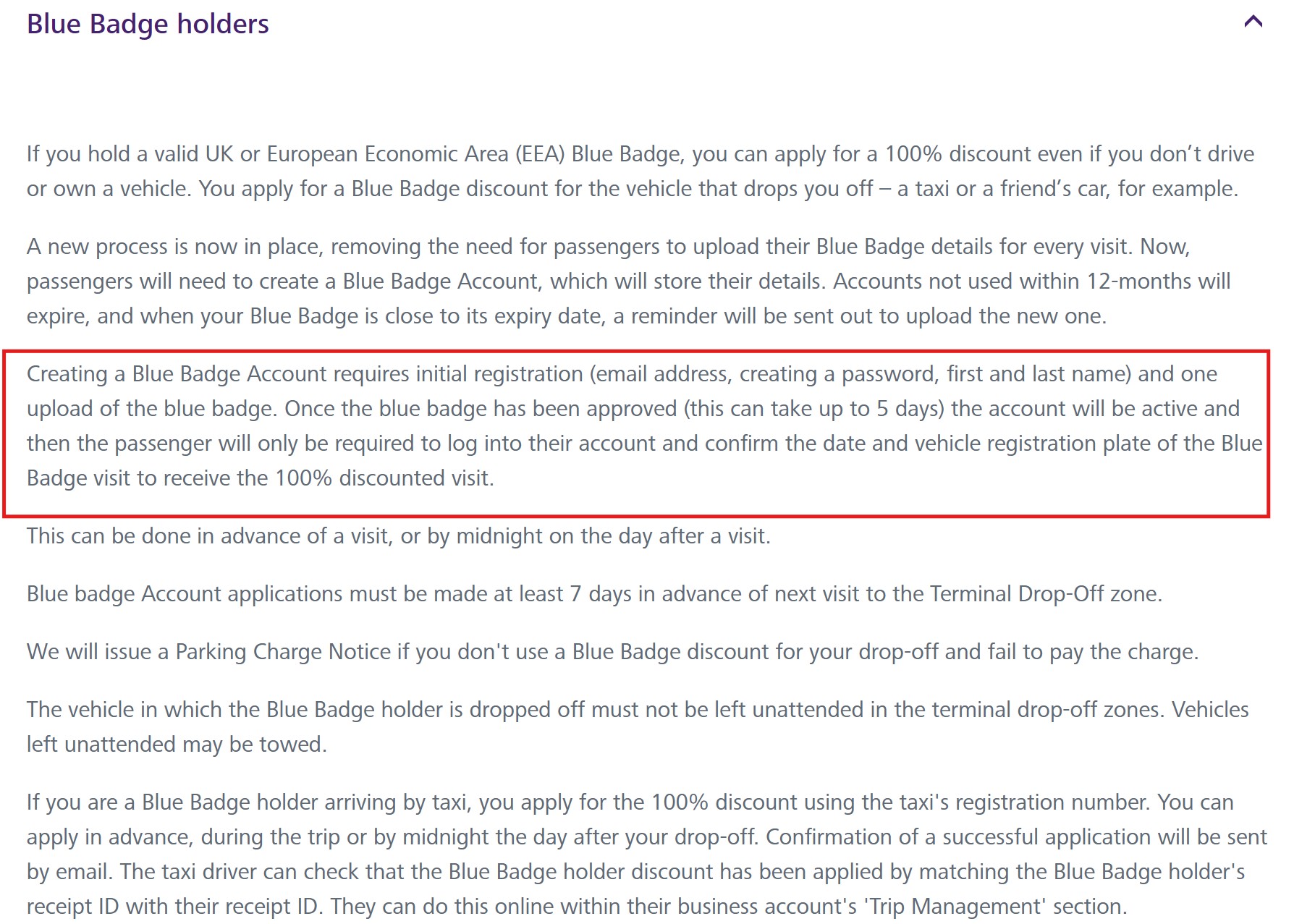
Heathrow’s official Blue Badge guidance explains the 100% terminal drop-off concession, account registration and eligibility conditions.
Does Heathrow’s Drop-Off Charge Apply to Taxis and Private-Hire Vehicles?
In general, taxis and private-hire vehicles are subject to Heathrow’s drop-off charging arrangements unless an applicable exemption or concession has been correctly obtained.
Passengers should not assume that a taxi is exempt simply because the journey is commercial.
For a licensed driver, the fare arrangement may determine whether the passenger pays the drop-off fee separately or whether the cost is incorporated into the quoted journey price.
Customers booking airport transfers should check what the quoted price covers.
For business travellers, an airport transfer quote that appears slightly cheaper may not represent better value if terminal charges and other permitted additional costs are excluded.
Heathrow also provides a dedicated Authorised Vehicle Area for eligible private-hire vehicles waiting before collections.
That waiting facility serves a different purpose from the departures drop-off forecourt.
Military vehicles, emergency service vehicles and certain authorised Heathrow operational vehicles are among the categories covered by Heathrow’s published exemptions.
Ordinary personal vehicles are not exempt simply because the journey is necessary or brief.
Does the Heathrow Drop-Off Charge Include ULEZ?
No. The Heathrow terminal drop-off charge and London’s Ultra Low Emission Zone charge are separate.
Heathrow became part of London’s ULEZ on 29 August 2023.
Vehicles that do not meet the relevant emissions standards and do not qualify for an exemption may incur the £12.50 daily ULEZ charge when driven within the zone.
The additional financial impact can be substantial.
| Journey scenario | Drop-off charge | ULEZ charge | Combined cost |
|---|---|---|---|
| ULEZ-compliant vehicle, terminal drop-off | £7 | £0 | £7 |
| Non-compliant vehicle, terminal drop-off | £7 | £12.50 | £19.50 |
| ULEZ-compliant vehicle, eligible free Park & Ride visit | £0 | £0 | £0 |
| Non-compliant vehicle, eligible free Park & Ride visit | £0 | £12.50 | £12.50 |
These examples exclude fuel, tolls, other parking costs and additional applicable charges.
Motorists should check their vehicle’s emissions status rather than assuming that vehicle age alone determines liability.
A vehicle using a free Heathrow Park & Ride facility may still incur the ULEZ charge if it does not meet the applicable standards.
Our financial comparison highlights that a non-compliant vehicle can face a combined £19.50 cost for a single terminal drop-off before accounting for the expense of travelling to the airport.
How Much Does the Heathrow Drop-Off Charge Cost Frequent Travellers and Businesses?
For someone dropping off a relative once or twice a year, the £7 charge may represent a relatively small component of total travel expenditure.
For businesses, however, recurring airport transfers can create a measurable operating expense.
The key financial consideration is the number of chargeable entries made over time.
| Paid drop-offs per month | Monthly cost | Annual cost |
|---|---|---|
| 4 | £28 | £336 |
| 8 | £56 | £672 |
| 12 | £84 | £1,008 |
| 20 | £140 | £1,680 |
| 40 | £280 | £3,360 |
These calculations assume a fixed £7 charge for every visit throughout the period, without discounts, exemptions or future tariff changes.
A company making 20 chargeable Heathrow drop-offs per month would therefore spend £1,680 annually on the terminal fee alone.
At the former £6 rate, the equivalent expenditure would have been £1,440.
The 2026 increase adds £240 to the annual cost for that example.
This is a practical illustration of how a relatively modest individual price increase can become more significant when repeated across regular business journeys.
How Can Companies Control Heathrow Drop-Off Expenses?
Businesses should distinguish genuine travel requirements from avoidable payment administration costs.
A sensible approach includes registering appropriate vehicles for AutoPay, checking payment cards regularly, reconciling charges against actual journeys and retaining transaction records.
For employees travelling to Heathrow, an expenses policy should specify whether terminal drop-off costs are reimbursable and which supporting documents must be retained.
Companies should also assess whether employees need direct forecourt access or could reasonably use public transport or another airport transfer arrangement.
Where an employee has mobility requirements or must transport business equipment, choosing the lowest-cost option without considering accessibility and practicality may be inappropriate.
VAT treatment and tax deductibility should be checked against the nature of the business journey and the supporting invoice.
A payment confirmation alone should not be treated as sufficient evidence of recoverable VAT without checking the relevant tax information.
What If You Enter the Wrong Drop-Off Zone or Pay for the Wrong Vehicle?
Mistakes can happen when motorists are unfamiliar with Heathrow’s road layout.
A driver may enter the wrong terminal forecourt, pay for an incorrect vehicle registration or purchase a drop-off credit that is never used.
Heathrow’s payment terms provide for refunds in specified circumstances, including certain unused trips and payments associated with an incorrect registration.
However, customers should not assume every payment can be cancelled automatically.
APCOA reviews refund requests according to the applicable terms.
For payment enquiries, customers can contact:
APCOA customer services: 0333 200 7459
Refund email: refunds.heathrowdropoff@apcoa.com
Retaining the original transaction receipt and registration details makes an enquiry easier to investigate.
Prepaid drop-off trips normally remain valid for 12 months. Unused prepaid credits can expire, so businesses purchasing multiple trips should monitor their balances rather than treating prepayment as an unlimited entitlement.
A temporary £1 card pre-authorisation may also appear when payment details are checked. Heathrow explains that this is a temporary hold rather than an additional drop-off fee.
Motorists should distinguish such authorisations from completed charges when reviewing bank statements.
Is the Government Planning to Reduce Airport Drop-Off Charges?
Airport drop-off charges have attracted increasing attention from policymakers and consumer groups during 2026.
In October 2026, Parliament considered provisions for a government review of airport drop-off charges through the Civil Aviation (Consumer Protection and Regulatory Reform) Bill.
The proposed review would examine the impact of these charges on airport users, with particular attention potentially given to affordability, accessibility, transparency and travel behaviour.
During the Public Bill Committee proceedings on 20 October 2026, a proposal for a £5 cap on airport drop-off charges was discussed.
However, the Government did not support setting a predetermined £5 cap before completing the review.
Keir Mather, Parliamentary Under-Secretary of State for Transport, emphasised:
“fairness, transparency and ultimately choice about their transport mode”
His remarks formed part of an official parliamentary discussion about the experience of passengers using airport drop-off facilities.
The wider debate also considered the difficulties faced by disabled travellers, rural passengers and people without suitable public transport alternatives.
The committee agreed to provisions for a review to be completed within 12 months of Royal Assent, but the Bill had not completed its parliamentary passage as of 24 October 2026.
There is therefore no general £5 national airport drop-off cap in force as a result of the October discussions.
Heathrow’s published £7 charge remains applicable.
Any future changes would need to be assessed against the legislation ultimately enacted and the airport’s subsequent charging announcements.
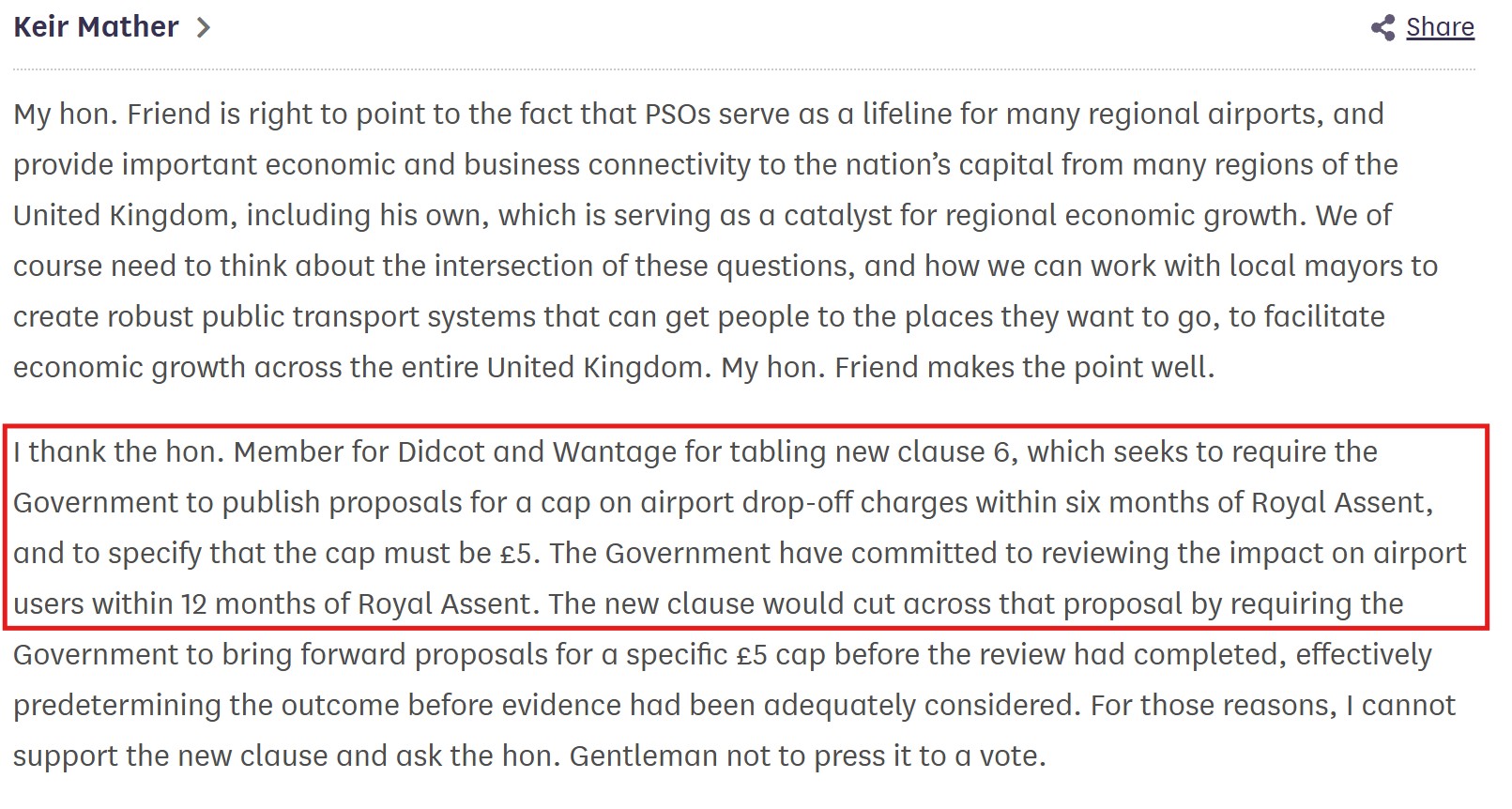
Parliamentary proceedings from 20 October 2026 show discussion of the proposed airport drop-off charge review and the suggested £5 charging cap.
How Does Heathrow Compare With Other London Airports?
Heathrow’s £7 charge should be assessed alongside the wider cost of airport travel.
Different airports operate different payment systems, time limits and free parking arrangements.
At Gatwick, for example, the published standard terminal drop-off charge is higher than Heathrow’s basic fee, while separate Long Stay facilities provide a free parking alternative.
Travellers comparing these arrangements should understand parking costs at Gatwick and the differences between terminal and longer-stay parking.
Stansted also offers a free parking option, but its Mid Stay facility operates under different time limits and re-entry conditions.
The arrangements for free parking at Stansted Airport demonstrate why motorists should not assume that all London airports apply the same rules.
Our comparison identifies one consistent financial principle: the price advertised for direct terminal access is only part of the decision.
Drivers should consider passenger mobility, luggage, shuttle transfers, payment arrangements and the possibility of additional charges.
A free parking option may be suitable for a flexible family journey but less practical for someone carrying substantial equipment or travelling under time constraints.
The most economical choice is the one that balances the total cost with the requirements of the journey.
What Should Drivers Check Before Visiting Heathrow?
Motorists planning to drop someone off at Heathrow should confirm the correct terminal and identify whether direct forecourt access is necessary.
The standard £7 charge is convenient for passengers who can unload and proceed towards departures without assistance.
Those who can use Park & Ride may avoid the charge completely, provided they comply with the facility’s conditions.
Drivers should also check whether their vehicle incurs ULEZ charges and whether any Blue Badge concession has been approved.
For business journeys, payment responsibility should be agreed before travel, particularly where taxis, company vehicles or third-party airport transfers are involved.
Finally, the payment deadline should not be treated as a minor administrative detail.
Missing a £7 charge can expose drivers to an £80 Parking Charge, although APCOA’s specific seven-day late-payment procedure may assist eligible customers who act promptly.
Final Thoughts
Heathrow’s £7 drop-off charge is a relatively simple flat-rate system, but drivers can encounter avoidable costs if they misunderstand the payment deadline, enter a chargeable area more than once or use the wrong parking facility.
Our analysis indicates that the most important financial distinction is between direct terminal access and the availability of free Park & Ride alternatives.
Terminal 4’s two-hour free Zone A arrangement is particularly relevant following its 2026 parking changes, while motorists using other terminals should plan around much shorter free parking periods.
For regular business journeys, correctly configured AutoPay and consistent expense monitoring can help prevent administrative errors and unnecessary enforcement charges.
Ultimately, drivers who confirm their terminal, understand the payment rules and choose the most suitable parking arrangement can manage Heathrow drop-off expenses without compromising the practical needs of their journey.
Frequently Asked Questions About the Heathrow Drop-Off Charge
How much does Heathrow charge for dropping someone off?
Heathrow charges £7 each time a vehicle enters a designated terminal drop-off zone. The charge applies across Terminals 2, 3, 4 and 5.
Can I pay the Heathrow drop-off charge after leaving?
Yes. Payment can be completed after the journey, provided it is made by 11:59pm on the following calendar day.
Is Heathrow drop-off free for 10 minutes?
No. The £7 fee applies upon entry to a designated terminal forecourt, even when passengers are dropped off very quickly. Separate free Park & Ride arrangements are available.
Can I drop someone off at Heathrow for free?
Yes. Eligible private vehicles can use designated Park & Ride facilities. The usual free allowance is 29 minutes at Terminals 2, 3 and 5, while Terminal 4 Zone A currently offers up to two hours.
What if I forgot to pay the Heathrow drop-off charge?
Contact APCOA promptly. Its published procedure allows eligible drivers who make contact within seven days of their visit to arrange payment at the original £7 rate, subject to the operator’s process.
Does Heathrow automatically charge my bank card?
Only if a relevant vehicle has been registered for an active AutoPay service with valid payment details. Otherwise, motorists must arrange payment themselves.
Can I use the Heathrow drop-off area to collect someone?
No. Pick-ups and waiting are not permitted in the designated departures drop-off zones. Use an authorised parking or pick-up facility instead.
Are Blue Badge holders exempt from the Heathrow drop-off charge?
Eligible Blue Badge holders can receive a 100% discount, but they must complete Heathrow’s registration and journey declaration procedures correctly.
Does the Heathrow drop-off charge include ULEZ?
No. ULEZ is separate. A non-compliant vehicle without an exemption may incur an additional £12.50 daily ULEZ charge.
Will Heathrow reduce the drop-off charge to £5?
No confirmed reduction is currently in force. Parliament discussed a proposed £5 airport drop-off cap in October 2026, but it was not adopted as an immediate charging rule.
Hannah is a London lifestyle and consumer writer at London Insider News, covering property, transport, local developments, cost-of-living issues and stories affecting everyday life across the capital.
More from TRANSPORT
Check Congestion Charge 2027: How to Check by Number Plate, Postcode and Payment Status?
Before driving into central London, checking the Congestion Charge can prevent an £18 daily expense from…
Pay Stansted Drop Off Charge: How to Pay Online, Current Fees, Deadlines and Free Alternatives?
Drivers using London Stansted Airport's Express Set Down area must pay a drop-off charge after their…
Do I Need to Pay Congestion Charge in London? 2027 Rules, 2026 Updates, Costs and Exemptions
If you're planning to drive through central London, you may be wondering, do I need to…