Which Budget Supermarket Tuna Beat John West? Full Taste Test Results and 2027 Buying Guide
Discover which budget supermarket tuna beat John West in the 2026 taste test. Compare Tesco, Aldi, Lidl and M&S scores, prices and savings for 2027.
 Adam
London Business & News Writer
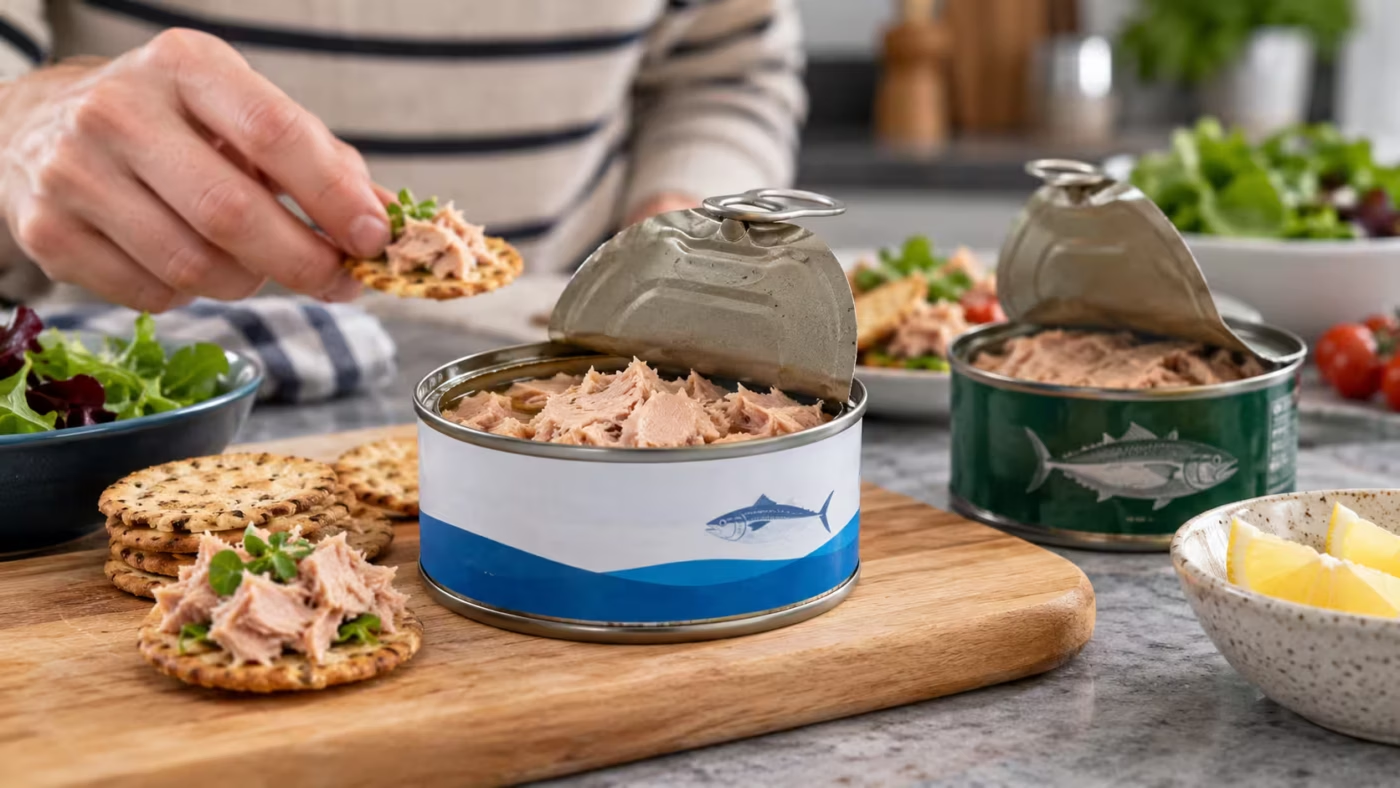
Tesco Tuna Chunks in Spring Water was the budget supermarket tuna that beat John West in an October 2026 taste test. Priced at just 65p for a 145g tin, Tesco received an impressive 9.5/10 (95%), compared with John West’s 8/10 (80%) for a £2.25 tin.
Marks & Spencer also finished ahead of John West, scoring 9/10 (90%) for its 80p tuna.
The findings attracted attention because an inexpensive supermarket product outperformed a recognised household brand in a direct comparison of flavour, texture and appearance.
However, there is an important update for shoppers preparing their grocery budgets for 2027.
As checked on 12 November 2026, Tesco’s official online listing displayed the same 145g spring-water tuna product at 80p. Therefore, the original 65p winning price should be treated as a historical test price, not a guaranteed price for 2027.
We analysed the original seven-product taste test, the supermarkets’ product specifications, separate consumer comparisons and the financial implications of switching from branded to own-label canned fish.
Our findings show that the most useful measure of value is not always the cheapest tin. Actual drained weight, protein content, product consistency and promotional pricing can make a substantial difference.
Which Budget Supermarket Tuna Beat John West in the Recent Taste Test?
The winner was Tesco Tuna Chunks in Spring Water, 145g, which received the highest rating in a comparison published in October 2026.
The original taste test was conducted by journalist Angela Patrone, whose findings appeared in UK news coverage on 25 October 2026.
She compared seven canned tuna products, including six supermarket own-brand alternatives and John West.
The supermarket products came from Tesco, Aldi, Lidl, Sainsbury’s, Marks & Spencer and Waitrose.
Each product was sampled after draining, allowing the tester to assess its flavour, texture and appearance without adding mayonnaise, salad dressing or other ingredients.
Tesco’s product emerged as the preferred option.
It delivered relatively substantial tuna chunks, an appealing consistency and a balanced flavour. Its principal drawback was the absence of a ring-pull lid.
That packaging limitation was not significant enough to prevent it from winning.
The result is particularly notable because Tesco’s tuna was priced £1.60 below the branded John West product at the time.
From a consumer finance perspective, this demonstrates the potential value of periodically comparing familiar branded products with lower-priced supermarket alternatives.
Nevertheless, the 95% rating represents one journalist’s score rather than a national customer satisfaction survey or scientifically established measure of product quality.
How Did All Seven Supermarket Tuna Products Score?
The reported comparison produced substantial differences between products sold at similar prices.
Supermarket Tuna Taste Test Results: October 2026
| Rank | Supermarket or brand | Test price | Tin weight | Taste score | Percentage |
| 1 | Tesco | 65p | 145g | 9.5/10 | 95% |
| 2 | M&S | 80p | 160g | 9/10 | 90% |
| 3 | John West | £2.25 | 125g | 8/10 | 80% |
| 4 | Sainsbury’s | 65p | 145g | 7/10 | 70% |
| 5 | Waitrose | £1.50 | 160g | 5/10 | 50% |
| 6 | Lidl | 65p | 145g | 4/10 | 40% |
| 7 | Aldi | 65p | 145g | 1/10 | 10% |
The percentages convert the original journalist’s ratings to a 100-point scale. Prices are historical, and the listed tin weights include packing liquid.
Three findings stand out.
First, Tesco scored 15 percentage points higher than John West while selling for approximately 71.1% less per tin.
Second, M&S achieved a 90% rating while costing £1.45 less than John West.
Third, Tesco and Aldi were both priced at 65p, yet they received dramatically different scores.
The 85-percentage-point difference between Tesco and Aldi indicates that equally priced products can deliver very different experiences to an individual reviewer.
Our assessment is that these findings challenge two common shopping assumptions: that well-known brands always taste better and that similarly priced own-brand products offer broadly identical quality.
Neither assumption was supported consistently by this particular comparison.
However, consumers should avoid treating the results as permanent supermarket rankings. Product formulations, suppliers, fish batches and individual preferences can change.
Why Did Tesco Tuna Taste Better Than John West?
Tesco’s winning result was largely attributed to its texture and flavour.
The tuna retained relatively large, recognisable pieces after draining. These chunks were considered more appealing than the smaller pieces found in certain competing tins.
The taste also struck a favourable balance between saltiness and the natural flavour of the fish.
Angela Patrone acknowledged her surprise at the result, writing:
“I was genuinely taken aback”
Her assessment is significant because John West had previously been her preferred brand.
The Tesco product challenged that preference without requiring a higher retail price.
John West still performed respectably, receiving 8/10, but its smaller pieces and less impressive flavour when eaten without additional ingredients prevented it from finishing first.
This distinction matters because canned tuna is consumed in several ways.
For example, a shopper using tuna in a mayonnaise-heavy sandwich might care less about individual chunk size than someone eating it directly in a salad.
Similarly, texture can matter more in a jacket potato topping, where larger pieces may retain their structure.
Our review therefore suggests that the winning result should be interpreted according to how the product was tested.
Tesco performed best when sampled plain after draining.
That does not automatically establish it as the best tuna for every recipe or consumer preference.
What Are the Latest Tesco Tuna Price Updates for 2026 and 2027?
One of the most important improvements to the original story is distinguishing the October taste-test price from the latest available retail information.
During the October 2026 comparison, the winning Tesco tuna cost 65p.
However, Tesco’s official grocery product page displayed 80p for its 145g Tuna Chunks in Spring Water on 12 November 2026.
The listing also identified a drained weight of 102g and a unit price of £7.84 per kilogram of drained product.
Tesco Tuna Price Comparison
| Price measure | October 2026 taste test | November 2026 official listing |
| Product | Tesco Tuna Chunks in Spring Water | Tesco Tuna Chunks in Spring Water |
| Net weight | 145g | 145g |
| Price per tin | 65p | 80p |
| Drained weight | 102g | 102g |
| Price per 100g drained | Approx. 63.7p | Approx. 78.4p |
The difference between the two recorded prices is 15p per tin.
However, these observations came from different dates and purchasing contexts. They should not be interpreted as proof that every Tesco store increased its price by an identical amount.
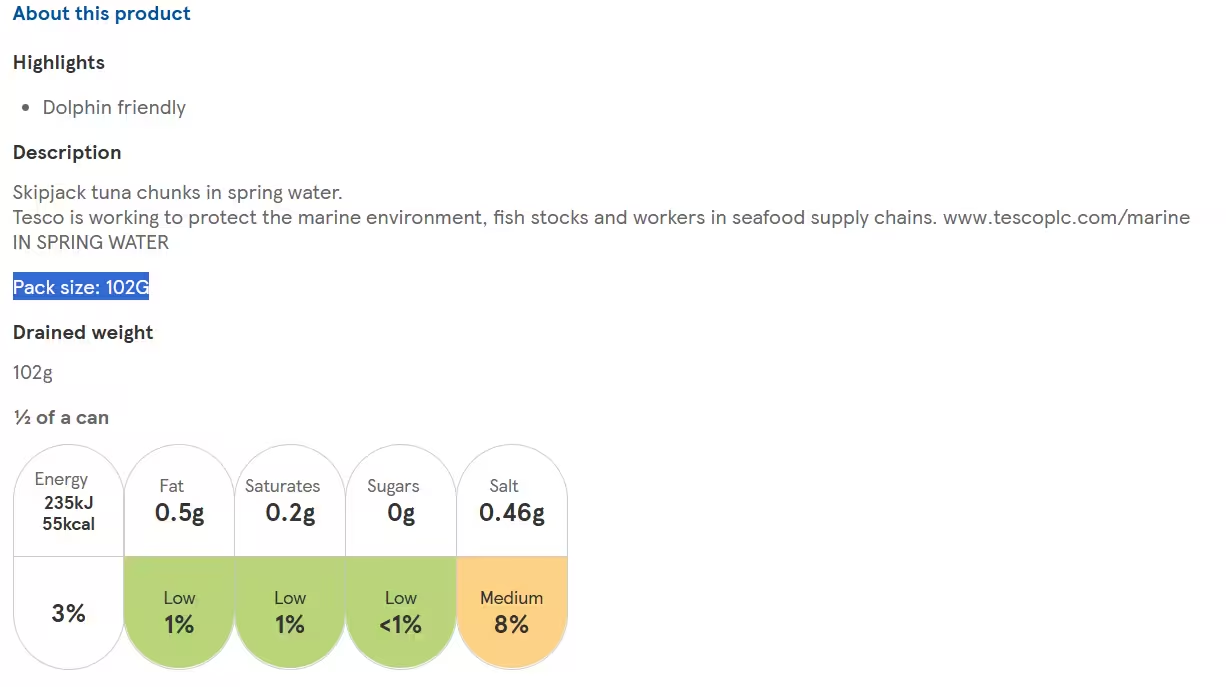
Tesco’s official grocery listing for Tuna Chunks in Spring Water 145g, showing the November 2026 online price of 80p, 102g drained weight and unit price.
What Should Shoppers Expect in 2027?
There is no verified 2027 result establishing a new winner of this particular seven-product taste test.
Retail prices in 2027 will depend on supplier contracts, fish procurement costs, packaging, logistics, retailer pricing strategies and promotions.
Our financial assessment is that shoppers should monitor the actual cost of the product they buy, rather than assuming that the original 65p price will remain available.
A stronger value comparison in 2027 would examine three factors together: the latest selling price, drained fish weight and whether the product continues to meet the buyer’s expectations.
Which Supermarket Tuna Was the Best Alternative to Tesco?
Marks & Spencer finished second with its 160g Tuna Chunks in Spring Water.
At 80p in the original test, it was only 15p more expensive than Tesco while achieving a 90% taste rating.
The product received favourable comments for its substantial chunks, relatively appealing colour and pleasant flavour.
Its main weakness was slightly less satisfying saltiness than Tesco’s product.
From a value perspective, the relatively small historical price difference means M&S was a credible alternative for consumers who preferred its texture or flavour.
The brand’s official product information identifies skipjack tuna as the main ingredient and states that the fish is pole-and-line caught.
M&S also lists the following nutritional information per 100g:
| Nutrient | M&S tuna | Tesco tuna |
| Protein | 23.5g | 24.9g |
| Energy | 99 kcal | 109 kcal |
| Fat | 0.6g | 1.0g |
| Salt | 0.75g | 0.90g |
These are retailer-declared nutritional values, not independent laboratory test results.
They demonstrate that shoppers can consider more than flavour when choosing between two similarly priced tins.
For example, a customer monitoring salt intake may pay attention to the difference between the declared 0.75g and 0.90g per 100g.
Another customer may place greater value on protein content, pack size or sourcing information.
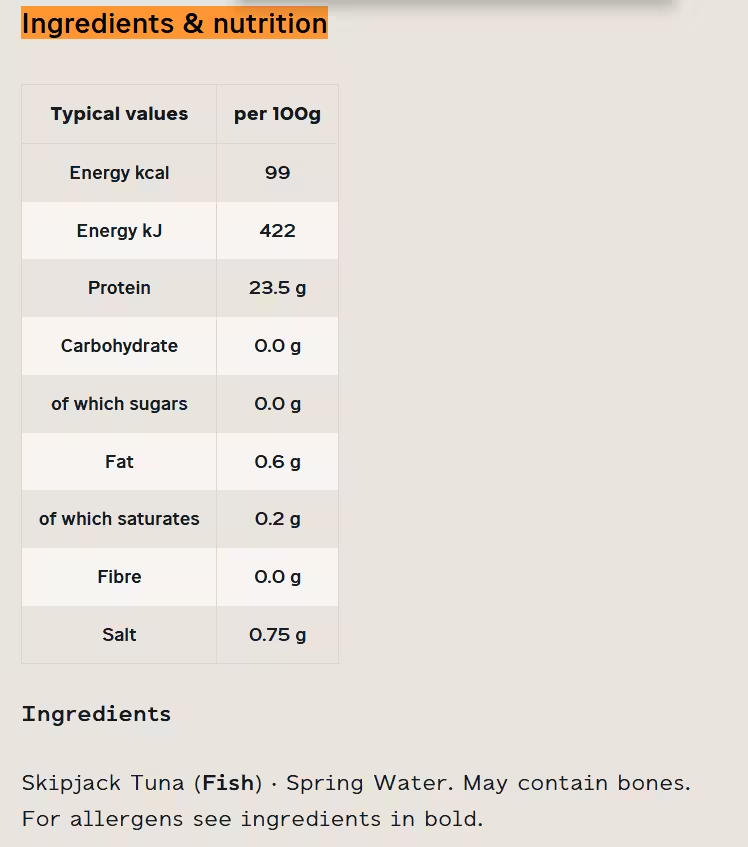
M&S Tuna Chunks in Spring Water official product information, showing the 160g tin, skipjack ingredients, nutritional values and pole-and-line fishing description.
Why Did Aldi, Lidl, Sainsbury’s and Waitrose Score Lower?
The remaining four supermarket alternatives produced mixed results.
Sainsbury’s finished fourth with 7/10, equivalent to 70%.
Its tuna initially impressed the tester with recognisable chunks and a reasonably pleasant flavour, but a less enjoyable aftertaste reduced its final rating.
Waitrose received 5/10, or 50%.
Although its 160g tin was larger than several competing products, the stronger fish flavour was considered excessive by the reviewer.
Lidl finished sixth, scoring 4/10, equivalent to 40%.
The tuna looked reasonably acceptable, but the flavour was regarded as comparatively bland. The reviewer felt additional ingredients could improve the eating experience.
Aldi finished seventh with a rating of 1/10, or 10%.
The product was criticised for a stronger odour, fragmented texture and relatively mushy consistency.
These observations should not be confused with an official food safety assessment.
A low taste rating does not demonstrate that a product is unsafe, incorrectly manufactured or unsuitable for consumption.
It reflects the tester’s subjective experience of the particular tin examined.
For consumers, the important lesson is that a single product review should inform rather than replace personal judgement.
Someone purchasing Aldi tuna primarily for pasta dishes may have different expectations from a reviewer eating tuna directly from the can.
Shoppers planning to visit the discount retailer can also check Aldi opening times before travelling, particularly during Sundays and bank holidays.
Why Did Another 2026 Tuna Taste Test Name Different Winners?
The October 2026 comparison was not the only supermarket tuna review published during the year.
On 5 September 2026, food writer Tom Hunt published a separate tuna tasting in The Guardian.
That review identified Sainsbury’s Taste the Difference albacore tuna steak in spring water as its best overall product.
Co-op responsibly sourced tuna chunks in brine was selected as the best bargain.
At first glance, these findings might appear inconsistent with Tesco’s October victory.
However, the tests involved different products.
The September comparison included premium albacore tuna, brine-packed products, multipacks and different branded alternatives.
It also examined factors such as fishing methods, sourcing information, aroma and texture.
The Tesco product assessed in that review was tuna chunks in brine, rather than the 145g spring-water product that subsequently won Angela Patrone’s October comparison.
Consequently, the two results cannot be combined into a single ranking.
Our analysis identifies an important consumer research principle: the phrase “best supermarket tuna” is meaningful only when the product category and testing criteria are clearly defined.
A premium albacore steak may outperform an inexpensive skipjack product in one evaluation while offering weaker value for someone seeking an economical sandwich filling.
Similarly, a tuna brand can perform differently when packaged in brine, spring water or oil.
For 2027 shoppers, the useful question is not simply which supermarket won a past test, but which exact product offers the best combination of taste, price and suitability for their intended use.
How Much Money Could Shoppers Save by Choosing Tesco Instead of John West?
The financial difference between Tesco and John West was substantial in the October 2026 comparison.
Tesco cost 65p, whereas John West cost £2.25.
That created a saving of £1.60 per tin.
The Tesco alternative was therefore approximately 71.1% cheaper per tin, with John West costing about 3.46 times the Tesco price.
The difference becomes more significant when applied to repeat purchases.
Potential Household Savings Based on October 2026 Prices
| Tins purchased monthly | Monthly saving | Annual saving |
| 1 | £1.60 | £19.20 |
| 2 | £3.20 | £38.40 |
| 4 | £6.40 | £76.80 |
| 8 | £12.80 | £153.60 |
These calculations are illustrative and use the historical 65p Tesco and £2.25 John West prices. They assume identical purchase quantities and unchanged prices over 12 months.
A household buying four tins every month could therefore have saved £76.80 annually under the original price comparison.
For someone purchasing eight tins monthly, the potential annual saving would have reached £153.60.
These examples are not forecasts of savings in 2027 because current prices and promotional offers may differ.
Nevertheless, they explain why own-label products are commercially important.
Small differences in the cost of frequently purchased items can accumulate over time.
A saving of £1.60 may appear modest in isolation, but repeated across several cupboard staples, the financial impact can become more meaningful.
The same affordability principle underpins targeted grocery assistance programmes, including Sainsbury’s £3 fruit and veg scheme, although that initiative has separate eligibility rules and was not a universal supermarket price reduction.
Our assessment is that consumers achieve the clearest budget improvements when they calculate savings across their regular shopping basket rather than relying on one headline discount.
Why Is Drained Weight Important When Comparing Tinned Tuna Prices?
A major weakness in many supermarket price comparisons is that they focus on the weight displayed on the front of the tin.
For canned tuna, the net weight includes both fish and packing liquid.
The actual amount of fish available after draining may be substantially lower.
Tesco’s official information provides a useful example.
Its 145g spring-water tuna tin has a declared drained weight of 102g.
That means approximately 70.3% of the product’s declared net weight consists of drained fish.
The difference between 145g and 102g is 43g.
At the historical 65p price, Tesco’s tuna cost approximately 63.7p per 100g of drained fish.
At the November 2026 listed price of 80p, the equivalent cost was approximately 78.4p per 100g.
The formula is straightforward:
Price per 100g of drained fish = (Tin price ÷ drained fish weight) × 100
For example:
80p ÷ 102g × 100 = approximately 78.4p per 100g.
This calculation is particularly valuable when comparing different can sizes.
A larger tin does not necessarily contain more edible fish if it also includes substantially more liquid.
Similarly, a more expensive no-drain product could be more competitive than its headline price suggests if a greater proportion of its stated weight is usable fish.
We recommend comparing like-for-like products by their drained-weight unit prices rather than relying solely on the labelled net weight.
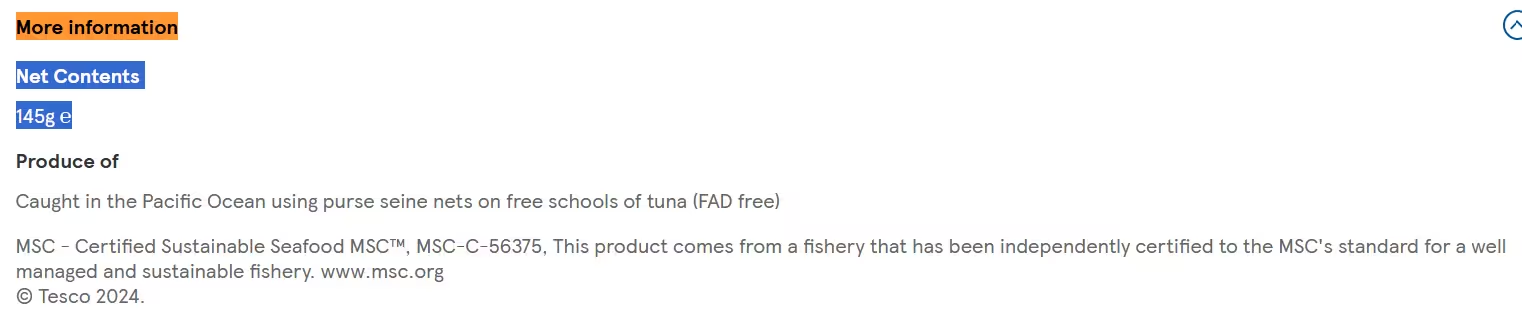
Tesco’s declared 102g drained weight for a 145g tuna tin, demonstrating why the total pack weight differs from the quantity of fish.
Is Tesco Tuna Better Value for Protein in 2027?
Protein content provides another useful way to assess the value of canned fish.
Tesco declares approximately 24.9g of protein per 100g of drained tuna.
Using its 102g drained weight, a full tin contains approximately 25.4g of protein.
At the 80p November 2026 listing price, that equates to around 3.15p per gram of protein.
This calculation is useful for consumers who regularly buy tuna as a convenient protein source.
However, protein content should not be treated as the only measure of value.
Different food products offer different nutritional characteristics, and the role of tuna within a balanced diet depends on overall eating habits.
A consumer may reasonably prefer a product with slightly less protein if it has a flavour, texture, salt level or sourcing standard that better meets their needs.
For households managing a grocery budget, the strongest comparison considers both nutrition and the amount of food that is actually consumed.
Buying a cheaper product that regularly goes uneaten does not necessarily produce a genuine saving.
Does John West Have Evidence That Its Own Tuna Tastes Better?
John West has published information about separate consumer taste testing for its EcoTwist tuna range.
According to the company, research conducted by Wirral Sensory Services involved 100 regular consumers of canned tuna.
Participants tested products without brand identification, and the sequence of presentation was randomised.
The exercise assessed nine tuna products and was repeated in December 2025 and January 2026.
John West reported that EcoTwist finished first for taste within that research, scoring 7.36/10 compared with 7.05/10 for the next product.
The company also reported a leading result for overall quality.
These findings offer useful context because they demonstrate that different research designs can reach different conclusions.
However, the John West testing and October 2026 journalist’s comparison should not be treated as directly equivalent.
One involved a 100-consumer panel examining several products, while the other reflected the preferences of a single reviewer.
The John West research was also published by the brand in support of its own product claims.
Our assessment is that neither finding proves a product will always be preferred by every consumer.
The more defensible conclusion is that Tesco won the specified October 2026 comparison, while John West has reported favourable results from a separate consumer test involving EcoTwist.
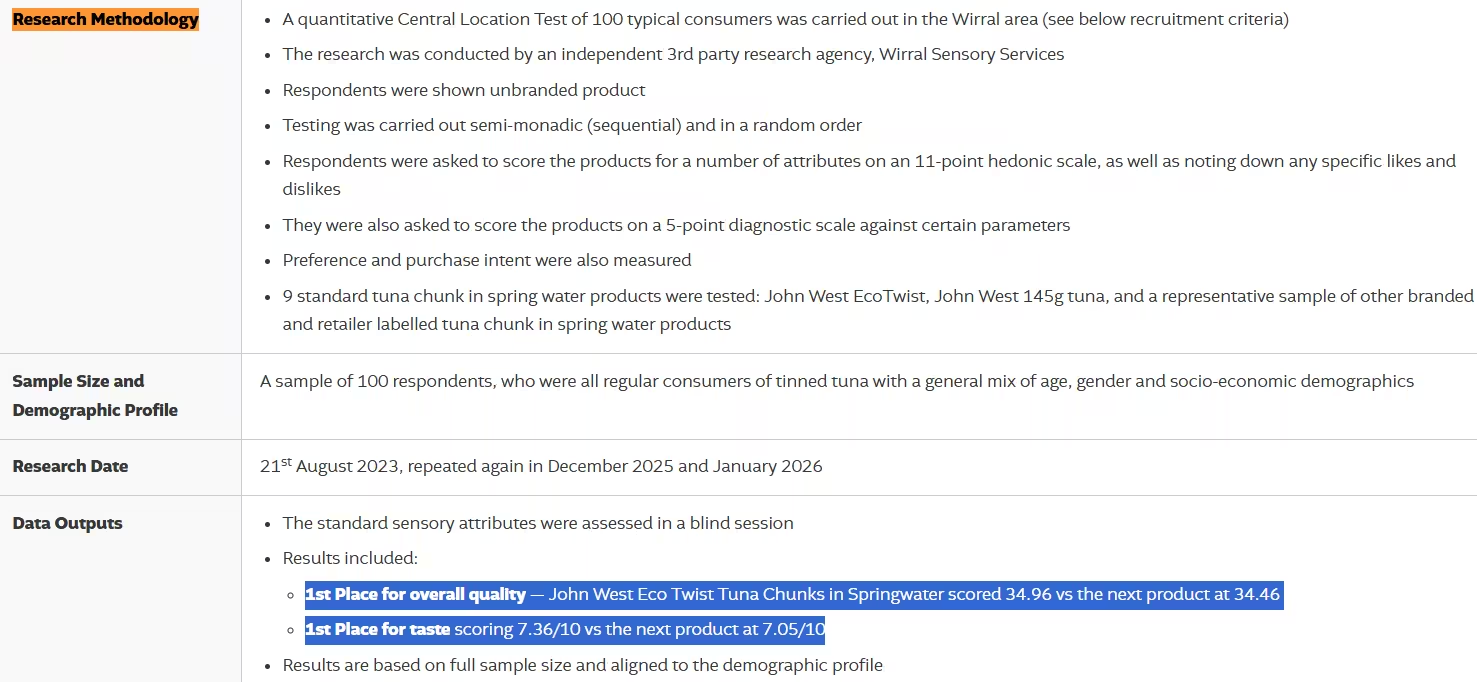
John West’s published EcoTwist research methodology, identifying the 100-consumer taste panel, blind testing process and reported taste results.
Does Sustainable Tuna Cost More Than Budget Tuna?
Sustainability is another consideration for shoppers who want to evaluate more than price.
Tuna products can differ by species, fishing location, catch method and third-party certification.
Tesco’s official listing describes its relevant spring-water product as skipjack tuna caught in the Pacific Ocean using fish-aggregating-device-free purse-seine methods.
It also displays Marine Stewardship Council certification.
M&S describes its tuna as pole-and-line caught.
The Marine Stewardship Council explains that certified seafood comes from fisheries assessed against its fisheries sustainability standard.
However, it would be incorrect to assume that every product labelled sustainably sourced has identical environmental credentials.
Fishing methods, stock conditions and geographic origins can vary.
Similarly, a product with a higher taste score does not automatically have a better environmental performance.
For shoppers, these factors should be assessed separately.
| Buying consideration | What to examine |
| Taste | Texture, flavour and intended recipe |
| Price | Cost per tin and per 100g drained |
| Nutrition | Protein, salt and other declared values |
| Species | Skipjack, albacore or another tuna species |
| Fishing method | Pole-and-line, purse seine or another method |
| Certification | Relevant independent certification and product information |
| Convenience | Ring-pull opening, packaging and storage requirements |
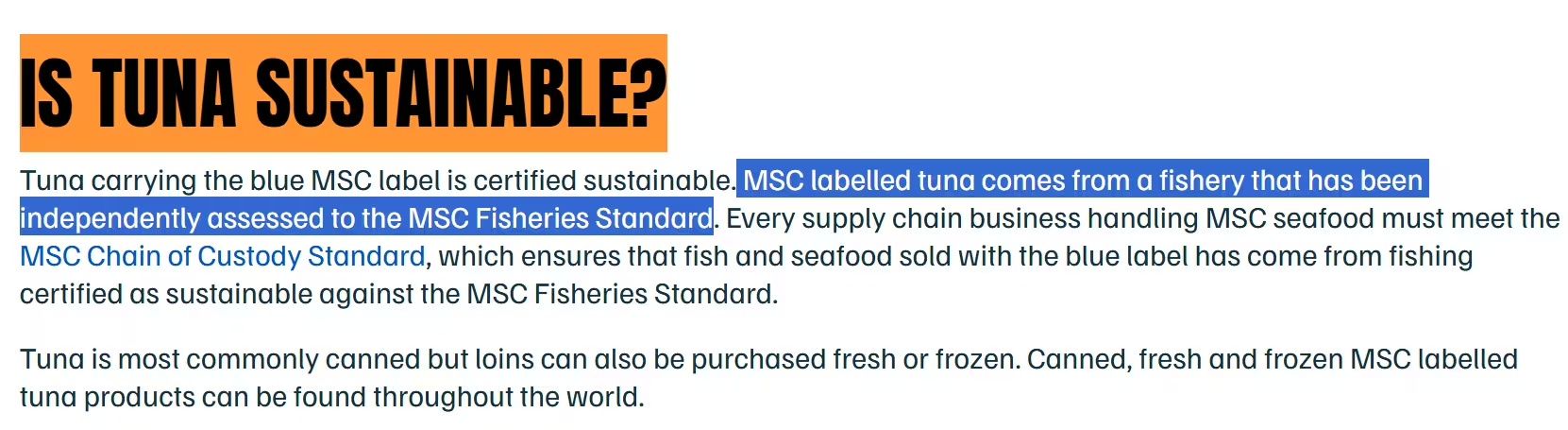
The Marine Stewardship Council’s official explanation of tuna species, fisheries certification and the blue MSC label.
Why Are Supermarket Own-Brand Products Challenging Famous Food Brands?
The Tesco taste-test result highlights an important commercial development in food retailing.
Own-label products are no longer competing exclusively on price.
Supermarkets also use their own product ranges to attract customers, build loyalty and differentiate themselves from competitors.
For established manufacturers, this creates a commercial challenge.
A recognised brand can justify higher prices through consumer trust, product consistency, familiarity, convenience or distinctive features.
However, that advantage becomes harder to maintain when customers discover less expensive alternatives that meet their expectations.
The October tuna comparison illustrates the tension.
John West offered strong brand recognition, but the reviewer preferred the lower-priced Tesco product.
This does not mean brand loyalty has disappeared or that John West has lost market share because of the test.
It does suggest that consumers have reasons to reassess the premium they pay for individual branded staples.
Competition between supermarkets also extends beyond pricing.
The UK’s Competition and Markets Authority confirmed changes in October 2026 affecting land agreements used by Aldi and Lidl.
The Aldi and Lidl competition ruling is relevant to the wider retail landscape because access to supermarket locations can influence consumer choice and the competitive environment.
Our analysis is that meaningful grocery competition involves several connected factors: pricing, product quality, store accessibility, stock availability and consumer trust.
A supermarket cannot establish durable value merely by offering the lowest price on one product.
Its performance also depends on whether shoppers remain satisfied enough to buy the product again.
What Should UK Shoppers Check Before Buying Tuna in 2027?
For households planning their 2027 food budgets, we recommend a practical comparison based on current product information.
Check the latest price rather than relying on the original 65p headline:The Tesco winner’s November 2026 listing already differed from the October test price. Future promotions and retailer price changes may alter the comparison again.
- Compare drained weight instead of net weight alone: A larger-looking tin may not provide more usable fish.
- Examine the exact tuna variety: Tuna chunks in spring water, tuna in brine, tuna in sunflower oil and no-drain tuna should not automatically be treated as identical products.
- Compare the cost of multipacks: A multipack may lower the effective cost per tin, but consumers should check the number of cans, drained quantities and any loyalty-card conditions.
- Consider how the tuna will be used: Larger chunks may appeal to people preparing salads or jacket potatoes, while smaller flakes may be suitable for sandwiches and pasta fillings.
- Check product sourcing and nutritional declarations: These can matter for shoppers with specific dietary or environmental preferences.
- Account for shopping convenience and availability: A lower-priced product may be less attractive if reaching the retailer requires unnecessary travel expenditure.
For example, shoppers buying groceries from different retailers should check Sainsbury’s opening times or their preferred store’s local trading hours before planning a visit.
The broader financial principle is to compare the complete cost and benefit of a purchase.
The lowest individual shelf price is not always the most economical decision when transport, delivery fees, storage and the risk of food waste are considered.
Final Verdict: Was Tesco’s Budget Tuna Worth Buying?
Tesco delivered the strongest result in the October 2026 comparison, with a 95% taste score and a substantially lower recorded price than John West.
Marks & Spencer was another notable performer, finishing second with 90%.
For consumers, the findings reinforce an important financial lesson: a recognised brand and a higher price do not automatically guarantee a better eating experience.
However, the most useful 2027 purchasing decision will depend on current prices rather than historical headlines.
Our review suggests that consumers can achieve better grocery value by combining taste preferences with drained-weight comparisons, nutritional information and realistic household savings calculations.
Tesco won the original test, but the best-value tuna in 2027 will be the product that offers each shopper the strongest balance of price, usable quantity and quality.
Frequently Asked Questions
Which budget supermarket tuna beat John West in the recent taste test?
Tesco Tuna Chunks in Spring Water won the October 2026 comparison with a score of 9.5/10, or 95%. John West scored 8/10, equivalent to 80%.
How much did the winning Tesco tuna cost?
The winning 145g Tesco tuna cost 65p in the October 2026 test. Tesco’s official online listing displayed 80p on 12 November 2026. The price available in 2027 will need to be checked separately.
Which supermarket tuna came second?
Marks & Spencer finished second with 9/10, equivalent to 90%. Its 160g Tuna Chunks in Spring Water cost 80p in the reported comparison.
Was Aldi or Lidl tuna better than John West?
Neither beat John West in the October test. Lidl received 4/10 and Aldi received 1/10, compared with John West’s 8/10.
Is Tesco tuna healthier than John West?
The taste-test result does not establish that Tesco is healthier. Nutritional value depends on the exact products being compared, their ingredients, protein and salt contents, and individual dietary needs.
Does Tesco’s 145g tuna tin contain 145g of fish?
No. Tesco declares a drained weight of 102g for its 145g spring-water tuna product. The higher net weight includes packing liquid.
Is Tesco tuna still the best supermarket tuna for 2027?
Tesco remains the documented winner of the October 2026 comparison. However, no new 2027 result from that same test has been established. Shoppers should compare current prices, product specifications and any newer independent taste tests before making a purchasing decision.
Adam is a London business and news writer at London Insider News, covering local developments, finance, entrepreneurship and the stories shaping businesses and communities across the capital.
More from LONDON NEWS

Nationwide UK Property Price Drop: Will House Prices Fall Further in 2027? Latest 2026 Figures and Forecasts
The Nationwide UK property price drop has become an increasingly important issue for homeowners, first-time buyers,…

Discontinued Cadbury Chocolate Back in UK: Nostalgic Favourite Returns After 18 Years as Shoppers Celebrate
Discontinued Cadbury chocolate is back in the UK, with the return of nostalgic favourites including Astros…

Rachel Reeves Stamp Duty Receipts Fall: £541m Decline, 2026 Budget Changes and 2027 Property Market Outlook
Rachel Reeves' stamp duty changes are facing renewed scrutiny after research revealed an estimated £541 million…