Kemi Badenoch Inheritance Tax Policy 2026: Who Benefits From the Proposed Changes?
Kemi Badenoch has proposed abolishing inheritance tax on family homes and increasing the tax-free allowance to £500,000 per person. Discover how the proposed reforms could affect UK homeowners, inheritance tax bills, family wealth and estate planning.
 Hannah
London Lifestyle & Consumer Writer

Kemi Badenoch has announced a major inheritance tax policy that could change how millions of pounds in family wealth are transferred between generations.
At the Conservative Party Conference on 7 October 2026, she pledged to abolish inheritance tax on qualifying family homes and increase the standard tax-free inheritance allowance to £500,000 per person.
Under the proposal, a married couple or civil partners could pass their main home to direct descendants without inheritance tax and leave a further £1 million in other assets tax-free.
The Conservatives estimate that the reforms would cost approximately £6 billion annually.
Our analysis of the official announcement, existing HMRC rules, independent economic assessments and business taxation considerations examines who would benefit, how much families could potentially save, and whether the proposed changes would deliver meaningful financial advantages.
Importantly, this is an opposition policy announcement, not a change to current inheritance tax law.
What Is Kemi Badenoch’s Inheritance Tax Policy?
Kemi Badenoch’s inheritance tax policy proposes removing inheritance tax from qualifying main family homes passed to children or grandchildren while increasing the standard tax-free allowance from £325,000 to £500,000 per individual.
The announcement contains three principal commitments:
- Family home exemption: Qualifying main homes inherited by direct descendants would be exempt from inheritance tax, regardless of their value.
- Higher inheritance allowance: The standard nil-rate band would increase to £500,000 per individual, potentially providing £1 million for married couples or civil partners.
- Long-term abolition: The Conservatives intend eventually to abolish inheritance tax entirely, subject to public finances.
The proposal would replace the existing combination of the £325,000 standard nil-rate band and the additional £175,000 residence nil-rate band.
However, the party has not yet published complete legislation addressing every technical circumstance, including complex trusts, jointly owned properties and potential anti-avoidance measures.
Speaking about the proposal, Badenoch stated:
“That is why the next Conservative government will legislate so nobody will ever pay Inheritance Tax on their family home.”
Her statement reflects a wider Conservative argument that families should retain more of the wealth accumulated through employment, business ownership and property investment.
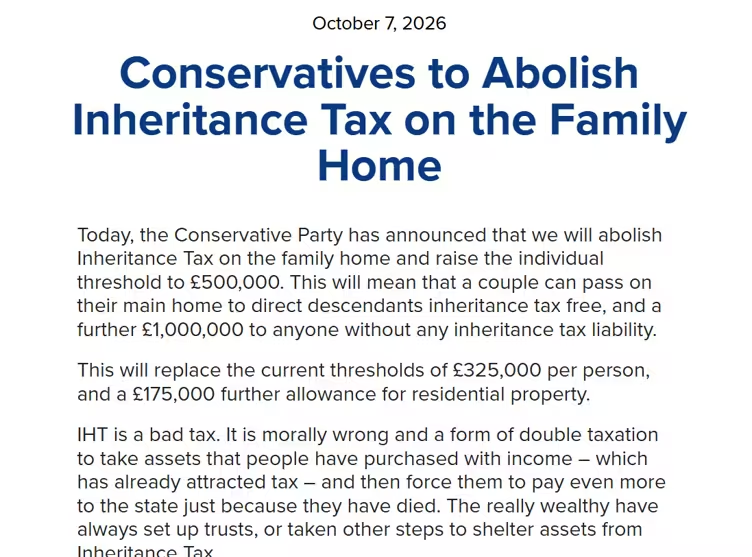
The Conservative Party’s official announcement, dated 7 October 2026, confirming plans to abolish inheritance tax on family homes and increase the individual inheritance allowance to £500,000.
How Would the New Inheritance Tax Rules Work?
The proposed arrangement would distinguish between a qualifying family home and other assets held within an estate.
Currently, the value of an individual’s estate generally includes property, savings, investments, possessions and relevant business interests, subject to applicable exemptions and reliefs.
Under Badenoch’s proposal, a qualifying main residence transferred to direct descendants would be removed from the inheritance tax calculation.
Other taxable assets would remain subject to inheritance tax, but families would benefit from the higher standard allowance.
What Happens to the Family Home?
Consider a married couple whose main residence is valued at £1.5 million.
Under the proposed arrangement, the entire qualifying property could pass to their children without inheritance tax.
There would be no £1 million maximum on the value of the qualifying home itself.
This distinction matters for London families, particularly those who purchased properties decades ago at much lower prices.
An inherited home worth £2 million could potentially receive complete exemption, provided the property met the final legislation’s requirements.
What Happens to Savings and Investments?
The proposed standard allowance would increase to £500,000 per person.
For qualifying couples, this would provide £1 million against other taxable assets, separate from the family home exemption.
For example, a couple leaving a qualifying home worth £1.2 million and savings worth £750,000 could potentially transfer both without inheritance tax.
The home would fall within the proposed property exemption, while the savings would remain below the combined £1 million allowance.
This does not mean that every couple would automatically receive the same tax treatment. Previous gifts, debts, ownership arrangements, trusts and the final statutory rules could affect individual outcomes.
What Are the Current Inheritance Tax Rules in 2026?
Inheritance tax currently applies at a standard rate of 40% to the taxable part of an estate above the available allowances.
HMRC’s existing rules provide:
| Current rule | October 2026 position |
| Standard nil-rate band | £325,000 |
| Residence nil-rate band | Up to £175,000 |
| Potential combined allowance for one person | £500,000 |
| Potential combined allowance for a qualifying couple | £1 million |
| Standard inheritance tax rate | 40% |
| Reduced rate on qualifying estates with charitable gifts | 36% |
| Residence allowance taper starts | £2 million estate value |
The maximum £1 million combined allowance currently available to some married couples is not automatic for every estate.
The residence allowance depends on passing a qualifying residential interest to direct descendants. It is also gradually withdrawn when an estate exceeds £2 million.
The withdrawal operates at £1 of residence allowance for every £2 above that threshold.
Consequently, a larger estate may lose the additional property-related allowance even where the deceased owned a valuable family home.
This is one reason the Conservatives’ proposed unlimited family home exemption would significantly change the treatment of some wealthy estates.
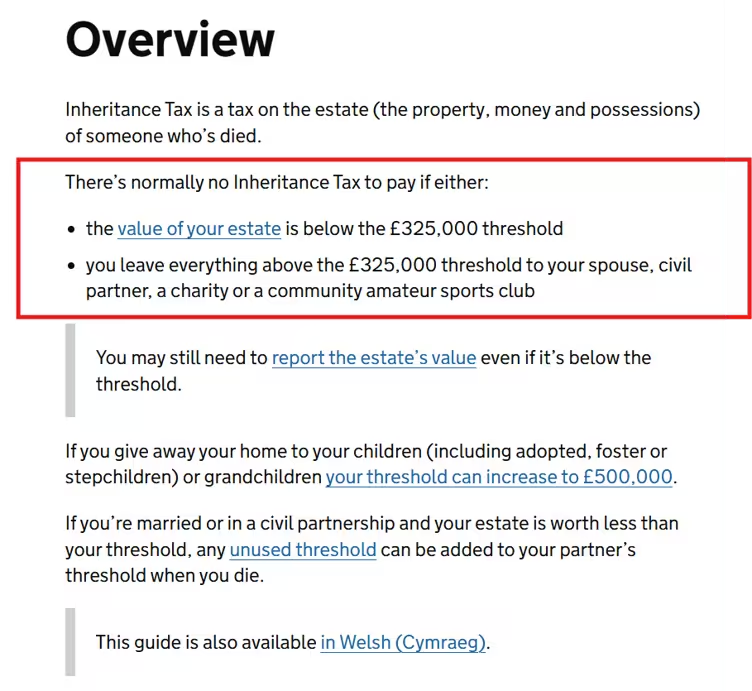
HMRC’s official inheritance tax guidance showing the £325,000 standard allowance, the circumstances in which the threshold can increase to £500,000, and the standard 40% inheritance tax rate.
How Much Inheritance Tax Could Families Save?
The financial impact depends on estate composition, whether the home qualifies and the available reliefs.
Our calculations below compare current inheritance tax rules with a simplified interpretation of Badenoch’s proposal.
They assume a qualifying married couple or civil partners, fully available transferred allowances, a home passing to direct descendants, no previous chargeable gifts and no additional reliefs.
| Family home | Other assets | Current estimated IHT | Under proposed rules | Potential saving |
| £700,000 | £200,000 | £0 | £0 | £0 |
| £900,000 | £500,000 | £160,000 | £0 | £160,000 |
| £400,000 | £1.4 million | £320,000 | £160,000 | £160,000 |
| £2 million | £800,000 | £860,000 | £0 | £860,000 |
These figures are illustrative calculations rather than official government estimates or guaranteed individual tax outcomes.
Example: A London Family With a £1.4 Million Estate
Consider a family leaving a £900,000 home and £500,000 in other assets.
The combined estate is £1.4 million.
Under existing arrangements, assuming the full £1 million combined allowance is available, inheritance tax would apply to £400,000.
At 40%, the tax liability would be £160,000.
Under the proposed system, the £900,000 family home would be exempt, while the £500,000 in other assets would fall within the new allowance.
The potential saving would therefore be £160,000.
Example: An Estate Worth £2.8 Million
Consider another couple leaving a £2 million main residence and £800,000 in savings and investments.
The total estate would be £2.8 million.
Under current rules, the residence nil-rate band would be completely withdrawn because of the estate’s value.
Assuming only the couple’s combined £650,000 standard allowance remained, the inheritance tax calculation would be:
£2,800,000 − £650,000 = £2,150,000 taxable estate.
At 40%, the potential inheritance tax liability would be £860,000.
Under Badenoch’s proposed system, the qualifying family home would be exempt and the remaining £800,000 would fall within the £1 million combined standard allowance.
The potential tax liability would therefore fall to zero.
This demonstrates why the largest cash savings could be concentrated among families with substantial property wealth.
Who Would Benefit Most From Badenoch’s Proposal?
The biggest financial beneficiaries would generally be estates already liable for inheritance tax, particularly those containing valuable residential property.
However, receiving an inheritance does not automatically mean a family would benefit financially from the policy.
Our assessment identifies four groups with different levels of potential exposure.
1. London Homeowners
London households could be among the most significant beneficiaries because residential property represents a substantial proportion of family wealth in many boroughs.
Properties purchased several decades ago may now be worth considerably more than their original purchase prices.
A homeowner may have accumulated substantial property wealth without receiving a corresponding increase in disposable income.
Under the proposed exemption, qualifying homes could pass to children or grandchildren without inheritance tax.
Nevertheless, the strongest financial benefits would accrue to estates that would otherwise face an inheritance tax liability.
2. Married Couples and Civil Partners
Qualifying couples could benefit from the proposed £1 million standard allowance alongside the family home exemption.
This could make inheritance arrangements simpler for some families.
However, estate planning would still need to address beneficiary arrangements, wills, previous gifts and ownership structures.
3. Families With High-Value Property
Families holding large amounts of wealth in their main residence could potentially benefit substantially.
The existing £2 million estate threshold for withdrawing the residence allowance makes this particularly relevant to larger estates.
Removing the home from inheritance tax could produce greater savings than simply increasing the standard allowance.
4. Children Inheriting Property
Beneficiaries could receive a larger share of the estate if inheritance tax liabilities were reduced.
However, inherited property may still create financial obligations.
These can include maintenance, insurance, service charges, mortgage liabilities and possible future tax consequences.
A family inheriting a London leasehold flat should also investigate the property’s ground rent obligations, remaining lease term and management charges.
Removing inheritance tax would not remove these ownership costs.
Why Are Economists Concerned About the Policy?
The most significant economic criticism concerns the distribution of benefits and the effect of the proposed exemption on the housing market.
Stuart Adam, Senior Economist at the Institute for Fiscal Studies, examined the announcement on 7 October 2026.
He concluded:
“The biggest beneficiaries would be those with the highest wealth and the most valuable homes.”
The IFS assessment identifies an important trade-off.
Removing inheritance tax from family homes would reduce the tax burden for affected estates, but it could also encourage households to hold more wealth in residential property rather than other assets.
Could the Policy Discourage Downsizing?
Potentially, yes.
Consider an older homeowner deciding whether to sell a large family home and move into a smaller property.
If the original home could eventually be inherited without inheritance tax, retaining that property might become more attractive than selling and holding additional cash or investments.
These incentives could reduce the supply of larger homes available to younger families.
They might also encourage some wealthier households to purchase more expensive main residences because the additional value could later pass to descendants tax-free.
However, this is a predicted behavioural response rather than evidence that house prices have already changed because of the announcement.

The Institute for Fiscal Studies’ 7 October 2026 assessment by economist Stuart Adam, explaining which households are expected to benefit most and the potential effects on housing-market decisions.
What Could the Policy Mean for Entrepreneurs?
For entrepreneurs, inheritance tax policy has consequences beyond the transfer of a residential property.
Many business owners hold wealth across multiple asset classes, including a family home, company shares, commercial property, pensions and investment portfolios.
The treatment of each asset matters when determining the financial value of the proposal.
Would Family Businesses Become Inheritance Tax-Free?
Not automatically.
Badenoch’s family home exemption would not, by itself, mean that every business asset could pass to the next generation without inheritance tax.
The Conservative Party has separately pledged to reverse inheritance tax changes affecting family farms and businesses.
Under the rules introduced on 6 April 2026, the combined allowance for 100% Agricultural Relief and Business Relief is generally £2.5 million per individual, with unused allowance potentially transferable between spouses or civil partners.
Qualifying assets above the available allowance generally receive 50% relief rather than 100%.
This means the effective inheritance tax exposure on the excess qualifying value may be up to 20%, depending on the wider estate.
Badenoch’s separate promise to reverse these reforms should therefore be assessed independently from the proposed family home exemption.
How Could Business Owners Plan Their Estates?
Business owners should consider the relationship between personal and commercial wealth.
For instance, someone with a £1 million family home, £2 million in qualifying company shares and £500,000 in savings would need to assess the relevant business reliefs alongside the proposed standard allowance.
The family home exemption would address only one part of the estate.
Our financial analysis suggests that business succession planning should continue to prioritise:
- Accurate business and property valuations.
- Ownership and shareholder arrangements.
- Wills and succession agreements.
- The availability of Business Relief.
- Pension and retirement planning.
- Liquidity available to meet potential tax liabilities.
- The consequences of transferring ownership during life.
Entrepreneurs should not restructure a company purely on the assumption that an opposition tax proposal will become law.
Would the Policy Change Inheritance Tax on Pensions?
Badenoch’s announcement did not establish a new exemption for inherited pensions.
Under legislation already enacted, most unused pension funds and pension death benefits are due to enter the inheritance tax estate calculation for deaths on or after 6 April 2027, subject to specified exceptions.
These changes are distinct from the Conservative family home proposal.
The interaction would nevertheless matter if Badenoch’s reforms were eventually implemented.
For example, a family might inherit a qualifying main residence without inheritance tax while still facing potential tax exposure on pension funds or other financial assets.
The proposed £500,000 standard allowance could reduce that liability, but it would not necessarily eliminate it.
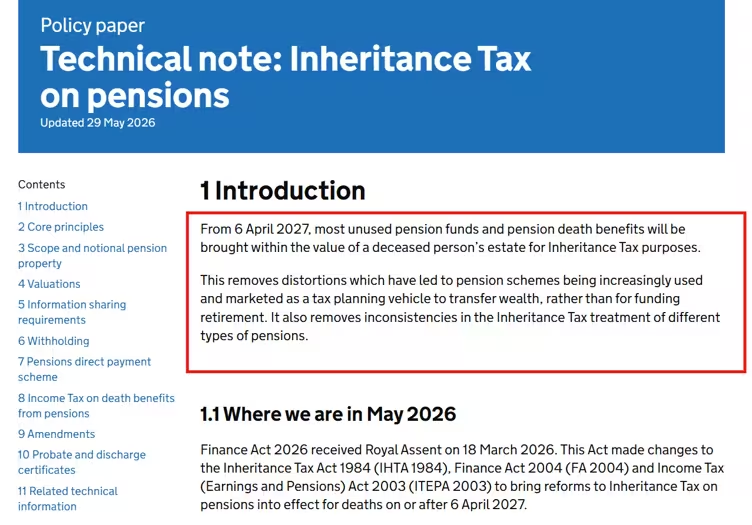
HMRC’s official technical guidance confirming that most unused pension funds and pension death benefits will become part of inheritance tax calculations from 6 April 2027.
How Much Would the Inheritance Tax Policy Cost?
The Conservatives estimate that their proposed inheritance tax changes would cost approximately £6 billion annually.
This represents a substantial potential reduction in tax receipts.
The party has linked its wider tax-cutting programme to a plan to reduce government expenditure, including welfare spending and departmental costs.
At its October 2026 conference, the Conservatives outlined proposed savings totalling £71 billion.
However, the existence of a savings target does not establish that every saving will be delivered or that it will arise within the same financial period as a particular tax cut.
Independent analysis must therefore consider whether the proposals are achievable, how the savings would be allocated and the consequences for public services.
Why Does the Government Collect Inheritance Tax?
Inheritance tax contributes revenue to the Treasury and is intended to tax certain transfers of accumulated wealth.
Supporters of the existing system argue that it can reduce some inequalities created by large inherited fortunes.
Opponents argue that taxing assets accumulated through previously taxed income, savings and investment can discourage wealth creation and intergenerational financial planning.
Both arguments involve economic trade-offs.
A reduction in inheritance tax would leave more money with affected families, but it would also reduce the funds available for government spending or deficit reduction unless replacement savings or revenues were delivered.
How Many Estates Currently Pay Inheritance Tax?
Inheritance tax affects a relatively small proportion of estates, although the proportion is forecast to increase.
According to figures discussed in the IFS’s October 2026 assessment, based on Office for Budget Responsibility forecasts:
| Period | Estates paying inheritance tax |
| 2023–24 | 4.6% |
| 2026–27 forecast | 5.5% |
| 2030–31 forecast | 9.5% |
The projected increase reflects factors including frozen thresholds, asset values and changes to reliefs.
These projections are uncertain and could change with housing prices, policy decisions and wider economic conditions.
They also describe the existing policy baseline rather than the number of estates expected to pay inheritance tax if Badenoch’s proposal became law.
The distinction is important.
A tax may affect fewer than one in ten estates while still generating substantial revenue from the wealthiest estates.
Consequently, the financial benefit of reform is not evenly distributed across all households.
Is Kemi Badenoch’s Inheritance Tax Policy Fair?
The policy’s fairness depends on whether the objective is to protect inherited family property, reduce tax complexity, encourage savings or distribute the benefits of taxation more evenly.
From the perspective of families facing inheritance tax on a home accumulated through decades of ownership, the proposal could provide meaningful financial relief.
It could also reduce pressure to sell inherited property simply to meet an estate’s tax liability.
However, renters and households without substantial inherited assets would receive little direct benefit.
This creates a significant difference between the policy’s general political appeal and the number of households likely to obtain a measurable tax saving.
Our assessment identifies three competing considerations.
Family wealth protection: The policy would allow more private wealth to pass to future generations without taxation, potentially improving beneficiaries’ financial security.
Distributional fairness: Families already owning expensive properties would generally gain more than households with limited assets or no expectation of an inheritance.
Housing-market efficiency: Exempting one asset category without similar treatment for other investments could influence asset allocation and discourage some homeowners from selling larger properties.
No single consideration determines whether the policy is desirable. The overall judgement depends on the weighting given to fiscal fairness, ownership incentives and public revenue.
How Does Our Financial Assessment Rate the Proposal?
Our editorial assessment considers the announced policy’s clarity, potential benefits, fiscal detail and implementation certainty.
These ratings are analytical judgements, not survey findings, verified probabilities or scores provided by independently interviewed experts.
| Assessment factor | Editorial rating | Our reasoning |
| Clarity of the main announcement | 80% | The proposed home exemption and higher allowance are clearly stated |
| Detail of eligibility and technical rules | 45% | Important definitions and complex estate arrangements remain unresolved |
| Breadth of direct financial benefits | 35% | Benefits are concentrated among estates that would otherwise pay inheritance tax |
| Transparency of fiscal implementation | 50% | A cost estimate and wider savings plan exist, but delivery remains uncertain |
| Certainty of the policy becoming law | Not rated | Electoral outcomes and future legislation cannot be reliably expressed as a percentage |
These scores are intended to identify relative strengths and weaknesses rather than suggest a scientifically measured policy outcome.
Our overall assessment is that the proposal offers a substantial potential tax saving for a specific group of property-owning households, but it is not a universal inheritance tax cut benefiting every family equally.
What Questions Remain Unanswered?
Several technical details will need clarification before families can assess the proposal with certainty.
What counts as the main family home? The final rules would need to address multiple residences, mixed-use properties, changes of residence and ownership through trusts.
Would unmarried couples receive equivalent treatment? The announcement describes a £1 million allowance for couples, but the precise operation for unmarried partners requires clarification. Existing transferable allowances generally depend on marriage or civil partnership.
What happens when a home passes to someone other than a direct descendant? The announced exemption focuses on children and grandchildren. Other beneficiaries may receive different treatment.
Would lifetime gifts of property qualify? The inheritance tax rules for gifts, continued occupation and gifts with reservation of benefit would need to be considered.
Would there be a limit on the value of a qualifying home? The headline commitment contains no stated property-value cap, but final legislation would determine the full conditions of the exemption.
Would the reform apply retrospectively? No confirmed retrospective commencement arrangements have been established.
These issues are particularly important to families with complex ownership arrangements, blended families, multiple properties or substantial business interests.
What Should Families Do Before the Policy Becomes Law?
Families should continue using existing inheritance tax rules when making financial decisions.
An announcement made by an opposition party does not remove any current tax liability.
The most practical approach is to understand the estate’s present position while remaining prepared for future changes.
Our recommended review would include obtaining an up-to-date property valuation, checking the beneficiaries named in an existing will, estimating the total taxable estate and examining the availability of current allowances.
Families should also document relevant lifetime gifts, review pension arrangements and identify any circumstances requiring specialist advice.
Where inheritance tax planning involves significant property wealth or private company ownership, advice from a qualified solicitor, chartered tax adviser or appropriately regulated financial professional may be valuable.
Major gifts, transfers or changes of ownership should not be carried out solely to anticipate a policy that has not been legislated.
When Could Kemi Badenoch’s Inheritance Tax Policy Start?
There is currently no confirmed implementation date.
The Conservatives would need to form a government capable of passing the necessary legislation.
The final policy could also be amended before or during that process.
For now, the existing inheritance tax rules remain applicable.
The distinction between an announced political commitment and enacted tax legislation is central to responsible estate planning.
What Is the Future of Inheritance Tax in the UK?
Badenoch’s proposal has renewed debate over how Britain should tax property wealth and financial assets transferred between generations.
The Conservatives have framed their policy around protecting homeownership, encouraging saving and reducing the taxation of accumulated family wealth.
Opponents and independent economists have raised concerns about the concentration of benefits among wealthier households and the potential consequences for the housing market.
For London, the issue has particular significance because the value of inherited residential property can represent a substantial proportion of an estate.
Our financial assessment suggests that the policy could produce large savings for affected families, particularly when a valuable main residence is combined with other assets.
However, a full judgement requires more than comparing headline tax thresholds.
It also requires examining implementation costs, public spending decisions, distributional effects and whether the exemption would encourage excessive investment in residential property.
Until the proposed changes become law, families and entrepreneurs should distinguish potential future tax advantages from the obligations that currently apply.
Frequently Asked Questions
Has Kemi Badenoch abolished inheritance tax?
No. Badenoch has proposed exempting qualifying family homes and raising the standard inheritance tax allowance. The changes have not become law.
Would the inheritance tax threshold increase to £1 million?
Under the proposal, the standard allowance would increase to £500,000 per individual, potentially providing £1 million for qualifying married couples or civil partners.
Would children pay inheritance tax on an inherited house?
A qualifying family home passed to direct descendants would be exempt under the proposed policy. Existing inheritance tax rules continue to apply until any new legislation takes effect.
Would the policy benefit people who do not own property?
The higher standard allowance could benefit some estates containing savings or investments, but households without assets above existing thresholds would generally see no direct inheritance tax saving.
Would buy-to-let properties qualify for the exemption?
The announced exemption concerns the qualifying main family home. Additional investment properties should not be assumed to qualify.
Would inheritance tax disappear completely?
The Conservatives have identified complete abolition as a longer-term ambition. Their immediate proposal is a major reduction rather than the abolition of inheritance tax on every asset.
How much could London families save?
Savings would depend on estate value and available reliefs. In illustrative circumstances, some qualifying estates could save tens or hundreds of thousands of pounds, while estates with no existing tax liability would save nothing.
Hannah is a London lifestyle and consumer writer at London Insider News, covering property, transport, local developments, cost-of-living issues and stories affecting everyday life across the capital.
More from PROPERTY

Right to Rent Share Code 2027: How to Get, Generate and Check Your Code Online?
Updated: 4 November 2026 | 2027 Guide A Right to Rent share code is a nine-character…

John Healey Budget Property Tax Raid: Landlords Face Higher Taxes as £2m Mansion Levy Stays
Chancellor John Healey has announced a fresh property tax increase in the October 2026 Budget, with…

Nationwide UK Property Price Drop: Will House Prices Fall Further in 2027? Latest 2026 Figures and Forecasts
The Nationwide UK property price drop has become an increasingly important issue for homeowners, first-time buyers,…