John Healey Budget Property Tax Raid: Landlords Face Higher Taxes as £2m Mansion Levy Stays
John Healey's October 2026 Budget introduces higher property income tax rates for UK landlords, rising to 24%, 44% and 49% from April 2027. The government has also confirmed a £2 million mansion tax threshold from April 2028. We examine how these property tax changes could affect landlords, rental prices, homeowners and the wider UK housing market.
 Adam
London Business & News Writer

Chancellor John Healey has announced a fresh property tax increase in the October 2026 Budget, with landlords facing higher income tax bills from April 2027 and owners of expensive homes preparing for an additional annual council tax surcharge from 2028.
The announcement has raised concerns across Britain’s property market, particularly among private landlords, estate agents and investors already dealing with mortgage costs, maintenance expenses and tighter rental regulations.
Under the new measures, property income tax rates will rise to 24% for basic-rate taxpayers, 44% for higher-rate taxpayers and 49% for additional-rate taxpayers in England, Wales and Northern Ireland.
The decision adds another two percentage points to the increase previously announced by former Chancellor Rachel Reeves, bringing the total planned rise to four percentage points from current rates.
Our analysis of the Budget documents and published property industry responses indicates that the financial consequences could extend beyond landlords.
Tenants may face additional rental pressure if property investors reduce their portfolios or attempt to recover higher taxation costs through rent increases.
Meanwhile, the government has maintained its planned High Value Council Tax Surcharge for properties worth at least £2 million in England, although speculation about lowering the qualifying threshold to £1.5 million has not become government policy.
What Has John Healey Announced About Property Tax in the Budget?
John Healey’s first Budget, delivered on 28 October 2026, introduces a further increase in the taxation of property income as part of the government’s wider effort to strengthen public finances and support households facing rising living costs.
The Chancellor has kept the headline rates of income tax on employment earnings unchanged while increasing the tax burden on certain forms of investment income.
Property income and savings interest will both face higher rates from 6 April 2027.
The government argues that the approach distributes tax responsibilities more fairly between people earning employment income and individuals receiving income from assets.
For property investors, however, the latest announcement represents another reduction in the potential after-tax return from residential lettings.
The changes include:
- An additional two-percentage-point increase in property income tax from April 2027.
- Combined property income tax rates of 24%, 44% and 49%.
- Confirmation of the £2 million High Value Council Tax Surcharge threshold.
- New deferral arrangements, discounts and exemptions for qualifying high-value homeowners.
- Further government consideration of how third-party property income information is reported to HMRC.
Importantly, these measures do not represent one universal tax imposed on every homeowner. They affect different groups depending on rental profits, property value, ownership structure and location.
How Much Will Landlords Pay Under the New Property Tax Rates?
The most significant immediate development for private landlords is the confirmation that two separate tax increases will take effect together in April 2027.
Rachel Reeves had previously announced a two-percentage-point increase in the 2025 Budget.
Healey has now added another two percentage points, meaning affected property taxpayers face a combined four-percentage-point rise compared with the rates applicable in 2026–27.
| Property income tax band | Current 2026–27 rate | Previously planned 2027–28 rate | New 2027–28 rate |
| Basic rate | 20% | 22% | 24% |
| Higher rate | 40% | 42% | 44% |
| Additional rate | 45% | 47% | 49% |
The increase is four percentage points, rather than a uniform 4% relative increase in the tax rate.
For example, increasing a marginal rate from 20% to 24% represents a 20% relative increase in that rate. Moving from 40% to 44% represents a 10% relative increase.
The actual increase in an individual’s overall tax bill will depend on their taxable rental profits, applicable tax bands, deductions and other income.
The government has confirmed the rates in its official property and savings income tax policy document.
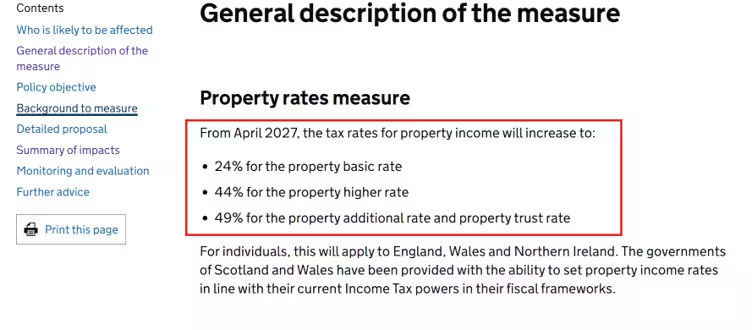
HMRC confirms that property income tax rates will increase to 24%, 44% and 49% from April 2027.
How Much Extra Tax Could a Landlord Pay?
We examined three simplified rental profit scenarios to illustrate the potential financial impact of the new rates.
| Annual taxable rental profit | Tax at current rate | Tax at new rate | Additional annual tax |
| £10,000 at basic rate | £2,000 | £2,400 | £400 |
| £15,000 at higher rate | £6,000 | £6,600 | £600 |
| £25,000 at additional rate | £11,250 | £12,250 | £1,000 |
These examples assume that all the stated profit falls within the specified tax band, with no personal allowance applied to that profit. They illustrate the full four-percentage-point increase against current rates.
A landlord generating £15,000 in taxable annual rental profit, entirely within the higher-rate band, could therefore pay approximately £600 more in annual property income tax from April 2027 than under current rates.
The change is particularly relevant for landlords with substantial mortgage commitments because taxation applies to the calculated property profit, subject to the existing rules for allowable expenditure and finance-cost relief.
Residential mortgage interest does not generally operate as an unrestricted deduction for individual landlords, which can make the relationship between taxable profit and actual cash flow more complicated.
We believe the important financial distinction is between a property’s accounting profit and the cash remaining after mortgage repayments, repairs, insurance, compliance costs and tax.
A rental property can continue generating positive taxable profits while delivering a considerably smaller cash surplus to its owner.
How Many Landlords Could Be Affected by Healey’s Property Tax Changes?
The government’s published impact assessment provides a clearer picture of the scale of the measure.
HMRC estimates that approximately 5% of taxpayers will experience an average £225 annual tax increase in 2027–28 as a result of the additional property tax rise announced in the 2026 Budget.
By the 2031–32 tax year, approximately 2.4 million landlords, representing around 5% of taxpayers, are expected to be affected by the latest property rate measure.
The financial implications differ significantly across landlords.
Someone receiving a relatively small rental income alongside employment earnings may experience a modest increase, while investors with several properties and substantial taxable profits could face considerably higher additional liabilities.
The Treasury also estimates that the new property income tax measure will raise the following amounts:
| Financial year | Estimated additional government revenue |
| 2027–28 | £35 million |
| 2028–29 | £575 million |
| 2029–30 | £435 million |
| 2030–31 | £445 million |
| 2031–32 | £455 million |
These figures relate to the additional two-percentage-point measure announced in 2026, rather than the combined revenue from both Budgets.
The government expects 84% of income tax payers to be unaffected by the combined property and savings income rate changes.
That distinction matters because the wider debate about a property tax raid can sometimes suggest that all homeowners or income tax payers will receive the same increase.
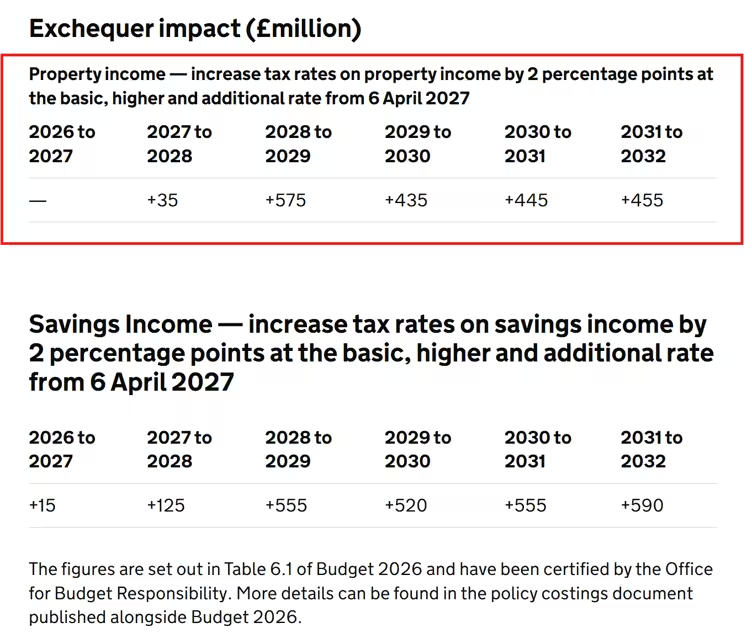
HMRC forecasts how much additional property income tax the October 2026 Budget measure will raise between 2027–28 and 2031–32.
Why Are Landlords Concerned About the Budget Property Tax Raid?
Property professionals have warned that successive tax increases could reduce the attractiveness of residential investment, particularly for smaller landlords holding properties in their personal names.
The underlying concern is not simply the higher headline tax percentage.
It is the cumulative effect of increased taxation, mortgage costs, property maintenance, compliance obligations and uncertainty over future returns.
Timothy Douglas, Head of Policy and Campaigns at Propertymark, described the new increase as a “further disincentive to potential landlords from entering the market”.
His published response also warned that existing landlords could be negatively affected and that reduced investment may ultimately place pressure on tenants.
This concern is supported by the Office for Budget Responsibility, which examined the potential impact of both property income tax increases in its October 2026 economic forecast.
The OBR described the combined measures as a material reduction in returns to private landlords and warned that they risk creating a sustained increase in rents.
The watchdog identified two possible mechanisms.
First, higher taxes may discourage prospective landlords from purchasing rental properties, limiting the long-term supply of homes available to rent.
Second, landlords who remain in the market may gain more flexibility to raise rents if competition between rental providers weakens.
Ben Beadle, chief executive of the National Residential Landlords Association, criticised the announcement, stating:
“The Chancellor has today made life harder for renters right across the country.”
His comments reflect the industry’s argument that increasing costs for property owners can eventually influence rental prices.
However, that outcome should not be interpreted as an automatic or immediate rent increase for every tenant.
Actual rental changes will continue to depend on local supply and demand, tenants’ affordability, contractual arrangements and applicable rental legislation.
Will John Healey’s Budget Property Tax Changes Push Up Rents in London?
London’s private rental market may be particularly sensitive to changes in property investment returns because purchase prices, financing requirements and operating expenses are already substantial.
Landlords with highly leveraged properties could experience pressure on their after-tax income when the new rates begin in April 2027.
For example, a landlord receiving £2,000 per month in rent might initially appear to generate £24,000 in annual rental income.
However, the property’s actual financial performance depends on mortgage interest, management fees, repairs, insurance, service charges and other relevant costs.
Higher tax rates can reduce the remaining return even when the monthly rent stays unchanged.
Our financial analysis suggests that three factors will determine how landlords respond: the property’s current profitability, the owner’s ability to absorb additional taxation and whether market conditions allow a rent increase.
Some landlords may accept smaller profits to preserve stable tenancies. Others may reconsider investment plans, refinance their properties or sell underperforming assets.
There are already wider concerns about property investment profitability, with analysis of UK landlord property sales losses highlighting the financial pressure some investors face when selling properties.
For tenants, the consequences are potentially significant.
A sustained reduction in available rental homes could increase competition for properties, particularly in London boroughs where affordable housing supply remains limited.
Households already calculating how much rent they can afford may find that even relatively small monthly increases affect their budgets.
The Budget also leaves Local Housing Allowance rates frozen for 2027–28, creating additional challenges for eligible lower-income renters when private market rents exceed housing support.
The important point is that a higher landlord tax does not legally require landlords to increase rent, but it may influence investment decisions and rental market conditions over time.
Has John Healey Introduced a New Mansion Tax on Expensive Homes?
Separate from the property income tax increase, the government has confirmed further details of the High Value Council Tax Surcharge, which will apply to qualifying residential properties in England from April 2028.
The policy was initially announced in the 2025 Budget, meaning it is not an entirely new tax created by Healey in October 2026.
However, his Budget has confirmed important implementation arrangements, including deferrals, discounts, exemptions and increased charges on certain long-term empty properties.
The tax will apply to residential properties worth £2 million or more, assessed using the relevant April 2026 valuation basis.
Ahead of the Budget, there had been speculation that the government could reduce the threshold to £1.5 million, potentially bringing more properties into the tax system.
The confirmed arrangements retain the £2 million starting threshold.
How Much Will the Mansion Tax Cost?
| Property valuation | Annual surcharge |
| £2 million to below £2.5 million | £2,500 |
| £2.5 million to below £3.5 million | £3,500 |
| £3.5 million to below £5 million | £5,000 |
| £5 million and above | £7,500 |
These charges will apply in addition to existing council tax bills.
The surcharge will generally be payable by the property owner rather than the occupier, distinguishing it from the usual structure of council tax liability.
The government estimates that fewer than 1% of residential properties in England will fall within the measure.
Annual revenue is expected to reach approximately £400 million from 2028–29.
The October Budget also confirms a deferral scheme for qualifying homeowners who may struggle to pay, alongside discounts and exemptions.
A 100% premium will apply to properties left substantially unfurnished and unoccupied for at least 12 months, subject to the detailed rules.
The latest arrangements are set out in the government’s official High Value Council Tax Surcharge guidance.
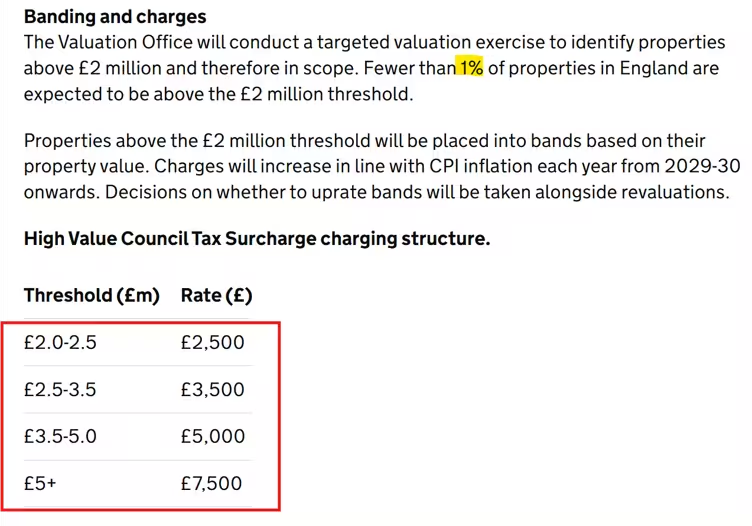
The government’s confirmed High Value Council Tax Surcharge bands show annual charges ranging from £2,500 to £7,500.
Why Does the Mansion Tax Matter for London Homeowners?
Although the policy applies across England, its impact is expected to be concentrated in locations with relatively expensive housing.
London contains substantial numbers of properties above the £2 million threshold, including homes occupied by long-term owners who may have experienced significant increases in property values.
Some households may therefore own valuable properties without generating particularly high annual incomes.
The proposed deferral arrangements are designed to address certain affordability problems, but homeowners will still need to understand the eligibility conditions and potential future liabilities.
Property taxation also influences confidence in the wider housing market.
Recent concerns about falling stamp duty receipts and weaker luxury property transactions demonstrate how changes affecting expensive homes can become part of a larger debate about market activity and government revenue.
The surcharge may influence some owners’ decisions about retaining, selling or transferring expensive properties, although the actual market response cannot yet be measured.
Will Property Tax Changes Affect First-Time Buyers and Homeowners?
The higher property income tax rates are primarily directed at taxable property income rather than people who simply own and occupy their main home.
An ordinary homeowner who does not receive taxable rental profits will not automatically become liable for the new property income tax rates.
However, homeowners with qualifying rental activities, including some arrangements involving letting part of a property, may need to consider how existing allowances and reliefs interact with the new rules.
The Budget also includes measures intended to support first-time buyers.
The government’s new Your First Home scheme is expected to provide eligible buyers of qualifying new-build properties with a 20% equity loan.
The scheme will include an initial five-year interest-free period, with a minimum deposit requirement of 2.5%.
Household income limits are expected to be £140,000 in London and £110,000 outside London, with property price caps that differ between inner London, outer London and other areas.
Pre-registration is scheduled for late December 2026, with applications from February 2027 and the first loans from April 2027.
The new programme could improve access to ownership for some households, although its effect on overall property availability will depend on housebuilding activity and the scheme’s practical implementation.
The Budget therefore presents a mixed picture for the housing sector: higher taxation for certain property investors alongside additional financial support for qualifying first-time buyers.
Could the Property Tax Raid Encourage Landlords to Sell Their Properties?
A potential reduction in rental property investment is one of the most significant longer-term risks identified in the current Budget debate.
For investors holding several properties, the additional tax may lead to a reassessment of individual asset performance.
Properties with low yields, high mortgage costs or substantial maintenance requirements could become less financially attractive after April 2027.
Nevertheless, selling is not automatically the best option.
A property disposal can create capital gains tax liabilities, estate agency fees and other transaction costs.
Landlords may also lose future rental income and potential capital appreciation.
Similarly, transferring property into a limited company is not a straightforward solution to the higher individual property income tax rates.
Companies are subject to corporation tax rules rather than the new personal property income tax bands, but transferring an existing property may create stamp duty and capital gains tax consequences.
There may also be refinancing costs and different tax implications when company profits are withdrawn.
For individuals considering entering the rental market, understanding the practical responsibilities of renting out a house in the UK is increasingly important alongside assessing future taxation.
Our assessment is that landlords should evaluate their total investment return rather than make decisions based solely on the headline tax rate.
The real financial questions concern future rental demand, maintenance expenditure, financing arrangements, tax liabilities and the opportunity cost of retaining a particular property.
What Does the Property Tax Increase Mean for the UK Economy?
The Chancellor has presented the latest tax measures as part of a wider package intended to maintain fiscal discipline and fund support for households and businesses.
In this context, taxing investment income more heavily allows the government to raise additional revenue without increasing the main income tax rates on employment earnings.
However, the policy creates an economic trade-off.
Higher property taxation raises revenue from existing profitable landlords, but it may also influence future investment decisions.
If fewer investors enter the private rental sector, rental housing supply could grow more slowly than demand.
This would be particularly concerning in areas where population growth, employment opportunities and existing housing shortages are already placing pressure on accommodation.
On the other hand, supporters of higher property taxation argue that income earned from assets should not necessarily receive more favourable treatment than employment income.
The government also maintains that the changes are progressive, with higher-income households contributing a substantial share of the additional revenue.
Around half of the revenue raised from the combined increases in property and savings income taxation is expected to come from the highest-income 10% of households.
For business owners and entrepreneurs, the central question is whether the additional revenue and household support will outweigh any reduction in property investment incentives.
This cannot be established from the tax announcement alone.
It will depend on how investors, tenants, housebuilders and financial markets respond over the coming years.
What Should Landlords and Property Investors Do Before April 2027?
The new rates are scheduled to take effect on 6 April 2027, giving property owners time to evaluate their finances before the next tax year.
Our analysis suggests that investors should concentrate on several practical financial considerations.
- Review expected rental profits for 2027–28 using the confirmed tax rates.
- Calculate cash flow after financing costs, maintenance and other expenses.
- Identify whether rental profits could move into a higher tax band.
- Consider the implications of retaining or selling properties.
- Review existing rental agreements and legal restrictions before contemplating rent changes.
- Seek qualified tax advice before restructuring ownership or transferring property into a company.
Landlords should also distinguish between the measures already announced and possible future reforms.
The October Budget confirms the new property income tax rates, but it does not mean every previously reported proposal to reform stamp duty, capital gains tax or property ownership taxation has been implemented.
Property investors should make decisions using confirmed rules and current financial projections rather than speculative headlines.
Conclusion
John Healey’s October 2026 Budget marks another significant increase in the taxation of UK rental property income, with new rates of 24%, 44% and 49% scheduled from April 2027.
The additional rise could affect millions of landlords, while the £2 million High Value Council Tax Surcharge remains on course for April 2028.
Although the Treasury expects the measures to raise additional revenue and support its fiscal objectives, property professionals and the OBR have highlighted potential consequences for rental investment and tenant affordability.
For landlords, the immediate priority is understanding the financial effect of the new rates. For renters and homeowners, the longer-term issue is whether the changes influence housing availability, rents and property market confidence.
Frequently Asked Questions
Is John Healey increasing property tax in the 2026 Budget?
Yes. Healey announced an additional two-percentage-point increase in property income tax, bringing the total rise to four percentage points from current rates when the changes take effect in April 2027.
What will the new landlord property income tax rates be?
From 6 April 2027, the announced rates are 24% for basic-rate, 44% for higher-rate and 49% for additional-rate property income in England, Wales and Northern Ireland.
Will every homeowner pay the new property tax?
No. The new property income tax rates concern taxable income from property, while the separate high-value council tax surcharge applies to qualifying English homes worth £2 million or more.
Has the mansion tax threshold been reduced to £1.5 million?
No. Despite earlier speculation, the confirmed High Value Council Tax Surcharge threshold remains £2 million, with charges beginning in April 2028.
Will landlords increase rents because of the Budget?
Some landlords may seek higher rents or reduce investment, but increases are not automatic. Local market conditions and tenancy rules will determine what changes are possible.
Does the new property tax apply in Scotland?
The announced 24%, 44% and 49% individual property income rates apply to England, Wales and Northern Ireland. Scottish property income taxation is subject to devolved tax-setting arrangements.
When will the new property tax changes take effect?
The higher property income tax rates are scheduled for 6 April 2027. The separate High Value Council Tax Surcharge is due to begin in April 2028.
Adam is a London business and news writer at London Insider News, covering local developments, finance, entrepreneurship and the stories shaping businesses and communities across the capital.
More from PROPERTY

Right to Rent Share Code 2027: How to Get, Generate and Check Your Code Online?
Updated: 4 November 2026 | 2027 Guide A Right to Rent share code is a nine-character…

Nationwide UK Property Price Drop: Will House Prices Fall Further in 2027? Latest 2026 Figures and Forecasts
The Nationwide UK property price drop has become an increasingly important issue for homeowners, first-time buyers,…

UK Landlord Property Sales Losses Jump 32% to £1.15bn as London Flats Face Growing Pressure
UK landlord property sales losses have surged by 32% to £1.15 billion, according to newly published…