UK Landlord Property Sales Losses Jump 32% to £1.15bn as London Flats Face Growing Pressure
 Adam
London Business & News Writer

UK landlord property sales losses have surged by 32% to £1.15 billion, according to newly published research based on HM Revenue & Customs data, raising fresh concerns about the financial sustainability of Britain’s buy-to-let property market.
The figures, obtained by Bowmore Wealth Group through a Freedom of Information request and released on 27 October 2026, show that realised losses on residential property investment disposals increased from £870 million in 2023–24 to £1.15 billion in 2024–25.
The findings arrive at a particularly difficult time for property investors in London, where house prices have weakened, flats have underperformed, and landlords are reconsidering whether rental income adequately compensates them for borrowing costs, taxation and property management responsibilities.
According to the latest official housing statistics, average London property prices declined by 2.2% in the year to August 2026, while London flats and maisonettes experienced a sharper annual fall of 5%.
Our analysis of HMRC-linked research, official housing market statistics and published commentary from property finance professionals suggests the financial pressures are not limited to landlords struggling with mortgages.
Investors holding leasehold flats, owners facing expensive refurbishment requirements and smaller landlords with limited financial reserves may also face difficult selling decisions.
However, the £1.15 billion figure requires careful interpretation. It represents reported losses on investment property disposals during 2024–25, not the overall net loss of Britain’s entire landlord sector.
The data does not subtract profitable sales by other investors and does not measure losses on properties that remain unsold.
The latest research therefore raises a broader financial question: is London’s buy-to-let market still delivering sufficient returns to justify its increasing costs and risks?
UK Landlord Property Sales Losses: What the £1.15 Billion Figures Reveal
Bowmore Wealth Group’s research identifies a substantial rise in losses crystallised when residential investment properties were sold.
A crystallised loss occurs when an investor completes a sale and records a loss for tax purposes. This differs from a paper loss, where the estimated market value of a property falls but the owner continues holding it.
The distinction matters because a landlord whose property has declined from £450,000 to £400,000 has not necessarily realised a £50,000 capital loss. That loss becomes relevant to the sale calculation only when the property is disposed of, subject to the applicable tax rules and allowable costs.
Key UK Landlord Loss Figures
| Financial indicator | Reported figure |
| Realised residential investment disposal losses, 2023–24 | £870 million |
| Realised residential investment disposal losses, 2024–25 | £1.15 billion |
| Year-on-year increase | 32% |
| Increase in reported losses | Approximately £280 million |
| London annual house price change, August 2026 | -2.2% |
| London annual flat price change, August 2026 | -5.0% |
| UK annual house price change, August 2026 | +0.9% |
The contrast between national house price growth and London’s declining property values is particularly significant.
While UK housing prices have recorded modest annual growth, that national average conceals substantial differences between property types, locations and investment strategies.
For landlords who purchased expensive flats during periods of stronger London market activity, a fall in selling prices can eliminate years of expected capital appreciation.
David Floyd, Head of Private Clients at Bowmore Financial Planning, highlighted the changing investment environment.
“BTL investors are looking at the growth in global stock markets and the high yields on UK Government bonds”
He noted that investors are questioning whether buy-to-let remains attractive when rental returns are relatively low compared with alternative investments.
This highlights an important shift in investor behaviour. Rather than evaluating rental property exclusively through expected capital appreciation, landlords increasingly need to assess the return available after mortgage interest, taxation, maintenance, void periods and administration.
Our financial assessment is that low rental yields become especially problematic when an investor’s expected capital appreciation fails to materialise.
Why London Landlords Are Among the Most Exposed?
London remains one of Britain’s most expensive residential property markets, making the financial consequences of falling values particularly significant.
The latest HM Land Registry House Price Index for August 2026 places the average London property price at approximately £554,000.
London flats averaged around £427,000, down from approximately £450,000 in August 2025.
That represents an annual reduction of roughly £23,000 in the average recorded flat price, although this is a market-wide comparison rather than the calculated loss on an individual property.
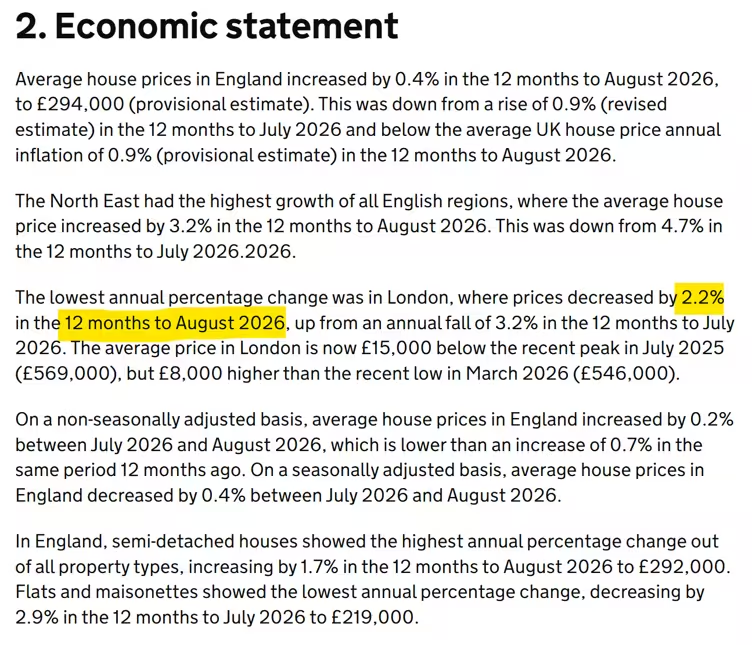
HM Land Registry’s August 2026 House Price Index shows that average London property prices fell 2.2% annually, with flats and maisonettes recording a steeper 5% decline.
Separate research from e.surv Chartered Surveyors, published in October 2026, found that almost four in ten London flats resold after being held for five to ten years changed hands below their previous recorded purchase prices.
This was the highest proportion among the geographical areas examined in the research.
For comparison, approximately one-third of similarly held flats in the South East and East of England sold below their previous prices, while the proportion was closer to one in five across the Midlands and northern England.
Importantly, e.surv’s findings concern resold flats generally and are not restricted to buy-to-let properties. Nevertheless, the results are highly relevant to landlords because flats account for a substantial proportion of London’s residential investment stock.
Aneisha Beveridge, Head of Research at Hamptons, previously described the changing London market:
“In London, upward house price growth is no longer the one-way bet it once seemed.”
The observation captures an important change in the financial expectations of investors who purchased London residential property during periods of strong appreciation.
Our examination of the available evidence identifies several factors placing pressure on flat valuations.
- Leasehold costs: Higher service charges, building insurance expenses and major works bills can reduce the attractiveness of apartments to prospective purchasers.
- Building safety concerns: Some developments face additional documentation, remediation and lending requirements that complicate property sales.
- Mortgage affordability: Investors and owner-occupiers may be unwilling or unable to pay previous asking prices when borrowing remains relatively expensive.
- Weaker capital appreciation: Buyers who previously justified expensive purchases through expected future price growth may now place greater emphasis on rental yield and ongoing expenditure.
These pressures do not affect every borough or property equally. Individual buildings, lease terms, maintenance obligations and local demand remain central to valuations.
London Property Market Performance Varies by Area
The official August 2026 House Price Index highlights considerable differences between London boroughs.
| London area | Annual average house price change |
| Camden | -10.6% |
| Westminster | -14.3% |
| Barnet | -4.4% |
| Croydon | -1.5% |
| Bexley | +1.9% |
| Barking and Dagenham | +4.7% |
These are annual changes in average transaction-based prices, not the percentages of landlords selling at a loss. Local results can also be volatile where transaction volumes are limited or the mix of properties sold changes.
Nevertheless, they illustrate why property investors should not treat London as one uniform market.
Why Are UK Landlords Selling Properties at a Loss?
Our review of the latest landlord-sector research suggests that selling decisions are increasingly influenced by several overlapping financial pressures rather than a single market event.
Higher Mortgage Costs Are Reducing Net Rental Income
Mortgage financing remains one of the most important determinants of buy-to-let profitability.
Landlords who originally secured comparatively low fixed mortgage rates may face higher monthly repayments or interest costs when refinancing.
For example, interest on a £280,000 interest-only mortgage would cost:
- £5,600 annually at 2%.
- £11,200 annually at 4%.
- £14,000 annually at 5%.
- £16,800 annually at 6%.
These are illustrative calculations, not quotations for currently available mortgage products.
A landlord moving from a 2% mortgage rate to 5% would face an additional £8,400 in annual interest costs on the same outstanding mortgage balance.
That increase could absorb much of the rental income previously available for maintenance, savings or profit.
The effect can be especially pronounced in London, where higher acquisition prices often require substantial borrowing.
Property Management Costs Are Becoming More Significant
Landlords must also account for costs that are frequently overlooked when gross rental yields are advertised.
These may include letting-agent fees, licensing, insurance, repairs, compliance inspections, service charges, ground rent where applicable, and periods without rental income.
Investors considering renting out a house in the UK need to assess these expenses before deciding whether a property represents an attractive long-term investment.
A rental property producing £24,000 annually does not automatically generate £24,000 in profit.
The actual return depends on operating expenditure, financing and the landlord’s tax position.
This is particularly important for smaller investors who rely on rental income to supplement employment earnings or fund retirement.
The Renters’ Rights Act Has Changed Investment Decisions
The Renters’ Rights Act 2025 introduced substantial changes to England’s private rented sector, with the principal tenancy reforms taking effect on 1 May 2026.
These included the abolition of Section 21 no-fault evictions, the introduction of assured periodic tenancies and revised procedures governing possession and rent increases.
The legislation does not mean landlords can never recover possession of their properties. There are specified legal grounds, including circumstances involving an intended sale, although landlords must satisfy the applicable conditions and notice requirements.
For landlords assessing future rental income, the ability to adjust rents remains an important consideration.
Understanding how much a landlord can increase rent in London is therefore directly relevant to financial forecasting.
David Floyd has also suggested that the Renters’ Rights Act may have encouraged some investors to sell despite the prospect of taking a loss.
However, one important distinction must be maintained: the legislation’s May 2026 implementation cannot explain losses already realised in the 2024–25 tax year.
Instead, the Act is relevant to current and future disposal decisions, alongside other financial pressures.
Property Tax Changes Are Influencing Investor Confidence
Taxation has become another important consideration for individual landlords.
Under the property income tax changes scheduled to take effect from April 2027, the rates applying to relevant property income in England will be:
| Property income tax band | Rate from April 2027 |
| Basic rate | 22% |
| Higher rate | 42% |
| Additional rate | 47% |
These rates also apply within the relevant framework for Wales and Northern Ireland. Scotland’s property income arrangements involve separate devolved considerations.
Individual residential landlords must also account for restrictions on mortgage interest relief. The treatment of finance costs can cause a landlord’s taxable property income to differ significantly from their cash profit after mortgage interest.
From April 2027, finance cost relief is intended to operate at the new 22% property basic rate for those within the relevant regime.
The tax position of a landlord operating through a limited company differs from that of an individual holding property personally, so the impact should not be treated as identical.
For investors already facing modest yields, even relatively small changes in effective taxation may influence whether they retain, refinance or dispose of a property.
How Much Could a London Landlord Actually Lose?
To understand the financial pressure behind the headline figures, we modelled an illustrative London buy-to-let flat purchased for £400,000.
The scenario assumes monthly rent of £1,850, an interest-only mortgage balance of £280,000 and a 5% annual mortgage interest rate.
Example: Annual Buy-to-Let Cash Flow
| Income or expenditure | Annual amount |
| Rental income | £22,200 |
| Mortgage interest | -£14,000 |
| Service charges | -£3,600 |
| Letting and management | -£2,220 |
| Maintenance | -£1,400 |
| Insurance and compliance | -£800 |
| Allowance for rental voids | -£1,100 |
| Estimated annual cash position | -£920 |
Illustrative figures only. The void allowance is a financial provision rather than necessarily an immediately deductible tax expense. Actual tax liabilities, capital repayments, exceptional expenditure and individual property circumstances are excluded.
The property has an advertised gross rental yield of approximately 5.55%, calculated by dividing annual rental income by its purchase price.
Despite that apparently reasonable headline yield, the model produces a negative annual cash position before income tax.
This demonstrates why gross yield alone is insufficient when evaluating residential property investment.
If the landlord subsequently sells the property for £365,000, compared with an original purchase price of £400,000, the simple purchase-to-sale price difference would be £35,000, equivalent to an 8.75% decline.
Estate-agent fees, legal costs and the original acquisition expenditure would further affect the investor’s overall financial outcome.
Mortgage repayments of principal, if any, and rental profits or losses accumulated over the holding period would also influence the investor’s lifetime return.
Importantly, the commercial investment loss and the loss recognised for Capital Gains Tax purposes are not necessarily the same amount.
That distinction is particularly relevant to landlords planning an exit.
Are Landlords Leaving the UK Buy-to-Let Market?
Recent transaction and sentiment research provides evidence that landlords are restructuring their property portfolios.
According to analysis from TwentyCi’s property data operation, approximately 44,000 properties exited the private rented sector between early July and mid-September 2026.
The figures indicated an average exit rate of approximately 562 properties per day during the period, compared with 495 per day a year earlier.
This points to increasing disposal activity, although individual transactions may involve landlords selling to other investors, owner-occupiers or buyers with different intentions for the property.
Property118’s third-quarter 2026 landlord sentiment survey also found that 40.4% of respondents expected to sell one or more properties over the following three years, while another 25.2% intended to leave the sector completely.
Those figures are useful indicators of sentiment among respondents, but they should not be interpreted as nationally representative forecasts of landlord behaviour.
The latest evidence also points to a more nuanced position than a universal collapse in buy-to-let profitability.
Research from Pegasus Insight and Foundation reported in August 2026 found that 86% of surveyed landlords said they were making a profit from their lettings activity, while 5% reported operating at a loss.
That profitability measure concerns rental operations, rather than whether the property could be sold above its original purchase price.
The findings suggest that property market weakness and landlord profitability can coexist.
A debt-free landlord may continue receiving positive rental income even when the market value of the property falls.
Conversely, a heavily mortgaged landlord may experience negative cash flow even when the property has retained its purchase value.
This distinction is essential when assessing the health of the wider rental market.
Is Selling a Buy-to-Let Property Still Financially Sensible?
A decision to sell should be assessed against the financial consequences of retaining the property.
For an investor experiencing persistent negative cash flow, holding an asset simply to avoid recognising a capital loss may create additional expenditure.
However, selling immediately can also be expensive if the property is temporarily undervalued, an early repayment charge applies, or substantial transaction costs would be incurred.
Our analysis suggests that landlords should assess five financial considerations before deciding.
- First, calculate the true net rental return: Gross rent should be adjusted for financing, management, tax, maintenance, insurance and realistic vacancy assumptions.
- Second, assess the property’s market value using completed comparable sales: Asking prices alone do not establish the amount a buyer is prepared to pay.
- Third, examine mortgage refinancing options: A different financing structure may improve monthly cash flow, although extending borrowing or switching products can increase long-term costs.
- Fourth, consider transaction costs and tax: A property sold at a lower price may still produce an unexpected tax calculation depending on its ownership history and allowable expenditure.
- Finally, compare the expected risk-adjusted return with alternative uses of capital: Investment decisions should consider liquidity, volatility, diversification and the owner’s financial objectives, rather than only the headline yield available elsewhere.
A further complication is that landlords selling to other property investors may encounter aggressive negotiations.
Hamptons analysis of July 2026 transactions found that investors paid an average of 88.7% of the original asking price, while 56% of investor offers were at least 10% below asking.
These findings underline the importance of realistic valuation and understanding the buyer market.
For landlords who purchased fully refurbished or turnkey property investments, the original premium paid for convenience and immediate rental readiness may not be recoverable at resale.
Our Editorial Property Investment Risk Assessment
The following ratings are our qualitative assessment of exposure to current market pressures. They are not statistical probabilities of losing money, and they are not derived from an investor survey.
| Investment situation | Indicative risk rating | Assessment |
| Highly leveraged London leasehold flat | 85% | Very high exposure |
| Buy-to-let property requiring major repairs | 80% | High exposure |
| London flat with substantial service charges but no mortgage | 60% | Moderate exposure |
| Low-leverage rental house with stable occupancy | 45% | Lower relative exposure |
Our assessment considers four broad factors: financing sensitivity, property valuation risk, recurring ownership costs and potential difficulty selling.
These ratings are intended as an editorial comparison of investor risk profiles rather than a substitute for professional valuation or financial advice.
What Happens to Tenants When Landlords Sell?
An increase in landlord property sales also raises questions about rental availability and the security of existing tenancies.
A property being sold does not automatically terminate the tenancy of someone living in it.
Some landlords sell with tenants remaining in occupation, allowing another investor to acquire the property and continue receiving rental income.
Where a landlord seeks possession to sell a property with vacant possession, the applicable legal procedures must be followed.
In England, the post-May 2026 possession framework includes Ground 1A for landlords intending to sell, subject to conditions including restrictions during the first 12 months of a new tenancy and a four-month notice requirement.
For tenants, the practical consequences depend on whether the purchaser intends to continue letting the property and whether a lawful possession process has been completed.
The broader relationship between landlord exits and rental supply is also complicated.
When an investment property is sold to an owner-occupier, it generally ceases to be available for private renting.
When sold to another landlord, it may remain part of the rental stock.
Meanwhile, institutional build-to-rent developments may introduce additional rental properties even as individual landlords leave the market.
These distinctions matter in London, where rental demand remains substantial.
Official September 2026 rental statistics recorded average private rent of approximately £2,338 per month across London, an annual increase of 3.5%.
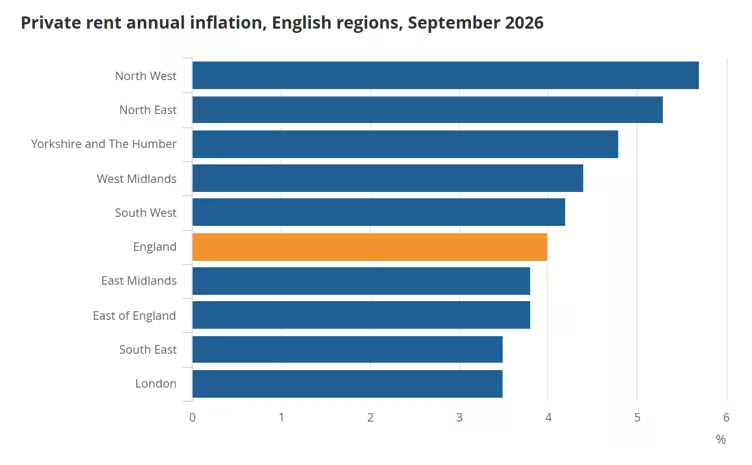
Office for National Statistics data released in October 2026 shows average London private rents reached £2,338 in September, with annual rental inflation of 3.5%.
Although London’s rental inflation was among the lowest regional rates in England, its average monthly rent remained the country’s highest.
This shows that weakening property sale prices do not necessarily translate into falling rents for tenants.
An investor may be struggling to achieve a profitable return while renters continue facing considerable affordability pressures.
Can Landlords Claim Tax Relief on Property Sales Losses?
Landlords disposing of investment property should distinguish between a commercial loss and an allowable capital loss for tax purposes.
Under HMRC’s Capital Gains Tax framework, allowable losses from disposing of chargeable assets can generally be used to reduce chargeable capital gains, subject to the relevant rules.
An allowable capital loss is not automatically deductible from ordinary rental income or employment earnings.
Losses reported for a tax year normally offset relevant gains for that year, while unused eligible losses may be carried forward under the applicable conditions.
HMRC generally allows taxpayers to claim qualifying capital losses within four years after the end of the tax year in which the disposal took place.
For the 2026–27 tax year, the individual Capital Gains Tax annual exempt amount is £3,000. Standard individual rates are 18% and 24%, depending on the taxpayer’s circumstances.
A UK residential property disposal resulting in a taxable gain generally requires reporting and payment within 60 days of completion. The reporting rules for a loss-only disposal differ, including where a person is non-UK resident.
Landlords should therefore assess both their sale proceeds and their historical acquisition and improvement expenditure before finalising a tax return.
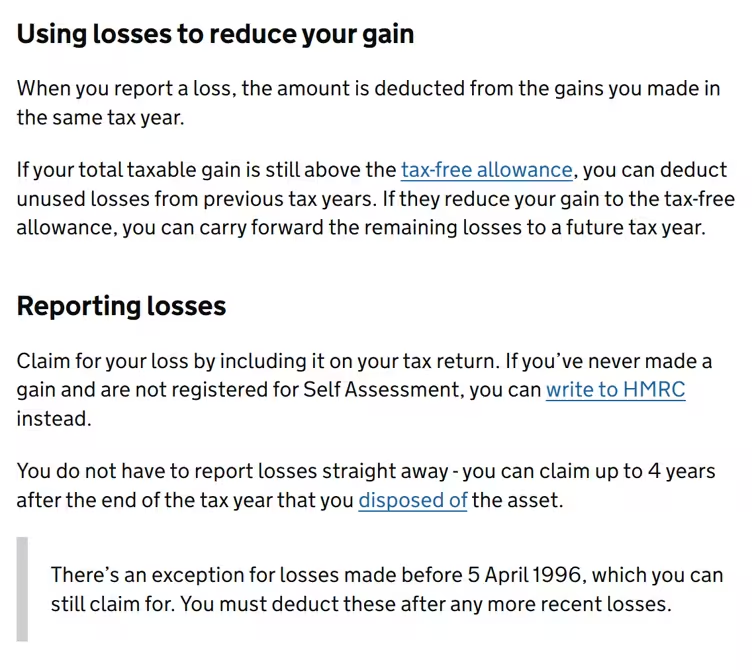
HMRC guidance explains how allowable capital losses can reduce taxable gains and outlines the four-year period for claiming eligible losses.
The distinction becomes especially important for investors who previously received substantial rental profits but are now considering selling below the original purchase price.
Capital Gains Tax relief cannot necessarily recover the broader economic cost of years of mortgage interest, poor investment performance or the opportunity cost of holding the property.
What Could Happen to the London Buy-to-Let Market in 2027?
The next phase of London’s buy-to-let market will depend on borrowing costs, rental demand, house price movements, tax policy and the willingness of investors to supply rental housing.
The planned increase in individual property income tax rates from April 2027 will be an additional consideration for landlords evaluating their expected returns.
Property investment may remain viable in locations where rental demand is resilient, operating costs are manageable and acquisition prices support an attractive net yield.
However, landlords holding expensive flats with significant borrowing and rising leasehold expenditure may face continuing pressure.
The weakness in the wider London sales market is also affecting property transaction economics beyond buy-to-let.
Recent research into London luxury property sales and stamp duty receipts illustrates how changes in transaction activity and purchasing costs can influence investor behaviour and government tax revenues.
For property entrepreneurs, the critical issue is increasingly the sustainability of cash flow.
A rental investment that appears profitable before financing and tax may produce disappointing returns once all financial obligations are included.
Conversely, a long-held, low-debt property with reliable occupancy and manageable maintenance costs may remain attractive despite weaker short-term valuations.
Our assessment is that the market is undergoing a period of investment reassessment rather than a uniform withdrawal of all private landlords.
The latest £1.15 billion realised-loss figure is a significant warning about the consequences of buying expensive property, relying heavily on capital appreciation and underestimating long-term ownership costs.
But it does not establish that every landlord is making a loss or that selling is necessarily the best financial decision.
Final Assessment
The latest figures on UK landlord property sales losses reveal a significant challenge for residential property investors, with reported crystallised losses increasing 32% to £1.15 billion in the 2024–25 tax year.
London’s property market presents particular concerns, as falling flat valuations and high ownership costs create difficult decisions for investors who originally expected strong capital growth.
Our review of official statistics, market research and professional financial commentary indicates that the greatest vulnerability lies where high borrowing costs, expensive property maintenance and weak resale performance coincide.
Nevertheless, profitable rental businesses continue operating throughout the country, and not every landlord sale represents a distressed transaction.
The defining question for 2027 is likely to be whether private rental property can continue delivering sufficiently attractive after-tax returns to compensate investors for its financial commitments and regulatory responsibilities.
For landlords, the figures reinforce a fundamental investment principle: property ownership should be evaluated on actual cash flow, capital risk and long-term returns—not simply on the expectation that house prices will always rise.
Frequently Asked Questions
Why are UK landlords selling properties at a loss?
Higher mortgage costs, falling valuations in some markets, property maintenance expenses, taxation and changing investor expectations are among the main pressures influencing selling decisions.
How much did UK landlords lose on property sales?
HMRC-linked research released in October 2026 identified £1.15 billion in reported realised losses on residential investment property disposals during the 2024–25 tax year, up 32% from £870 million.
Are London landlords losing more money than landlords elsewhere?
London has experienced weaker property price performance, particularly for flats. However, the £1.15 billion research does not provide a complete geographical breakdown proving the total losses suffered by London landlords.
What percentage of London flats are selling at a loss?
e.surv research found that almost 40% of London flats resold after being held for five to ten years changed hands below their previous recorded purchase price in the 12 months to August 2026. The figure includes owners generally, not just landlords.
Can a landlord claim tax relief after selling a property at a loss?
Qualifying capital losses can generally be used against taxable capital gains under HMRC rules. The exact treatment depends on ownership, allowable expenditure and the individual’s tax circumstances.
Will landlords continue selling properties in 2027?
Some may continue reducing their portfolios because of borrowing costs, taxation, maintenance and regulation. However, future sales volumes cannot be reliably predicted from recent losses alone.
Is buy-to-let still worth investing in?
Buy-to-let can remain profitable where acquisition prices, financing and operating costs support sustainable net returns. Investors should evaluate the full financial position rather than relying on gross rental yield or expected capital appreciation.
Adam is a London business and news writer at London Insider News, covering local developments, finance, entrepreneurship and the stories shaping businesses and communities across the capital.
More from PROPERTY

Right to Rent Share Code 2027: How to Get, Generate and Check Your Code Online?
Updated: 4 November 2026 | 2027 Guide A Right to Rent share code is a nine-character…

John Healey Budget Property Tax Raid: Landlords Face Higher Taxes as £2m Mansion Levy Stays
Chancellor John Healey has announced a fresh property tax increase in the October 2026 Budget, with…

Nationwide UK Property Price Drop: Will House Prices Fall Further in 2027? Latest 2026 Figures and Forecasts
The Nationwide UK property price drop has become an increasingly important issue for homeowners, first-time buyers,…