How to Appeal a Parking Ticket in the UK?: Step-by-Step Guide, Costs and Your Rights in 2026
Learn how to appeal a parking ticket in the UK in 2026, including council and private parking appeals, PCN deadlines, required evidence, appeal letters and your legal rights.
 Hannah
London Lifestyle & Consumer Writer
Receiving a parking ticket can be frustrating, particularly when the charge appears unfair or results from a minor misunderstanding.
Whether a driver has parked in a restricted bay, overstayed at a supermarket or received a penalty through the post, understanding how to appeal a parking ticket can prevent unnecessary expenditure.
In the UK, motorists can challenge parking tickets issued by local councils and private parking operators.
However, the appeal procedure depends on the type of ticket, the issuing organisation, the applicable regulations and the evidence available.
In October 2026, the government also announced important changes to private parking enforcement, including stronger protections against unfair charges and clearer requirements for appeals. These reforms are moving through the statutory process and are not yet in force.
Our analysis of official parking enforcement procedures, independent appeal requirements and the financial consequences of missed deadlines highlights one important principle: a parking ticket should be checked carefully before payment, but challenging it does not guarantee cancellation.
For London drivers, commuters, delivery operators and business owners managing several vehicles, knowing the correct procedure can also help control unexpected transport expenditure.
Can You Appeal a Parking Ticket in the UK?
Yes. Motorists have the right to challenge parking tickets they believe have been incorrectly issued.
A successful appeal may result in the ticket being cancelled completely. However, the procedure differs between council-issued penalties and charges from private parking companies.
For example, a driver who receives a Penalty Charge Notice from a London borough generally follows the council’s formal enforcement process. A motorist charged by a private supermarket car park must normally challenge the parking operator first.
The main differences are:
| Parking ticket type | Issuing organisation | Appeal procedure |
| Penalty Charge Notice | Local councils | Informal challenge, formal representation and potentially an independent tribunal |
| Parking Charge Notice | Private parking company | Operator appeal followed by POPLA or IAS, where applicable |
| Fixed Penalty Notice | Police or authorised enforcement body | Procedure stated on the notice, potentially involving a magistrates’ court |
| Excess Charge Notice | Relevant parking authority | Appeal arrangements specified by the issuing authority |
| London road-user charging PCN | Transport for London | Formal representation followed by London Tribunals where eligible |
Although both Penalty Charge Notices and Parking Charge Notices are commonly abbreviated to PCN, they operate under different legal frameworks.
Council parking penalties are statutory civil enforcement charges. Private parking charges usually arise from alleged breaches of contractual parking conditions.
This distinction matters because it determines where the appeal must be submitted, who considers it and what happens if it is rejected.
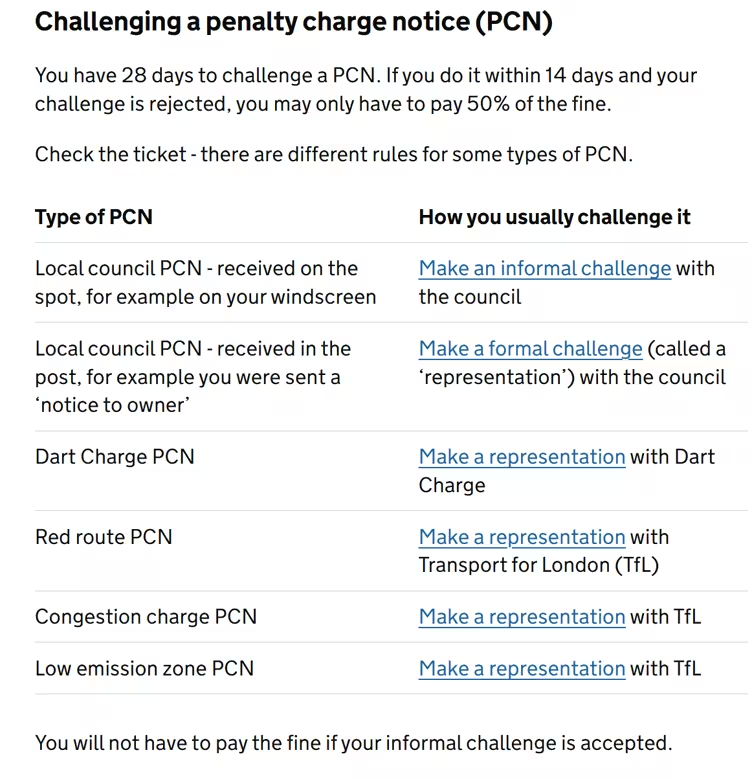
Official government guidance explaining the differences between council parking penalties, private parking charges and the available appeal procedures.
What Are the Valid Reasons to Appeal a Parking Ticket?
A successful challenge generally depends on demonstrating that the parking restriction was not breached, the ticket was issued incorrectly or another recognised ground applies.
The strongest cases normally combine a clear explanation with relevant supporting evidence.
Incorrect or Unclear Parking Signs
Motorists may have grounds for appeal if restrictions were inadequately displayed or signs were misleading.
For instance, a driver might receive a parking ticket after using a bay where temporary restrictions were not communicated clearly.
Photographs showing the position, condition and visibility of the signs can help establish whether the restriction was reasonably identifiable.
Parking Payment Was Already Made
A ticket may be challenged where the driver can demonstrate that payment was made correctly.
Supporting evidence might include a parking app confirmation, payment receipt, transaction history or pay-and-display ticket.
A payment reference can be particularly valuable when the operator’s records do not appear to match the vehicle registration.
Incorrect Vehicle or Ownership Information
A registered keeper may be able to challenge a ticket issued for a vehicle they did not own at the relevant time.
Sales receipts, DVLA records or documentation showing a change of keeper can help establish the circumstances.
A clerical mistake on a ticket is not automatically enough to invalidate it. The significance of the error depends on the applicable rules and whether it affects the validity of the notice.
Vehicle Breakdown or Medical Emergency
Unexpected mechanical failures and medical emergencies can be relevant reasons for requesting cancellation.
A breakdown recovery receipt, garage invoice or suitable medical documentation may support the explanation.
For council penalties, such circumstances may require the issuing authority to exercise discretion rather than establish an automatic legal exemption.
Failure to Follow Enforcement Procedures
Council parking enforcement must comply with statutory requirements.
An appeal may be justified where an authority has failed to follow a required procedure, applied an incorrect charge or made another legally significant enforcement error.
For London council parking cases, procedural impropriety is an expressly recognised ground of appeal.
| Reason for challenge | Useful supporting evidence |
| Unclear signage | Photographs of signs and bay markings |
| Parking already paid | Receipt, app confirmation or bank record |
| Incorrect vehicle ownership | Sales document or DVLA correspondence |
| Vehicle breakdown | Recovery report or garage invoice |
| Medical emergency | Relevant supporting documentation |
| Valid parking entitlement | Permit, ticket or eligibility evidence |
| Incorrect enforcement procedure | Copies of notices and correspondence |
Our assessment is that evidence connected directly to the alleged contravention is more useful than a general statement that the penalty is unfair.
How to Appeal a Council Parking Ticket Step by Step?
A council-issued Penalty Charge Notice generally has several stages.
The process is particularly important for motorists who receive tickets while parking on public roads or in council-controlled car parks.
Step 1: Check the Parking Ticket
Begin by reviewing the information printed on the notice.
Confirm the vehicle registration, location, date, time, contravention code and issuing authority.
If the notice refers to a location where the vehicle was not parked, or the details appear inaccurate, retain a copy and investigate the discrepancy.
Drivers should also establish whether the notice was attached to the windscreen or issued by post because this affects the next appeal stage.
Step 2: Submit an Informal Challenge
For a council parking PCN attached to a vehicle, the first opportunity is usually an informal challenge.
This is submitted directly to the issuing council, often through its online penalty portal.
Although the normal initial challenge window is 28 days, submitting within the first 14 days can be financially beneficial.
Many councils preserve or reoffer the 50% early-payment discount when an informal challenge is submitted within this initial period and subsequently rejected.
However, this should not be assumed without checking the specific authority’s conditions.
An informal challenge should explain why the ticket appears incorrect and include relevant evidence.
If the council accepts the challenge, the penalty is cancelled.
Step 3: Make Formal Representations
Where an informal challenge is rejected and the penalty remains unpaid, the registered keeper may receive a Notice to Owner.
This begins the formal representation stage.
Formal representations must normally be submitted within 28 days of service of the Notice to Owner.
If the original council PCN was issued by post, formal representations can generally be made directly without a preliminary informal challenge.
At this stage, the person liable for the penalty should identify the appropriate legal ground and provide supporting documents.
For parking PCNs under the relevant civil enforcement rules, councils generally have 56 days to respond to formal representations. Failure to respond within that statutory period can result in the representations being treated as accepted.
Step 4: Appeal to an Independent Tribunal
If the council rejects the formal representations, it will send a Notice of Rejection.
The motorist will normally have 28 days from service of that notice to appeal to an independent adjudicator.
The responsible tribunal depends on the location:
- London: London Tribunals.
- England outside London and Wales: Traffic Penalty Tribunal.
Independent adjudicators examine the legal grounds, available evidence and relevant enforcement requirements.
Where an appeal succeeds, the penalty is cancelled. Where it is dismissed, the full penalty will generally remain payable.
The tribunal process is normally free for motorists, although costs may be awarded in exceptional cases involving unreasonable conduct.
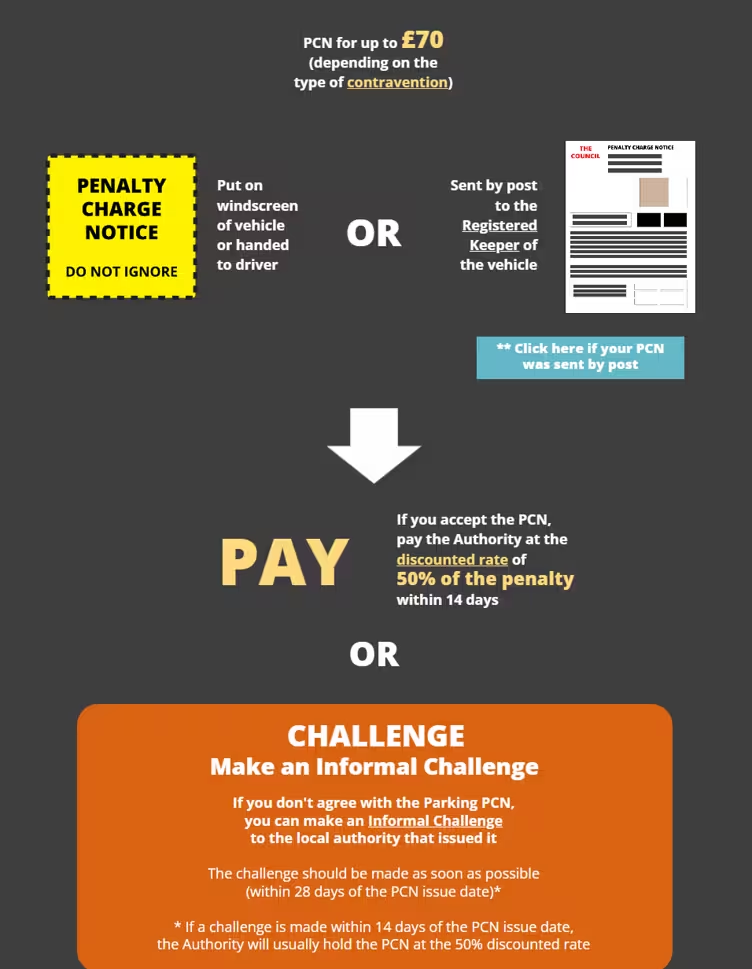
The official Traffic Penalty Tribunal process showing how a parking penalty progresses from an informal challenge to formal representations and independent appeal.
How Long Do You Have to Appeal a Parking Ticket?
Deadlines are among the most important factors when deciding how to challenge a parking penalty.
Submitting an appeal after the permitted period may reduce the options available.
For a typical council parking PCN in England, the main deadlines are:
| Stage | Typical time limit |
| Initial council PCN | 28 days to pay or challenge |
| Early-payment discount | Usually first 14 days |
| Certain postal PCN discounts | 21 days where applicable |
| Formal representation | 28 days after service of the relevant notice |
| Independent tribunal appeal | 28 days after service of the Notice of Rejection |
| Charge Certificate increase | Normally 50% if enforcement reaches that stage |
These periods are not interchangeable.
For example, the 28-day period for formal representations generally begins with service of the Notice to Owner, not the date on which the motorist first received the windscreen ticket.
Similarly, a driver should not assume that submitting a challenge automatically extends every payment deadline.
Keeping copies of submission confirmations and response dates helps establish whether an appeal was made on time.
Does the 10-Minute Grace Period Help You Appeal?
The 10-minute grace period is frequently misunderstood.
For qualifying council-controlled parking places in England, motorists are generally protected from receiving a PCN during the first 10 minutes after an authorised parking period expires.
For example, a driver who paid until 2:00 pm in an eligible council parking bay should not normally receive a penalty solely for remaining there until 2:07 pm.
However, the rule does not create a general right to park illegally for 10 minutes.
It does not ordinarily apply to parking on double yellow lines, stopping in a prohibited area or failing to pay the required parking tariff in the first place.
The distinction is between remaining briefly beyond an otherwise lawful parking period and parking where no permission exists.
Private car parks operate under a different system, and drivers must consider the relevant operator’s code and parking terms.
The government’s October 2026 reforms introduce further requirements for private operators, but the newly announced statutory code is not yet operational.
How Do You Appeal a Private Parking Ticket?
Private parking charges are commonly issued at supermarkets, retail parks, hospitals, hotels, residential developments and privately managed car parks.
These charges usually arise from an alleged breach of the parking terms displayed on signs.
Examples include overstaying, failing to register a vehicle, parking outside an authorised bay or not purchasing the required parking session.
Unlike a council penalty, a private parking charge is generally a contractual claim rather than a statutory fine.
Nevertheless, a private operator may pursue an unpaid charge through civil court proceedings where legally justified.
The appeal process normally begins with the operator that issued the notice.
- First, check the operator’s identity. The ticket should identify the company and explain how to challenge the charge.
- Second, examine the parking conditions. Look at signage, payment requirements, permitted duration and any evidence supplied by the operator.
- Third, send a written appeal. Explain the circumstances, identify the disputed facts and provide supporting documents.
- Fourth, consider independent adjudication. If the operator rejects the appeal, the relevant independent service depends on its accredited trade association.
| Parking operator membership | Independent appeal service |
| British Parking Association (BPA) | Parking on Private Land Appeals (POPLA) |
| International Parking Community (IPC) | Independent Appeals Service (IAS) |
For POPLA, motorists normally have 28 days from the operator’s rejection notice to submit their independent appeal.
POPLA also requires a 10-digit verification code supplied by the operator.
The IAS has its own appeals procedure and applicable time limits, which should be checked against the rejection notice.
Submitting an independent appeal does not necessarily preserve an earlier discounted payment offer.
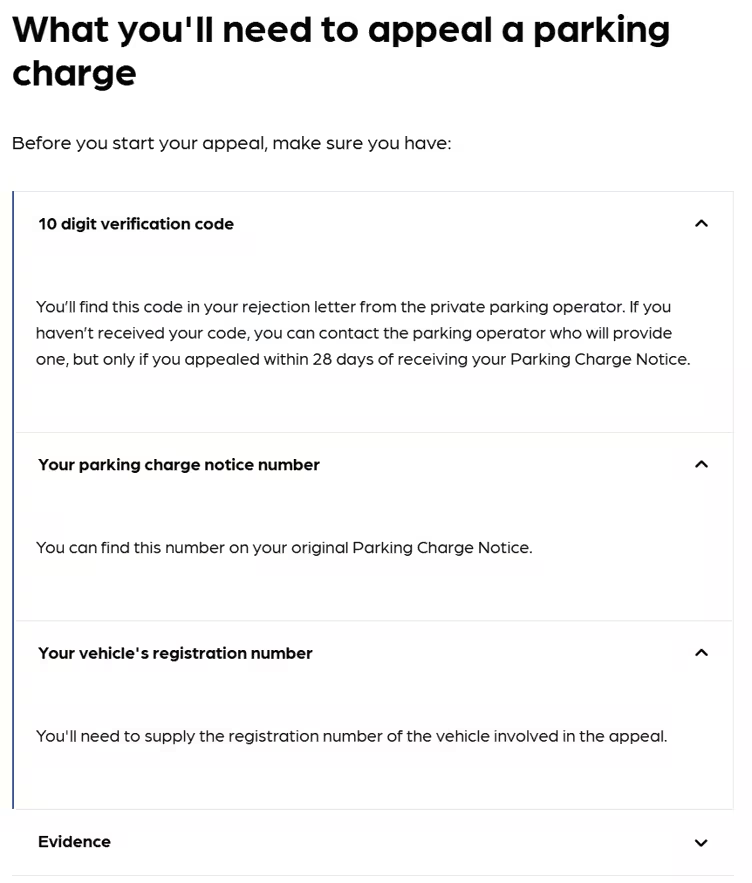
POPLA’s official appeal guidance explaining the verification code, supporting evidence and submission requirements for private parking charge appeals.
What Are the New Private Parking Appeal Rules for 2026?
One of the most important developments for UK motorists is the government’s new Private Parking Code of Practice.
The government laid the code before Parliament on 20 October 2026, introducing a framework intended to improve standards across private parking facilities in England, Scotland and Wales.
As of 28 October 2026, the code remains subject to parliamentary scrutiny and has not yet taken effect.
The government expects to issue it on 30 November 2026, provided no parliamentary objections prevent that timetable. It is expected to come into force 21 days after issue.
The forthcoming standards include several important protections.
- A minimum consideration period: Drivers will generally have at least five minutes to assess the conditions and decide whether to park, with longer periods applying to certain larger sites.
- A grace period: A minimum 10-minute grace period will generally apply after the end of a permitted parking session, subject to specified exceptions.
- Stronger appeal protections: The new Appeals Charter identifies situations where charges should be cancelled when supported by reliable evidence.
- Reduced charges for certain mistakes: Qualifying minor errors, including some permit or registration mistakes, will attract a reduced charge of £20 on appeal.
- A maximum standard parking charge: The code retains a £100 cap on standard parking charges, together with a 40% early-payment reduction.
These provisions are not a blanket exemption from parking rules. The code contains exceptions, conditions and evidential requirements.
In a parliamentary statement on 20 October 2026, minister Florence Eshalomi described the reforms as protections intended to make unfair private parking practices a thing of the past.
For motorists, the key distinction is timing: appeals made before the new code takes effect must be assessed under the rules and legal obligations applicable at that time. Drivers should not assume the forthcoming statutory protections already apply to every existing ticket.
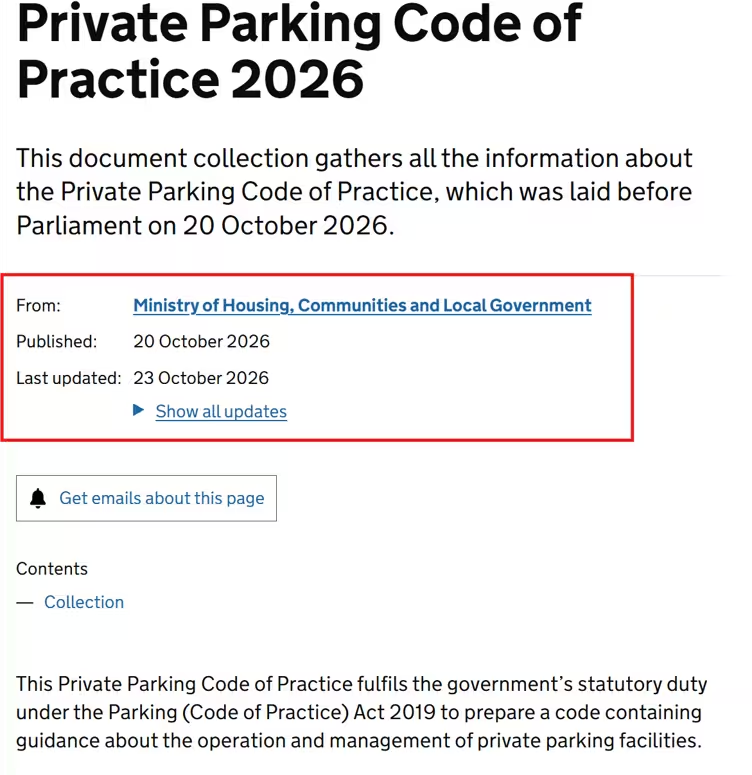
The government’s Private Parking Code of Practice 2026 and its publication timeline, showing the new national standards being introduced for private parking operators.
What Evidence Gives a Parking Ticket Appeal a Stronger Basis?
Evidence should establish what happened, when it happened and why the charge is disputed.
In our assessment, the most useful appeal documentation is material that can be independently checked.
Photographs taken immediately after discovering a ticket may show the relevant road markings, parking signs and vehicle position.
Payment receipts can help establish whether the correct parking tariff was purchased.
Vehicle records may demonstrate that a notice was addressed to someone who was not the owner at the relevant time.
For a vehicle breakdown, recovery documentation can establish the timing and location of the incident.
Businesses may also have access to vehicle tracking data, delivery records and employee journey logs that help explain the circumstances of a disputed parking charge.
Where an operator relies on Automatic Number Plate Recognition (ANPR), motorists should examine whether the recorded entry and exit times accurately describe the alleged breach.
For example, a camera system may record separate entry and exit movements while the driver is looking for a parking space or leaving a congested car park.
However, ANPR entry and exit timestamps do not automatically establish that a charge is invalid. The circumstances must be assessed against the applicable conditions and requirements.
Our recommended evidence checklist is:
- Copy of the original parking notice.
- Photographs of signs, bay markings and the vehicle’s position.
- Parking receipt, booking confirmation or payment record.
- Relevant correspondence with the issuing organisation.
- Documentary proof of exceptional circumstances, where applicable.
- Record of the appeal submission date and reference number.
Evidence should be submitted in the format required by the relevant operator or tribunal.
For example, POPLA normally requires supporting material to be uploaded directly and does not generally accept evidence supplied only through external file-sharing links.
How Do You Write a Parking Ticket Appeal Letter?
A parking ticket appeal does not need to be unnecessarily complicated.
The purpose is to identify the penalty, explain the factual or legal reason for disputing it and direct the issuer to the supporting evidence.
The following example can be adapted for an initial council challenge or private operator appeal. Formal council representations should also identify the relevant statutory ground where required.
Subject: Request to Review Parking Ticket – Reference [PCN Number]
Dear Parking Enforcement Team,
I am writing to challenge parking ticket [PCN number], issued on [date] in relation to vehicle registration [registration number] at [location].
I believe the ticket should be cancelled because [briefly explain the specific reason for the challenge].
The circumstances are as follows:
[Provide a factual explanation of what happened, including relevant dates, times, parking conditions and any information supporting your position.]
I have attached [photographs, payment records or other documents] to support my challenge.
I request that the issuing authority or operator review this evidence and cancel the charge where the relevant legal or appeal requirements are satisfied.
Please confirm receipt of this challenge and provide your decision in writing.
Yours faithfully,
[Full name]
[Contact details]
[PCN reference]
The wording should reflect the actual circumstances.
A driver who paid correctly should focus on proof of payment. Someone challenging unclear restrictions should identify the specific signs or markings involved.
Unsupported claims, irrelevant legal terminology and copied allegations that do not match the evidence can make an appeal less persuasive.
Is It Better to Appeal a Parking Ticket or Pay the Discounted Amount?
From a personal finance perspective, appealing a parking ticket involves balancing the evidence, likely outcome and potential financial exposure.
There are several percentages that drivers should understand.
| Financial rule | Percentage | Example |
| Typical council early-payment discount | 50% | £100 penalty reduced to £50 |
| Private parking early-payment reduction under the relevant industry standards | 40% | £100 charge reduced to £60 |
| Council Charge Certificate increase | 50% | £100 penalty increases to £150 |
| Successful cancellation | 100% of the relevant charge removed | £100 charge becomes £0 |
These percentages describe financial rules and illustrative outcomes, not parking appeal success ratings.
There is no reliable universal percentage that predicts whether an individual parking ticket appeal will succeed.
The outcome depends on the facts, evidence, applicable law and the decision-making body.
A motorist who has clear proof that the penalty was issued incorrectly may have a sound reason to challenge it.
By contrast, a driver who knowingly breached an unambiguous restriction without mitigating circumstances should consider the financial consequences before rejecting an available discount.
Once a case proceeds to formal representations or independent adjudication, an earlier discounted payment option may no longer be available.
The appropriate decision is therefore not simply whether an appeal is possible, but whether there is a credible basis for challenging the liability.
Can You Appeal Airport Parking and Drop-Off Charges?
Airport parking disputes require particular attention because airports may operate several different charging systems.
A driver can encounter charges for terminal drop-off areas, short-stay car parks, long-stay facilities or restricted airport roadways.
Some of these charges are contractual, while others may be governed by airport-specific rules or byelaws.
Consequently, motorists should not automatically assume that an airport parking notice follows the same procedure as a council-issued PCN.
For example, understanding the Gatwick drop-off charge is important because the designated terminal forecourt has specific payment deadlines, vehicle recognition arrangements and enforcement conditions.
Likewise, motorists using Heathrow should distinguish the airport’s designated drop-off area from its terminal parking facilities. The Heathrow drop-off charge operates under its own published payment and enforcement arrangements.
Where a ticket has been issued, the driver should establish:
- Whether the notice relates to a parking session or an unpaid access charge.
- Which organisation issued it.
- Whether the operator has provided evidence of the alleged breach.
- Whether the relevant tariff and restrictions were adequately communicated.
- What appeal procedure and deadline apply.
For regular flyers and business travellers, reviewing airport parking options across London can also help reduce the risk of unexpected parking expenditure.
Airport drop-off areas should not be treated as ordinary car parks with an assumed free grace period.
A short visit or an accidental entry does not automatically remove a charge, although the relevant terms and specific circumstances may provide grounds to challenge it.
How Should Business Owners and Fleet Managers Handle Parking Tickets?
Parking enforcement can create additional administrative costs for businesses operating company cars, delivery vans, taxis and other commercial vehicles.
The financial impact extends beyond the original charge.
A disputed ticket can involve employee time, correspondence, vehicle administration and potential hire-company fees.
For an organisation managing multiple vehicles, inconsistent handling can result in unnecessary escalation.
Our financial analysis suggests that businesses should manage parking notices through a documented internal procedure rather than treating each ticket as an isolated expense.
A suitable process includes recording the ticket immediately, identifying the person responsible for handling the appeal and checking the evidence before any payment is authorised.
The registered keeper may be legally responsible for a council PCN even when another employee was driving.
Private parking liability can be different, particularly where statutory keeper-liability requirements are relevant.
For leased or hired vehicles, the business should examine its rental agreement and any liability-transfer procedure.
An operator may seek payment from the registered keeper, hire company or another liable party depending on the applicable legal framework.
A Practical Fleet Management Example
Consider a business operating 20 delivery vehicles.
If each vehicle receives two parking penalties annually, the business may have to manage 40 notices.
At an illustrative £100 per notice, the total initial exposure would be £4,000.
If all 40 were eligible for a 50% discount and were paid at that rate, the expenditure would fall to £2,000.
If all 40 instead reached a stage where a 50% statutory surcharge applied, the amount would increase to £6,000, excluding other potential enforcement costs.
These are hypothetical financial scenarios, not estimates of actual parking ticket frequency or appeal performance.
They nevertheless demonstrate why prompt assessment matters.
For businesses, the most effective approach combines prevention, proper employee training and evidence-based challenges when a charge appears incorrect.
What Happens If Your Parking Ticket Appeal Is Rejected?
Rejection does not necessarily mean the matter has reached its final stage.
The next step depends on the type of parking charge and the stage of the procedure.
For council penalties, a rejected informal challenge may be followed by a Notice to Owner and formal representation.
A rejected formal representation may then be appealed to the relevant independent tribunal.
For private parking charges, the operator’s rejection may provide access to POPLA or the IAS.
However, an unsuccessful independent private parking appeal does not automatically extinguish the operator’s ability to pursue payment through civil proceedings.
Drivers should read every decision carefully and take action within the stated deadline.
What Happens If You Ignore a Parking Ticket?
Ignoring a council PCN can result in further statutory enforcement.
Where the relevant deadlines expire, the authority may issue a Charge Certificate increasing the penalty by 50%.
The case may subsequently progress to registration of the debt and enforcement action.
A private parking operator may send reminders, use debt recovery procedures or bring a civil claim where it considers the charge recoverable.
Receiving a private parking ticket does not itself create a County Court Judgment.
However, a court judgment that remains unpaid can have serious financial consequences, including potential effects on credit records.
A debt collector’s letter should not be confused with a court order, but neither should formal court documents be ignored.
If a notice has reached an advanced enforcement stage, motorists should examine the relevant procedures immediately rather than assuming the ordinary initial appeal route remains available.
Can You Appeal a Parking Ticket After 28 Days?
A late challenge may still be possible in some circumstances, but acceptance is not guaranteed.
The original appeal deadline and the reason for missing it are important.
A council may exercise discretion to consider a late representation, while an independent tribunal may consider whether there is sufficient justification to admit a late appeal.
Private parking operators may also have procedures for exceptional circumstances, depending on the applicable code and rules.
Situations that may warrant consideration include serious illness, delayed delivery of correspondence or circumstances preventing the recipient from receiving the notice.
Evidence explaining the delay is important.
Motorists who discover an old parking penalty after enforcement has progressed should not simply submit an ordinary appeal letter and assume it will stop recovery.
Different statutory procedures may apply, particularly where a Notice to Owner was never received or representations were submitted but no rejection was received.
Are Parking Ticket Appeal Rules Different in Scotland and Northern Ireland?
Yes. Drivers should not automatically apply English and Welsh council parking procedures throughout the United Kingdom.
Scotland has its own arrangements for council parking enforcement and appeals, including the Scottish parking appeals system.
Northern Ireland also has separate parking enforcement and adjudication procedures.
Private parking charges in Scotland are subject to different legal considerations from those in England and Wales, particularly concerning the statutory transfer of liability from drivers to vehicle keepers.
The forthcoming UK government private parking code is intended to cover England, Scotland and Wales, but it does not replace the distinct statutory council parking arrangements in each jurisdiction.
Drivers should use the instructions provided by the issuing authority and the official appeal service relevant to their location.
Conclusion: What Is the Best Way to Appeal a Parking Ticket?
Understanding how to appeal a parking ticket begins with identifying the issuer, checking the deadline and establishing whether there is a legitimate basis for challenging the charge.
Council-issued penalties follow statutory enforcement procedures, while private parking disputes generally begin with the operator and may progress to an independent appeals service.
The most effective challenges rely on relevant evidence, accurate explanations and timely submissions.
For individuals, this can prevent unnecessary financial losses. For businesses operating several vehicles, a consistent approach to parking compliance and ticket administration can reduce avoidable costs and disruption.
The private parking reforms announced in October 2026 should improve consumer protections once implemented, but motorists must continue to follow the rules currently applicable to their notices.
Ultimately, the strongest parking ticket appeal is one supported by clear facts, appropriate evidence and compliance with the relevant procedural deadlines, rather than an expectation that every charge can be cancelled.
Frequently Asked Questions About Parking Ticket Appeals
Can I Appeal a Parking Ticket Without Photographs?
Yes. Photographs are useful but not always essential.
Payment confirmations, permits, witness statements, vehicle ownership records and other relevant documentation may provide sufficient evidence.
The appropriate evidence depends on the reason for the challenge.
Can I Appeal a Parking Ticket After Paying It?
Usually, paying a parking ticket closes the normal appeal process.
There may be limited exceptions under particular rules, but motorists should not assume they can pay first and challenge later.
If an appeal is being considered, the payment and appeal conditions should be checked before proceeding.
Is It Free to Appeal a Parking Ticket?
Submitting a council parking challenge is generally free.
Independent statutory parking tribunals and the standard POPLA and IAS appeal procedures are also generally free for motorists.
However, an unsuccessful appeal may leave the original charge payable, and separate costs can arise if the matter eventually enters court proceedings or other enforcement stages.
Can a Parking Ticket Affect My Credit Score?
A parking ticket does not automatically affect a driver’s credit score.
However, an unpaid private parking charge that results in a court judgment can create credit-related consequences if the judgment is not satisfied in accordance with the applicable rules.
The distinction between an unpaid demand and a court judgment is important.
Can I Appeal a Parking Ticket if I Have a Blue Badge?
Yes. Blue Badge holders can challenge parking tickets where a valid entitlement, exemption or other relevant circumstance supports the case.
However, a Blue Badge does not provide unrestricted parking rights.
Different conditions apply to council parking places, restricted roads and private car parks.
The badge holder should check whether the particular location and restriction permitted the parking activity in question.
What if the Parking Ticket Was Issued While Someone Else Was Driving?
Responsibility depends on the ticket type.
For most council parking PCNs, the vehicle owner or registered keeper is normally responsible, subject to the applicable statutory exceptions.
Private parking cases may involve driver liability or keeper liability where the necessary legal conditions are met.
A driver should not assume that identifying another person automatically cancels their own liability.
Hannah is a London lifestyle and consumer writer at London Insider News, covering property, transport, local developments, cost-of-living issues and stories affecting everyday life across the capital.
More from TRANSPORT
Check Congestion Charge 2027: How to Check by Number Plate, Postcode and Payment Status?
Before driving into central London, checking the Congestion Charge can prevent an £18 daily expense from…
Pay Stansted Drop Off Charge: How to Pay Online, Current Fees, Deadlines and Free Alternatives?
Drivers using London Stansted Airport's Express Set Down area must pay a drop-off charge after their…
Do I Need to Pay Congestion Charge in London? 2027 Rules, 2026 Updates, Costs and Exemptions
If you're planning to drive through central London, you may be wondering, do I need to…