What Is a Turnkey Property? Meaning, Costs, Benefits and Investment Risks in the UK
 Adam
London Business & News Writer

A turnkey property is a home that is fully completed, renovated or prepared for immediate occupation, allowing buyers to move in or landlords to rent it out without undertaking major additional work.
For property investors, it can provide a relatively straightforward route into the rental market, although convenience does not automatically guarantee profitability.
Our analysis of UK property investment guidance, landlord obligations, rental calculations and the practical considerations facing property entrepreneurs suggests that the strongest turnkey investments combine three essential qualities: a reasonable purchase price, reliable rental demand and manageable ongoing costs.
However, purchasing a finished property can involve premium pricing, leasehold charges, tax liabilities and unexpected maintenance expenses.
Understanding these financial implications is particularly important in London, where acquisition costs and long-term property management expenses can significantly affect returns.
What Is a Turnkey Property in the UK?
A turnkey property is a residential or commercial property that is ready to use immediately, without requiring substantial renovation, decoration or construction work.
The expression comes from the idea that the buyer should only need to turn the key to begin using the property.
In practical terms, a turnkey home normally has a completed kitchen, functioning bathroom, finished flooring, operational heating, electricity, water and an acceptable standard of decoration.
Some properties also include furniture, kitchen appliances, tenant-finding services and professional property management.
For example, an investor purchasing a fully refurbished two-bedroom flat could potentially advertise it for rent shortly after completion without arranging building contractors or paying for extensive improvements.
However, there is an important distinction between three situations:
- Move-in ready: The home is suitable for immediate occupation.
- Rental ready: The property is prepared for letting, subject to necessary compliance and administrative checks.
- Tenanted investment: The property is sold with an existing occupier and tenancy arrangement.
These descriptions are not interchangeable.
A furnished apartment may be ready for occupation but still require landlord safety checks. Equally, a property already occupied by tenants might have unresolved maintenance issues or an unprofitable rental agreement.
Our financial assessment is that the word turnkey describes the property’s readiness, not its investment performance.
What Is Included in a Turnkey Property?
The precise specification depends on the developer, seller or property investment company.
A genuinely finished turnkey property generally includes the following.
| Property feature | What buyers should expect |
| Kitchen | Installed units, worktops, sink and functioning essential fittings |
| Bathroom | Completed sanitary fittings, plumbing and ventilation |
| Flooring | Finished flooring throughout |
| Decoration | Completed walls, ceilings and interior finishes |
| Heating | Operational heating and hot-water systems |
| Electrical installations | Working electrical systems and appropriate safety documentation |
| Windows and doors | Fitted, functional and secure |
| Furniture | Included only where expressly agreed |
| Appliances | Included according to the written sales specification |
| Property management | Optional or included under a separate agreement |
| Existing tenants | Only where the property is specifically sold as tenanted |
A common misunderstanding is that every turnkey apartment comes fully furnished.
That is not necessarily the case.
A property developer might advertise an apartment as turnkey while offering a furniture package at an additional cost.
Investors should request a written inventory and specification before exchanging contracts, identifying exactly which fixtures, appliances and services are included.
The same principle applies to rental management. Purchasing a turnkey property does not automatically mean that an agent will manage the property indefinitely.
How Does Turnkey Property Investment Work?
Turnkey property investment involves purchasing a property that has already been prepared for residential use or rental occupation.
Rather than coordinating refurbishment work independently, the investor purchases a completed asset and focuses on acquisition, financing, letting and long-term ownership.
Step 1: Find a Suitable Property
Investors normally begin by comparing completed new-build apartments, professionally refurbished houses and existing properties marketed as ready-to-let investments.
The location should be evaluated using employment opportunities, transport connections, tenant demand, local property prices and realistic rental values.
A visually impressive apartment in a weak rental market may perform worse than an ordinary property in an established residential neighbourhood.
Step 2: Review the Purchase Price
The seller’s asking price should be compared with completed transactions involving similar properties.
An investor should establish whether the asking price contains a significant premium for refurbishment, furniture or additional services.
For example, paying £300,000 for a completed apartment may appear reasonable until comparable properties are found selling for £275,000.
The £25,000 difference represents approximately 9.1% of the lower comparison price.
That premium might be justified by genuine improvements, but it should never be accepted without evidence.
The UK Land Registry’s sold-price records provide a useful starting point for independent research.
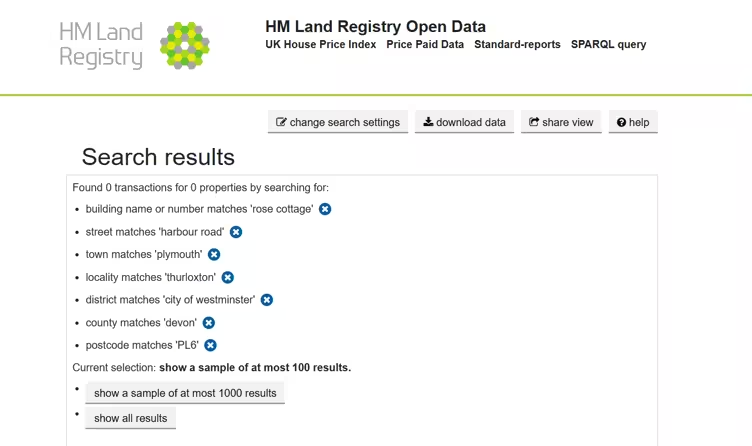
HM Land Registry’s official sold-property-price search allows buyers to review recorded transactions and compare the asking price of a turnkey property with similar homes.
Step 3: Complete Legal and Mortgage Checks
Once an offer is accepted, the buyer’s solicitor investigates ownership, title restrictions, searches and relevant legal documentation.
For leasehold apartments, the solicitor should also examine the remaining lease term, service charges, ground rent provisions, planned major works and restrictions on subletting.
Where the property is being purchased as an investment, the buyer should obtain suitable buy-to-let finance rather than assuming a standard residential mortgage will permit letting.
Step 4: Inspect the Property
Even where a property looks newly renovated, buyers should consider obtaining an independent survey.
Freshly painted walls and modern kitchen installations do not prove that the underlying building is free from damp, structural defects, roof problems or inadequate workmanship.
A professional inspection can help identify risks that would otherwise undermine the financial advantages of purchasing a finished property.
Step 5: Prepare the Property for Letting
Where the property will be rented out, landlords must ensure that all applicable safety, licensing and tenancy requirements have been met.
Our detailed assessment of renting out a house in the UK explains the responsibilities involved in moving from property ownership to lawful rental operation.
Step 6: Manage the Investment
After tenants move in, the investor receives rental payments while meeting the ongoing obligations of ownership.
These include repairs, insurance, mortgage repayments, tax, compliance and any contracted management charges.
A letting agent can handle much of the daily work, but the landlord generally retains legal and financial responsibilities.
What Are the Different Types of Turnkey Properties?
Turnkey properties are not restricted to newly constructed apartments.
New-Build Turnkey Properties
These are completed homes sold by developers with kitchens, bathrooms, heating, flooring and essential installations already finished.
They may be attractive to buyers seeking modern layouts and potentially lower immediate maintenance requirements.
However, new developments can carry premium prices, service charges and restrictions relating to leases or estate management.
A property advertised off-plan as a future turnkey investment is not yet a completed turnkey property. Buyers must also assess developer, construction and completion risks.
Renovated Turnkey Properties
These are older buildings that have undergone refurbishment before being sold.
Improvements may include new kitchens, bathrooms, flooring, decoration, heating systems or electrical work.
The benefit is avoiding direct responsibility for the renovation project.
The risk is that the purchaser may have limited visibility over the quality, cost and extent of the completed work.
Furnished Turnkey Properties
These homes are marketed with furniture and appliances already installed.
They may appeal to landlords targeting professionals, relocating employees or tenants who want a ready-furnished apartment.
However, furnishings require replacement over time, and the package’s advertised value should be checked against comparable retail costs.
Tenanted Turnkey Properties
These are properties sold with an existing tenancy.
The buyer may inherit an established income stream, but should first verify the actual rent being paid, payment history, tenancy terms, deposit arrangements and any outstanding disputes.
Purchasing an occupied property is not the same as obtaining guaranteed income.
The buyer should also establish whether the existing tenancy permits the intended ownership and financing arrangements.
How Much Does a Turnkey Property Cost in the UK?
There is no fixed price for a turnkey property.
Purchase prices depend on location, size, condition, ownership structure, rental demand and whether refurbishment or furnishing costs have been incorporated into the asking price.
A completed property may be more expensive than an otherwise comparable home requiring improvement.
However, investors should consider the total acquisition cost, not just the amount advertised.
What Additional Costs Should Buyers Expect?
| Expense | Financial consideration |
| Property purchase | Agreed selling price |
| Stamp Duty Land Tax | Depends on price, circumstances and applicable rates in England or Northern Ireland |
| Solicitor and conveyancing fees | Depends on transaction complexity |
| Survey and valuation | Depends on property and survey type |
| Mortgage arrangement fees | Depends on lender and product |
| Furniture package | May be included or separately charged |
| Service charge | Relevant to many leasehold properties |
| Ground rent | Depends on lease terms and legal restrictions |
| Insurance | Depends on property type and cover |
| Property management | Depends on agent and service agreement |
| Initial cash reserve | Allowance for unexpected repairs and vacant periods |
For a qualifying additional residential property purchased in England for £300,000 under the rates in force in October 2026, the higher-rate Stamp Duty Land Tax calculation would normally be:
- 5% on the first £125,000 = £6,250
- 7% on the next £125,000 = £8,750
- 10% on the remaining £50,000 = £5,000
Total SDLT: £20,000.
This example assumes the higher additional-property rates apply and excludes any separate non-UK resident surcharge or special reliefs. Different transaction circumstances can change the calculation.
Scotland and Wales have separate property transaction tax systems.
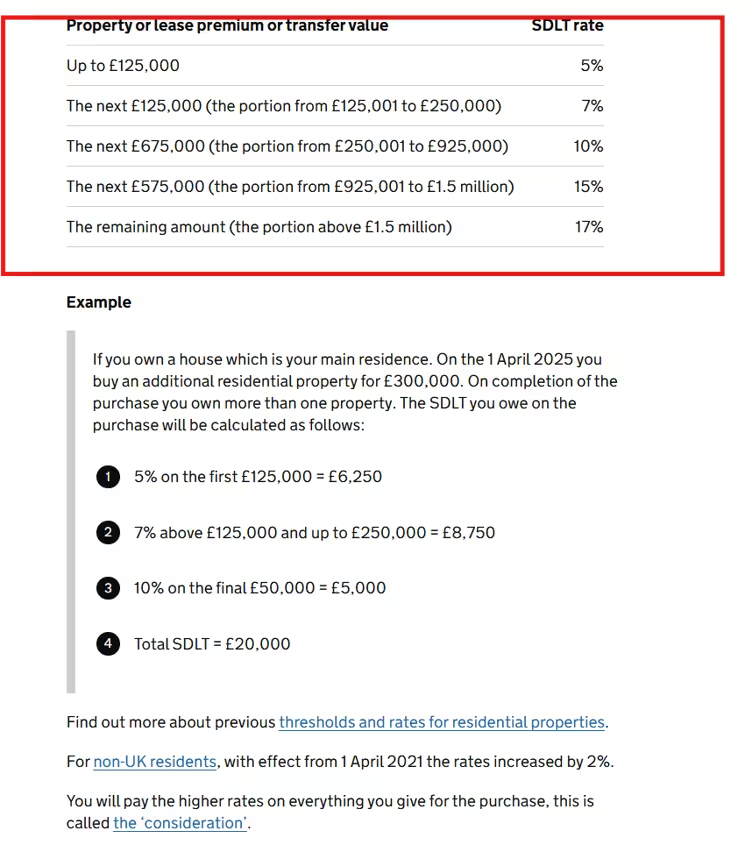
HMRC’s official additional-property Stamp Duty Land Tax rates, showing the tax bands that can apply to a £300,000 buy-to-let purchase in England.
The financial impact of these costs is significant because stamp duty and professional fees increase the amount of capital committed without directly increasing the property’s rental income.
How Much Rental Income Can a Turnkey Property Generate?
The potential rental income depends primarily on the location, achievable market rent, occupancy and operating costs.
A property described as ready-to-let does not have an automatic rental yield.
Investors should calculate returns using independently supported rental estimates rather than developer forecasts alone.
How Is Gross Rental Yield Calculated?
Gross rental yield measures annual rent against the property purchase price before operating expenses.
Gross rental yield = (Annual rental income ÷ Purchase price) × 100
Consider a hypothetical turnkey investment:
| Investment detail | Illustrative figure |
| Property purchase price | £300,000 |
| Advertised monthly rent | £1,750 |
| Annual rent at 100% occupancy | £21,000 |
| Gross rental yield | 7.00% |
At first glance, a 7% gross yield may appear attractive.
However, that percentage does not account for vacant periods, management charges, repairs, leasehold costs or mortgage interest.
When advertisements use rent quoted per calendar month, investors should calculate annual income using 12 monthly payments before adjusting for realistic void periods.
How Much Could the Net Rental Yield Be?
We developed the following illustrative operating-cost calculation to show how a 7% advertised gross yield can translate into a significantly lower return.
These are model assumptions, not quoted market averages or the results of a particular investment.
| Annual income or expense | Example amount |
| Potential annual rent | £21,000 |
| One month without rent | −£1,750 |
| Rent actually collected | £19,250 |
| Management fees, assumed 12% of collected rent including VAT | −£2,310 |
| Service charge | −£2,400 |
| Maintenance allowance | −£1,200 |
| Insurance | −£350 |
| Compliance allowance | −£250 |
| Operating income before mortgage and tax | £12,740 |
If the property costs £300,000, the operating yield relative to purchase price is approximately 4.25%.
However, a more complete acquisition calculation should include the costs of purchasing the property.
Assuming:
- Property price: £300,000
- SDLT: £20,000
- Conveyancing and other initial costs: £3,000
The total acquisition cost would be £323,000.
That reduces the illustrative unleveraged operating return on total acquisition cost to approximately 3.94% before financing and tax.
This is a substantial difference from the advertised 7% gross yield.
It also excludes irregular capital expenditure, such as major building works, and potential transaction costs on a future sale.
What Happens When Mortgage Interest Is Included?
Suppose the investor finances 75% of the £300,000 property price using an interest-only buy-to-let mortgage.
The hypothetical mortgage would be £225,000.
At an assumed annual interest rate of 5%, the interest expense would be:
£225,000 × 5% = £11,250 annually.
Deducting that interest from the illustrative £12,740 operating income leaves £1,490 per year, or approximately £124 per month before tax.
The investor would have initially committed approximately £98,000 in deposit, SDLT and estimated acquisition costs, excluding financing fees and reserves.
That represents an illustrative pre-tax cash-on-cash return of around 1.52%.
The 5% interest rate is a modelling assumption, not a claim about available mortgage products.
For an individual landlord, mortgage interest tax treatment can also mean that taxable profit differs substantially from cash profit.
Our assessment is that investors should always examine gross yield, operating yield, financing costs and post-tax cash flow separately.
Why Do Property Investors Choose Turnkey Properties?
The main commercial advantage of a turnkey property is reduced preparation work.
For some investors, purchasing a completed property offers a more manageable route into residential letting than acquiring a building requiring extensive renovation.
Faster Preparation for Occupation
Where the property is genuinely complete and legally compliant, the buyer may be able to move in or begin finding tenants without a lengthy refurbishment period.
This can reduce the time between purchasing the asset and using it.
However, rental income begins only when rent is contractually payable and collected. An empty turnkey property does not automatically generate income.
Reduced Renovation Management
Refurbishment projects can involve finding contractors, obtaining quotations, sourcing materials and addressing unexpected problems.
A turnkey buyer may avoid much of that process.
For business owners and entrepreneurs whose time is occupied by other commercial activities, the reduction in practical management work may have meaningful value.
Greater Initial Cost Visibility
A finished property allows purchasers to inspect the completed layout and specification.
That can make the immediate condition easier to assess than a property requiring extensive work.
Nevertheless, visible completion does not eliminate hidden defects or future expenditure.
Easier Remote Ownership
Turnkey investments may appeal to buyers living in another city or country.
Professional management can reduce the need for frequent physical visits.
However, buyers should still conduct independent due diligence and understand the financial and legal responsibilities of ownership.
What Are the Main Risks of Buying a Turnkey Property?
The biggest risks are not necessarily related to the appearance of the property.
They often arise from the price paid, ownership arrangements, long-term costs and unrealistic expectations about future income.
Paying More Than Market Value
Property developers and specialist investment sellers may incorporate refurbishment costs, furniture, marketing expenditure and profit into their asking prices.
A premium is not automatically unreasonable.
However, paying significantly above independently supported market value can reduce future capital growth and make refinancing or resale more difficult.
A mortgage lender may also value the property below the agreed purchase price.
This could require the buyer to contribute additional cash or renegotiate the transaction.
Unexpected Leasehold Expenditure
Many London turnkey apartments are leasehold properties.
Buyers may be responsible for annual service charges and contributions towards communal maintenance, building insurance, repairs and major works.
Some older leases also contain ground rent obligations.
Understanding ground rent and its financial implications is therefore important when assessing the full cost of a leasehold purchase.
Certain newer long residential leases are subject to restrictions under the Leasehold Reform (Ground Rent) Act 2022, meaning the permitted ground rent will generally be a peppercorn.
However, older leases and exempt arrangements can differ.
A peppercorn rent arrangement does not remove service charges, insurance contributions or the potential cost of major building repairs.
Misleading Rental Guarantees
Some turnkey investment packages are advertised with guaranteed returns.
For example, a seller may offer a 7% rental guarantee for a limited period.
That does not necessarily mean the underlying property is capable of producing a sustainable 7% yield from ordinary market tenants.
Investors should establish:
- Who provides the guarantee and whether that organisation can meet its obligations.
- Whether payments are based on the purchase price or another calculation.
- How long the guarantee lasts.
- Whether the property price has been inflated to fund the guarantee.
- What happens when the guarantee expires.
- Whether there are exclusions, conditions or early-termination provisions.
A contractual guarantee is only as reliable as its terms and the ability of the responsible party to pay.
Poor Renovation Quality
A newly refurbished kitchen can make a property attractive while more expensive defects remain unresolved.
Examples include concealed damp, inadequate ventilation, ageing plumbing, poor electrical work and defective roof coverings.
A buyer should request relevant certificates, warranties, permissions and completion documentation while also considering an independent survey.
Limited Opportunities to Add Value
Investors who purchase an unimproved property sometimes increase its value through renovation, extension or changes to layout, subject to the necessary permissions.
With a completed turnkey property, much of that opportunity may already have been captured by the seller.
This can reduce the potential for an investor to generate an immediate improvement-led increase in capital value.
Difficulty Selling the Property
Turnkey properties can still be difficult to resell.
A future buyer will consider prevailing market values, mortgage affordability, lease terms, building condition and competing properties.
Investors should be especially careful with apartment developments containing many near-identical units offered for sale at the same time.
A property’s attractive finish does not guarantee that it can be sold quickly or at a profit.
Is a Turnkey Property Better Than a Renovation Property?
Neither option is automatically superior.
The appropriate choice depends on financial resources, experience, available time and investment objectives.
| Comparison | Turnkey property | Renovation property |
| Immediate condition | Generally ready for use | Requires some work |
| Upfront purchase price | May include a convenience premium | May offer a lower acquisition price |
| Renovation involvement | Usually limited | Potentially substantial |
| Speed to occupancy | Potentially faster | Depends on work required |
| Control over finishes | Limited | Usually greater |
| Construction risk | Less direct work, but hidden defects remain possible | Direct exposure to project costs and delays |
| Scope to add value | Often more limited | Potentially greater |
| Investor time commitment | Generally lower initially | Generally higher |
| Rental-readiness costs | Often included in asking price | Must be budgeted separately |
| Financial return | Depends on the total price and expenses | Depends on purchase price and successful delivery |
Consider two opportunities.
Property A is a turnkey home available for £300,000.
Property B is a comparable home advertised for £270,000 that requires an estimated £20,000 refurbishment.
Property B initially appears £10,000 cheaper after renovation.
However, the buyer must also account for additional transaction differences, holding costs, finance charges, possible rent lost during the renovation and the risk of exceeding the £20,000 budget.
Equally, the completed Property A should not be assumed to be worth £300,000 simply because that is the seller’s asking price.
Our assessment is that turnkey investing generally makes more sense when convenience, faster occupation and limited project involvement are priorities.
Renovation-led investment may be more appropriate for buyers who have experience managing improvements and can identify properties where the potential additional value adequately compensates for the work and risk.
Is Turnkey Property Investment Worth It in London?
London presents a different investment environment from many regional UK markets because capital requirements can be substantial and leasehold apartment ownership introduces additional financial considerations.
The value of a turnkey property in London depends less on whether the home is newly finished and more on whether its purchase price and achievable rent support the investment.
Location and Tenant Demand
Turnkey apartments near transport connections, employment centres, universities and established residential districts may attract suitable tenant interest.
However, rental demand varies considerably between neighbourhoods and property types.
A buyer should compare the property’s rent with similar homes currently advertised and, wherever possible, actual recently agreed rents.
Service Charges and Building Costs
London apartment ownership may involve communal maintenance, lifts, concierge facilities, shared heating systems and management-company expenditure.
High service charges can materially reduce net rental income.
Buyers should request recent service charge accounts, current budgets, information about reserve funds and details of proposed major works.
For taller or more complex buildings, legal advisers should also investigate building safety documentation and any outstanding remediation or mortgageability concerns.
Rental Affordability
A property capable of attracting £2,000 per month in rent is not necessarily an attractive investment if the purchase price, service charges and financing costs absorb most of that income.
It is also important to consider whether the intended tenant group can sustainably afford the rent.
Our London rental process and affordability overview provides further context on the practical obligations and costs experienced by private renters.
Future Rent Increases
Landlords cannot assume they will be free to increase rents whenever their mortgage or service charge costs rise.
The changes introduced under the Renters’ Rights Act affect the process and frequency of rent increases for most private assured tenancies in England.
Understanding how much a landlord can increase rent in London can therefore help investors avoid unrealistic income-growth projections.
For London acquisitions, our strongest recommendation is to calculate the property’s expected net operating income before deciding whether its turnkey specification justifies the asking price.
What UK Property Rules Must Turnkey Investors Check in 2026?
Turnkey status does not create an exemption from landlord legislation.
A completed investment property must satisfy the relevant legal requirements before being offered for rent.
Landlord Safety Responsibilities
Depending on the property, landlords may be required to provide or maintain:
- Safe gas installations and appropriate gas safety records.
- Electrical installation safety inspections and reports.
- Required smoke and carbon monoxide alarms.
- Suitable fire precautions and safe escape arrangements.
- An appropriate Energy Performance Certificate.
- Compliance with applicable property licensing requirements.
- Appropriate tenancy deposit protection arrangements.
- Legally compliant tenancy documentation and rental procedures.
Rules can vary by property type, location and jurisdiction.
In London, investors should also investigate any selective, additional or HMO licensing requirements imposed by the relevant borough.
Energy Efficiency Requirements
At the time of writing, most covered privately rented residential properties in England and Wales generally require an EPC rating of at least E unless a valid exemption applies.
The government has also announced a policy to introduce a higher energy performance standard equivalent to EPC C, with a planned compliance date of 1 October 2030.
The 2030 framework requires further legislation and implementation, so investors should not describe every aspect of the future standard as already fully operational.
A newly refurbished turnkey home should not automatically be considered future-proof.
Buyers should inspect the actual EPC, assess the building’s energy performance and consider whether additional improvements may become necessary.
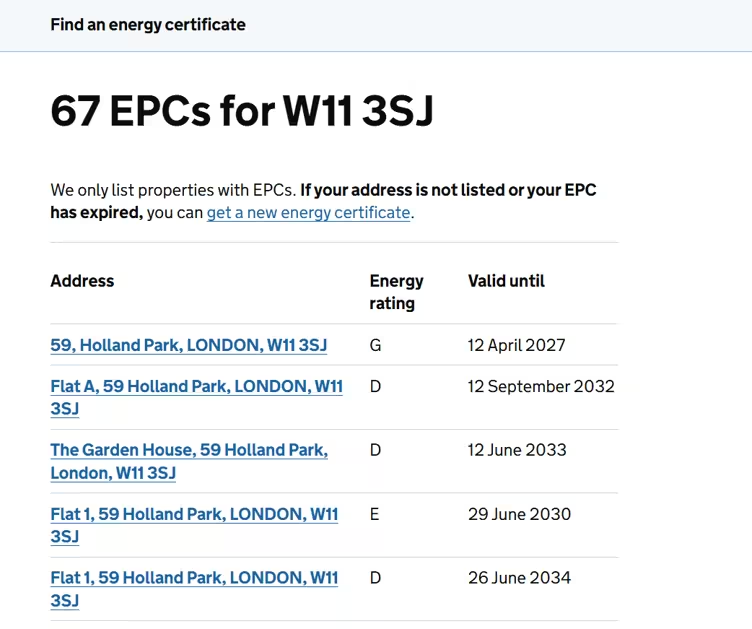
The official government Energy Performance Certificate service, showing how buyers can check a property’s energy rating and recommended efficiency improvements before committing to a turnkey investment.
Renters’ Rights Act Changes
Major tenancy reforms under the Renters’ Rights Act 2025 took effect in England on 1 May 2026.
The changes include the abolition of Section 21 no-fault evictions for the covered private rented sector, the move to assured periodic tenancies and changes affecting rent increases, rental bidding and other tenancy practices.
These reforms matter to turnkey investors because they affect tenancy management, income assumptions and the process of recovering possession.
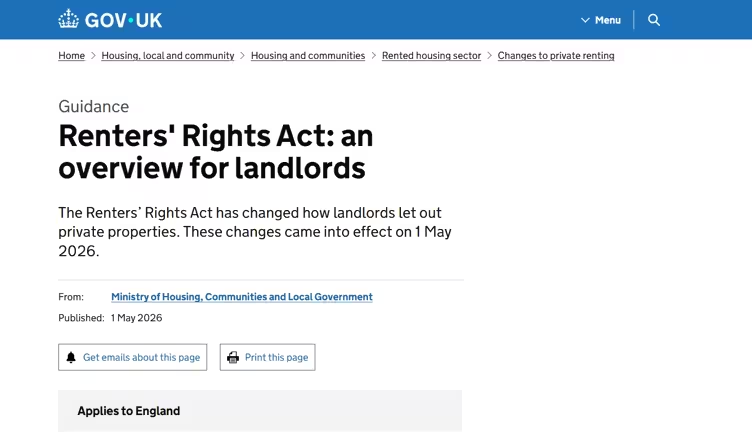
Official government guidance on the Renters’ Rights Act, including the changes to private tenancies that took effect on 1 May 2026.
A professional management company may help implement these requirements, but ownership of a turnkey investment does not remove the landlord’s responsibilities.
How Do We Rate Turnkey Property Investment?
To compare suitability across different buyer objectives, we developed an indicative editorial scoring approach based on four equally weighted considerations:
- Initial convenience — 25%: The extent to which substantial preparation work is avoided.
- Financial suitability — 25%: Whether the likely costs align with the buyer’s objectives.
- Management suitability — 25%: The level of ongoing involvement required relative to the buyer’s preferences.
- Control and flexibility — 25%: The ability to make changes, manage costs and pursue future opportunities.
The following percentages represent illustrative editorial suitability ratings for buyer profiles, not measured investment returns, consumer survey findings or guaranteed outcomes.
| Buyer or investor profile | Editorial suitability rating | Assessment |
| Busy professional seeking a completed investment | 85% | Strong potential fit where price and management terms are reasonable |
| Buyer wanting a move-in-ready home | 82% | Attractive where condition and valuation are independently verified |
| Remote investor with professional management | 78% | Convenient, but relies on local oversight and reliable agents |
| First-time landlord seeking limited renovation work | 74% | May simplify preparation, while legal and financial responsibilities remain |
| Experienced investor pursuing renovation-led value creation | 43% | Less suitable where much of the improvement value is priced in |
| Highly leveraged investor expecting entirely passive income | 30% | Significant exposure to interest costs, low cash flow and ongoing obligations |
Our editorial assessment: A turnkey property can be a highly suitable purchase for someone prioritising time and simplicity.
Its attractiveness declines when the purchase depends on aggressive borrowing, unrealistic rental assumptions or an expectation of guaranteed passive returns.
Individual properties should be assessed on their own merits rather than applying these ratings to a specific development.
What Should You Check Before Buying a Turnkey Property?
Before investing, we recommend a structured due diligence process.
1. Verify the Asking Price
Compare recent completed sales involving similar homes, adjusting for location, condition, size and tenure.
Do not assume that the seller’s projected resale value is an independent valuation.
2. Confirm the Full Specification
Obtain written confirmation of included furniture, appliances, fixtures, warranties, management services and any promised improvements.
Clarify whether the property is already completed or still awaiting construction or refurbishment.
3. Inspect the Building
Consider an independent survey and investigate the condition of roofs, plumbing, electrical installations, heating, ventilation and common areas.
For renovated properties, ask what work has actually been completed.
4. Investigate the Legal Ownership
Your solicitor should review title, tenure, lease length, subletting restrictions, service charges, ground rent and any restrictions affecting resale or mortgage finance.
For leasehold flats, obtain appropriate management information and investigate anticipated major works.
5. Test the Rental Figures
Use independent letting-agent assessments and comparable market evidence.
Calculate returns under realistic assumptions for vacancies, repairs and management costs.
A useful stress test is to model lower rental income alongside higher interest rates or service charges.
6. Review Management Arrangements
Check the agent’s fees, contract duration, termination provisions, maintenance approval limits and responsibilities.
A property management service should simplify administration, not conceal costs.
7. Check Existing Tenancies
If tenants are already in place, review signed agreements, rent statements, arrears, deposit protection and any known disputes.
Ask your solicitor to confirm how relevant tenancy obligations and records transfer on completion.
8. Examine the Exit Strategy
Consider who would buy the property in five or ten years.
Assess local owner-occupier demand, financing availability, building condition and the potential effect of major maintenance works.
9. Maintain a Financial Reserve
A completed home can still experience unexpected repairs or periods without rental income.
Buyers should retain accessible funds rather than committing their entire budget to the purchase deposit, stamp duty and furniture.
A successful turnkey purchase should remain financially manageable even when actual income is temporarily below expectations.
What Are the Common Mistakes Turnkey Property Buyers Make?
Our review identifies several decision-making errors that deserve particular attention.
Assuming turnkey means risk-free: Completion removes some renovation uncertainty but does not eliminate market, legal, financial or property-condition risk.
Focusing only on gross rental yield: Advertised returns can omit the ongoing expenses that determine actual cash flow.
Accepting seller valuations without comparison: The cost of refurbishment does not necessarily translate into an equivalent increase in market value.
Ignoring service charges: In apartment investments, communal expenditure can materially affect long-term profitability.
Relying on rental guarantees: Guaranteed payments must be examined alongside contract terms and the financial strength of the provider.
Overlooking management responsibilities: Even fully managed investments require financial decisions, legal compliance and periodic oversight.
Avoiding these mistakes can help investors distinguish between a genuinely useful turnkey opportunity and an expensive property marketed primarily on convenience.
Our conclusion is that turnkey property should be viewed as a convenience-based purchasing model, not a shortcut to guaranteed wealth.
The quality of the investment ultimately depends on what the buyer pays, what the property can realistically earn, the obligations attached to ownership and its long-term resale prospects.
Frequently Asked Questions
Does Turnkey Mean Fully Furnished?
No. Turnkey generally means that the property is ready for occupation or use. Furniture may be included, but buyers should confirm the exact specification and inventory.
Can You Get a Mortgage on a Turnkey Property?
Yes, subject to the property’s mortgageability and the lender’s requirements. Buyers intending to let the property generally need suitable buy-to-let finance, while unusual construction, lease terms or valuations can affect eligibility.
Are Turnkey Properties More Expensive?
They can be. The asking price may include refurbishment costs, furnishing and the seller’s profit. However, the actual premium should be measured against comparable properties and the cost of preparing an alternative home.
Can a Turnkey Property Generate Immediate Rental Income?
Potentially, particularly if it is sold with a paying tenant. Otherwise, the buyer must first secure a tenant and meet applicable letting requirements. Rental income is never automatic merely because the property is finished.
Is a Turnkey Property Suitable for First-Time Investors?
It may suit buyers who want to avoid managing extensive renovations. However, first-time investors still need to understand financing, legal compliance, operating expenses and possible rental losses.
Can You Sell a Turnkey Property at Any Time?
An owner can generally offer the property for sale, subject to legal, financing and contractual restrictions. However, completing a sale depends on demand, price, tenancy arrangements and the property’s marketability.
Is Turnkey Property Investment Better Than Buy-to-Let?
Turnkey describes the property’s condition and level of preparation, while buy-to-let describes the investment strategy. A turnkey property can itself be a buy-to-let investment, so the two terms are not competing investment categories.
Is Buying a Turnkey Property Worth It?
A turnkey property can be worth buying when its completed condition saves meaningful time and the asking price remains justified by the local market.
For homeowners, the attraction is the ability to move into a finished property without planning extensive renovation.
For investors, the attraction is the potential to reduce preparation work and move more quickly towards a functioning rental business.
However, neither benefit guarantees a profitable purchase.
Our financial analysis illustrates how a property marketed with a 7% gross rental yield can produce a considerably lower return after vacancies, management fees, leasehold expenditure and financing costs.
The strongest investment decisions therefore involve evaluating the property as both a physical asset and an operating business.
Adam is a London business and news writer at London Insider News, covering local developments, finance, entrepreneurship and the stories shaping businesses and communities across the capital.
More from BUYING & LEASEHOLD

What Is Ground Rent? Meaning, Costs and UK Leasehold Rules in 2026
Ground rent is one of the most misunderstood costs associated with owning a leasehold property in…

What Is Peppercorn Rent? | Meaning, Costs and UK Leasehold Rules in 2026
Peppercorn rent is a nominal ground rent, legally defined under the Leasehold Reform (Ground Rent) Act…

How Does Rent to Buy Work? Eligibility, Costs and Finding a Home
Buying a home in the UK has become increasingly challenging for households that can afford monthly…