Rachel Reeves Stamp Duty Receipts Fall: £541m Decline, 2026 Budget Changes and 2027 Property Market Outlook
Explore Rachel Reeves’ £541m stamp duty receipts decline, falling luxury property sales, 2026 Budget changes and the outlook for UK property taxes in 2027
 Adam
London Business & News Writer

Rachel Reeves’ stamp duty changes are facing renewed scrutiny after research revealed an estimated £541 million reduction in tax receipts from luxury property transactions, alongside a 14% decline in sales of English homes valued above £5 million.
The figures have raised questions about whether higher property transaction taxes are discouraging wealthy buyers, reducing activity in London’s prime housing market and limiting the revenue the Treasury can collect.
Research published by Knight Frank on 23 October 2026 found that high-value property transactions declined significantly in the 18 months following Reeves’ October 2024 Budget.
However, the financial picture has become more complicated following Chancellor John Healey’s October 2026 Budget.
The Office for Budget Responsibility (OBR) has subsequently revised its forecast for Stamp Duty Land Tax receipts down by £3.2 billion for 2026–27 and £3.5 billion for 2027–28 compared with its March 2026 projections.
These are separate figures covering different periods and tax bases, but together they demonstrate why property transactions are becoming increasingly important to the government’s fiscal outlook.
Our analysis of HMRC statistics, OBR forecasts and published commentary from property and investment professionals suggests that the issue extends beyond the luxury housing sector.
It also concerns mortgage affordability, property valuations, landlord profitability, overseas investment and the financial sustainability of the wider housing market.
For buyers and property investors considering opportunities in 2027, understanding the relationship between stamp duty, market activity and acquisition costs is becoming essential.
Why Have Rachel Reeves’ Stamp Duty Receipts Fallen by £541 Million?
The £541 million figure comes from research by property consultancy Knight Frank, which examined residential property transactions exceeding £5 million in England.
Its analysis compared two 18-month periods before and after Rachel Reeves delivered her first Budget on 30 October 2024.
During that Budget, Reeves increased the Stamp Duty Land Tax surcharge for qualifying additional residential properties from 3% to 5%.
The change increased the upfront tax liability for many second-home purchasers and property investors.
Knight Frank subsequently examined transaction records from HM Land Registry, LonRes and its own market data.
After adjusting the £5 million threshold for property price movements, it identified a significant reduction in completed sales.
What Do the Luxury Property Transaction Figures Show?
| Financial indicator | Before October 2024 Budget | After October 2024 Budget | Change |
| Properties sold above £5m | 2,569 | 2,208 | -14.1% |
| Estimated stamp duty receipts | £3.395bn | £2.855bn | Approximately -15.9% |
| Number of completed sales lost | — | 361 fewer | -14.1% |
| Reported reduction in estimated receipts | — | £541m | Approximately -16% |
| Additional-property surcharge | 3% | 5% | +2 percentage points |
The estimated revenue totals are rounded. Knight Frank reported a £541 million reduction using its underlying calculations.
An important detail is that the additional-property surcharge itself generated an estimated £201 million more revenue during the later period.
Nevertheless, the overall estimated tax take from the selected high-value transactions was lower.
This creates a challenge for property taxation.
A higher rate can produce more revenue from an individual transaction, but that benefit can be weakened if the number or value of transactions declines.
For London, where some residential sales generate hundreds of thousands of pounds in stamp duty, changes in a comparatively small number of transactions can have substantial financial consequences.
However, the analysis does not prove that the increase in stamp duty alone caused all 361 missing transactions.
Buyer confidence, borrowing costs, international tax considerations and property valuations also influenced the market during the comparison periods.
Does the £541 Million Decline Mean Total UK Stamp Duty Revenue Has Fallen?
No. This is an important distinction that can easily be missed in reporting about Rachel Reeves’ tax changes.
The £541 million represents Knight Frank’s estimated reduction in stamp duty associated with a defined group of English residential property transactions above £5 million.
It is not an official HMRC figure showing that total stamp duty receipts across the UK declined by the same amount.
Knight Frank used assumptions when estimating the tax attributable to those transactions.
Its calculations assumed that half of purchasers paid both the additional-property surcharge and the separate 2% non-UK resident surcharge, applying those assumptions consistently across the comparison periods.
These assumptions are useful for analysing market behaviour, but they do not provide the same evidence as actual tax returns from each individual transaction.
The wider HMRC statistics illustrate the difference.
According to the monthly tax receipts bulletin published on 21 October 2026, the broader stamp taxes and Annual Tax on Enveloped Dwellings category recorded approximately £10.1 billion in receipts between April and September 2026.
That was approximately £200 million higher than the equivalent period a year earlier.
| Revenue measurement | Latest reported position |
| Knight Frank estimate for English £5m-plus sales | Down £541m across two 18-month periods |
| Estimated change in high-value transaction revenue | Approximately -16% |
| HMRC stamp tax and ATED receipts, April–September 2026 | £10.1bn |
| Annual change in this broader HMRC grouping | Approximately +£200m |
| Total HMRC tax and NIC receipts, April–September 2026 | £467.3bn |
The HMRC category includes taxes and transactions outside the luxury residential market examined by Knight Frank.
Therefore, both findings can be accurate at the same time.
Our financial interpretation is that revenue weakness within the luxury property segment is evidence of pressure on a valuable tax base, rather than proof that all UK property transaction tax receipts have declined.
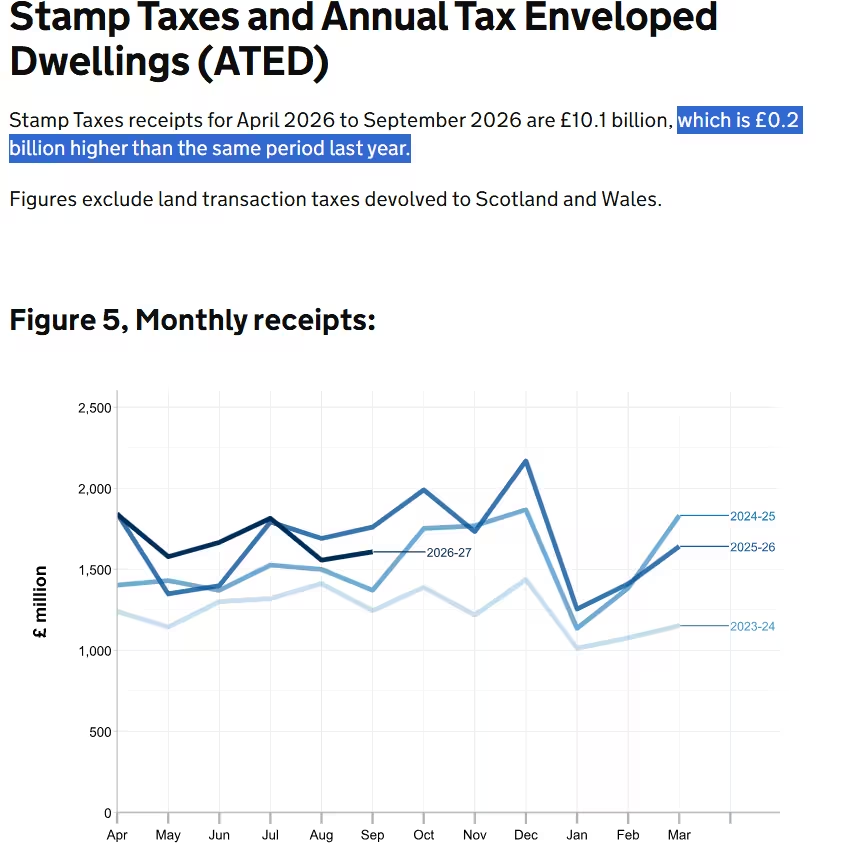
HMRC’s October 2026 tax receipts bulletin shows £10.1 billion in stamp tax and ATED receipts during April–September 2026, approximately £200 million above the comparable period.
What Did the October 2026 Budget Change for Stamp Duty and Property Investors?
The political context changed substantially on 28 October 2026 when Chancellor John Healey delivered the Autumn Budget.
Rachel Reeves, who introduced the October 2024 stamp duty surcharge increase, had been replaced as Chancellor in July 2026.
The October 2026 Budget did not announce a general reduction in residential Stamp Duty Land Tax rates for ordinary buyers.
Instead, its property-related announcements included changes affecting landlords, high-value homeowners, property income and certain specialist transactions.
For investors, the most important development was not an immediate reduction in stamp duty.
It was the updated outlook for property-related taxation and the growing evidence that higher borrowing costs and weakening transaction activity could affect Treasury revenue.
Our review of the October 2026 property tax changes identifies a combination of pressures that property businesses should consider when planning acquisitions for 2027.
What Has the OBR Forecast for Stamp Duty Receipts in 2027?
The OBR’s October 2026 Economic and Fiscal Outlook revised its forecast for SDLT receipts significantly below its March estimates.
| Financial year | Revision to SDLT receipts forecast compared with March 2026 |
| 2026–27 | -£3.2bn |
| 2027–28 | -£3.5bn |
| 2028–29 | -£3.7bn |
| 2029–30 | -£4.2bn |
| 2030–31 | -£4.2bn |
These figures represent changes in forecasts, not confirmed losses or the estimated financial cost of one particular Budget decision.
The OBR attributed the weaker outlook mainly to lower-than-expected receipts, weaker house price assumptions and reductions to forecast property transactions.
Its wider forecast for property transaction taxes, which also includes devolved property transaction taxes and the Annual Tax on Enveloped Dwellings, projects £16.5 billion for 2026–27 and £18.4 billion for 2027–28.
That represents an expected increase of approximately 11.5% between those financial years.
The forecast therefore does not predict that receipts will keep falling indefinitely.
Instead, it suggests a weaker starting position followed by a gradual recovery, subject to economic and housing-market conditions.
For property investors, this is significant because Treasury revenue forecasts depend partly on the same market factors that influence private investment returns.
If transaction activity or property values remain weaker than expected, the government’s projected revenues could face further pressure.
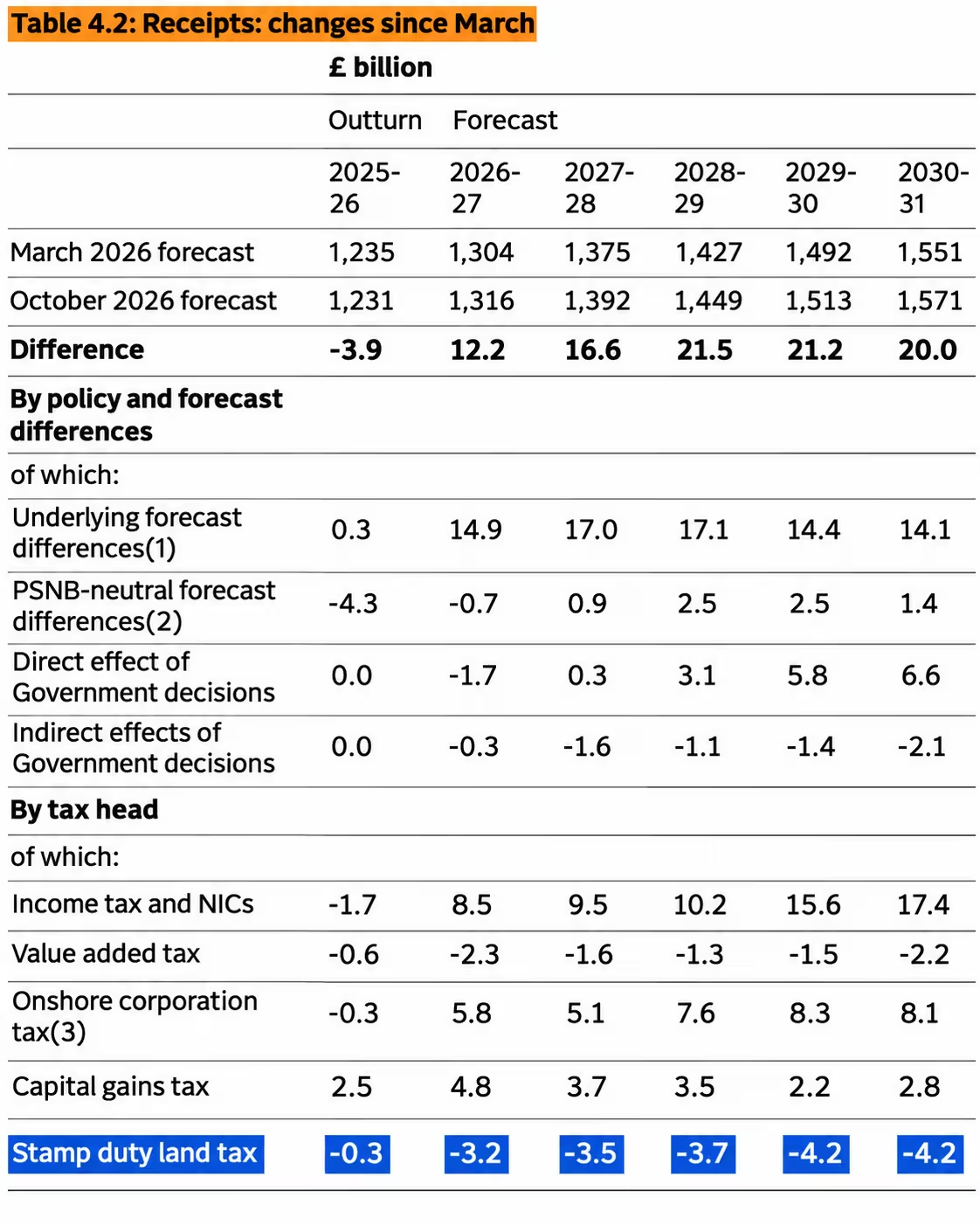
The OBR’s October 2026 Economic and Fiscal Outlook revises expected Stamp Duty Land Tax receipts down by £3.2 billion for 2026–27 and £3.5 billion for 2027–28 compared with March 2026 forecasts.
What Are the Stamp Duty Rates for 2027?
As of November 2026, the residential SDLT rates applicable in England and Northern Ireland remain based on the thresholds introduced from April 2025.
No general residential rate reduction for 2027 was announced in the October 2026 Budget.
The amount payable depends on the property’s price, the buyer’s existing ownership interests, residence status and eligibility for relief.
Residential Stamp Duty Rates for England and Northern Ireland
| Property price band | Standard SDLT rate | Typical additional-property rate |
| Up to £125,000 | 0% | 5% |
| £125,001–£250,000 | 2% | 7% |
| £250,001–£925,000 | 5% | 10% |
| £925,001–£1.5m | 10% | 15% |
| Above £1.5m | 12% | 17% |
These rates apply progressively to the relevant portions of the property purchase price.
The higher rates generally apply when the purchase results in the buyer owning more than one residential property, subject to the statutory conditions and exemptions.
A qualifying non-UK resident buyer may also face an additional 2% surcharge.
First-time buyer relief remains available to qualifying purchasers, with no SDLT payable on the first £300,000 and 5% charged on the portion between £300,001 and £500,000.
That relief is unavailable if the total property price exceeds £500,000.
The tax arrangements differ in Scotland and Wales, where separate property transaction taxes operate.
For buyers entering the housing market through Rent to Buy arrangements, stamp duty and other acquisition costs remain important when calculating how much needs to be saved before completing a purchase.
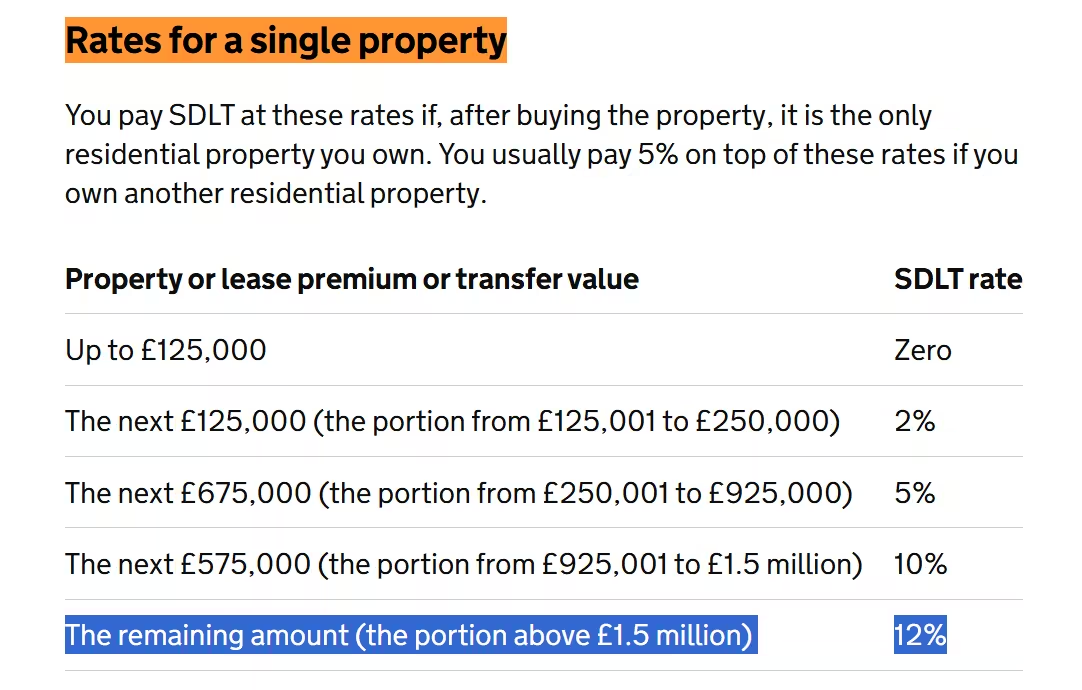
Official residential Stamp Duty Land Tax rates for England and Northern Ireland, showing the standard marginal bands and the additional-property surcharge.
How Much Stamp Duty Could London Property Buyers Pay in 2027?
The financial effect of higher transaction taxes becomes more apparent when examining specific purchase prices.
Using the residential rates in force in November 2026, we calculated illustrative SDLT liabilities across several property values.
Estimated Stamp Duty Costs by Purchase Price
| Purchase price | Standard buyer | Additional-property buyer | Additional-property buyer also subject to 2% non-resident surcharge |
| £500,000 | £15,000 | £40,000 | £50,000 |
| £1 million | £43,750 | £93,750 | £113,750 |
| £2 million | £153,750 | £253,750 | £293,750 |
| £5 million | £513,750 | £763,750 | £863,750 |
These examples assume ordinary residential marginal bands, the applicable additional-property surcharge and, where specified, the separate non-resident surcharge. They exclude special company-purchase provisions, reliefs and other circumstances that could affect the final liability.
A qualifying additional-home buyer purchasing a £5 million property could therefore face £763,750 in stamp duty.
That is approximately 15.3% of the property’s purchase price before conveyancing, surveys, mortgage fees or other expenses.
For a purchaser who also pays the non-resident surcharge, the illustrative liability increases to £863,750, or approximately 17.3% of the acquisition price.
These amounts can influence investment decisions even among buyers who are not dependent on conventional mortgages.
Stamp duty increases the initial investment without directly producing rental income or increasing the property’s physical value.
It can also make a relatively short holding period less attractive.
A purchaser who expects to sell a property after three years must account for the fact that SDLT is generally an acquisition expense rather than an amount automatically recovered when the property is sold.
Our assessment is that property investors should evaluate the total acquisition cost rather than focusing exclusively on the purchase price.
That approach is particularly important when considering turnkey investment properties, where renovation costs may be reduced but transaction taxes and ongoing operating expenses can still affect financial performance.
Why Is London’s Luxury Property Market Particularly Exposed?
London represents one of the UK’s most valuable residential property markets.
Prime neighbourhoods such as Mayfair, Knightsbridge, Belgravia, Kensington and Chelsea contain a concentration of homes that can generate substantial stamp duty liabilities.
These markets also attract buyers whose purchasing decisions may be influenced by international taxation, currency movements, investment structures and residency considerations.
When the cost of acquiring an expensive property rises, potential buyers may reassess whether the investment is financially attractive compared with alternatives.
A wealthy buyer can potentially postpone a purchase, acquire a less expensive property or allocate capital elsewhere.
This does not mean every buyer will react in the same way.
Nevertheless, it helps explain why transactions involving expensive homes can be sensitive to changes in taxation.
Knight Frank’s October 2026 research also identified some improvement in parts of London’s premium residential market.
Prime central London prices recorded quarterly growth of approximately 0.3% in September 2026, the first positive quarterly reading in four years.
Transaction volumes across prime central and outer London declined by approximately 2.5% in the year to September, compared with a 14% annual decline recorded in March.
These figures suggest some stabilisation after a weaker period, but they do not confirm that the market has entered a sustained recovery.
What Do Wider UK Housing Statistics Reveal?
Evidence from the wider housing market reinforces the importance of examining several indicators together.
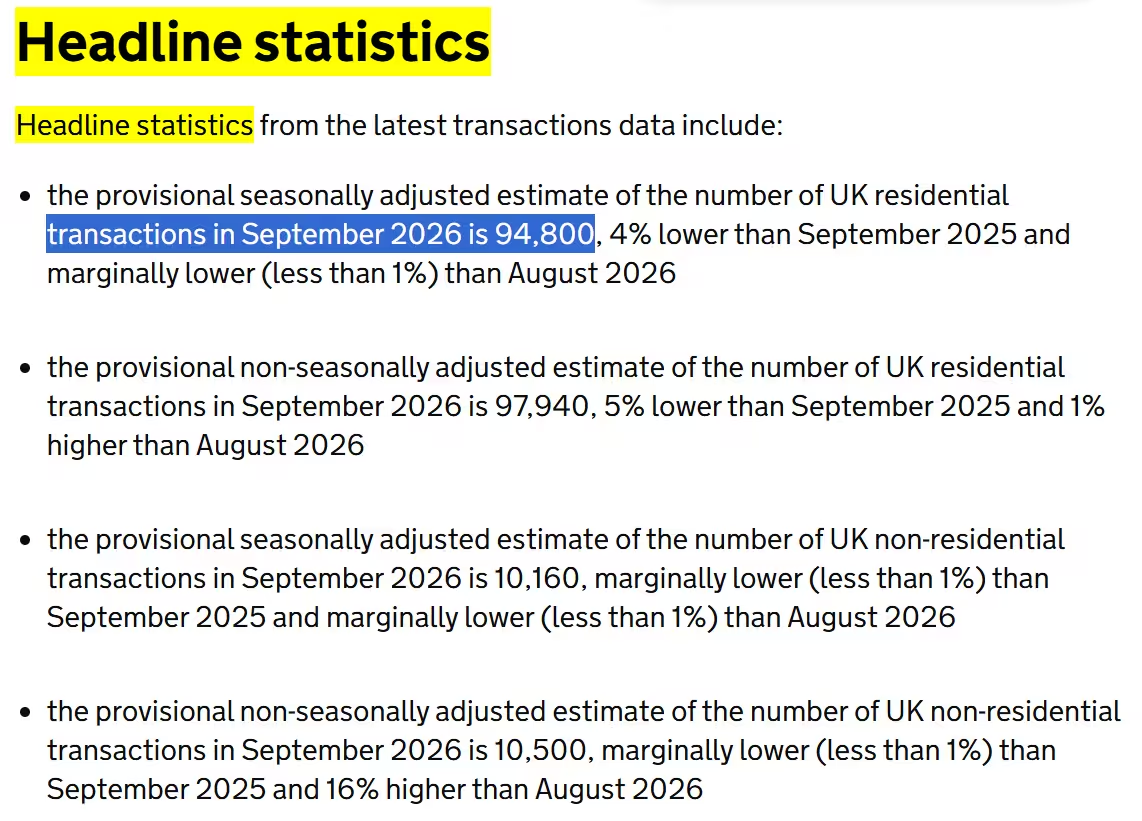
HMRC’s property transaction statistics, published on 30 October 2026, estimated 94,800 seasonally adjusted UK residential transactions in September.
That was approximately 4% below September 2025.
The Bank of England also reported that mortgage approvals for house purchases decreased to 53,400 in September 2026, below the preceding six-month average of approximately 58,800.
Nationwide’s October 2026 House Price Index recorded annual UK house price growth of just 0.5%, the weakest annual growth rate since January 2024.
These measurements describe different stages of the housing market.
Mortgage approvals offer a forward-looking indication of buyer activity, while completed transactions and tax receipts reflect purchases that have already progressed.
House price indices provide information about changing valuations.
Our analysis suggests that all three measures should be considered when evaluating the outlook for stamp duty receipts.
The Nationwide UK property price slowdown also illustrates why national averages can conceal considerable regional differences, particularly when London’s expensive residential market faces different financial pressures from more affordable parts of Britain.
HMRC recorded an estimated 94,800 seasonally adjusted UK residential transactions in September 2026, approximately 4% below the equivalent month in 2025.
What Are Property and Investment Professionals Saying About the Decline?
Published professional commentary indicates concern about the relationship between higher property taxation and Britain’s attractiveness to international investors.
Tom Bill, the author of Knight Frank’s October 2026 analysis, examined the fall in high-value transactions alongside changes affecting internationally mobile buyers.
His research highlighted the importance of comparing overall receipts rather than assuming that higher tax rates necessarily produce greater revenue.
Leslie Macleod-Miller, chief executive of Foreign Investors for Britain, was critical of the wider investment environment.
In his comments to Knight Frank, he described the stamp duty decline as:
“The stamp duty loss is one of many indicators”
He argued that the figures reflected a wider problem with Britain’s international competitiveness.
His organisation has promoted changes intended to attract overseas investment, including an investor visa proposal.
That position represents an industry advocacy perspective and should not be treated as independent proof that the tax changes caused the entire revenue reduction.
Roarie Scarisbrick, of buying agency Property Vision, was also critical of Britain’s attractiveness to overseas buyers.
In commentary reported in October 2026, he said the country had:
“not been a welcoming, appealing place for international friends”
This reflects the experiences and concerns being expressed within sections of the prime residential property industry.
However, we should distinguish these professional opinions from independently verified economic outcomes.
The published figures establish that transactions declined within Knight Frank’s selected market.
They do not establish how many individual purchasers moved abroad, changed their tax residence or abandoned a property transaction specifically because of SDLT.
Our review of these professional perspectives suggests that stable tax rules and predictable acquisition costs could play a meaningful role in rebuilding investor confidence.
Nevertheless, the strength of any future recovery will also depend on borrowing costs, property valuations and wider economic conditions.
How Could Higher Property Taxes Affect London Landlords in 2027?
Stamp duty is only one component of the financial burden facing property investors.
From 6 April 2027, the government plans to increase tax rates on qualifying property income for individuals.
The October 2026 Budget confirmed rates of 24%, 44% and 49% for the property basic, higher and additional rates in England, Wales and Northern Ireland.
These changes increase the importance of evaluating the return available after operating costs, financing expenses and taxation.
Consider a hypothetical buy-to-let property purchased for £500,000.
Assume it generates rental income of £2,250 per month.
Annual gross rental income would be £27,000, creating a gross yield of 5.4% against the purchase price.
If the buyer qualifies for the additional-property SDLT rates, the stamp duty liability would be £40,000.
The total acquisition cost would rise to £540,000 before legal fees or other expenses.
Measured against that purchase price plus SDLT, the gross rental yield falls to 5%.
| Investment calculation | Illustrative amount |
| Property purchase price | £500,000 |
| Monthly rental income | £2,250 |
| Annual gross rental income | £27,000 |
| Gross yield on purchase price | 5.4% |
| Additional-property stamp duty | £40,000 |
| Purchase price plus SDLT | £540,000 |
| Gross yield on price plus SDLT | 5.0% |
These figures are illustrative assumptions, not average rental values or guaranteed investment returns.
They exclude mortgage interest, maintenance, insurance, management charges, periods without tenants and tax on rental profits.
The actual cash return could therefore be considerably lower.
Our assessment of renting out a property highlights the importance of examining operating costs and landlord responsibilities before assuming that rising rental income will translate into higher profits.
Investors also need to consider how frequently rents can be reviewed and whether local tenant affordability supports the increases required to cover higher costs.
London’s rent increase rules can influence how landlords respond to financial pressure.
Meanwhile, recent analysis of landlord property sales losses shows why resale values and exit costs deserve as much attention as projected rental income.
Will the £2 Million Mansion Tax Increase Property Costs in 2027?
Another significant development concerns the High Value Council Tax Surcharge.
The government confirmed further details of this measure in October 2026.
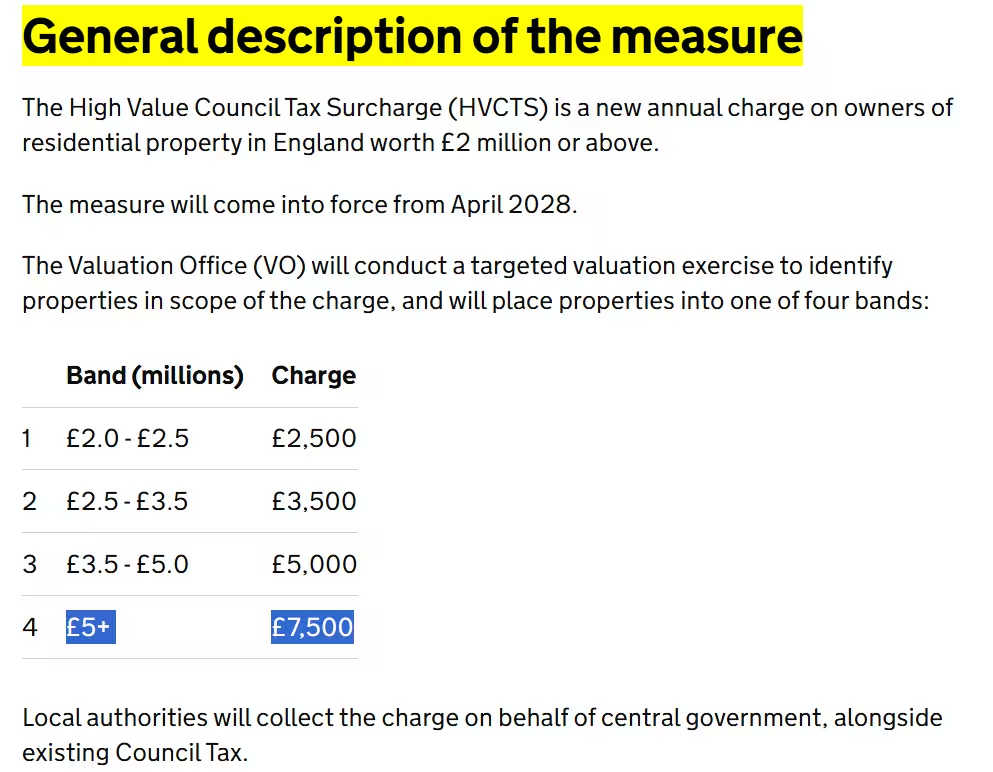
The surcharge will apply to qualifying residential properties in England valued at £2 million or more, but it is scheduled to take effect in April 2028, not April 2027.
The proposed annual charges are:
| Property valuation | Annual surcharge |
| £2m to below £2.5m | £2,500 |
| £2.5m to below £3.5m | £3,500 |
| £3.5m to below £5m | £5,000 |
| £5m and above | £7,500 |
These charges are additional to ordinary Council Tax.
For investors considering acquisitions in 2027, the forthcoming surcharge may affect longer-term ownership calculations even though it is not scheduled to begin until the following year.
A purchaser acquiring a £5 million London property could potentially face an additional £7,500 annual charge from April 2028, subject to the final applicable rules and any reliefs.
The government has also confirmed plans for discounts, exemptions and a deferral scheme.
The distinction between transaction taxes and annual property charges matters.
Stamp duty is ordinarily paid when a taxable property acquisition takes place.
The High Value Council Tax Surcharge will instead create an ongoing liability for qualifying ownership.
Our financial interpretation is that investors should model both types of expense when estimating the total cost of holding expensive residential assets.
HMRC’s October 2026 policy announcement confirms the High Value Council Tax Surcharge bands, with annual charges ranging from £2,500 to £7,500 from April 2028.
Could Stamp Duty Receipts Recover in 2027?
A recovery is possible, but it should not be confused with a guaranteed improvement in every property market segment.
The OBR’s October 2026 projections anticipate that wider property transaction tax revenue will rise from £16.5 billion in 2026–27 to £18.4 billion in 2027–28.
This represents expected growth of approximately 11.5%.
However, those forecasts remain below earlier expectations.
For London, the outcome will depend partly on whether transaction volumes recover sufficiently to offset continued pressure on property values.
Borrowing conditions will be central to the outlook.
If mortgage affordability improves, more buyers may be able to complete purchases.
Similarly, increased confidence among international investors could support activity in the prime market.
However, if acquisition costs remain high and buyers continue postponing decisions, the recovery could be slower than forecast.
How Sensitive Is Luxury Stamp Duty Revenue to Transaction Volumes?
We calculated an illustrative scenario using Knight Frank’s estimated £2.855 billion in receipts from the later 18-month comparison period.
Assuming the average estimated tax per transaction remains unchanged:
| Illustrative scenario | Estimated receipts across an equivalent 18-month period |
| 10% fewer qualifying transactions | £2.570bn |
| Transactions remain at the same level | £2.855bn |
| 10% more qualifying transactions | £3.141bn |
This simplified model illustrates how changes in transaction activity can affect revenue.
It is not an official forecast for 2027, and actual outcomes would also depend on purchase prices, buyer circumstances, reliefs and the composition of completed sales.
Nevertheless, the calculation highlights why the Treasury has an interest in maintaining a functioning property market.
The potential tax benefit from higher rates must be considered alongside the possibility that some transactions will not proceed.
What Should Property Buyers, Sellers and Investors Watch in 2027?
Our analysis identifies several considerations likely to influence property market decisions during 2027.
- Property transaction volumes: HMRC’s monthly statistics will reveal whether completed sales recover across the wider UK market. Regional and price-band differences will be particularly important.
- Mortgage affordability: Lending rates, mortgage approvals and refinancing conditions will affect both owner-occupiers and investment purchasers.
- High-value property demand: Activity in prime central London will provide evidence of whether internationally mobile buyers and wealthy domestic purchasers are returning to the market.
- Property tax legislation: Buyers should monitor the implementation of the October 2026 Budget measures and any further announcements concerning SDLT or annual property charges.
- Rental profitability: Landlords should consider the scheduled April 2027 property income tax increases alongside mortgage costs and the financial impact of the forthcoming 2028 surcharge.
- Leasehold ownership costs: London flat buyers should also examine service charges, planned major works and ground rent obligations before committing to a purchase.
For property entrepreneurs, the central principle is to evaluate an investment using total acquisition costs, realistic income expectations and the likely costs of selling.
A property may remain attractive over a long holding period while becoming financially unattractive for a short-term investment because of high transaction expenses.
The same reasoning applies to homeowners.
A buyer planning to move again within a few years should consider whether stamp duty, legal costs and potential future selling expenses could outweigh the expected financial benefits of the purchase.
Final Thoughts
The estimated £541 million reduction in stamp duty receipts from England’s luxury property market has highlighted the financial risks associated with taxes that depend on completed transactions.
Knight Frank’s research identified 14% fewer qualifying property sales and approximately 16% lower estimated receipts following Rachel Reeves’ October 2024 Budget.
However, these findings do not establish that the tax increase alone caused the decline or that total UK stamp duty revenue fell by the same amount.
The October 2026 Budget and the OBR’s revised forecasts provide a more complete picture of the challenges facing the property market.
For 2027, the important question is whether improving transaction activity and investor confidence can support a recovery while property buyers and landlords continue managing substantial acquisition and ownership costs.
Our overall assessment is that Britain’s luxury property tax debate should focus on the relationship between tax rates, transaction volumes and the long-term strength of the property market.
For London buyers, landlords and property businesses, a sustainable investment decision will depend less on predicting a particular tax announcement and more on understanding the full financial implications of acquiring, holding and eventually selling property.
Frequently Asked Questions
How much have Rachel Reeves’ stamp duty receipts fallen?
Knight Frank estimated a £541 million decline in stamp duty receipts associated with English residential property sales above £5 million when comparing the 18 months before and after the October 2024 Budget.
The estimate does not represent a confirmed £541 million decline in total UK stamp duty revenue.
Why did luxury property sales fall by 14%?
Higher transaction taxes, mortgage costs, changes affecting international investors and wider economic uncertainty may all have contributed.
Knight Frank recorded a reduction from 2,569 to 2,208 qualifying sales, but the available evidence does not establish that stamp duty changes alone caused the decline.
Will stamp duty increase in 2027?
The October 2026 Budget did not announce a general increase in residential SDLT rates for 2027. As of November 2026, the existing residential bands remain the applicable basis for planning, although future government decisions could change the rules.
How much stamp duty would someone pay on a £5 million house?
Under the standard residential bands, a £5 million purchase in England would normally attract £513,750 in SDLT. A qualifying additional-property purchase would attract approximately £763,750, increasing to £863,750 if the separate 2% non-resident surcharge also applies. Special circumstances or reliefs can change these amounts.
Will stamp duty receipts recover in 2027?
The OBR forecasts wider property transaction tax revenue of £18.4 billion in 2027–28, compared with £16.5 billion in 2026–27. That implies a recovery of approximately 11.5%, but it remains a forecast rather than a confirmed outcome.
Is the £2 Million Mansion Tax Starting in 2027?
No. The High Value Council Tax Surcharge is scheduled to begin in April 2028 for qualifying residential properties in England worth at least £2 million. Annual charges are planned to range from £2,500 to £7,500, with applicable exemptions, discounts and deferral arrangements.
Is Rachel Reeves Still the Chancellor of the Exchequer?
No. John Healey became Chancellor in July 2026 and delivered the October 2026 Budget. Rachel Reeves introduced the stamp duty surcharge increase in October 2024, which remains the subject of the Knight Frank research.
Adam is a London business and news writer at London Insider News, covering local developments, finance, entrepreneurship and the stories shaping businesses and communities across the capital.
More from PROPERTY

Right to Rent Share Code 2027: How to Get, Generate and Check Your Code Online?
Updated: 4 November 2026 | 2027 Guide A Right to Rent share code is a nine-character…

John Healey Budget Property Tax Raid: Landlords Face Higher Taxes as £2m Mansion Levy Stays
Chancellor John Healey has announced a fresh property tax increase in the October 2026 Budget, with…

Nationwide UK Property Price Drop: Will House Prices Fall Further in 2027? Latest 2026 Figures and Forecasts
The Nationwide UK property price drop has become an increasingly important issue for homeowners, first-time buyers,…