How to Rent Out Your House in 2027? Complete UK Landlord Guide, Costs, Tax and 2026 Rules
Renting out your house in 2027 involves new landlord rules, property taxes and compliance costs. Explore the steps, legal requirements and potential rental profits.
 Adam
London Business & News Writer

Renting out your house in 2027 could generate regular income, help you retain a valuable property asset and provide an alternative to selling your home.
However, higher property taxes, borrowing costs and major changes to England’s rental legislation mean that becoming a landlord requires more financial preparation than simply finding a tenant.
The Renters’ Rights Act introduced significant changes on 1 May 2026, including the abolition of Section 21 no-fault evictions and a new system of rolling tenancies. The October 2026 Budget also confirmed plans to increase property income tax rates to 24%, 44% and 49% from 6 April 2027, subject to the necessary legislation.
Our analysis of official housing guidance, mortgage market data, property-sector commentary and landlord financial obligations indicates that prospective landlords should evaluate three factors before renting out a property: legal compliance, realistic after-tax income and long-term ownership costs.
This guide explains how to rent out your house step by step, what certificates and permissions you need, how much it could cost and whether becoming a landlord remains financially worthwhile in 2027.
Can You Legally Rent Out Your House in the UK in 2027?
Yes. You can generally rent out a house you own, whether you purchased it as an investment, inherited it or previously occupied it as your main residence.
However, ownership does not automatically give you unrestricted permission to let the property.
The requirements depend on your mortgage agreement, property ownership structure, local authority regulations and the type of tenancy you intend to create.
| Situation | Can you rent out the property? | Main requirement |
| House owned outright | Generally yes | Meet landlord and licensing obligations |
| House with residential mortgage | Usually, with permission | Obtain lender consent or suitable mortgage |
| Buy-to-let property | Yes | Follow mortgage and letting conditions |
| Leasehold flat | Depends on lease | Check subletting restrictions and consent |
| Inherited house | Generally yes | Confirm ownership and estate arrangements |
| Shared ownership property | Often restricted | Obtain any required permissions |
| Former family home | Generally yes | Review mortgage, insurance and tax implications |
| Council or housing association property | Normally not without express permission | Check tenancy and statutory restrictions |
Landlords must also distinguish between the four UK nations. The detailed tenancy reforms discussed throughout this article apply primarily to England, including London.
Wales has its own Renting Homes framework, while Scotland and Northern Ireland operate different tenancy, licensing and possession arrangements.
How Do You Rent Out Your House Step by Step?
Our review of the property letting process identifies 12 important stages that homeowners should complete before and after accepting tenants.
Step 1: Obtain Permission From Your Mortgage Lender
If your home has an outstanding residential mortgage, you will normally need the lender’s approval before renting it out.
Some lenders offer consent to let, particularly when homeowners temporarily move for employment, relocate abroad or move in with a partner.
Other lenders may require a switch to a buy-to-let mortgage.
The main options are:
- Consent to let: Permission to rent out a property while retaining an existing residential mortgage, usually subject to conditions.
- Buy-to-let mortgage: A mortgage specifically arranged for property letting, with different lending and affordability criteria.
- Let-to-buy: An arrangement that may allow you to retain and rent your previous home while purchasing another residence.
Do not assume that paying your mortgage on time automatically permits you to rent out the property.
Letting without approval can breach your mortgage conditions and potentially invalidate relevant insurance protection.
If you own a leasehold flat, you should also check whether the freeholder’s consent is needed before subletting.
Step 2: Research the Rental Value of Your Property
Determining the correct rent is one of the most important financial decisions landlords make.
An asking rent should reflect the property’s actual market position, not simply the income the owner needs to cover their mortgage.
Compare similar properties based on location, bedrooms, condition, transport connections, energy efficiency, parking and furnishing arrangements.
For example, two comparable properties in London may attract different rents because one is significantly closer to a railway station or employment centre.
It is also important to understand the difference between weekly and monthly rental advertisements.
A property advertised at £450 per week generates an annual headline rent of £23,400, equivalent to £1,950 per calendar month.
The correct calculation is:
Weekly rent × 52 ÷ 12 = Monthly equivalent
Understanding what PW means in rent and PCM rental prices helps landlords compare competing advertisements accurately.
Our financial assessment is that maximising the asking rent does not always maximise annual income.
Consider two scenarios:
| Scenario | Monthly asking rent | Occupied months | Annual rental income |
| Higher asking rent | £2,100 | 10 | £21,000 |
| Competitive asking rent | £2,000 | 12 | £24,000 |
The lower-priced property produces £3,000 more annual rental income in this example because it remains occupied.
These are illustrative occupancy scenarios, not market forecasts.
Landlords should also examine how much rent London households can afford when assessing demand and setting realistic asking prices.
Step 3: Check Local Council Licensing Requirements
Not every privately rented house needs a landlord licence, but some properties cannot lawfully be let without one.
The three main licensing categories are:
| Licence type | When it applies |
| Mandatory HMO licence | Generally required for properties occupied by five or more people forming at least two households and sharing facilities |
| Additional HMO licence | Applies to smaller HMOs covered by a council’s designated scheme |
| Selective landlord licence | May apply to ordinary privately rented properties within designated local authority areas |
A property occupied by three unrelated adults sharing a kitchen or bathroom may qualify as a house in multiple occupation, even if mandatory HMO licensing does not apply.
For example, a three-bedroom London house rented to one family may not require an HMO licence. However, it could still require a selective licence if the local borough operates such a scheme.
Before advertising, check the exact property address through your local council.
Licensing costs vary considerably by authority and property type, so landlords should obtain the current fee rather than assume a single national price.
Step 4: Complete the Required Property Safety Checks
Landlords must provide accommodation that is safe, properly maintained and suitable for residential occupation.
For a typical private rental in England, the main responsibilities include:
| Requirement | General rule |
| Gas safety | Annual safety checks of relevant gas appliances and flues by a Gas Safe registered engineer |
| Electrical safety | Electrical installations inspected at least every five years, or sooner where required |
| Energy Performance Certificate | Generally a minimum EPC rating of E, unless a valid exemption applies |
| Smoke alarms | Required on each storey used as living accommodation |
| Carbon monoxide alarms | Required in rooms containing specified fixed combustion appliances, excluding gas cookers |
| Furniture fire safety | Landlord-provided upholstered furnishings must meet applicable standards |
| Property condition | Structure, heating, sanitation, ventilation and other installations must be properly maintained |
| Water and damp | Identify and address significant hazards, including dangerous damp and mould |
A gas safety record must be supplied to a new tenant before occupation. An existing tenant must normally receive an updated record within 28 days of the inspection.
The electrical installation report must also be provided within the applicable statutory timeframes.
Having the relevant certificates does not remove the landlord’s broader responsibility to address dangerous housing conditions.
Step 5: Check the EPC and Prepare for Future Energy Rules
Energy efficiency is increasingly important when assessing the long-term cost of renting out a house.
For covered domestic private rented properties in England and Wales, the existing minimum energy efficiency requirement generally remains EPC E, unless a valid exemption applies.
However, the government confirmed in January 2026 that a higher standard is planned for 1 October 2030.
The policy is intended to require privately rented homes to achieve EPC C or an equivalent standard, subject to the final implementing legislation and available exemptions.
The government’s published framework includes a £10,000 improvement cost cap per property, with qualifying exemptions and transitional provisions.
This does not mean every landlord must immediately spend £10,000.
An owner considering letting a poorly insulated house in 2027 should nevertheless estimate the potential cost of improving:
- Loft and cavity wall insulation.
- Draught-proofing and thermal performance.
- Heating controls and system efficiency.
- Windows and other relevant building improvements.
- Ventilation where necessary to prevent moisture problems.
For landlords purchasing or retaining older houses, future compliance expenditure should form part of the investment assessment.
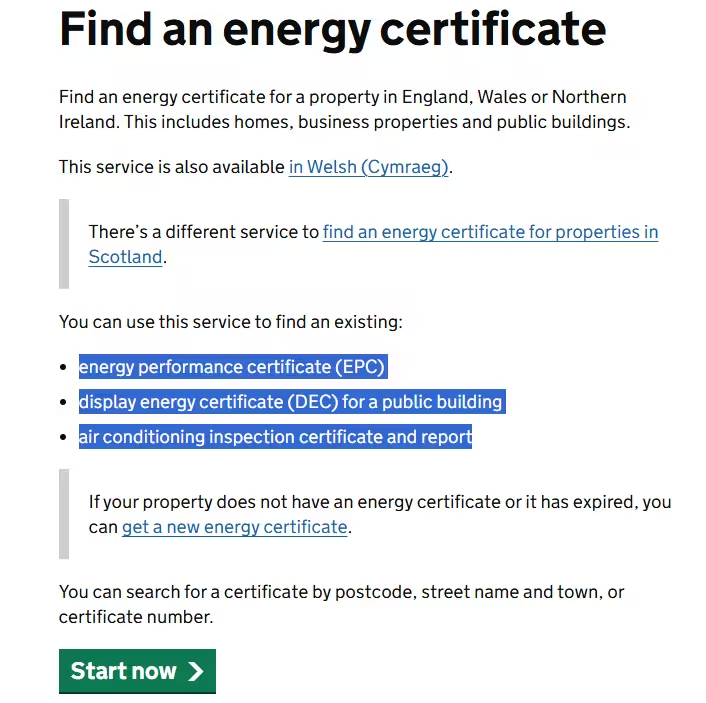
Official Energy Performance Certificate search showing how landlords can find an existing EPC and check a property’s energy efficiency rating.
Step 6: Prepare the Property for Tenants
A rental property should be clean, secure and in good working condition before occupation.
Inspect the heating system, boiler, doors, windows, plumbing, electrical fittings and any supplied appliances.
Repair damage and investigate leaks rather than covering them with decoration.
Landlords should also decide whether to advertise the property furnished or unfurnished.
A furnished property may appeal to students, relocating professionals or certain short-term occupiers, depending on the tenancy arrangement.
An unfurnished home may attract households intending to stay longer and bring their own furniture.
Neither approach guarantees a higher financial return.
Our assessment is that spending money on essential maintenance and durable fixtures usually has a stronger operational justification than expensive decorative upgrades that tenants may not value.
Step 7: Arrange Suitable Landlord Insurance
Ordinary homeowner insurance may not provide appropriate cover once tenants occupy the property.
Landlords should inform their insurer about the change in occupation and obtain cover suitable for their circumstances.
Available policy features may include buildings insurance, landlord-owned contents, property owners’ liability and optional rent protection.
If you own a leasehold flat, some buildings insurance may already be arranged through the freeholder and funded through service charges.
Landlords should check for duplicate cover and understand any policy exclusions.
Step 8: Decide Whether to Use a Letting Agent
You can rent out your own house without a letting agent.
However, self-management means dealing directly with tenants, arranging repairs, maintaining compliance records and monitoring rental payments.
Letting agents can provide tenant finding, referencing, rent collection and full property management.
Illustrative management fees are often modelled as a percentage of rent, but actual charges differ by location, service and VAT treatment.
For a property generating £2,000 monthly rent:
| Management fee | Monthly charge | Annual charge |
| 8% | £160 | £1,920 |
| 10% | £200 | £2,400 |
| 12% | £240 | £2,880 |
| 15% | £300 | £3,600 |
These examples assume 12 occupied months and percentages inclusive of VAT.
An agent charging 12% on a fully occupied property would cost £2,880 annually.
Before choosing an agency, examine tenant-finding charges, maintenance mark-ups, termination clauses, minimum fees and any additional administrative costs.
The landlord remains responsible for important legal duties even where an agent undertakes day-to-day management.
Step 9: Advertise the Property and Reference Applicants
Create a clear rental advertisement showing the property’s location, size, condition, facilities, EPC information and asking rent.
The 2026 legislation introduced a significant change to the advertising process in England.
For covered lettings, landlords and agents must advertise a specific asking rent and cannot invite, encourage or accept offers above that amount.
For example, where a house is advertised at £1,900 per month, the landlord cannot accept an applicant’s offer of £2,050 simply to outbid competing tenants.
Landlords may still carry out lawful, proportionate affordability assessments and request appropriate references.
Typical checks include income evidence, employment information, previous landlord references and permitted credit checks.
However, the Renters’ Rights Act also prohibits discrimination against prospective tenants because they receive benefits or have children.
An applicant’s income sources should be considered fairly.
For households receiving housing assistance, understanding Universal Credit support towards private rent can help landlords evaluate the wider affordability position without automatically rejecting benefit recipients.
Step 10: Complete Right to Rent Checks
In England, landlords must conduct prescribed Right to Rent checks for adult occupiers covered by the scheme.
These checks establish whether an applicant is legally permitted to rent residential accommodation.
Depending on the applicant’s circumstances, verification may involve accepted identity documents, an authorised digital identity service or the Home Office’s online checking system.
Some applicants with digital immigration status provide a nine-character share code.
Landlords can use it alongside the applicant’s date of birth to access the official verification result.
Our detailed explanation of the Right to Rent share code covers the checking process, document requirements and relevant 2026 updates.
Landlords should apply checks consistently, retain required records securely and arrange follow-up verification where legally necessary.
Right to Rent checks apply in England, not Scotland, Wales or Northern Ireland.
Step 11: Prepare the Tenancy Agreement and Handle Payments
For most new private assured tenancies in England, the traditional fixed-term assured shorthold tenancy has been replaced by an assured periodic tenancy.
These agreements generally operate on a rolling basis without a contractual end date.
Landlords must provide the required written tenancy information, and the agreement should clearly identify the parties, property, rent, payment schedule and lawful responsibilities.
The 2026 rules also changed when advance rent can be requested.
For covered tenancies, landlords cannot ask for, encourage or accept rent before the tenancy agreement has been signed.
After signing but before occupation, the maximum advance payment is normally one month’s rent for monthly tenancies, or 28 days’ rent for shorter payment periods. Specific exceptions apply.
Deposit restrictions remain important.
| Payment | General limit |
| Holding deposit | One week’s rent |
| Tenancy deposit where annual rent is below £50,000 | Five weeks’ rent |
| Tenancy deposit where annual rent is £50,000 or more | Six weeks’ rent, where the statutory framework applies |
| Pre-tenancy rent for a monthly tenancy | Normally one month after agreement signing |
| Deposit protection deadline | Within 30 days of receiving the deposit |
Landlords must protect qualifying tenancy deposits in a government-approved scheme and provide the required information.
Step 12: Complete the Inventory and Manage the Tenancy
Before handing over the keys, prepare a comprehensive inventory documenting the property’s condition.
Include dated photographs, meter readings, appliance information and records of existing damage.
The tenant should have an opportunity to review the inventory and raise inaccuracies.
Once the tenancy begins, the landlord or appointed agent should maintain organised records of payments, repairs, inspections, safety certificates and relevant communications.
A reliable maintenance process is particularly important where tenants report heating failures, dangerous defects or serious damp.
The objective is not simply to secure the first rental payment. It is to establish a sustainable tenancy with clear responsibilities and appropriate financial controls.
What Landlord Rules Changed in 2026, and What Is Expected in 2027?
The Renters’ Rights Act 2025 introduced major reforms to the English private rented sector from 1 May 2026.
Other measures are being introduced in phases, so landlords should distinguish between rules already operating and requirements planned for later implementation.
| Reform | Timing or status | What landlords should know |
| Section 21 no-fault eviction abolition | Effective 1 May 2026 | New possession action generally requires a valid legal ground |
| Assured periodic tenancies | Effective 1 May 2026 | Most covered tenancies have no fixed end date |
| Rental bidding restrictions | Effective 1 May 2026 | Offers above the published asking rent cannot be accepted |
| Benefit and child discrimination protections | Effective 1 May 2026 | Blanket exclusions are prohibited |
| Rent increase process | Effective 1 May 2026 | Generally once yearly using Form 4A and at least two months’ notice |
| Pet requests | Effective 1 May 2026 | Landlords must consider requests and cannot unreasonably refuse |
| Private Rented Sector Database | Regional rollout planned from late 2026 into 2027 | Mandatory registration is being introduced in stages |
| Landlord Ombudsman | Later implementation expected | The government’s roadmap anticipates mandatory participation in 2028 |
| Decent Homes Standard and Awaab’s Law extension | Further implementation required | Additional minimum housing standards are planned |
| Higher rental energy efficiency standard | Planned for October 2030 | Landlords should prepare for EPC C or equivalent requirements |
Will Landlords Need to Register Their Properties in 2027?
The government plans to introduce a national Private Rented Sector Database for England.
This is separate from existing local council property licensing schemes.
The database is intended to collect information about private landlords and their properties, including identifying and safety-related details.
A draft 2026 statutory instrument sets out a proposed regional registration timetable, with London scheduled for 15 July 2027.
However, that regional timetable is contained in draft regulations and should not be treated as finally enacted until the necessary parliamentary and commencement processes are completed.
Landlords should monitor confirmed government announcements and avoid assuming an anticipated registration date is already legally binding.
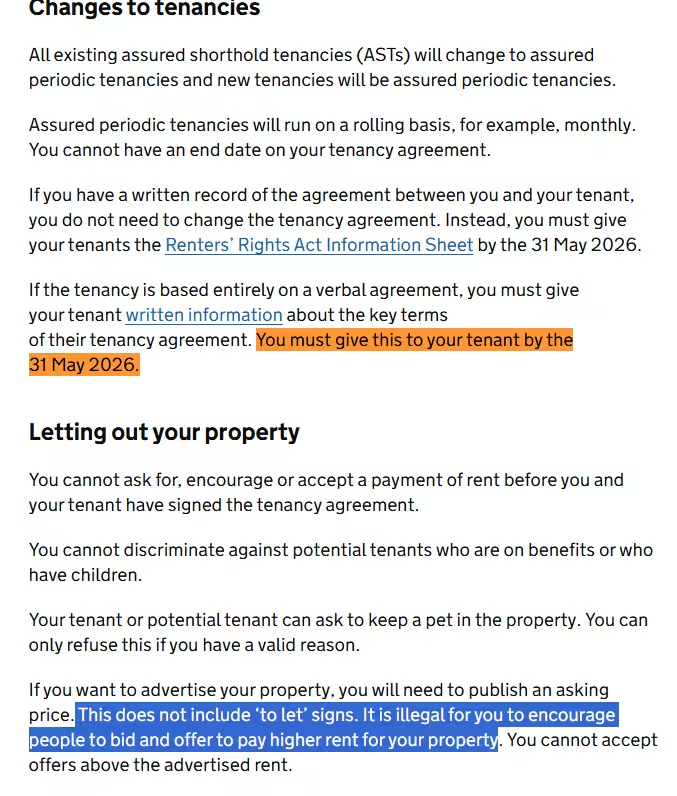
Official landlord guidance explaining the tenancy changes introduced on 1 May 2026, including Section 21 abolition, rolling tenancies and rent increase restrictions.
How Much Does It Cost to Rent Out a House in 2027?
The cost of becoming a landlord depends on the property’s condition, licensing obligations, insurance, mortgage arrangements and whether an agent is appointed.
Our illustrative preparation budget for an ordinary residential letting in England is:
| Expense | Illustrative cost |
| EPC assessment, if needed | £60–£120 |
| Gas safety inspection, where applicable | £70–£140 |
| Electrical installation inspection | £150–£350 |
| Annual landlord insurance | £200–£500 |
| Cleaning and minor property preparation | £300–£1,500 |
| Inventory and check-in | £100–£250 |
| Initial repair contingency | £750–£2,000 |
| Total indicative budget | £1,630–£4,860 |
These are budgeting assumptions rather than verified quotations or nationally representative average prices.
The estimate excludes major repairs, landlord licence fees, mortgage product fees, substantial energy improvements and letting-agent charges.
A property with an outdated boiler, extensive electrical defects or significant damp problems could require considerably more investment.
From a business perspective, landlords should separately budget for initial compliance costs, recurring annual expenses and an emergency cash reserve.
Treating these as one combined expense can make the investment appear more profitable than it really is.
How Much Profit Can You Make From Renting Out Your House in 2027?
Profit depends on more than monthly rent.
Mortgage costs, repairs, vacancies, management fees and taxation can significantly reduce the income a property generates.
Our financial model uses an illustrative London property worth £450,000, with a monthly asking rent of £2,000.
Example: Annual Rental Cash Flow
| Financial item | Annual amount |
| Property value | £450,000 |
| Potential rent at £2,000 per month | £24,000 |
| One vacant month | −£2,000 |
| Actual annual rent received | £22,000 |
| Agent management at 12% of rent received | −£2,640 |
| Landlord insurance | −£350 |
| Safety checks and administration | −£300 |
| Repairs and maintenance | −£1,200 |
| Service charges and other owner expenses | −£1,800 |
| Net operating income before financing | £15,710 |
| Mortgage interest | −£7,500 |
| Cash surplus before Income Tax | £8,210 |
The property generates a pre-tax cash surplus of approximately £684 per month.
However, this is not the same as the amount the landlord can safely spend.
The model excludes mortgage principal repayments, major capital expenditure and exceptional losses.
It also assumes all listed operating expenses are legitimate costs of the property. The actual tax treatment of individual items must be checked separately.
Gross and Net Rental Yield
Gross yield measures the annual advertised rent against the property’s capital value.
Gross rental yield = Annual rent ÷ Property value × 100
For our example:
£24,000 ÷ £450,000 × 100 = 5.33%
A more informative operating calculation deducts vacancy and ordinary operating expenses before financing and tax.
£15,710 ÷ £450,000 × 100 = 3.49%
The net operating yield is therefore approximately 3.5%.
For comparison, published mortgage-industry data for Q2 2026 recorded a UK average gross buy-to-let rental yield of 7.27% and an average interest rate of 4.82% across new buy-to-let loans.
Those are UK market figures, not London-specific returns, and should not be treated as forecasts for an individual property.
James Tatch, Head of Analytics at UK Finance, said in his published October 2026 assessment that:
“Looking ahead, higher borrowing costs are likely weighing down on buy-to-let demand.”
The observation is relevant because borrowing costs can substantially change the return available to landlords even when rental income remains stable.
How Much Could Be Left After 2027 Property Income Tax?
The 2027 property income tax changes make after-tax cash flow especially important.
Consider the same example and assume:
- The £15,710 operating profit is fully taxable before residential finance-cost relief.
- All taxable profit falls within the higher property income tax band.
- The landlord qualifies for the full £1,500 basic-rate finance-cost tax reduction on £7,500 of mortgage interest.
- There are no other relevant adjustments or relief restrictions.
| Calculation | 2026–27 | Planned 2027–28 |
| Property profit before finance costs | £15,710 | £15,710 |
| Assumed marginal property tax rate | 40% | 44% |
| Tax before finance-cost reduction | £6,284 | £6,912.40 |
| Illustrative finance-cost reduction | −£1,500 | −£1,500 |
| Estimated Income Tax | £4,784 | £5,412.40 |
| Cash surplus before tax | £8,210 | £8,210 |
| Cash remaining after tax | £3,426 | £2,797.60 |
| Monthly after-tax cash | £285.50 | £233.13 |
Under these assumptions, the planned higher property-income tax rate reduces annual after-tax cash by £628.40.
This is a simplified marginal-rate comparison, not a personalised tax calculation. Actual liabilities depend on other income, allowances, tax bands, deductible expenditure and the applicable finance-cost relief limits.
It illustrates why a property can generate £24,000 in advertised annual rent while providing its owner with a much smaller amount of disposable cash.
What Tax Will You Pay When Renting Out Your House in 2027?
Rental income is generally taxable after accounting for eligible expenses, allowances and reliefs.
The October 2026 Budget introduced a particularly important development for landlords planning their finances for the 2027–28 tax year.
The government confirmed that property-income tax rates are intended to increase by a combined four percentage points compared with 2026–27.
| Property income tax band | 2026–27 rate | Planned rate from 6 April 2027 |
| Basic | 20% | 24% |
| Higher | 40% | 44% |
| Additional | 45% | 49% |
These property-income rates are planned for England, Wales and Northern Ireland. Scotland’s treatment is subject to its devolved tax framework and relevant decisions.
The changes are scheduled to be legislated through Finance Bill 2026–27.
For a landlord with £10,000 of taxable rental income entirely within one applicable band, the four-percentage-point increase could represent £400 of additional annual tax before accounting for individual adjustments.
Which Landlord Expenses Are Tax-Deductible?
Many ordinary expenses of managing and maintaining a rental property can qualify for deduction when calculating property profits.
Depending on the circumstances, these include management fees, qualifying repairs, landlord insurance, relevant accountancy and legal costs, service charges and utilities paid by the landlord.
Replacing a damaged component with a comparable item may qualify as a repair, while substantial improvements can have different tax treatment.
Individual residential landlords generally cannot deduct mortgage interest in full from rental income when calculating taxable profits.
Instead, they may receive a basic-rate finance-cost tax reduction, subject to applicable restrictions.
The distinction is particularly important for higher-rate taxpayers and heavily mortgaged properties.
Does the £1,000 Property Allowance Apply?
Individuals may qualify for a property income allowance of up to £1,000 per tax year.
However, claiming the allowance instead of deducting actual expenses is not always beneficial.
There are also restrictions and interactions with residential finance-cost relief.
Landlords should compare the relevant treatments rather than assume that taking the allowance automatically produces the lowest tax bill.
For readers following the wider October Budget, the 2027 landlord property tax changes provide additional context about the financial pressures facing property owners.
Timothy Douglas, Head of Policy and Campaigns at Propertymark, described the announced increase as:
“a further disincentive to potential landlords from entering the market”
His published October 2026 comments also raised concerns about the potential implications for rental supply.
These concerns are important to consider, although they do not establish that every landlord will increase rent or that every property will become less profitable.
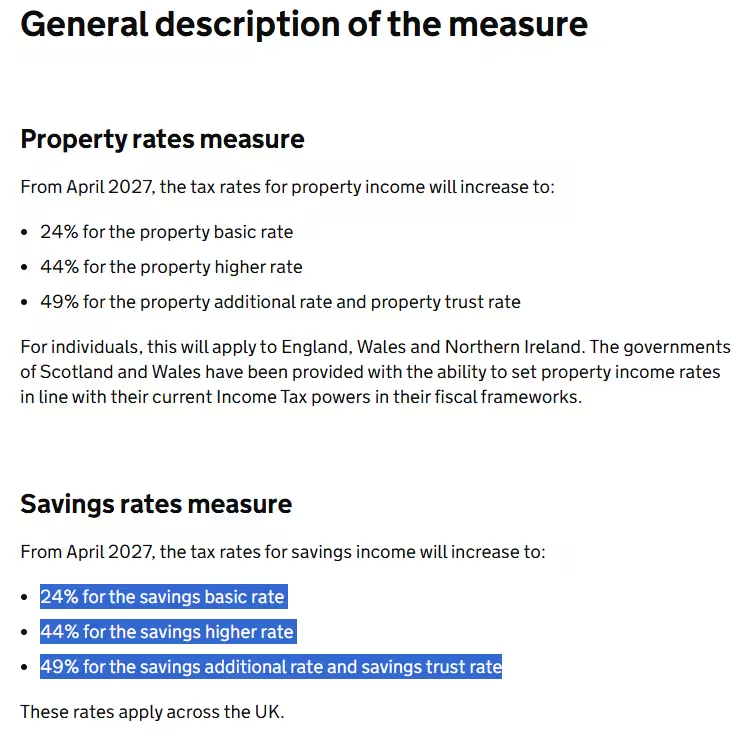
Official October 2026 tax policy confirming the planned property-income tax rates of 24%, 44% and 49% from April 2027.
Will Making Tax Digital Affect Landlords in 2027?
Yes, for landlords whose qualifying income exceeds the relevant thresholds.
Making Tax Digital for Income Tax is being introduced in stages.
| Start date | Qualifying income threshold |
| 6 April 2026 | More than £50,000 |
| 6 April 2027 | More than £30,000 |
| 6 April 2028 | More than £20,000 |
The 2027 threshold is assessed using qualifying income from the 2025–26 tax year, under HMRC’s published timetable.
Qualifying income generally combines relevant gross property and self-employment income, rather than being based simply on net rental profit.
For example, a landlord receiving £24,000 in annual gross rental income may fall below the £30,000 threshold if there is no additional qualifying income.
However, if that person also has £12,000 of qualifying self-employment income, the combined total reaches £36,000.
Subject to the applicable rules and exemptions, that could bring them within the April 2027 requirements.
Landlords within scope must maintain digital records using compatible software and submit the required quarterly updates and year-end information.

HMRC’s official Making Tax Digital eligibility page showing the April 2026, April 2027 and April 2028 income thresholds.
Can You Increase the Rent After Your Tenant Moves In?
Landlords in England can increase rent, but they must follow the legal process applicable to the tenancy.
Since May 2026, covered assured periodic tenancies generally require landlords to use the statutory Section 13 procedure.
This involves serving the prescribed Form 4A, providing at least two months’ notice and complying with the restrictions on frequency.
Rent cannot generally be increased more than once in a 12-month period or during the first 12 months of a new tenancy.
There is no universal statutory percentage ceiling of 3%, 5% or 10% on private rent increases under this system.
However, tenants can challenge a proposed increase that exceeds open-market rent.
For example, a landlord proposing to increase rent from £1,800 to £1,950 per month should examine comparable properties and follow the prescribed process rather than assume the increase is automatically lawful.
The financial consequences of the 2026 reforms are covered in more detail in our analysis of how much a landlord can increase rent in London.
Can You Get Your House Back If You Want to Sell or Move Into It?
Potentially, but landlords must use the appropriate legal possession process.
The abolition of Section 21 means landlords can no longer generally rely on a no-fault eviction notice for covered tenancies.
Instead, they must establish a valid possession ground and comply with the required procedures.
Selling the property or moving into it may constitute a lawful ground in appropriate circumstances.
However, the relevant grounds are generally unavailable during the first 12 months of a tenancy.
Notice requirements differ by possession ground, and a landlord may need a court order if a tenant does not leave.
This is a particularly important consideration for homeowners who intend to rent out their property temporarily.
The property may not be available for immediate personal occupation simply because the owner’s circumstances have changed.
Landlords should review their long-term plans before granting a tenancy rather than assume that renting out a home offers the same flexibility as leaving it vacant.
What Happens If You Rent Out Your House While Living Abroad?
Homeowners can rent out UK property while living overseas, subject to relevant mortgage, insurance and landlord obligations.
However, being outside the UK introduces additional management and tax considerations.
The Non-resident Landlords Scheme applies to certain people whose usual place of abode is outside the UK and who receive UK rental income.
Letting agents may be required to deduct and account for tax under the scheme, unless HMRC has authorised payment of rent without deduction.
Where there is no letting agent, a tenant paying sufficient rent may have obligations under the scheme.
A landlord living abroad should therefore consider appointing an appropriate agent, obtaining tax advice and establishing a reliable process for repairs and tenant communication.
Renting out a former main residence can also affect Capital Gains Tax when the property is eventually sold.
Private Residence Relief may apply to qualifying periods of occupation, but it should not be assumed that all gains will remain exempt after a period of letting.
Can You Rent Out a Room Instead of the Whole House?
Yes, and the financial and legal position may be different.
A homeowner who continues living in their property and lets a furnished room may qualify for the Rent a Room Scheme.
The scheme allows qualifying gross receipts of up to £7,500 per tax year to be exempt from Income Tax, or £3,750 where the income is shared.
This scheme does not automatically apply when an owner moves out and rents the entire property.
The occupier’s legal status can also differ depending on whether they share living accommodation with the resident landlord.
For example, some lodgers occupy under licences rather than the assured periodic tenancy framework that applies to many whole-property rentals.
Homeowners should distinguish these arrangements before relying on ordinary landlord tenancy templates.
Is It Better to Rent Out Your House or Sell It in 2027?
The decision depends on mortgage costs, rental income, ownership expenses, future housing needs and the property’s resale prospects.
Renting may be financially attractive for a homeowner who wants to retain a property and can generate sustainable after-tax income.
Selling may be more suitable if the property requires substantial investment, produces a weak net yield or ties up capital needed elsewhere.
| Consideration | Renting out the property | Selling the property |
| Ownership | Retained | Transferred |
| Regular rental income | Potentially available | No continuing rent from that property |
| Maintenance costs | Remain with owner | Generally end after completion |
| Mortgage commitments | May continue | Normally settled on completion |
| Property price exposure | Retained | Removed for the sold asset |
| Tax | Rental Income Tax and possible future CGT | Potential CGT depending on circumstances |
| Liquidity | Capital remains tied up | Equity may be released |
| Time commitment | Ongoing management required | Usually ends after completion |
Property investors should avoid assuming that house prices will consistently rise.
Recent UK property price changes illustrate why capital appreciation should be treated as uncertain rather than guaranteed.
Research into landlord property sales losses also highlights the importance of evaluating the eventual disposal value, especially for owners who purchased at higher prices.
Leasehold owners should examine both current expenditure and future liabilities.
For example, understanding ground rent and service charges can materially change the profitability of renting out a flat.
Our financial conclusion is that renting should be assessed as a complete investment decision, not simply a comparison between monthly rent and the mortgage payment.
How Do We Rate Renting Out a House in 2027?
Our editorial assessment considers the main financial and operational characteristics of renting out an ordinary residential property in England.
These ratings are editorial evaluations, not surveyed landlord satisfaction percentages, verified investment success rates or predictions of future returns.
| Assessment factor | Editorial rating | Reason |
| Potential for recurring income | 82% | Regular rent is possible when the property remains occupied |
| Long-term asset retention | 68% | Ownership is retained, but property values can change |
| Tax efficiency | 48% | Higher planned property-income tax rates and finance-cost restrictions reduce some returns |
| Cost predictability | 58% | Repairs, insurance, vacancies and compliance expenses can vary |
| Ease of management | 60% | Agents can reduce administrative work but introduce fees |
| Overall editorial rating | 63% | An unweighted average indicating opportunities alongside significant financial and compliance risks |
The score does not mean a landlord has a 63% probability of achieving a profit.
A mortgage-free property with strong rental demand may have a very different financial profile from a highly leveraged property requiring major repairs.
Likewise, a landlord using full management services may value convenience more highly than an owner who prioritises reducing fees.
Our assessment favours properties with resilient local demand, manageable ownership costs, good energy efficiency and adequate financial reserves.
What Should Landlords Prepare for Before 2027?
Landlords planning to let their property during 2027 should review both their immediate obligations and future regulatory changes.
The main preparation priorities are:
- Confirm mortgage, insurance and leasehold permissions.
- Check local licensing requirements and property safety certificates.
- Review whether the proposed asking rent is realistic.
- Update tenancy agreements and deposit procedures to reflect the 2026 reforms.
- Prepare for the planned 2027 property-income tax increases.
- Check Making Tax Digital eligibility using the correct tax-year income.
- Monitor the phased Private Rented Sector Database rollout.
- Review the property’s energy performance and possible costs before October 2030.
- Maintain financial reserves for repairs, vacancies and tax payments.
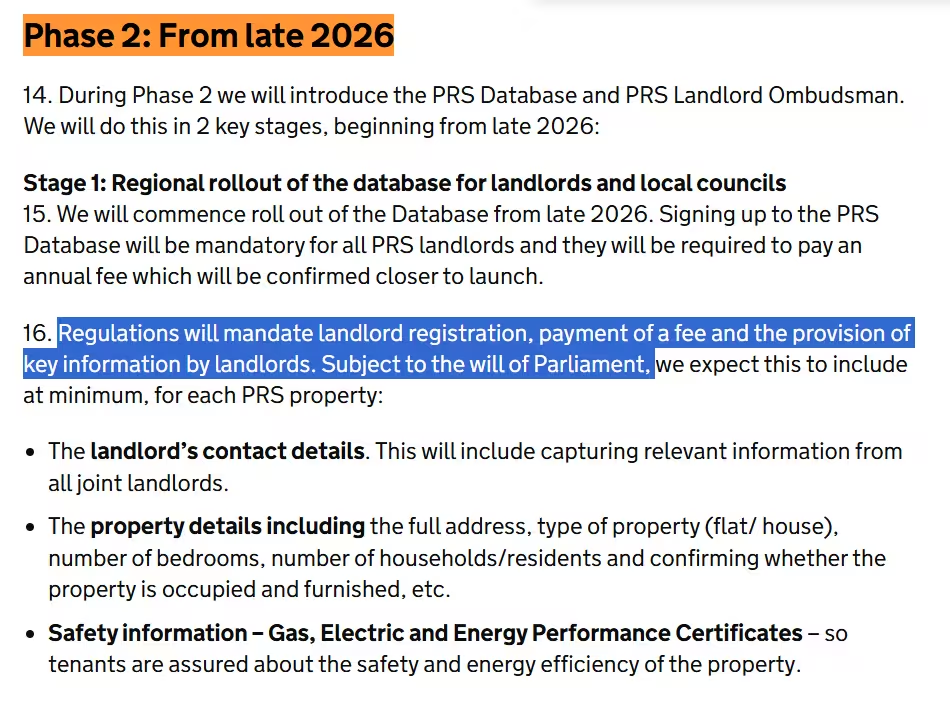
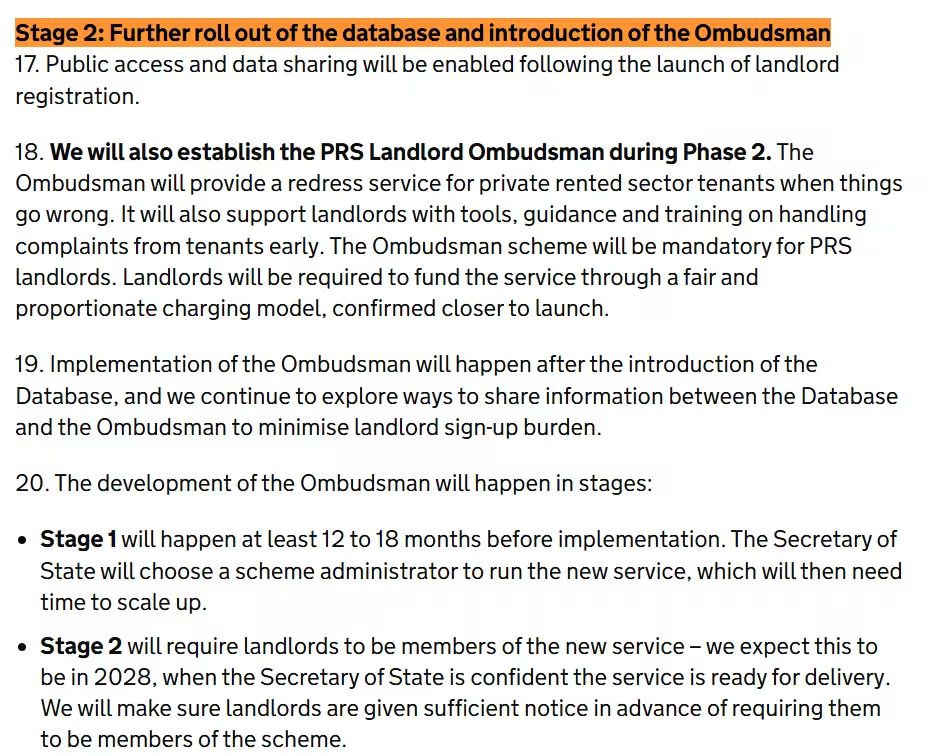
Government implementation roadmap explaining the phased introduction of the Private Rented Sector Database and Landlord Ombudsman.
Conclusion
Renting out your house in 2027 can provide regular income and allow you to retain ownership of a valuable property, but profitability depends on careful planning.
The tenancy reforms introduced in May 2026 changed how landlords advertise homes, manage agreements, increase rent and recover possession. Meanwhile, higher property-income tax rates planned for April 2027 could reduce after-tax returns.
Our analysis indicates that the strongest letting decisions begin with accurate rental valuations, legal compliance, realistic expense forecasts and sufficient financial reserves.
Before accepting tenants, homeowners should assess the complete financial position and ensure that renting remains suitable for their long-term property and investment objectives.
Frequently Asked Questions
Can I rent out my house if I still have a mortgage?
Yes, provided your lender permits it. You may need consent to let or a suitable buy-to-let mortgage, depending on your mortgage agreement and circumstances.
Do I need a landlord licence to rent out my house in 2027?
Not every rental property requires a licence. However, mandatory or additional HMO licensing and local selective licensing schemes may apply, so check the property’s exact address with the council.
How much tax will landlords pay in 2027?
The government plans property-income tax rates of 24%, 44% and 49% from 6 April 2027 in England, Wales and Northern Ireland, subject to the required legislation. The actual liability depends on taxable profits, allowances and other income.
Can I rent out my house without an estate agent?
Yes. A landlord can manage advertising, referencing, rent collection and maintenance directly, but must still comply with all applicable legal requirements.
Can a landlord ask for six months’ rent upfront in 2027?
For most covered new assured periodic tenancies in England, landlords cannot require six months’ advance rent. The ordinary pre-tenancy limit after signing is generally one month for monthly-paying tenants, subject to specific exceptions.
Can I move back into my house after renting it out?
Potentially, but you must use an applicable legal possession ground and follow the correct notice and court procedures. The moving-in ground is generally unavailable during the first 12 months of a covered tenancy.
Is renting out a house worth it in 2027?
It may be worthwhile if net rental income remains attractive after mortgage costs, repairs, tax and other expenses. Homeowners should compare the expected after-tax cash flow with the financial consequences of selling the property.
Adam is a London business and news writer at London Insider News, covering local developments, finance, entrepreneurship and the stories shaping businesses and communities across the capital.