Nationwide UK Property Price Drop: Will House Prices Fall Further in 2027? Latest 2026 Figures and Forecasts
Explore Nationwide’s latest UK house price figures, London property declines, mortgage costs and 2027 forecasts to see whether house prices could fall further.
 Hannah
London Lifestyle & Consumer Writer

The Nationwide UK property price drop has become an increasingly important issue for homeowners, first-time buyers, landlords and property investors as Britain’s housing market enters a period of weaker growth and higher mortgage costs.
Nationwide Building Society’s latest House Price Index, published on 30 October 2026, revealed that annual UK house price growth slowed to just 0.5%, its weakest level since January 2024. The average UK property price stood at £273,566, compared with £274,251 in September.
Although the published average fell by £685, seasonally adjusted house prices were unchanged during October. This distinction matters: the figures show a substantial slowdown in growth, not a nationwide annual house price crash.
The situation has become more challenging following the Bank of England’s decision on 5 November 2026 to increase Bank Rate from 3.75% to 4%.
Meanwhile, professional forecasts for 2027 have become divided. The Office for Budget Responsibility expects UK property prices to rise by approximately 2.5%, while Savills anticipates a 1.5% decline.
Our analysis of Nationwide figures, mortgage lending activity, property transaction data and professional housing-market research suggests that the central concern for 2027 is not simply whether house prices will fall.
It is whether household incomes, borrowing costs and regional property valuations can support a sustainable recovery.
For property buyers and investors, understanding this distinction could be more valuable than attempting to predict the exact bottom of the housing market.
What Are the Latest Nationwide UK House Price Figures for 2026?
Nationwide’s October 2026 figures show that the UK property market has lost considerable momentum since the summer.
Annual price growth slowed from 1.6% in August to 0.8% in September and then to 0.5% in October.
Nationwide House Price Index: October 2026
| Property market indicator | October 2026 | September 2026 |
| Average UK house price | £273,566 | £274,251 |
| Annual property price growth | +0.5% | +0.8% |
| Monthly change, seasonally adjusted | 0.0% | -0.3% |
| Monthly house price index | 547.8 | 548.1 |
| Published average price difference | -£685 | — |
| Overall direction | Stagnation | Monthly decline |
Source period: Nationwide House Price Index, October 2026. The September monthly figure reflects the revised value in the October release.
The £685 reduction in the published average represents approximately 0.25% of September’s average property price. However, these published averages are not seasonally adjusted, so the difference should not be described as Nationwide’s official monthly house price change.
The seasonally adjusted October movement was effectively zero.
Nevertheless, the weakening annual growth rate highlights a change in conditions for sellers who previously expected property values to appreciate consistently.
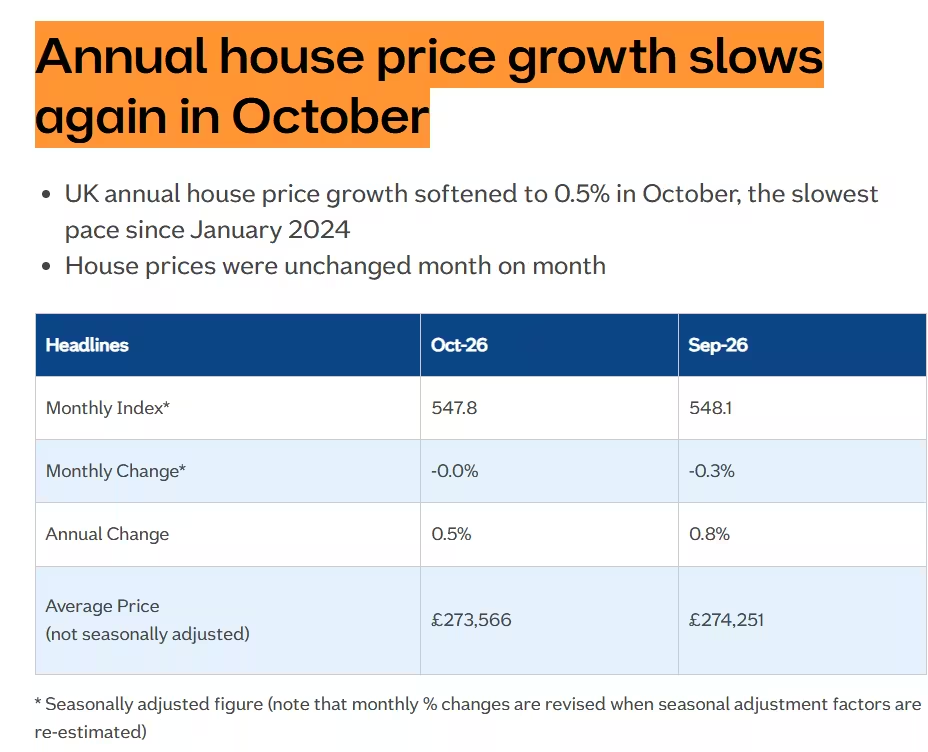
Nationwide’s official October 2026 House Price Index shows average UK property prices of £273,566, annual growth of 0.5% and unchanged seasonally adjusted monthly prices.
Nationwide’s Chief Economist, Robert Gardner, commented on the near-term outlook:
“Forward-looking indicators suggest further softness in the near term.”
Gardner’s published assessment also identified weaker buyer enquiries, lower consumer confidence and financial uncertainty as factors affecting housing demand.
Our interpretation is that the UK property market is moving into a period where mortgage affordability and local housing supply could become more important than historical assumptions about annual capital growth.
Why Are UK House Prices Falling in Some Areas?
Property prices are being affected by a combination of higher borrowing costs, persistent inflation, subdued buyer confidence and differences in local housing demand.
These pressures are not distributed evenly across Britain.
Some northern markets continue recording positive annual growth, while properties in parts of southern and eastern England have experienced declines.
Higher Mortgage Rates Are Reducing Buying Power
Mortgage costs are one of the strongest financial influences on property demand.
The Bank of England increased Bank Rate to 4% on 5 November 2026, reversing part of the earlier monetary easing.
The decision followed continuing inflationary pressure, with annual CPI inflation reaching 3.5% in September.
The Bank also projected that inflation could reach approximately 5% by the middle of 2027.
Higher inflation expectations influence the wholesale interest rates used by lenders to price fixed-rate mortgages.
Consequently, mortgage products can become more expensive even before a central-bank rate decision is announced.
The financial impact becomes clearer when we examine repayments on a typical mortgage.
Illustrative mortgage repayment comparison
Assume a borrower takes a £250,000 repayment mortgage over 25 years.
| Mortgage interest rate | Monthly repayment | Annual repayment |
| 4% | £1,320 | £15,835 |
| 5% | £1,461 | £17,538 |
| 6% | £1,611 | £19,329 |
These are calculated repayment examples, not current lender quotations. They exclude mortgage fees, insurance and other ownership costs.
Increasing the mortgage rate from 4% to 6% would raise monthly repayments by approximately £291.
That represents an additional annual commitment of roughly £3,494.
For a household already managing energy bills, Council Tax, childcare and transportation expenses, such a difference can materially reduce the maximum property purchase price it can afford.
A £5,000 saving on a property’s purchase price may therefore be less significant than the long-term consequences of securing a substantially more expensive mortgage.
Inflation Is Weakening Household Budgets
Higher inflation can affect the property market through several channels.
First, households have less disposable income available for mortgage repayments and deposits.
Second, mortgage lenders must consider borrowers’ ability to meet payments alongside their other financial commitments.
Third, uncertainty about future interest rates can discourage buyers from committing to expensive long-term borrowing.
Our financial assessment is that property affordability must be measured through the full monthly cost of ownership rather than the advertised purchase price alone.
Buyers Have More Properties to Choose From
Zoopla’s October 2026 market research reported that the number of homes available for sale was approximately 7% higher than a year earlier.
At the same time, sales agreed were 7% lower.
These figures indicate a market in which buyers have more choice while some sellers face increased competition.
However, this does not mean every seller must accept a substantial discount.
Homes in desirable locations with realistic asking prices, strong transport connections and good physical condition can continue attracting serious interest.
The main change is that buyers may become less willing to pay above-market prices when suitable alternatives are available.
Will UK House Prices Fall in 2027?
The outlook for UK house prices in 2027 is uncertain, and the differences between professional forecasts demonstrate why a nationwide decline should not be presented as inevitable.
Our review identifies two particularly important published forecasts.
UK House Price Forecast Comparison for 2027
| Forecast provider | 2027 UK house price forecast | Interpretation |
| Office for Budget Responsibility | +2.5% | Modest nominal growth |
| Savills, November 2026 | -1.5% | Further market correction |
| Nationwide, October 2026 | No specific 2027 percentage in the October release | Continued near-term weakness |
The OBR’s October 2026 Economic and Fiscal Outlook anticipates house price growth of approximately 2% in 2026 and 2.5% in 2027.
Its central forecast assumes that the market can continue growing modestly despite mortgage affordability remaining under pressure.
Savills presents a more cautious assessment.
In research published on 9 November 2026, Savills forecast a 1.5% decline in UK house prices during 2027, citing elevated mortgage rates and weaker market activity.
Its assessment suggests that a more meaningful housing market recovery may be delayed until 2028.
The forecasts are based on different assumptions about inflation, borrowing costs, household incomes and the timing of economic recovery.
Our assessment: The disagreement illustrates the sensitivity of house prices to changing economic conditions. Neither forecast should be treated as a guaranteed outcome.
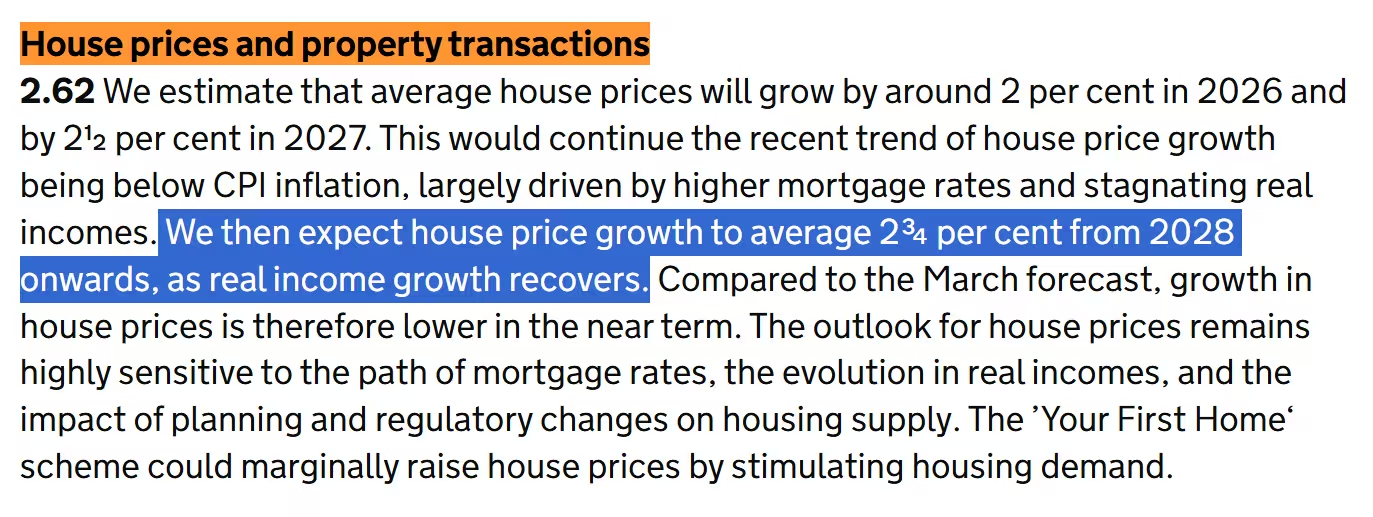
The Office for Budget Responsibility’s October 2026 forecast projects UK house price growth of approximately 2.5% in 2027, contrasting with Savills’ November forecast of a 1.5% decline.
What Would These Forecasts Mean for a £300,000 Property?
We calculated two illustrative outcomes using a property valued at £300,000 at the beginning of 2027.
| Scenario | Annual change | Illustrative property value | Gain or loss |
| OBR forecast applied | +2.5% | £307,500 | +£7,500 |
| Savills forecast applied | -1.5% | £295,500 | -£4,500 |
| More severe hypothetical decline | -5% | £285,000 | -£15,000 |
The third scenario is a sensitivity test, not a professional forecast.
The £12,000 difference between the OBR and Savills outcomes demonstrates how materially forecast assumptions can influence expectations.
For homeowners intending to remain in their property for many years, modest short-term price changes may have limited immediate financial consequences.
However, buyers planning to move, refinance or sell during 2027 could be more exposed to those differences.
Could Property Prices Fall in Real Terms Even If They Rise?
Yes.
A property can increase in nominal value while losing purchasing power after accounting for inflation.
For example, if house prices increased by 2.5% over a year while general consumer prices increased by 5% over the same period, the inflation-adjusted property price would decline by approximately 2.4%.
This is a hypothetical calculation rather than a prediction that annual inflation will average 5% throughout 2027.
It demonstrates why financial analysts distinguish between nominal property appreciation and real investment returns.
Which UK Regions Are Experiencing the Biggest Property Price Drops?
Nationwide’s third-quarter 2026 regional figures demonstrate that Britain does not have one uniform property market.
Northern Ireland and several northern regions continued recording comparatively strong house price growth, while some southern and eastern markets experienced annual declines.
Nationwide Regional House Price Performance: Q3 2026
| Region | Annual price change |
| Northern Ireland | +5.9% |
| North West England | +3.9% |
| Scotland | +3.3% |
| Northern England | +3.3% |
| Yorkshire and the Humber | +1.2% |
| Wales | +0.7% |
| London | +0.4% |
| South West England | -0.3% |
| East Midlands | -0.5% |
| East Anglia | -0.7% |
These are selected Nationwide Q3 2026 results, not October monthly figures. Its regional classification includes a separate northern England region.
East Anglia recorded the weakest annual performance among these selected regions, with house prices falling 0.7%.
The South West and East Midlands also recorded negative annual growth.
However, Northern Ireland registered an increase of 5.9%, demonstrating the importance of local economic conditions and affordability.
From an investment perspective, the regional divide matters because national averages can conceal substantial differences in asset performance.
Property investors should assess employment opportunities, rental demand, transaction volumes, supply and long-term affordability before treating an entire region as an attractive or declining market.
Why Are London House Prices Falling Faster Than the UK Average?
London is particularly exposed to housing-market pressure because property prices are relatively high compared with many buyers’ incomes.
HM Land Registry’s August 2026 UK House Price Index recorded an average London property value of approximately £554,430.
That represented an annual decline of 2.2%.
The South East recorded an annual decline of 0.8%, while the North East experienced growth of 3.2%.
These figures differ from Nationwide’s quarterly regional results because the two indices use different methods and reporting periods.
The official Land Registry figures also reveal that London flats have been performing particularly poorly.
Average flat and maisonette prices in London fell by approximately 5% annually in August 2026.
This underperformance is important because flats account for a significant share of London’s housing stock.
Why Are London Flats Losing Value?
We identify several financial and structural pressures affecting the flat market.
- Mortgage affordability: High purchase prices mean a relatively small change in interest rates can substantially increase monthly repayments.
- Leasehold charges: Buyers must consider service charges, ground rent where applicable, building insurance, lease terms and the possibility of major works.
- Building safety and maintenance: Certain apartment buildings may require additional expenditure, remediation or documentation before lenders approve mortgages.
- Buyer preferences: Some households may prefer houses offering greater space and flexibility, although demand varies considerably by neighbourhood and property type.
For leasehold buyers, understanding ground rent and related ownership expenses is increasingly important.
A flat advertised at a reduced purchase price can still represent poor value if service charges, repairs or financing arrangements make the long-term cost of ownership excessive.
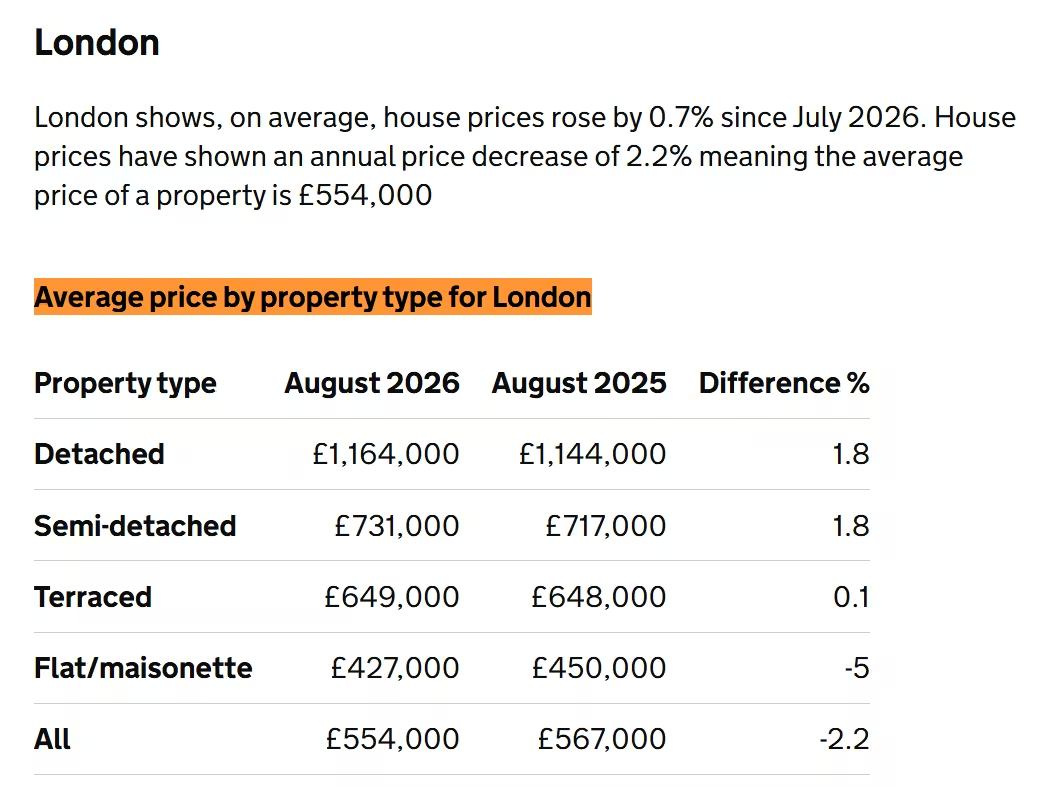
HM Land Registry’s August 2026 House Price Index shows London property prices declining by 2.2% annually, with flats and maisonettes experiencing a steeper fall.
Does Every London Borough Have Falling House Prices?
No.
Property-market performance can vary substantially between boroughs, neighbouring streets and different types of housing.
Higher-value boroughs may experience sharp changes in average transaction prices when the mix of properties being sold changes.
Similarly, more affordable outer-London markets may continue attracting buyers who have been priced out of central locations.
We would therefore avoid treating a borough-level average as a precise valuation of an individual property.
A more reliable comparison uses recent completed transactions involving similar homes, in comparable condition and with similar tenure arrangements.
Are Mortgage Approvals Showing That UK Property Demand Is Weakening?
The Bank of England’s September 2026 Money and Credit statistics provide evidence of reduced housing-market activity.
Mortgage approvals for home purchases declined to approximately 53,400 in September, compared with 54,800 in August.
This was also below the preceding six-month average of approximately 58,800.
| Mortgage indicator | September 2026 | August 2026 |
| House-purchase mortgage approvals | 53,400 | 54,800 |
| Remortgage approvals | 42,600 | 34,000 |
| Net mortgage borrowing | £3.9bn | £4.2bn |
| Effective rate on newly drawn mortgages | 4.63% | 4.60% |
Mortgage approvals are useful because they provide an indication of future housing transactions.
The decline suggests that fewer borrowers are progressing towards financed property purchases.
At the same time, remortgaging approvals increased sharply.
This may reflect households reviewing their financing arrangements as existing deals approach expiry, although the figures alone cannot establish borrowers’ individual reasons.
Our analysis suggests that a sustained housing market recovery is likely to require an improvement in purchasing affordability, mortgage availability and consumer confidence.
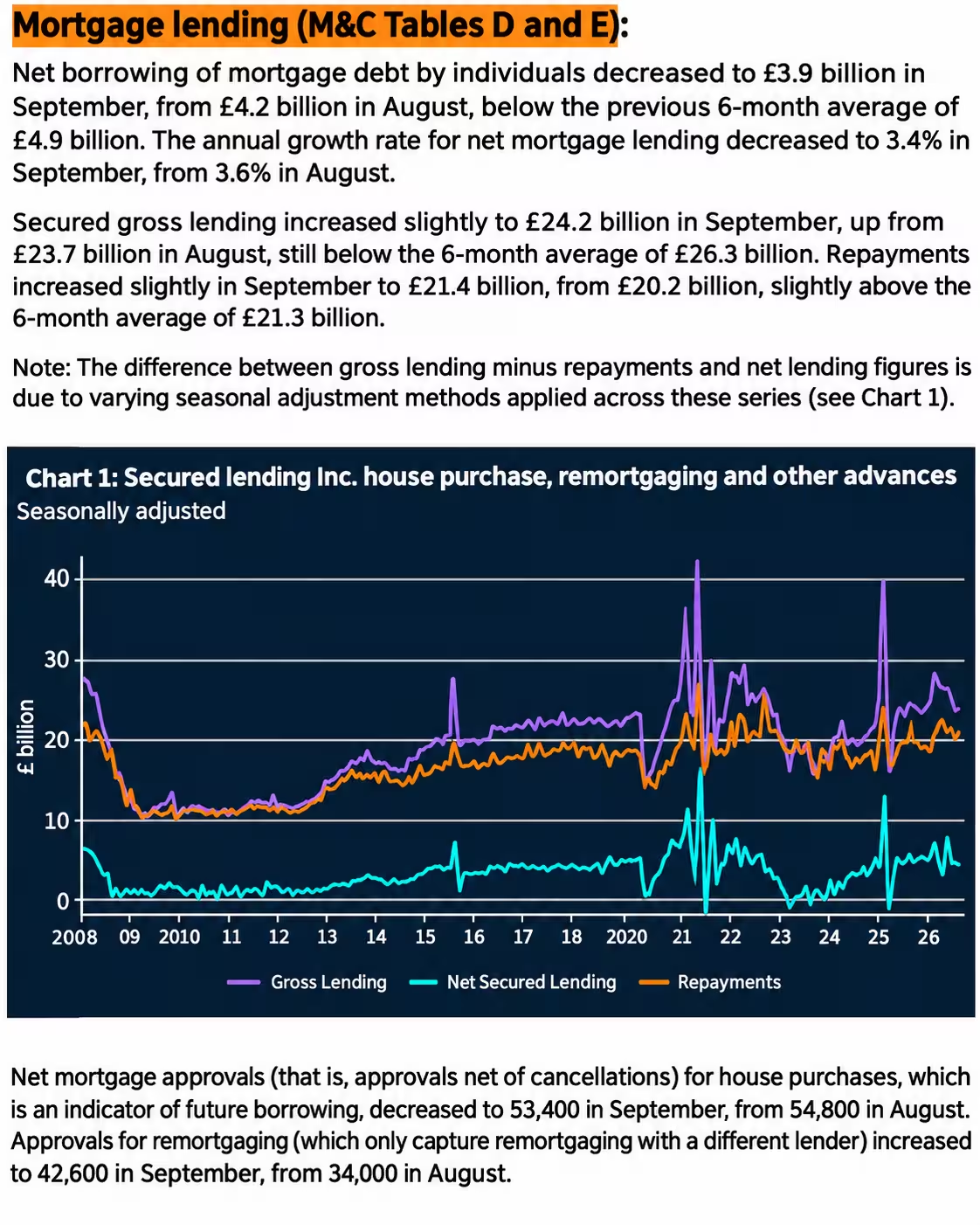
Bank of England Money and Credit data for September 2026 shows house-purchase mortgage approvals falling to 53,400 while remortgaging approvals increased to 42,600.
Is Now a Good Time to Buy a House in the UK?
For some buyers, a weaker property market can create opportunities.
However, the decision to purchase should not depend entirely on whether national prices are expected to rise or fall over the next few months.
Buyers should consider deposit availability, employment stability, mortgage affordability, property condition and the length of time they intend to remain in the home.
How Much Could a Buyer Save From a Property Price Reduction?
Consider a property initially advertised at £350,000.
| Negotiated reduction | Final purchase price | Saving |
| 0% | £350,000 | £0 |
| 2% | £343,000 | £7,000 |
| 3% | £339,500 | £10,500 |
| 5% | £332,500 | £17,500 |
| 7% | £325,500 | £24,500 |
These figures illustrate negotiated discounts, not average discounts currently achievable across the UK.
A 5% reduction would save £17,500 from the asking price.
However, the buyer should also examine whether the asking price was realistic in the first place.
A property advertised substantially above comparable sold prices may still be expensive after a sizeable reduction.
First-time buyers should also compare the cost of purchasing against the rent they currently pay.
For households deciding whether to continue renting, understanding how much rent they can afford is useful when creating a realistic savings and deposit plan.
Alternative routes to homeownership, including Rent to Buy, may help some households manage the challenge of saving a deposit while paying rent.
Should Buyers Wait Until 2027?
Waiting may be financially sensible for buyers who need more time to build savings, reduce debt or improve mortgage eligibility.
However, delaying a purchase does not guarantee a cheaper property.
House prices could decline while mortgage interest rates increase, leaving the overall monthly cost of purchasing higher.
The correct financial comparison is therefore the total cost of buying now against the realistic alternatives available later.
Our assessment is that buyers should prioritise affordability and long-term financial resilience rather than attempting to time every short-term movement in the Nationwide index.
Should Homeowners Sell Before Property Prices Fall Further?
Homeowners considering selling in 2027 face a different set of financial decisions.
The appropriate strategy depends on why they are moving, whether they need to buy another property and how much equity they have accumulated.
A homeowner relocating for work may benefit more from a reliable transaction than from waiting several months for a potentially higher selling price.
Similarly, someone trading up to a more expensive home may benefit if the next property also becomes cheaper.
Why Does Realistic Asking-Price Strategy Matter?
Zoopla’s October 2026 analysis found that 41% of homes initially listed below their estimated market value secured a buyer within 90 days.
Only 26% of homes initially priced at least 20% above estimated value achieved the same outcome.
These findings concern Zoopla’s specific April–June 2026 listing sample.
They are not guaranteed selling probabilities for individual properties.
Nevertheless, the difference highlights the importance of accurate initial pricing.
Our assessment is that sellers should consider three factors before setting an asking price:
- Recently completed sales of comparable properties.
- Current competing listings and local buyer demand.
- Their financial ability to hold the property if selling takes longer than expected.
The financial implications also include transaction-related taxation.
Recent reporting on stamp duty receipts and luxury property sales highlights how tax costs and changes in housing activity can influence the wider property market.
A seller should also calculate estate agency charges, conveyancing fees, mortgage exit costs and the cost of their next property before deciding whether to accept an offer.
How Could the Nationwide Property Price Drop Affect UK Landlords?
Property investors face additional risks when weak house prices coincide with expensive mortgages and rising operating costs.
Unlike owner-occupiers, landlords must consider both the income produced by the property and the return on the capital invested.
A property may generate stable rental income while declining in market value.
Equally, a property with a stable valuation can become less profitable if financing and operating costs rise.
Are UK Landlords Already Selling Properties at a Loss?
Recent reporting on UK landlord property sales losses highlights the financial consequences of weaker property valuations, particularly for investors holding expensive London flats.
However, investors should distinguish between a realised capital loss on sale and a temporary reduction in the estimated market value of a property they continue to own.
A landlord who does not need to sell may be able to continue receiving rent despite weaker property prices.
The more immediate concern may be refinancing.
How Can Falling House Prices Affect Mortgage Loan-to-Value Ratios?
Consider an investor who purchases a property for £400,000 using a £360,000 mortgage.
The original loan-to-value ratio is 90%.
If the property’s value declines by 5%, it would fall to £380,000.
Assuming the mortgage balance remains £360,000, the loan-to-value ratio would rise to approximately 94.7%.
That reduces the owner’s equity cushion and could limit access to some mortgage products.
| Financial indicator | Original position | Following a 5% price fall |
| Property value | £400,000 | £380,000 |
| Mortgage balance | £360,000 | £360,000 |
| Owner’s equity | £40,000 | £20,000 |
| Loan-to-value ratio | 90% | 94.7% |
This is a simplified sensitivity example. Actual mortgage balances may decline through repayments.
The calculation shows why leveraged investors can be more financially exposed to relatively modest property price movements.
How Will 2027 Property Tax Changes Affect Landlords?
Housing-market risk is not limited to mortgage costs.
The October 2026 Budget announced additional property income tax increases scheduled to take effect in April 2027.
The resulting rates for relevant property income in England, Wales and Northern Ireland are scheduled to reach 24%, 44% and 49%, depending on the applicable tax band.
These changes could further reduce after-tax rental returns for affected landlords.
Our analysis of the 2027 landlord property tax increases illustrates why financing, taxation and maintenance costs should be assessed together.
Landlords who are considering retaining a former home rather than selling it should calculate the full financial implications of renting out their house.
This includes lender consent, legal compliance, rental yield, vacancies, insurance and potential future disposal costs.
Property owners should not assume that increasing rent will always compensate for higher investment expenses.
The scope for rental increases depends on local affordability, market rents and applicable tenancy rules, including the restrictions discussed in our analysis of landlord rent increases in London.
Does the Nationwide Property Price Drop Mean a UK Housing Market Crash?
The October 2026 Nationwide figures do not demonstrate that a nationwide housing market crash is taking place.
Although annual growth has weakened substantially, Nationwide still recorded a 0.5% increase compared with October 2025.
Seasonally adjusted prices were unchanged during October.
A housing market crash would generally involve a much more substantial and widespread reduction in property values, potentially accompanied by serious financial stress, distressed selling or disruptions to mortgage lending.
Current figures show a market experiencing stagnation and regional divergence rather than a confirmed nationwide collapse.
Nevertheless, some markets are already experiencing material declines.
London’s weaker flat prices and negative annual growth in parts of southern England indicate that certain property owners face greater exposure than national statistics suggest.
Could Negative Equity Become a Problem in 2027?
Negative equity occurs when a property’s market value falls below its outstanding mortgage balance.
For example, a household purchasing a £300,000 property with a £285,000 mortgage would initially hold £15,000 in equity, excluding purchasing costs.
If the property’s value declined by 7%, the estimated value would fall to £279,000.
Assuming the mortgage balance remained £285,000, the borrower would have approximately £6,000 in negative equity.
However, homeowners with substantial deposits and several years of mortgage repayments may be much less exposed.
Negative equity also does not automatically mean a homeowner must sell their property.
It becomes particularly important when selling, refinancing or changing mortgage arrangements.
Our assessment is that the financial resilience of households is a better indicator of individual risk than the nationwide average house price alone.
What Should Property Buyers and Investors Watch During 2027?
Several indicators will help determine whether the UK housing market stabilises or experiences additional price declines.
| Indicator | Why it matters | Potential market signal |
| Nationwide monthly HPI | Tracks mortgage-based property values | Direction of short-term prices |
| Bank of England Bank Rate | Influences borrowing conditions | Pressure on mortgage costs |
| Fixed mortgage pricing | Directly affects buyer affordability | Purchasing power |
| Mortgage approvals | Indicates prospective housing activity | Future transaction demand |
| Land Registry completed sales | Tracks actual completed transactions | Regional price performance |
| Properties available for sale | Shows supply conditions | Seller competition |
| Household inflation | Affects disposable income | Buyer affordability |
| Employment and wage growth | Influences mortgage eligibility | Financial resilience |
We consider the interaction between these indicators more informative than any single month’s house price movement.
For example, a small decline in Nationwide’s index accompanied by improving mortgage approvals could suggest that market conditions are beginning to stabilise.
Conversely, continuing price weakness alongside rising borrowing costs and fewer mortgage approvals would provide stronger evidence of a prolonged slowdown.
The next important scheduled data releases include HM Land Registry’s September 2026 house price figures on 18 November and the Bank of England’s next monetary policy announcement on 17 December 2026.
Subsequent reports during 2027 will establish whether the competing forecasts from the OBR and Savills are becoming more or less likely.
What Is Our Overall Assessment of the UK Property Market for 2027?
Our analysis indicates that the UK housing market is entering a period of heightened sensitivity to interest rates, affordability and local property conditions.
The most important development is the contrast between the modest national annual price increase and the more substantial declines experienced by selected locations and property types.
For first-time buyers, greater housing supply and slower price growth may improve negotiating opportunities.
For homeowners, the implications depend largely on mortgage exposure, accumulated equity and moving plans.
For landlords, the combined impact of borrowing costs, property income taxation, rental expenses and potentially weaker capital appreciation presents a more complex investment environment.
We would summarise the main factors as follows.
| Market consideration | Our assessment | Supporting evidence |
| National annual price growth | Weak | Nationwide +0.5% in October |
| London flat prices | Under pressure | Land Registry approximately -5% annually |
| Buyer activity | Subdued | Mortgage approvals at 53,400 |
| Housing supply | More competitive for sellers | Zoopla listings +7% annually |
| Mortgage affordability | Challenging | Bank Rate increased to 4% |
| 2027 price direction | Uncertain | OBR +2.5% versus Savills -1.5% |
These assessments are qualitative interpretations of published data, not probability scores or guarantees.
The evidence suggests that 2027 could remain difficult for heavily mortgaged households and investors, particularly if borrowing costs stay elevated.
However, it would be misleading to assume that every region will experience falling prices.
Our broader conclusion is that property performance in 2027 is likely to depend increasingly on local affordability, mortgage conditions and asset quality rather than on one national percentage.
Final Thoughts
The latest Nationwide UK property price drop figures confirm that Britain’s housing market has experienced a significant loss of momentum during 2026.
Annual price growth slowed to 0.5% in October, while the average published property price declined to £273,566.
The Bank of England’s November interest rate increase has added further pressure to mortgage affordability, and the disagreement between 2027 forecasts highlights the uncertainty surrounding the next phase of the housing market.
Although the OBR expects prices to rise by approximately 2.5% in 2027, Savills forecasts a 1.5% decline.
For buyers, the priority should be negotiating a sensible price without taking on unsustainable borrowing.
For sellers, accurate property valuations and realistic expectations will become increasingly important.
For landlords and investors, the focus should remain on rental cash flow, refinancing risks, tax exposure and the property’s long-term financial performance.
Our overall assessment is that the UK housing market faces a period of continued uncertainty rather than a confirmed nationwide crash. Regional differences are likely to remain central to property decisions throughout 2027.
Frequently Asked Questions
Have UK house prices dropped according to Nationwide?
Nationwide’s published average UK house price declined from £274,251 in September to £273,566 in October 2026. However, seasonally adjusted monthly prices were unchanged, and average prices remained 0.5% higher annually.
What is the average UK house price in October 2026?
Nationwide reported an average UK property price of £273,566 in October 2026.
Will UK house prices fall in 2027?
Forecasts are divided. The OBR expects approximately 2.5% growth in 2027, while Savills’ November 2026 forecast anticipates a 1.5% decline. Neither outcome is guaranteed.
Which UK regions have falling property prices?
Nationwide’s third-quarter 2026 data recorded annual declines in East Anglia, the East Midlands and the South West, among other areas. Land Registry figures also showed declines in London and the South East.
Are London house prices falling faster than elsewhere?
London has experienced significant weakness, particularly in flats. HM Land Registry reported a 2.2% annual decline in average London property prices in August 2026, with flats and maisonettes down approximately 5%.
Does a fall in UK house prices mean a property crash?
No. A modest monthly movement or a slowdown in annual growth does not establish that a nationwide property crash is occurring. A crash would generally involve more substantial and widespread declines.
Is 2027 a good year to buy a house?
It may be suitable for buyers with stable finances, sufficient deposits and affordable mortgage options. However, purchasing decisions should reflect individual circumstances and local property valuations rather than relying on national forecasts alone.
How will mortgage rates affect property prices in 2027?
Higher mortgage rates can reduce purchasing power and weaken demand. Lower or more stable mortgage pricing could support buyer confidence, although property prices also depend on employment, incomes and housing supply.
Hannah is a London lifestyle and consumer writer at London Insider News, covering property, transport, local developments, cost-of-living issues and stories affecting everyday life across the capital.
More from PROPERTY

Right to Rent Share Code 2027: How to Get, Generate and Check Your Code Online?
Updated: 4 November 2026 | 2027 Guide A Right to Rent share code is a nine-character…

John Healey Budget Property Tax Raid: Landlords Face Higher Taxes as £2m Mansion Levy Stays
Chancellor John Healey has announced a fresh property tax increase in the October 2026 Budget, with…

UK Landlord Property Sales Losses Jump 32% to £1.15bn as London Flats Face Growing Pressure
UK landlord property sales losses have surged by 32% to £1.15 billion, according to newly published…